
Test 7 of 25 · 20 questions · Free 2026
IL Permit Practice Test 7
Jump to the test ↓A fixed 20 question set from the Illinois bank with answers and plain English explanations. The real IL exam is 35 questions, 80 percent to pass; take the full length version on the main practice page.
Question 1 of 20 · 0 right so far
All 20 questions in test 7
Every question below comes from the Illinois question bank on this page. Open a question to see the correct answer and the explanation. Nothing here is hidden behind a signup.
1. During the Illinois permit phase, what nighttime driving restriction is listed for Sunday through Thursday?
- Driving is restricted from 8 p.m. until 5 a.m.
- Driving is restricted from 10 p.m. until 6 a.m.
- Driving is restricted from midnight until 5 a.m.
- No nighttime restriction applies during the permit phase
Show answer
Driving is restricted from 10 p.m. until 6 a.m.. For the permit phase, Illinois lists a Sunday-through-Thursday restriction from 10 p.m. to 6 a.m. Friday and Saturday have a different starting time, 11 p.m., so treating every night identically loses an important detail. The permit phase is not unrestricted after dark. A useful memory aid is earlier on school-night-type evenings and one hour later on Friday and Saturday. Local curfews may differ, so a posted or local requirement can be stricter.
Study this in the handbook: Teen curfews, passenger limits and phone rules
2. What distance between a driver and the air bag does the Illinois manual call desirable?
- 10 to 12 inches
- 2 to 4 inches
- 5 to 6 inches
- At least 24 inches
Show answer
10 to 12 inches. Air bags are lifesaving devices that work together with safety belts, but Illinois says special precautions should be taken in vehicles that have them. Illinois describes a gap of 10 to 12 inches between the driver and the air bag as desirable, especially for short, elderly, or pregnant drivers. Passengers should move their seats as far back as possible, and children age 12 and younger are best secured in the back seat.
Study this in the handbook: Seat belts, air bags and child seats
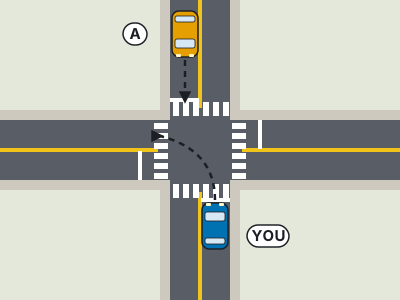
3. When making a left turn into oncoming traffic in Illinois, what is the driver's duty?
- Turn without yielding if the signal was green when entering
- Accelerate so the turning vehicle clears first
- Yield only to vehicles displaying hazard lights
- Yield to the oncoming traffic
Show answer
Yield to the oncoming traffic. A left-turning driver must yield to oncoming traffic. Entering on a green light does not remove that duty, although Illinois allows a driver already in the intersection to finish the turn after the light changes to red. The acceleration option encourages rushing across the path of traffic, and hazard lights are not the test. The useful visual cue is to search the opposing lane before turning, wait for a safe gap, and complete the turn without cutting off a vehicle coming straight.
Study this in the handbook: Speed limits, school zones and work zones
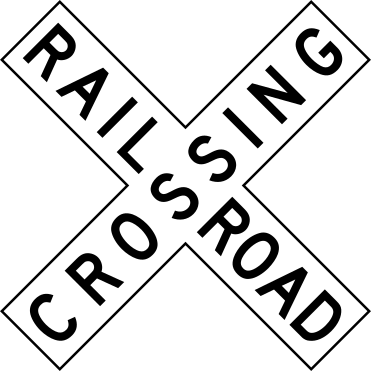
4. At a railroad crossing marked only by a crossbuck, what should an Illinois driver do?
- Accelerate because a crossbuck means the tracks have priority over drivers only
- Stop on the tracks to check whether another train is coming
- Proceed without looking because the crossbuck is not a warning device
- Slow down, look in both directions, listen, and cross cautiously if safe
Show answer
Slow down, look in both directions, listen, and cross cautiously if safe. When a railroad crossing has no warning devices or only a crossbuck, Illinois tells drivers to slow down, look in both directions, and listen for a train or railroad equipment. Crossing is allowed only after that check shows it is safe, and the vehicle should proceed with caution. The acceleration choice encourages a dangerous race, while stopping on the tracks creates an obstruction. Calling the crossbuck meaningless is also wrong because it marks the crossing and requires careful observation. Make sure there is room beyond the rails before entering.
Study this in the handbook: School buses, emergency vehicles and railroad crossings
5. A green Illinois guide sign can tell you which of the following?
- That a particular driving action is not allowed
- That construction dangers are ahead
- Where you are, which way to go, or the distance to a destination
- That a service facility is along the roadway
Show answer
Where you are, which way to go, or the distance to a destination. Green guide signs help drivers navigate. They can identify your location, show which way to go, and give the distance to destinations ahead. That makes green different from blue, which is reserved for services along the roadway. Orange warns about construction or maintenance dangers, and a prohibition is communicated by a regulatory sign with the relevant words or symbol, often using red. When reading a green sign, look for route direction, destination names, or mileage. Those navigation details tell you that the sign is guiding your trip rather than warning about a hazard or ordering a restricted movement.
Study this in the handbook: Sign shapes and colors
6. A first time Illinois driver is 19 and never took driver education. What course is required before getting a license?
- A six hour Adult Driver Education Course from a certified provider
- No course at all, because the driver is over 18
- A 30 hour high school driver education course
- An eight hour defensive driving course
Show answer
A six hour Adult Driver Education Course from a certified provider. Illinois requires first time drivers aged 18, 19, or 20 who have never been licensed or completed driver education to take a six hour Adult Driver Education Course, and only providers certified by the Secretary of State count. Turning 18 does not remove the requirement. The 30 hour classroom course is the high school program for younger students. The eight hour defensive driving course is the optional class that can lower insurance for drivers 55 and over.
Study this in the handbook: Instruction permit and the graduated license program
7. What is the safest response when an angry motorist tries to provoke you?
- Brake sharply to force the driver back
- Do not retaliate or engage the driver
- Follow closely until the driver pulls over
- Make eye contact to show confidence
Show answer
Do not retaliate or engage the driver. Illinois advises a driver who encounters an angry or aggressive motorist not to retaliate or engage that person. Hard braking, eye contact, or pursuit can turn hostility into a collision or confrontation. Keep enough room ahead to maneuver, and use locked doors and raised windows as additional protection. The useful habit is to create distance and let the other driver leave rather than compete for control of the roadway.
Study this in the handbook: Crashes, reports and insurance
8. How high may an Illinois vehicle's suspension be lifted, and how many bright lights may burn at once?
- Up to 12 inches, and six lights
- Any height, and any number of lights
- No more than 3 inches from the chassis frame, and no more than four 300 candlepower lights
- Up to 6 inches, and two lights
Show answer
No more than 3 inches from the chassis frame, and no more than four 300 candlepower lights. It is illegal to alter a vehicle's suspension to lift the body from the chassis frame more than 3 inches, and the horizontal line from front to rear may not vary over 3 inches. A vehicle may not have more than four 300 candlepower lights burning at once. The manual lists both limits among its equipment rules, so twelve or six inches, and six, two, or unlimited lights, all miss the stated figures.
Study this in the handbook: Required vehicle equipment
9. A pedestrian who already partly crossed during the walk signal may do what when the hand begins flashing?
- Continue to a sidewalk or safety island
- Turn around and stand in the travel lane
- Begin a new crossing from the opposite curb
- Wait in the roadway until the hand becomes steady
Show answer
Continue to a sidewalk or safety island. A pedestrian who began during the walk indication may continue to a sidewalk or safety island after the hand starts flashing. The flashing phase does not invite a fresh crossing, so turning around or beginning again from the opposite curb would create an unnecessary conflict with vehicles. Waiting in the roadway leaves the person exposed. The practical cue is to keep moving toward the nearest safe landing area and complete the crossing without hesitation.
Study this in the handbook: Traffic signals and arrows
10. On a four-lane Illinois highway, what should a driver do when approaching a disabled vehicle using hazard lights?
- Change lanes away from it if safe; otherwise reduce speed while passing
- Pass on the shoulder without reducing speed
- Maintain speed because hazard lights give the disabled vehicle priority
- Stop beside it and offer assistance from the travel lane
Show answer
Change lanes away from it if safe; otherwise reduce speed while passing. When a disabled vehicle displays hazard lights on a four-lane highway, move to a lane away from it if that change is safe. If a lane change cannot be made safely, reduce speed while approaching and passing, then wait until well beyond the vehicle before increasing speed. Stopping beside it exposes both vehicles to traffic, and using the shoulder at full speed removes the caution the situation requires. Hazard lights provide a warning, not priority. The practical cue is lane separation first, followed by a controlled slow pass when separation is unavailable.
11. How long must an Illinois driver age 15 hold an instruction permit before obtaining a driver’s license?
- Until age 18, with no minimum period
- At least three consecutive months
- At least six consecutive months
- At least nine consecutive months
Show answer
At least nine consecutive months. An Illinois driver age 15 must hold the instruction permit for at least nine consecutive months before obtaining a driver’s license. Three or six months are shorter than the stated minimum, while waiting until age 18 ignores the fixed permit requirement. The permit itself is valid for 24 months, but validity is different from the minimum holding period. Keep those two numbers separate: nine months is the required phase, and two years is the maximum permit validity. The same nine-month minimum appears in the permit-phase requirements.
Study this in the handbook: Instruction permit and the graduated license program
12. What does a lane reduction warning require an Illinois driver to anticipate?

- A new lane that permits passing on the shoulder
- A reduction in lanes and the need to change lanes or let traffic merge
- A permanent stop at the end of the roadway
- A rule that all vehicles must move to the left immediately
Show answer
A reduction in lanes and the need to change lanes or let traffic merge. Reduction in Lanes signs warn that the number of lanes in the direction of travel will decrease. The change may be temporary or permanent, so drivers should be prepared to change lanes or allow other vehicles to merge. The shoulder is not created as a passing lane, and the warning does not mean the roadway ends at a stop. Moving left immediately is too rigid because the open lane and surrounding traffic determine the safe maneuver. When traffic is congested, Illinois describes alternating turns at the reduction point as a zipper merge.
13. What do red roadway signs indicate?
- Warnings about construction equipment only
- Optional directions to recreation areas
- Regulatory instructions that must be obeyed
- Services such as fuel or food
Show answer
Regulatory instructions that must be obeyed. Red signs are regulatory signs and must be obeyed. Illinois examples include STOP, YIELD, DO NOT ENTER, and WRONG WAY. They are not optional recreation guides, construction-only warnings, or service markers. When red appears on one of these signs, treat the instruction as a traffic control command and follow the required action before continuing. The color signals that the instruction is mandatory.
Study this in the handbook: Sign shapes and colors
14. At a railroad crossing, what must a driver do when the flashing lights begin?
- Stop and remain stopped until the train passes and the lights stop flashing
- Continue if the crossing appears clear from the driver's lane
- Drive around a lowered gate before it reaches the pavement
- Stop only if a horn can be heard
Show answer
Stop and remain stopped until the train passes and the lights stop flashing. Flashing railroad crossing lights are a command to stop, not a suggestion based on whether a train is immediately visible. Illinois says to remain stopped until the train has passed and the lights have stopped flashing. Visual clearance or the absence of a horn does not cancel the warning. Going around a lowering gate is especially dangerous because the train may be hidden by distance, weather, or another obstruction. Stop before the crossing, keep clear of the tracks, and wait for the complete signal sequence to end.
Study this in the handbook: School buses, emergency vehicles and railroad crossings
15. What do broken white lines between lanes traveling in the same direction permit?
- Crossing when changing lanes or turning
- Crossing only to pass into opposing traffic
- Never crossing under any condition
- Stopping between the lines to wait for a signal
Show answer
Crossing when changing lanes or turning. Broken white lines separate lanes traveling in the same direction. Illinois allows crossing that line when changing lanes or turning, provided the maneuver is safe and legal. The marking does not authorize entering opposing traffic, and the word broken distinguishes it from a solid double white line that cannot be crossed. Signal, check surrounding traffic, and move only when the adjacent lane is clear.
Study this in the handbook: Pavement markings
16. Within what distance of an intersection or railroad crossing is passing banned on an Illinois two-lane road?
- 50 feet
- 100 feet
- 200 feet
- 500 feet
Show answer
100 feet. On an Illinois two-lane, two-way road, passing is not allowed within 100 feet of an intersection or railroad crossing, or within 100 feet of a bridge, viaduct, or tunnel when the view is blocked. Fifty feet is too short. Two hundred feet is the distance to be back in your lane before an oncoming vehicle, and 500 feet is the U-turn sight distance. Every construction zone is also a no passing zone.
Study this in the handbook: Passing, turning, roundabouts and parking
17. Illinois drivers of what age can get an insurance reduction for completing a defensive driving course?
- Under 21, after a four hour course
- 65 or over, after a two hour course
- Any age, after an online quiz
- 55 or over, after an eight hour course
Show answer
55 or over, after an eight hour course. Illinois drivers 55 and older may get a reduction on motor vehicle liability insurance after successfully completing an eight hour defensive driving course, and the manual says to contact your insurance agent to learn the amount. Drivers under 21 face remedial courses, not insurance discounts, in this manual. Sixty five with a two hour course and an online quiz at any age are not the stated rule. The course is a crash prevention class, not a license requirement.
18. Which DUI facts can bring enhanced penalties in Illinois?
- Any BAC over .08% on a weekday
- Driving a car older than 10 years
- Driving during daylight hours
- A BAC of .16% or more, or transporting a child under 16
Show answer
A BAC of .16% or more, or transporting a child under 16. Illinois may impose enhanced penalties when a DUI involves a BAC of .16% or more or a child under age 16 in the vehicle. A BAC over .08% is the basic illegal level, so it is not the enhancement, and the day of the week has nothing to do with it. The age of the car and the time of day are not factors. Aggravated DUI is a separate charge for things like a death or injury crash or a third DUI.
Study this in the handbook: DUI, implied consent and summary suspension
19. What should an Illinois driver do when no minimum speed is posted but driving unusually slowly would interfere with traffic?
- Drive at the slowest possible speed to conserve fuel
- Avoid driving so slowly that normal traffic movement is obstructed
- Stop in the lane until faster traffic passes
- Use the shoulder whenever traveling below the posted maximum
Show answer
Avoid driving so slowly that normal traffic movement is obstructed. Illinois advises drivers not to travel so slowly that they interfere with the normal movement of traffic when no minimum limit is posted. The rule addresses unreasonable obstruction, not a command to match the maximum speed in every condition. Fuel saving does not justify creating a blockage, and the shoulder is not a substitute travel lane. Use a speed that fits weather, visibility, traffic, and the roadway while avoiding unnecessary interference with vehicles behind you.
Study this in the handbook: Seat belts, air bags and child seats
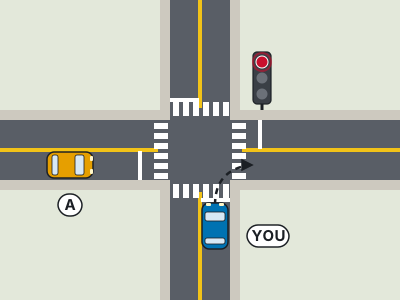
20. When may an Illinois driver turn right at a red light?
- Without stopping when no vehicle is visible
- Only after the signal turns green
- After a complete stop, yielding to oncoming traffic and pedestrians, unless prohibited by a sign
- After slowing below 10 mph and sounding the horn
Show answer
After a complete stop, yielding to oncoming traffic and pedestrians, unless prohibited by a sign. A right turn at a red light is allowed unless a sign prohibits it, but the driver must first come to a complete stop. Before turning, the driver must yield to oncoming traffic and pedestrians. Simply slowing down is not enough, and an empty-looking roadway does not remove the stop requirement. Waiting for green is more restrictive than the rule requires. Look for a No Turn on Red sign, stop at the required location, and check the intersection and crosswalk before moving. That sequence keeps the permission tied to its safety conditions.
Study this in the handbook: Traffic signals and arrows
QualitySpace is expanding to Illinois
We are a California-based independent insurance brokerage working on licensing in more states. We cannot help with Illinois insurance yet. Leave your email and we will let you know when we can.
Every question is written from the official Illinois Rules of the Road. Need paper? Printable IL practice test with answer key.
Last verified 2026-10-05. How we check every question · Study all 500 as flashcards
Frequently asked questions
How many questions are on this Illinois practice test?
This fixed set has 20 questions. It is test 7 of 25 from the 500 question Illinois bank. The real IL exam asks 35 questions and you need 28 correct.
What is the passing score for the real Illinois test?
80% must be answered correctly to be eligible for a Class D license (92 Ill. Adm. Code 1030.80) That figure comes from the official Illinois source cited on the DMV facts page.
How does this fixed test relate to the full Illinois bank?
Each numbered test is a fixed set of questions in a fixed order, so you can retake the same test later and compare. Every test mixes road signs and the other topics in about the same proportion as the full bank. Tests 1 to 25 together cover every question in the Illinois bank once. The full practice page mixes the whole bank at random.
Last verified 2026-10-05. See the Illinois DMV facts page for sourced state details.
Return to the full Illinois practice test · Study road signs