
Test 8 of 10 · 20 questions · Free 2026
ID Permit Practice Test 8
Jump to the test ↓A fixed 20 question set from the Idaho bank with answers and plain English explanations. The real ID exam is 40 questions, 85 percent to pass; take the full length version on the main practice page.
Question 1 of 20 · 0 right so far
All 20 questions in test 8
Every question below comes from the Idaho question bank on this page. Open a question to see the correct answer and the explanation. Nothing here is hidden behind a signup.
1. Why does the Idaho handbook say a 12 foot lane cannot be shared with a bicyclist?
- Bicycles are banned from 12 foot lanes
- Bicyclists must ride on the sidewalk
- It is not wide enough to pass safely, so change lanes to pass
- Because cyclists ride in the center by law
Show answer
It is not wide enough to pass safely, so change lanes to pass. A typical 12 foot wide travel lane is not wide enough to safely share with a bicyclist, and cycling instructors teach riders to stay away from the edge of the pavement to avoid edge debris and keep room for an emergency maneuver. Move into the next lane or wait for a gap to pass, drive with the expectation that bicyclists are on the road, and look again before turning.
Study this in the handbook: Pedestrians, children, horses and bicyclists
2. When may an Idaho bicyclist proceed through a red light?
- After stopping and yielding to vehicles already in or approaching the intersection, with caution
- Never
- Whenever no car is directly ahead
- Only when a police officer waves
Show answer
After stopping and yielding to vehicles already in or approaching the intersection, with caution. Idaho law lets bicyclists proceed with caution through a red light after stopping and yielding the right of way to vehicles already in the intersection or close enough to be a hazard, and treat a stop sign as a yield. Drivers should expect this, scan the corners more than once, and remember that an approaching bicyclist can cover 50 to 100 feet in a few seconds.
Study this in the handbook: Pedestrians, children, horses and bicyclists
3. Before entering an Idaho roundabout, to whom must you yield?
- Vehicles behind you on the approach road
- Only vehicles approaching from the right outside the circle
- No one, because entering traffic has priority
- Vehicles already circulating in the roundabout, plus pedestrians and bicyclists
Show answer
Vehicles already circulating in the roundabout, plus pedestrians and bicyclists. A roundabout is one-way and traffic already in the circle has priority over entering traffic. Drivers must also yield to pedestrians and bicyclists when entering and exiting. The right-side approach rule is not the controlling principle here, and entering traffic cannot claim priority simply by reaching the yield line. Slow down, read the markings, look left for circulating vehicles, and join only after the path is open. Keeping the entry speed low gives you time to recognize a person or vehicle already in motion.
Study this in the handbook: Railroad crossings and roundabouts
4. At what age can an Idaho teen get a Driver Training Permit to attend a driver training program?
- From 13 1/2, as long as the teen is enrolled in school
- From 14 1/2 up to, but not including, 17
- Only at exactly 16
- Only after turning 18
Show answer
From 14 1/2 up to, but not including, 17. The Driver Training Permit is the first step for young Idaho drivers and is open to anyone from 14 1/2 up to, but not including, age 17. Thirteen and a half is below the stated range, so school enrollment alone does not qualify a younger teen. The permit is not limited to a single birthday such as 16. At 18 an applicant can skip the liability signer and apply for a Class D Instruction Permit instead, so 18 is not the Driver Training Permit age.
Study this in the handbook: Driver training and instruction permits
5. When leaving an alley, driveway, or private road, to whom must the driver yield?
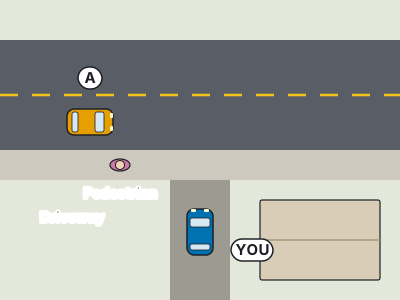
- Only pedestrians on the sidewalk
- Only vehicles approaching from the driver's left
- Pedestrians and traffic already on the street
- No one if the driver signals first
Show answer
Pedestrians and traffic already on the street. A vehicle leaving private property must stop before crossing the sidewalk and yield to people walking and traffic already using the public street. The signal-first choice confuses communication with priority. A turn signal tells others what you intend, but it does not make the entrance safe or give you precedence. Stop at the proper point, look both ways, check the sidewalk, and enter only after the roadway and pedestrian path are clear.
Study this in the handbook: Yielding to pedestrians and funeral processions
6. What happens to a DUI conviction in Idaho when the driver's BAC is 0.20 percent or higher?
- The conviction is reduced to a traffic warning
- Enhanced penalties apply beyond a standard DUI
- Only the vehicle registration is affected
- The driver receives no additional consequence
Show answer
Enhanced penalties apply beyond a standard DUI. Idaho treats a BAC of 0.20 percent or higher as a threshold for enhanced DUI penalties. That means the consequence is more serious than the ordinary DUI baseline, rather than a warning or a registration only issue. The no additional consequence choice ignores the heightened alcohol concentration. Do not use a legal threshold as a target. The handbook's prevention strategies include offering to be a designated driver, having the designated driver take all car keys, and getting a ride to and from parties where alcohol is present.
Study this in the handbook: DUI limits, penalties and test refusal
7. Idaho's move-over protection applies to a stopped tow truck or which other vehicle named in the handbook?
- A passenger vehicle waiting for directions
- A private delivery van
- A highway incident-response vehicle
- A farm tractor traveling on the shoulder
Show answer
A highway incident-response vehicle. Idaho requires drivers approaching a stopped emergency or police vehicle, tow truck, or incident-response vehicle with flashing lights to reduce speed below the posted limit and proceed cautiously. On a road with at least two lanes moving in the same direction, the driver must also change into a lane that is not beside the stopped vehicle when that move is safe. A delivery van or ordinary waiting car does not receive this named protection. The useful cue is flashing lights on a roadside response vehicle: slow first, then move away when the roadway permits.
Study this in the handbook: Emergency vehicles and the move over law
8. What does the pictured railroad crossbuck help a driver identify?
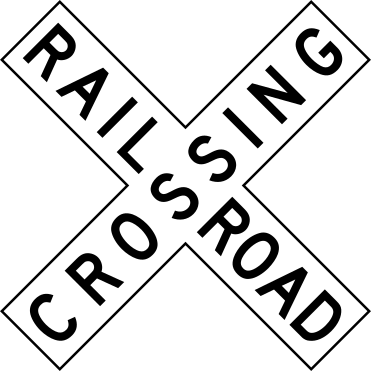
- A work-zone barrier that may be moved
- A pedestrian-only crossing at a school
- A railroad crossing where trains must be expected
- A hospital entrance with no horn use
Show answer
A railroad crossing where trains must be expected. A railroad crossbuck is one of the devices used at railroad crossings. The crossing remains a dangerous place even when a train is not immediately visible, so drivers should listen, look both ways, and never proceed until it is safe. The sign is not a school, hospital, or movable work-zone marker. When approaching the X-shaped device, search for tracks, active signals, gates, and enough room beyond the rails to clear the crossing completely.
Study this in the handbook: Railroad crossings and roundabouts
9. If your lane is next to a dashed yellow line and the other lane has a solid yellow line, when may you cross?
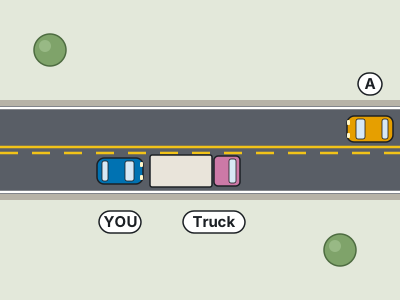
- When it is safe to pass another vehicle
- Never, because any yellow line prohibits crossing
- Only after stopping completely in your lane
- Whenever the vehicle behind is close
Show answer
When it is safe to pass another vehicle. The dashed side of a paired yellow marking identifies the direction that may cross to pass, provided the movement is safe. The solid side is the restricted direction, so the paint must be read from your lane rather than as one blanket prohibition. A complete stop is not the condition stated by the handbook, and following pressure from behind never creates permission. Check sight distance, oncoming traffic, and the vehicle being overtaken before crossing. If those checks fail, remain behind the slower vehicle until another opening appears.
Study this in the handbook: Pavement markings
10. Which vehicle qualifies for Idaho's special passing speed allowance when the other conditions are met?
- A bus carrying passengers
- A pickup towing a boat trailer
- A commercial semitrailer
- A motorcycle that is not towing anything
Show answer
A motorcycle that is not towing anything. Idaho's passing exception names a passenger vehicle, motorcycle, or pickup that is not towing another vehicle. A motorcycle traveling alone fits that vehicle condition. A pickup towing a boat trailer is excluded because it is towing, and a bus or a commercial semitrailer is not among the vehicle types the handbook lists. Even an eligible motorcycle must meet the other conditions, including a two lane road posted at 55 miles per hour or greater, and the allowance does not apply in work zones.
Study this in the handbook: Passing and slow vehicles
11. Which type of traffic sign is generally black and white, although some are red and white?
- Regulatory sign
- Warning sign
- Guide sign
- Work-zone marker only
Show answer
Regulatory sign. Regulatory signs communicate rules that control traffic, so their usual black-and-white or red-and-white appearance should be treated as an instruction. Warning signs are generally yellow and diamond-shaped, while guide signs use colors such as green, blue, or brown to provide route or service information. A work-zone marker is too narrow a category and does not describe the general color rule. Read the message, comply with its restriction, and do not assume a color distinction makes a regulatory sign optional.
Study this in the handbook: Regulatory and work zone signs
12. How does crash risk change at alcohol concentrations above .05, according to the Idaho handbook?
- It is unchanged until .08
- It doubles slightly above .05, is six times as great at .10, and 25 times at .15
- It falls slightly
- It rises only at .15
Show answer
It doubles slightly above .05, is six times as great at .10, and 25 times at .15. If you drink enough to push your alcohol concentration past .05 be careful: at slightly above .05 the risk of causing a crash doubles, at .10 it is six times as great, and at .15 it is 25 times as great. Impairment starts long before the legal limit, and you may be convicted of DUI below .08 when other substances are involved.
Study this in the handbook: Administrative suspension and how alcohol affects you
13. When approaching a yield sign, what should a driver do before crossing an intersection or entering a highway?
- Slow down and yield, stopping if necessary
- Accelerate to claim the right-of-way
- Stop only when a vehicle is already in the intersection
- Sound the horn instead of checking traffic
Show answer
Slow down and yield, stopping if necessary. A yield sign requires the driver to slow down and give the right-of-way to vehicles and pedestrians in the intersection or highway being entered. If necessary, the driver must stop before crossing or entering. Accelerating does the opposite, and waiting until a vehicle is already in the intersection can leave too little room to yield safely. A horn cannot replace observation or control. The visual cue is the inverted triangle: reduce speed early, scan the crossing path, and be ready to stop before proceeding.
Study this in the handbook: Regulatory and work zone signs
14. When passing a large vehicle, when should you merge back into its lane?
- Immediately after moving ahead, even if the vehicle disappears from the mirror
- As soon as your front bumper clears the truck's rear wheels
- Before the truck reaches the next intersection, regardless of mirror view
- After you can see the large vehicle's cab in your rear-view mirror
Show answer
After you can see the large vehicle's cab in your rear-view mirror. Large vehicles need more time and room to react, so cutting back too soon creates a dangerous conflict. Idaho advises keeping a steady passing speed and waiting until the cab of the large vehicle is visible in the rear-view mirror before merging. The bumper and rear-wheel choices leave too little separation. An intersection deadline has no bearing on the safe merge. Keep the truck fully visible, signal, check the lane, and return only when the safety zone is preserved.
Study this in the handbook: Right hooks, motorcycles and large vehicles
15. After a first violation of Idaho's no insurance law, how long must you provide proof of financial responsibility?
- Three years
- One year
- Six months
- Five years
Show answer
One year. A first violation of Idaho's no insurance law requires proof of financial responsibility for one year. Three years applies to a second no insurance offense within five years, and also to suspensions for serious offenses such as DUI or reckless driving. Six months is shorter than the rule. Five years is the look back period for counting a second offense, not the filing period.
Study this in the handbook: DUI limits, penalties and test refusal
16. Idaho prohibits parking within how many feet of railroad tracks?
- 50 feet
- 15 feet
- 20 feet
- 100 feet
Show answer
50 feet. The Idaho no parking list includes anywhere within 50 feet of railroad tracks. Fifteen feet is the minimum stopping distance from the nearest rail when you stop for a train, and also the fire hydrant parking distance, so it is easy to mix up. Twenty feet applies to crosswalks and fire station driveways. One hundred feet is the no passing distance near a railroad crossing, not the parking rule.
Study this in the handbook: Following distance, parking and backing
17. How many questions are on Idaho's Class D non-commercial knowledge test?
- 60 questions
- 25 questions
- 50 questions
- 40 questions
Show answer
40 questions. Idaho's Class D knowledge test consists of 40 questions, and the handbook says an applicant may miss up to six before failing. The 25 question choice may sound like a short permit quiz, but it is not the stated Class D test length, and 50 or 60 questions overstate it. Prepare from the handbook's rules, because the handbook says web based practice tests are not an accurate representation of Idaho knowledge tests, except for the sample questions ITD provides on its website.
Study this in the handbook: The vision, knowledge and skills tests
18. On an Idaho two lane highway, a slow vehicle must turn off where safe to let others pass once it is delaying how many vehicles?
- One or more
- Five or more
- Ten or more
- Three or more
Show answer
Three or more. Any vehicle moving slower than normal traffic that delays three or more other vehicles in a rural area or on a two lane highway must turn off the road wherever it is safe to let them pass. One vehicle is below that threshold. Five and ten are higher counts than the rule sets, so waiting for them would break the law. Slow moving vehicles also need the approved emblem.
Study this in the handbook: Passing and slow vehicles
19. How soon must you notify the Idaho Transportation Department when your address changes?
- Within 10 days
- Within 30 days
- Within 60 days
- At your next license renewal
Show answer
Within 30 days. Idaho requires you to notify ITD within 30 days when your address changes, using the online form, a county office, or written notice. Ten days is shorter than the rule, and 60 days is longer. Waiting until renewal is too late. The change on record does not print on the card unless you apply for a duplicate or renew. Written notice can be sent by email or mail.
Study this in the handbook: Expiration, renewal, extensions and address changes
20. What roadway transition does the pictured Two-Way Traffic sign warn about?
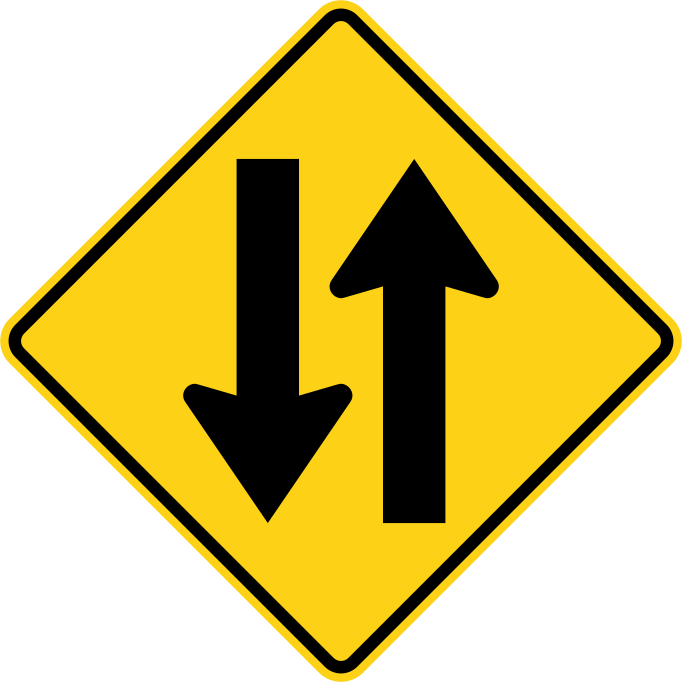
- A divided highway becomes a two-lane, two-way section
- A two-way road gains a permanent center median
- Both directions begin passing on the shoulder
- Traffic enters a one-way roundabout
Show answer
A divided highway becomes a two-lane, two-way section. The two opposing arrows warn that a divided, multilane highway is transitioning to a two-lane section carrying traffic in both directions. Expect oncoming vehicles after the division ends and keep alert for the center line and passing restrictions. The sign does not announce a new median, shoulder passing, or a one-way circle. Reduce speed if needed and place the vehicle correctly before opposing traffic becomes close enough to create a conflict.
Study this in the handbook: Warning signs
QualitySpace is expanding to Idaho
We are a California-based independent insurance brokerage working on licensing in more states. We cannot help with Idaho insurance yet. Leave your email and we will let you know when we can.
Every question is written from the official Idaho Driver's Handbook. Need paper? Printable ID practice test with answer key.
Last verified 2026-10-05. How we check every question · Study all 215 as flashcards
Frequently asked questions
How many questions are on this Idaho practice test?
This fixed set has 20 questions. It is test 8 of 10 from the 215 question Idaho bank. The real ID exam asks 40 questions and you need 34 correct.
What is the passing score for the real Idaho test?
34 of 40 correct; you can miss up to six questions before failing the test That figure comes from the official Idaho source cited on the DMV facts page.
How does this fixed test relate to the full Idaho bank?
Each numbered test is a fixed set of questions in a fixed order, so you can retake the same test later and compare. Every test mixes road signs and the other topics in about the same proportion as the full bank. Tests 1 to 10 together cover 200 of the 215 questions in the Idaho bank, each once. The full practice page mixes the whole bank at random.
Last verified 2026-10-05. See the Idaho DMV facts page for sourced state details.