
Test 4 of 10 · 20 questions · Free 2026
ID Permit Practice Test 4
Jump to the test ↓A fixed 20 question set from the Idaho bank with answers and plain English explanations. The real ID exam is 40 questions, 85 percent to pass; take the full length version on the main practice page.
Question 1 of 20 · 0 right so far
All 20 questions in test 4
Every question below comes from the Idaho question bank on this page. Open a question to see the correct answer and the explanation. Nothing here is hidden behind a signup.
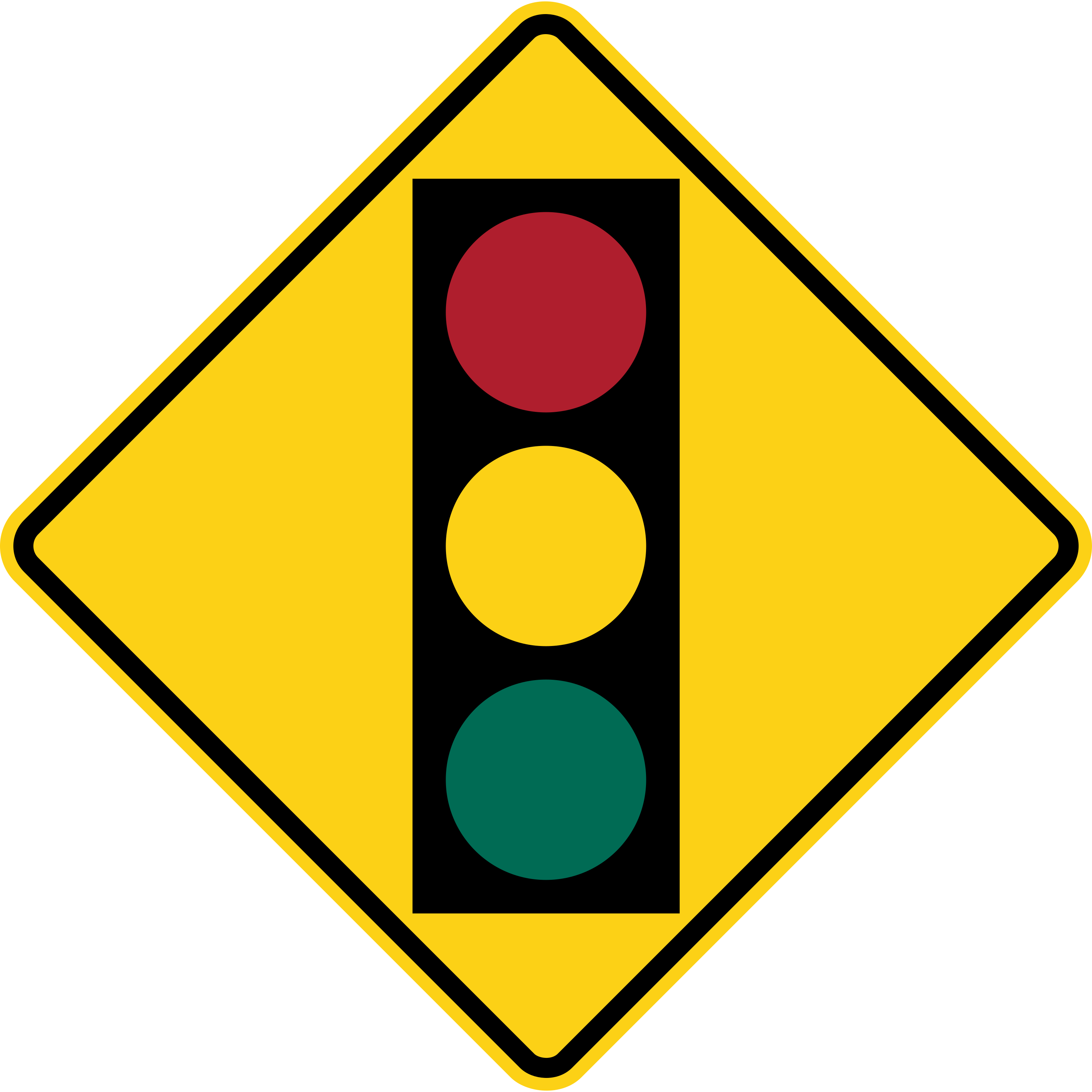
1. Why might the pictured traffic-signal-ahead sign be installed on a road?
- The intersection or signal view is blocked or traffic speeds are higher
- The road has no intersections for several miles
- Streetlights are permanently out of service
- A police checkpoint is guaranteed beyond the sign
Show answer
The intersection or signal view is blocked or traffic speeds are higher. Idaho uses the traffic-signal-ahead warning on higher-speed roads or where a driver’s view of the intersection or light is blocked. The purpose is preparation: expect an intersection and a stop light, then adjust attention and speed so a stop can be made safely if required. The sign does not promise a checkpoint or indicate broken streetlights. Treat limited sight distance as the reason to look farther ahead and avoid arriving too fast to respond.
Study this in the handbook: Warning signs
2. For a first DUI conviction in Idaho, what are the maximum jail term and fine listed in the handbook?
- Up to one year in jail and up to a $2,000 fine
- Up to six months in jail and up to a $1,000 fine
- Up to ten years in jail and up to a $5,000 fine
- No jail and a flat $250 civil penalty
Show answer
Up to six months in jail and up to a $1,000 fine. A first Idaho DUI conviction carries up to six months in jail and up to a $1,000 fine, plus a license suspension. Up to one year in jail and up to a $2,000 fine match a second conviction within 10 years. Ten years and $5,000 are the upper limits for a third conviction within 10 years, which is a felony. The $250 civil penalty belongs to refusing an evidentiary test, not to a DUI conviction.
Study this in the handbook: Emergency vehicles and the move over law
3. In daylight, what must mark a load that extends four feet or more beyond the rear of an Idaho vehicle?
- An orange triangle on the rear bumper
- A red flag at least 12 inches square at the end of the load
- A red flag at least 18 inches square at the end of the load
- Nothing, if the load is tied down securely
Show answer
A red flag at least 18 inches square at the end of the load. A load that sticks out four feet or more behind a vehicle must carry a red flag at least 18 inches square at its end. The flag must be red, and an orange triangle on the bumper is not the marking the rule names. A 12 inch flag is smaller than the rule requires. Tying the load down does not remove the marking duty. At night the flag must be replaced by a red light visible for at least 500 feet.
Study this in the handbook: Night, fog, rain and flash floods
4. How does Idaho classify a third DUI conviction within 10 years?
- As an infraction with a fine only
- As a felony
- As a civil penalty handled by ITD alone
- As a misdemeanor that is sealed after one year
Show answer
As a felony. A third or later DUI conviction within 10 years is a felony in Idaho. It carries mandatory jail of 30 days to ten years for an adult, a fine of up to $5,000, and a one to five year license suspension. An infraction or fine only outcome ignores the mandatory jail. The civil penalty label describes the separate administrative suspension and the refusal penalty, not the criminal conviction. The handbook says nothing about sealing the record.
Study this in the handbook: Emergency vehicles and the move over law
5. What must a driver do before proceeding through a flashing light signal at a railroad crossing?
- Stop while the lights are actively flashing and proceed only when safe
- Slow slightly and cross if no train is visible from the driver's seat
- Drive around the crossbuck because flashing lights are advisory only
- Wait for a green traffic light located beyond the tracks
Show answer
Stop while the lights are actively flashing and proceed only when safe. At a railroad crossing, active flashing lights require a stop. The driver may proceed only after the warning has ended and the crossing can be entered safely. Visibility alone is not enough because a train may be approaching from an unseen direction. Driving around a crossbuck or treating the signal as advice ignores the control device. Do not stop on the track, confirm there is room for the entire vehicle beyond it, and look both ways before moving across.
Study this in the handbook: Railroad crossings and roundabouts
6. At a roundabout, which traffic has priority when you are entering the circle?
- Vehicles entering from the opposite side at the same moment
- Vehicles waiting behind you at the entry
- Vehicles already in the roundabout on your left
- The largest vehicle approaching any entrance
Show answer
Vehicles already in the roundabout on your left. A roundabout is a one way circular intersection, and entering drivers must yield to traffic already circulating on the left. The waiting vehicle choice has no priority, while an opposite entry does not override the vehicle already in the circle. Vehicle size is irrelevant to this rule. Slow before the entry, read the signs and pavement markings, yield to pedestrians and bicyclists, and join only when a safe gap is available. Signal right as you approach your exit.
Study this in the handbook: Railroad crossings and roundabouts
7. When are Idaho headlamps and tail lamps required to be lighted?
- Only between midnight and 5 a.m.
- From sunset to sunrise and when poor visibility makes them necessary for safety
- Only when rain is falling directly on the vehicle
- Only on interstate highways
Show answer
From sunset to sunrise and when poor visibility makes them necessary for safety. The handbook requires headlamps and tail lamps from sunset to sunrise, and also whenever poor visibility makes them necessary for safety. Rain is only one possible source of reduced visibility, so the rain-only choice is too narrow. The time window is broader than midnight to 5 a.m., and the rule applies beyond interstates. Use headlamps rather than parking lights when illumination is needed, and turn them on early when daylight fades or visibility deteriorates.
Study this in the handbook: Night, fog, rain and flash floods
8. What should a driver do in a designated work zone with a posted reduced speed limit?
- Follow the vehicle ahead instead of the sign
- Use the normal highway limit unless workers enter the lane
- Slow only when a flagger is visible
- Observe the posted work zone limit
Show answer
Observe the posted work zone limit. The work-zone limit applies where it is posted, and Idaho warns that violating it can bring an enhanced, fixed penalty. The driver does not get to wait until workers enter the lane or substitute the normal highway limit. The vehicle ahead may be traveling unlawfully, so following it is not a safe legal standard. Spot the work-zone signs early, reduce speed before the activity area, and maintain attention around workers and changing lanes.
Study this in the handbook: Stopping at red lights and pedestrian beacons
9. Which animals does Idaho's Open Range warning concern?
- Livestock such as horses, cattle, sheep, and goats
- Only deer and elk
- Only cattle owned by ranchers
- Any domestic pet near a sidewalk
Show answer
Livestock such as horses, cattle, sheep, and goats. The handbook's open range material concerns livestock, including horses, cattle, sheep, and goats. These animals may be present without a fence and have the right-of-way in the area described by the warning. The deer and elk choice changes livestock into wildlife, while the cattle-only choice leaves out other listed animals. When the warning appears, treat any livestock near the road as a serious roadway hazard and be ready to stop without swerving into another lane.
Study this in the handbook: Mountains, open range and winter driving
10. Where must the supervising licensed adult sit during Idaho's GDL supervised period?
- Anywhere in the vehicle
- In the rear seat behind the driver
- In the front seat beside the driver
- In the passenger seat only when turning
Show answer
In the front seat beside the driver. The supervising adult must occupy the front seat beside the young driver. The adult must also hold a valid license and be at least 21 years old, and no other passenger may occupy the front seat during this supervised period. Sitting in the rear does not meet the stated arrangement, and supervision is not limited to turns or selected maneuvers. Before moving, confirm the adult's age, license, and seat position together.
Study this in the handbook: Graduated Driver's License rules
11. An Idaho driver under 17 is convicted of a second moving traffic violation. What GDL penalty applies?
- A warning letter
- A 60 day suspension of driving privileges
- A 6 month suspension of driving privileges
- A 30 day suspension of driving privileges
Show answer
A 30 day suspension of driving privileges. Idaho's GDL penalties for drivers under 17 step up with each moving violation conviction. The first conviction brings a warning letter, the second brings a 30 day suspension, and a third or later conviction brings a 60 day suspension. The warning letter is only for the first conviction, and 60 days is for the third. A 6 month suspension appears in the point system for 24 or more points in 36 months, not in the GDL penalty list.
Study this in the handbook: Points, suspensions and reinstatement
12. When must Idaho drivers dim their headlamps before meeting an oncoming vehicle?
- Only after the vehicles are side by side
- 200 feet before meeting the vehicle
- 100 feet before meeting the vehicle
- 500 feet before meeting the vehicle
Show answer
500 feet before meeting the vehicle. Idaho's lighting rule uses two different distances, so the direction of travel matters. An approaching vehicle must receive low beams beginning 500 feet before the vehicles meet. The 200-foot figure applies when overtaking another vehicle, not when meeting traffic head-on. Waiting until the cars are beside each other risks glare at the exact moment both drivers need clear vision. Remember the pairing: 500 feet for meeting, 200 feet for passing from behind.
Study this in the handbook: Night, fog, rain and flash floods
13. At the pictured stop sign, where should the vehicle stop first when a marked stop line is present?

- Before the marked stop line
- After entering the intersection
- Beside the nearest parked vehicle
- Only after another driver arrives
Show answer
Before the marked stop line. A stop sign requires a complete stop at the clearly marked stop line. If there is no line, the stopping point shifts to the near side crosswalk; without a crosswalk, stop at the point nearest the intersecting highway where approaching traffic can be seen before entering. Rolling into the intersection first is too late, and a parked vehicle is not a stopping reference. The stop is required every time, whether or not another driver has arrived. Look for the painted line before the front wheels reach the crossing path.
Study this in the handbook: Regulatory and work zone signs
14. How many errors can an Idaho Class D skills-test applicant make and still pass?
- Fifteen or fewer
- Six or fewer
- Ten or fewer
- Twelve or fewer
Show answer
Twelve or fewer. The Class D skills test is passing at twelve or fewer errors. This is different from the knowledge test, where the handbook discusses the number of questions that may be missed. A six-error figure belongs to that written-test context, not the driving score. The result also depends on avoiding a critical driving error, which ends the test with an automatic failure. Treat twelve as the maximum ordinary error count and continue to follow every sign, signal, and examiner instruction.
Study this in the handbook: The vision, knowledge and skills tests
15. Which statement describes the usual colors of Idaho regulatory signs?
- They are always orange and black
- They are always yellow and green
- They are generally blue and brown
- They are generally black and white, with some red and white
Show answer
They are generally black and white, with some red and white. Regulatory signs communicate rules, restrictions, or required actions. Idaho describes them as generally black and white, while noting that some are red and white. Yellow and green are associated with warning signs and school warnings, orange and black commonly identify work-zone warnings, and blue or brown serve other sign purposes. When a sign controls what drivers may do, consider the regulatory category before interpreting the particular symbol or wording.
Study this in the handbook: Regulatory and work zone signs
16. When stopping quickly in a vehicle equipped with ABS, how should you use the brake pedal?
- Apply continuous pressure and let the system work
- Pump the pedal rapidly to keep the wheels turning
- Release the pedal whenever the system pulses
- Apply firm pressure, then pump the pedal after the first pulse
Show answer
Apply continuous pressure and let the system work. With ABS, an emergency stop requires continuous pressure on the brake pedal. The system pumps the brakes for you and preserves steering control during hard braking, although it does not shorten the stopping distance. Pumping the pedal can defeat the system and increase the distance needed to stop. A pulse or pump noise is normal, so do not lift your foot when you feel it. Keep pressing, steer where you need to go, and follow the vehicle manual for ABS operation.
Study this in the handbook: Skids, emergency braking and car trouble
17. How far does a loaded truck at 55 mph need to stop on a dry road, according to the Idaho handbook?
- 100 feet
- 450 feet with properly adjusted brakes
- 200 feet
- 1,000 feet
Show answer
450 feet with properly adjusted brakes. It takes a loaded truck with properly adjusted brakes 450 feet to come to a complete stop when traveling 55 miles per hour on a dry road, so allow extra space for large vehicles to speed up or stop, never cut in front of one, and remember that sharp turns may require the truck to use more than one lane.
Study this in the handbook: Right hooks, motorcycles and large vehicles
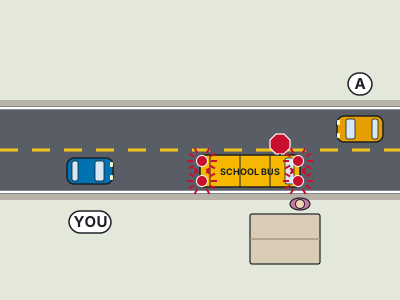
18. When must traffic remain stopped for a school bus loading or unloading students?
- Only while the driver can see children crossing
- Only until the bus door closes, even if the lights remain active
- As long as the bus's red lights flash or its stop arm is extended
- For exactly 30 seconds after the bus stops
Show answer
As long as the bus's red lights flash or its stop arm is extended. The school-bus rule is tied to the bus's warning devices. Traffic must stop and remain stopped while the red lights near the top flash and or the stop arm remains extended. Waiting only for visible children or for the door to close can release traffic while students are still at risk. The fixed 30-second choice is not the handbook's test. Watch the bus signals and wait until the active warning has ended and the roadway is clear.
Study this in the handbook: Stopping for school buses and emergency vehicles
19. What does a V-shaped barricade pattern mean when it is placed across a roadway?
- The lane is closed but the shoulder remains open for normal travel
- Traffic must follow a detour arrow on the barricade without checking for other signs
- The road is closed and traffic cannot proceed farther
- The road is open, but drivers should increase speed before the next hazard
Show answer
The road is closed and traffic cannot proceed farther. Barricade patterns direct drivers around closures or stop them from entering a blocked route. A V-shaped pattern means the road is closed and travel cannot continue beyond the device. Lines angled down to the left or right instead tell traffic which side to pass on, so they are different patterns. An open shoulder and a reason to speed up are not meanings assigned to this barricade. Stop before the closure, obey any detour signs, and never move the device to create a path for your vehicle.
Study this in the handbook: Guide signs and barricades
20. What must an Idaho driver do when a stop sign has no stop line or crosswalk?
- Stop only after entering the intersection
- Stop at the nearest point where approaching traffic can be seen
- Continue if no vehicle is visible behind the sign
- Stop 50 feet before the intersection
Show answer
Stop at the nearest point where approaching traffic can be seen. A stop sign still requires a complete stop even when the pavement offers no painted stopping reference. First look for a marked stop line, then the near-side crosswalk. If neither exists, stop at the point nearest the intersecting highway that gives you a view of approaching traffic before entering. Stopping after you cross the junction is too late, while a fixed 50-foot distance is not the handbook rule. The practical cue is to stop where visibility begins, then check traffic and pedestrians before moving.
Study this in the handbook: Regulatory and work zone signs
QualitySpace is expanding to Idaho
We are a California-based independent insurance brokerage working on licensing in more states. We cannot help with Idaho insurance yet. Leave your email and we will let you know when we can.
Every question is written from the official Idaho Driver's Handbook. Need paper? Printable ID practice test with answer key.
Last verified 2026-10-05. How we check every question · Study all 215 as flashcards
Frequently asked questions
How many questions are on this Idaho practice test?
This fixed set has 20 questions. It is test 4 of 10 from the 215 question Idaho bank. The real ID exam asks 40 questions and you need 34 correct.
What is the passing score for the real Idaho test?
34 of 40 correct; you can miss up to six questions before failing the test That figure comes from the official Idaho source cited on the DMV facts page.
How does this fixed test relate to the full Idaho bank?
Each numbered test is a fixed set of questions in a fixed order, so you can retake the same test later and compare. Every test mixes road signs and the other topics in about the same proportion as the full bank. Tests 1 to 10 together cover 200 of the 215 questions in the Idaho bank, each once. The full practice page mixes the whole bank at random.
Last verified 2026-10-05. See the Idaho DMV facts page for sourced state details.