
Test 10 of 10 · 20 questions · Free 2026
ID Permit Practice Test 10
Jump to the test ↓A fixed 20 question set from the Idaho bank with answers and plain English explanations. The real ID exam is 40 questions, 85 percent to pass; take the full length version on the main practice page.
Question 1 of 20 · 0 right so far
All 20 questions in test 10
Every question below comes from the Idaho question bank on this page. Open a question to see the correct answer and the explanation. Nothing here is hidden behind a signup.
1. Which Idaho license applicants are required to complete an approved Driver Training program?
- Every first time applicant, whatever their age
- Only applicants under 16
- Anyone under 17 who is applying for an Idaho driver's license
- Only applicants who have failed the skills test
Show answer
Anyone under 17 who is applying for an Idaho driver's license. Idaho requires Driver Training for anyone under 17 years of age who applies for a driver's license. An adult first time applicant is not covered by that requirement, so it does not apply to every new driver. The cutoff is 17, not 16, so a 16 year old must also complete the course. Failing a skills test does not trigger Driver Training; a failed test means waiting to retest and paying the fee again.
Study this in the handbook: Driver training and instruction permits
2. What does a flashing yellow arrow permit when turning?
- A turn only after waiting for a second green arrow
- A turn without checking for pedestrians because the arrow has priority
- A protected turn that requires oncoming traffic to stop
- A turn after yielding to oncoming traffic and pedestrians in the crosswalk
Show answer
A turn after yielding to oncoming traffic and pedestrians in the crosswalk. A flashing yellow arrow allows the turn, but it is permissive rather than protected. The driver must yield to oncoming traffic and pedestrians in crosswalks before moving. The protected-turn choice confuses this indication with a green arrow, and the unchecked-pedestrian choice removes a required yielding duty. Treat the flashing arrow as permission to proceed only after a deliberate search for people and opposing vehicles has shown that the turn is clear.
Study this in the handbook: Traffic signals
3. An emergency vehicle approaches with a siren or flashing red or blue lights. Where should you stop?
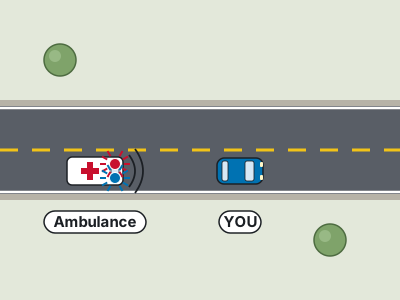
- In the nearest travel lane, even if it blocks the intersection
- At the next traffic light, without changing speed
- On the left shoulder so the emergency vehicle can pass on the right
- At the nearest right curb or roadway edge, clear of the intersection
Show answer
At the nearest right curb or roadway edge, clear of the intersection. Idaho requires a driver to stop for an approaching emergency or police vehicle and pull right to the nearest edge or curb. The vehicle must also be clear of any intersection, and the driver waits until the emergency vehicle passes or an officer permits movement. Stopping in the lane or at a future light can obstruct the responder's route. Think right, clear, and remain stopped whenever the warning is active.
Study this in the handbook: Yielding to pedestrians and funeral processions
4. How long must an Idaho driver keep an SR-22 on file after a suspension for a serious offense?
- Three years
- One year
- 30 days
- Ten years
Show answer
Three years. If your license was suspended for certain serious offenses such as reckless driving or driving under the influence, you must provide proof of financial responsibility for three years, in the form of an SR-22 certified statement of liability coverage from your insurer. The SR-22 is separate from ordinary proof of insurance and is not accepted as insurance proof for a skills test.
Study this in the handbook: DUI limits, penalties and test refusal
5. What does a typical black-on-yellow, diamond-shaped Idaho sign warn a driver about?
- A legal parking space reserved for a specific vehicle
- A maximum speed that applies under ideal conditions
- A motorist service such as fuel or lodging
- An unexpected condition that may require slowing or another action
Show answer
An unexpected condition that may require slowing or another action. Most warning signs use black symbols or lettering on yellow and have a diamond shape. They alert drivers to an unexpected condition, such as an intersection, a hill, a school area, or a slippery surface. The point is to prepare, which may mean reducing speed or taking another safe action. A maximum speed belongs to a regulatory sign, while services use guide signs. The diamond shape is the visual cue that the road ahead may demand extra attention before the hazard is reached.
Study this in the handbook: Warning signs
6. What does Idaho require when approaching a stopped emergency vehicle with flashing lights on a two-lane road?
- Reduce speed below the posted limit and proceed with caution
- Maintain the posted speed and pass closely
- Stop permanently until the vehicle is removed
- Turn around before reaching the emergency vehicle
Show answer
Reduce speed below the posted limit and proceed with caution. When a stopped emergency or police vehicle displays flashing lights, Idaho requires approaching drivers to immediately reduce speed below the posted limit and proceed with caution. The lane-change requirement applies when there are two or more lanes in the same direction, so on a two-lane road the central duty is slowing and careful passage. Normal speed leaves responders less protection, while stopping permanently or turning around is not the stated response. Scan for people and equipment near the roadway.
Study this in the handbook: Emergency vehicles and the move over law
7. What does an Idaho School Zone warning sign tell a driver to expect?

- A school area with a crossing, where children and a marked crossing may be present
- A railroad crossing where trains always have priority
- A hospital entrance with a mandatory parking restriction
- A no-passing area that applies only to commercial vehicles
Show answer
A school area with a crossing, where children and a marked crossing may be present. The School Zone warning sign marks an approaching school area with a crossing. Drivers should watch for children and the marked school crossing, and should pay attention to the posted school-zone speed limit because violations carry increased penalties. The sign does not identify a railroad, hospital, or commercial-only passing rule. The safest response is to reduce risk before reaching the crossing: scan the sidewalks and roadway, follow the posted limit, and be prepared for a child to enter the path unexpectedly.
Study this in the handbook: Warning signs
8. In Idaho, parking is not allowed within how many feet of a fire hydrant?
- 10 feet
- 20 feet
- 30 feet
- 15 feet
Show answer
15 feet. Idaho bans parking within 15 feet of a fire hydrant. Twenty feet is the distance for a crosswalk and for a fire station driveway, and 30 feet is the distance for a stop sign, yield sign, or traffic signal. Ten feet is shorter than the rule allows. The same list also bans parking in front of a driveway, within 50 feet of railroad tracks, and on bridges or overpasses.
Study this in the handbook: Following distance, parking and backing
9. What road condition does the pictured skidding-car warning identify?

- The road may become slippery in wet weather
- A designated area for vehicle racing
- A gravel surface that is always dry
- A mandatory chain-control checkpoint
Show answer
The road may become slippery in wet weather. The skidding-car sign warns that the road may become slippery in wet weather. Drivers should slow under those conditions and use smooth control inputs, since sudden braking or steering can reduce traction further. The symbol does not identify a race area, guarantee gravel, or announce a chain checkpoint. Fresh rain, standing water, and changing pavement can make the warning especially important, so reduce speed before the slick section rather than waiting for the vehicle to slide.
Study this in the handbook: Warning signs
10. When should you increase the normal following distance behind another vehicle?
- Only after the vehicle ahead activates its hazard lights
- At high speeds or in bad weather
- Only on dry roads when traffic is moving below the limit
- Never, if your tires have at least 2/32 inch of tread
Show answer
At high speeds or in bad weather. The three-second interval is a minimum starting point, not a universal maximum. Idaho specifically says to increase following distance at high speeds or in bad weather. Rain, ice, snow, and reduced visibility can make braking and judging distance more difficult, while speed increases the distance traveled during reaction time. Waiting for hazard lights is too late, and tire tread does not eliminate the need for a space cushion. Pick a fixed roadside object, count the gap, and in bad weather increase the three seconds several times for an extra margin of safety.
Study this in the handbook: Night, fog, rain and flash floods
11. What should an Idaho driver do after feeling drowsy on an interstate?
- Drink an energy beverage and continue until the next city
- Leave the road at the first rest stop or service area and take a nap
- Open a window and increase speed to stay alert
- Use high beams continuously while remaining in the travel lane
Show answer
Leave the road at the first rest stop or service area and take a nap. The handbook tells a drowsy driver to stop driving, pull off at the first rest stop or service area, and take a nap. Energy drinks and an open window do not remove fatigue, and speeding reduces the time available to react. High beams improve illumination in some conditions but are not a treatment for sleepiness. Treat drowsiness as an immediate safety problem: leave the travel lane, park legally, rest, and resume only when alert enough to control the vehicle.
Study this in the handbook: Defensive driving, distractions and fatigue
12. How can an Idaho driver who is temporarily out of state extend an expiring license?
- Drive on the expired license for a year
- Renew by phone for free
- Apply for an extension of up to 12 months for $10, with one final second extension available
- No extension is possible
Show answer
Apply for an extension of up to 12 months for $10, with one final second extension available. If you are temporarily out of state when your license expires, you may apply for an extension of up to 12 months for $10, and if necessary a second and final 12 month extension for another $10. Active duty military members and their dependents may apply for as many $10 extensions as needed during the service period. Contact ITD for the application.
Study this in the handbook: Expiration, renewal, extensions and address changes
13. What does a blue guide sign identify?
- A temporary lane closure only
- A no-passing restriction
- A warning about an unexpected roadway condition
- Motorist services
Show answer
Motorist services. Blue guide signs point to services useful to motorists, such as fuel, food, lodging, or medical help. They do not carry the general warning function of yellow diamond signs or the passing restriction associated with regulatory messages and pavement markings. A temporary lane closure belongs to work-zone control and may use orange devices. The handbook’s color grouping is a quick recognition tool, but still read the words or symbols for the exact service. If you need help, look for the blue service sign before making a sudden lane change.
Study this in the handbook: Guide signs and barricades
14. What is a shared center lane reserved for?
- Straight-through travel when traffic is congested
- Left turns, and permitted U-turns, from either direction
- Merging into it to continue straight past a backup
- Waiting there while a passenger enters the vehicle
Show answer
Left turns, and permitted U-turns, from either direction. A shared center lane is a turning space, not an extra travel lane. Drivers from either direction may use it for a left turn and for a U-turn when that movement is permitted. Driving straight through, passing, or waiting there would place a vehicle in the path of people preparing to turn. The handbook also warns against interfering with another vehicle using the center turn lane. Enter only far enough to complete the planned turn, scan for opposing users, and leave the lane promptly once the maneuver is finished.
Study this in the handbook: Turns, signals and U turns
15. What must a driver do when a blind pedestrian with a white cane is walking near the roadway?
- Yield only at a marked crosswalk
- Proceed unless a guide dog is present
- Yield the right-of-way to the pedestrian
- Sound the horn and continue first
Show answer
Yield the right-of-way to the pedestrian. Idaho specifically requires motor vehicles to yield to a blind person walking with a white cane or guide dog. The white cane alone is enough to trigger the protection, so waiting for a dog would be unsafe and incorrect. The marked-crosswalk choice also narrows the rule beyond the handbook's wording. Slow down well before the person's path, give room to cross, and continue only when the pedestrian is safely clear.
Study this in the handbook: Yielding to pedestrians and funeral processions
16. How far ahead must Idaho low beams illuminate the roadway?
- At least 350 feet
- At least 200 feet
- At least 100 feet
- At least 500 feet
Show answer
At least 100 feet. Low beams are required to light the roadway at least 100 feet ahead. The handbook assigns 350 feet to the visibility expected from high beams for people and vehicles, so using that larger number for low beams confuses the two settings. A 200-foot or 500-foot requirement is not the stated low-beam figure. Before driving at night, confirm that the lamps are aimed properly and that the low-beam pattern gives the required forward view without blinding other road users.
Study this in the handbook: Required equipment, seat belts and child seats
17. What does an Idaho speed limit sign establish under ideal driving conditions?
- The minimum speed required in every lane
- The maximum speed limit on that section of road
- A recommended speed that may always be exceeded
- The speed for trucks only
Show answer
The maximum speed limit on that section of road. A posted speed limit sets the maximum lawful speed for that section when conditions are ideal. It is not a promise that the same speed is safe during rain, snow, congestion, darkness, or another hazard. Nor does the sign create a minimum speed or apply only to trucks. Think of the number as a ceiling, then reduce speed when conditions require more stopping distance or control. A driver who treats the posted value as permission to exceed it has misunderstood the sign's purpose.
Study this in the handbook: Regulatory and work zone signs
18. When does an Idaho license marked Under 21 expire?
- On the holder's 21st birthday
- Five days after the holder's 21st birthday
- Thirty days after the holder's 21st birthday
- At the end of the calendar year
Show answer
Five days after the holder's 21st birthday. An Idaho credential marked Under 21 expires five days after the holder's 21st birthday. The birthday itself is not the expiration date, and the handbook does not extend the credential to a month or the end of the year. The same passage distinguishes an Under 18 credential, which expires five days after the 18th birthday. When checking a card, read the printed under-age notation and its date rather than assuming expiration occurs on the birthday.
Study this in the handbook: Expiration, renewal, extensions and address changes
19. What is the youngest age listed for an Idaho Motorcycle Instruction Permit applicant?
- There is no stated minimum age, but a valid Idaho license is required
- 14 1/2 years
- 16 years
- 18 years
Show answer
There is no stated minimum age, but a valid Idaho license is required. The motorcycle permit passage describes eligibility by requiring a valid Idaho driver's license and a passed motorcycle knowledge test. It does not provide a separate minimum age in that section. For applicants under 21, the handbook adds an approved Motorcycle Rider Training Course requirement. The age choices supply numbers that are not stated for the MIP itself. The key distinction is between the general permit conditions and the extra training condition that applies to someone younger than 21.
20. What happens if an Idaho skills test has a critical driving error?
- The examiner allows one retry during the same route
- The applicant receives five penalty points
- The test ends immediately with an automatic failure
- Only the related maneuver is scored again
Show answer
The test ends immediately with an automatic failure. A critical driving error is treated more seriously than an ordinary scored mistake. The handbook says it may cause an incident, injury, or death, and an occurrence produces an automatic failure with the skills test ending immediately. There is no same-route retry or limited re-score for the maneuver. Examples include disobeying a traffic signal, speeding, a lane violation, or striking an object. The safety cue is to prevent serious errors rather than rely on the ordinary error tally.
Study this in the handbook: The vision, knowledge and skills tests
QualitySpace is expanding to Idaho
We are a California-based independent insurance brokerage working on licensing in more states. We cannot help with Idaho insurance yet. Leave your email and we will let you know when we can.
Every question is written from the official Idaho Driver's Handbook. Need paper? Printable ID practice test with answer key.
Last verified 2026-10-05. How we check every question · Study all 215 as flashcards
Frequently asked questions
How many questions are on this Idaho practice test?
This fixed set has 20 questions. It is test 10 of 10 from the 215 question Idaho bank. The real ID exam asks 40 questions and you need 34 correct.
What is the passing score for the real Idaho test?
34 of 40 correct; you can miss up to six questions before failing the test That figure comes from the official Idaho source cited on the DMV facts page.
How does this fixed test relate to the full Idaho bank?
Each numbered test is a fixed set of questions in a fixed order, so you can retake the same test later and compare. Every test mixes road signs and the other topics in about the same proportion as the full bank. Tests 1 to 10 together cover 200 of the 215 questions in the Idaho bank, each once. The full practice page mixes the whole bank at random.
Last verified 2026-10-05. See the Idaho DMV facts page for sourced state details.