
Test 5 of 10 · 20 questions · Free 2026
ID Permit Practice Test 5
Jump to the test ↓A fixed 20 question set from the Idaho bank with answers and plain English explanations. The real ID exam is 40 questions, 85 percent to pass; take the full length version on the main practice page.
Question 1 of 20 · 0 right so far
All 20 questions in test 5
Every question below comes from the Idaho question bank on this page. Open a question to see the correct answer and the explanation. Nothing here is hidden behind a signup.
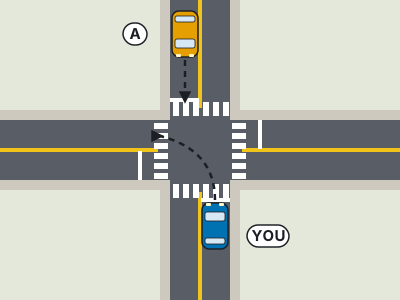
1. When turning left on a green circular signal, which traffic must you yield to before turning?
- No one, because a green signal protects every left turn
- Only vehicles approaching from the right
- Oncoming traffic and pedestrians in crosswalks
- Only pedestrians who are outside the crosswalk
Show answer
Oncoming traffic and pedestrians in crosswalks. A green circular signal permits movement, but it does not protect a left turn from conflicts. Idaho requires the driver in the left turn lane to yield to oncoming traffic and pedestrians in crosswalks before turning. The driver must judge when the opposing lane and the crossing are clear. A green light is therefore not permission to turn across an approaching vehicle, and the rule is not limited to traffic from one side. Pedestrians inside the crosswalk are expressly covered, so scan the crosswalk and turn only through a safe opening.
Study this in the handbook: Traffic signals
2. At night, how far ahead should low beams allow a driver to see the roadway?
- About 25 feet
- About 100 feet
- About 350 feet
- About 1,000 feet
Show answer
About 100 feet. The handbook distinguishes the visibility distances produced by the two headlight settings. Low beams allow the driver to see about 100 feet ahead, while high beams extend that distance to about 350 feet. The 350-foot choice belongs to high beams, not low beams. The shorter and longer alternatives do not match the stated equipment guidance. At night, keep speed low enough to stop within the visible distance, dim when meeting or following another vehicle, and watch for unlighted road users.
Study this in the handbook: Night, fog, rain and flash floods
3. What is the minimum space the Idaho handbook says a driver should leave when passing a bicyclist?
- 3 feet
- 1 foot
- 2 feet
- No set space, as long as you honk first
Show answer
3 feet. The Idaho handbook sets three feet as the minimum passing space when passing a bicyclist, and higher speeds call for more. One or two feet is less than the stated minimum. Honking is not a substitute for space and can startle a rider. If you cannot change lanes, wait for a break in oncoming traffic so you can give at least three feet.
Study this in the handbook: Pedestrians, children, horses and bicyclists
4. Under Idaho's passing exception on a two lane road posted 55 mph or higher, by how much may an eligible driver exceed the limit while passing a slower vehicle?
- Up to 5 mph
- Up to 10 mph
- Up to 15 mph
- Up to 25 mph
Show answer
Up to 15 mph. Idaho lets the driver of a passenger vehicle, motorcycle, or pickup that is not towing exceed the posted limit by up to 15 miles per hour while passing a vehicle going below the limit on a two lane road posted 55 or higher. Five and ten miles per hour understate the allowance, and 25 overstates it. The exception does not apply in work zones, and the driver must return to the right lane and the posted speed as soon as practicable.
Study this in the handbook: Passing and slow vehicles
5. A 30 year old is driving a commercial vehicle in Idaho. At what BAC is the driver considered to be driving under the influence?
- .04 or more
- .02 or more
- .08 or more
- .20 or more
Show answer
.04 or more. When operating a commercial vehicle, an Idaho driver is under the influence at .04 or more, half the ordinary adult limit. The .02 threshold applies to drivers under 21, and .08 applies to drivers 21 or older in a noncommercial vehicle. A BAC of .20 or more is the level that brings even stiffer penalties, not the starting point for a DUI.
Study this in the handbook: DUI limits, penalties and test refusal
6. How many points can completing an ITD approved Defensive Driving Course remove from an Idaho driving record?
- Up to 4 points
- Up to 3 points
- All points on the record
- Up to 6 points
Show answer
Up to 3 points. Completing an ITD approved Defensive Driving Course removes a maximum of three points, and the points must already be on the record before the course is finished. Four points is the maximum for the Traffic Safety Education Course offered by law enforcement at the time of a citation, not for the DDC. No course wipes every point, and six points is not a figure in the handbook. The course also never removes the conviction itself.
Study this in the handbook: Points, suspensions and reinstatement
7. What does the yellow diamond Intersection/Crossroad warning tell you to watch for?

- A divided highway ending at a toll station
- A guaranteed green signal at the next block
- A railroad gate that must remain closed
- A road crossing ahead and possible cross traffic in your path
Show answer
A road crossing ahead and possible cross traffic in your path. The Intersection/Crossroad warning means another road crosses the one you are using, so traffic may enter across your route. Scan both sides, control your speed, and be prepared to yield or stop if the intersection requires it. The green-signal choice invents a signal phase that the sign does not promise. A railroad gate and a toll station describe unrelated facilities. Treat the diamond as advance notice, then let the actual traffic control device and other road users determine when you proceed.
Study this in the handbook: Warning signs
8. During which dates may studded snow tires be used in Idaho?
- November 15 through March 15
- October 1 through April 30
- December 1 through February 28
- All year without a seasonal limit
Show answer
October 1 through April 30. Idaho permits studded snow tires during the seasonal window from October 1 through April 30. The dates matter because the allowance is not an all-year permission and does not use the shorter November-to-March period offered by another choice. Check the calendar before installing or leaving studs on the vehicle, especially when a trip crosses the seasonal boundary. This is an equipment-use date rule, separate from whether current weather makes winter tires useful.
Study this in the handbook: Mountains, open range and winter driving
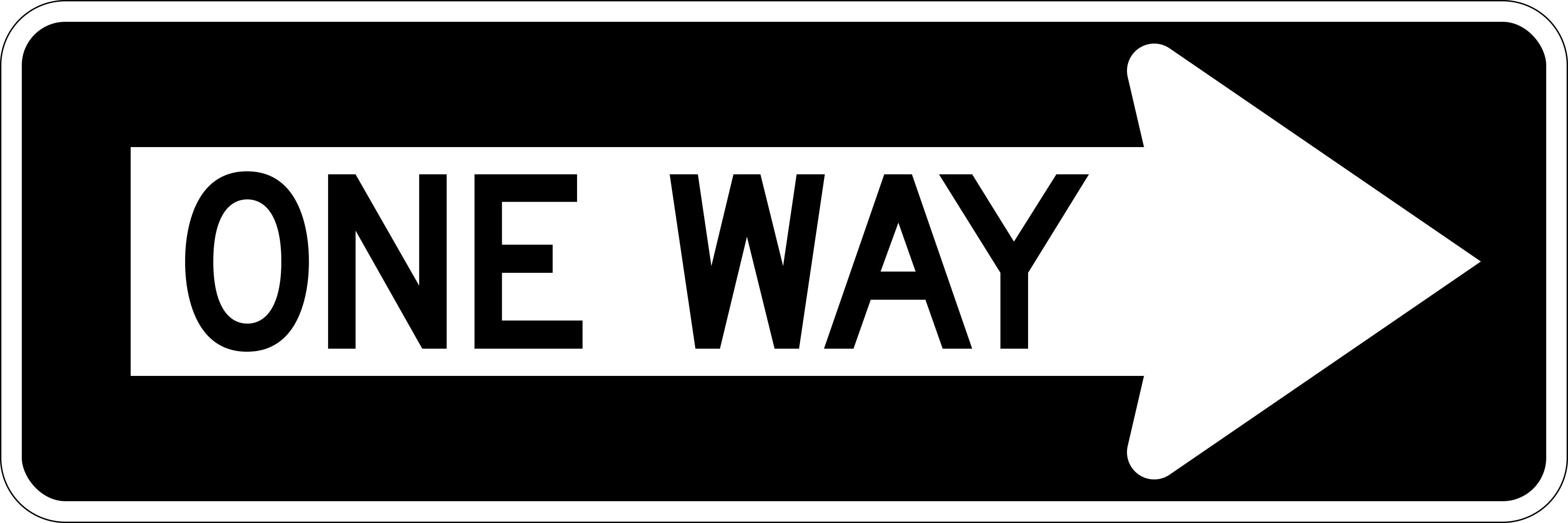
9. What should drivers learn to recognize about Idaho traffic signs?
- The brand of paint used on the sign
- Only the distance to the next town
- Only whether the sign is mounted on a metal post
- Their color, shape, messages, and symbols
Show answer
Their color, shape, messages, and symbols. Idaho expects drivers to recognize traffic signs through several visual and verbal features, including color, shape, messages, and symbols. Looking only at the post or guessing from the sign’s location leaves out the information that communicates the rule or warning. The distance to a town belongs to some guide signs, but it is not a universal sign feature. Use the pictured sign as a prompt to inspect its full design, then connect the symbol or wording to the movement, hazard, or direction it communicates.
Study this in the handbook: Regulatory and work zone signs
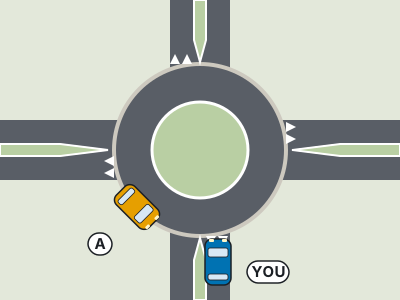
10. As you enter a roundabout, what is your first right-of-way responsibility?
- Yield to vehicles entering behind you before joining the circle
- Enter first if your vehicle is closer to the yield line
- Yield to traffic already in the circle
- Join the circle clockwise and take the first exit
Show answer
Yield to traffic already in the circle. Traffic circulating in the roundabout has priority over a driver entering it. Slow down, yield to vehicles already in the circle, and merge counter clockwise when a safe gap appears. Vehicles behind you do not receive priority over traffic already circulating, and being closer to the yield line gives no right to enter first. Clockwise travel is the opposite of the handbook's direction. Keep your speed low, yield to pedestrians and bicyclists, and turn on your right signal as you approach your exit.
Study this in the handbook: Railroad crossings and roundabouts
11. Besides signs and signals, who may provide traffic control directions in Idaho?
- Law enforcement officers, highway personnel, or school crossing guards
- Only passengers in nearby vehicles
- Only private tow-truck operators without lights
- Only pedestrians waiting at a crosswalk
Show answer
Law enforcement officers, highway personnel, or school crossing guards. Idaho says traffic control may also be provided by law enforcement officers, highway personnel, or school crossing guards. Their directions can apply while a driver is approaching a work area, a school crossing, or another managed roadway condition. The other choices describe people who do not automatically have authority to direct traffic. Watch for an officer, worker, or crossing guard giving a clear instruction, and obey that direction along with the signs, signals, and pavement markings governing the location.
Study this in the handbook: Regulatory and work zone signs
12. Which Idaho drivers may choose an eight year license renewal?
- Any driver over 16
- Only drivers over 65
- Commercial drivers only
- Drivers between 21 and 62 years of age
Show answer
Drivers between 21 and 62 years of age. A renewal is valid for four years or eight years, or to the end of a lawful stay in the United States, and drivers between 21 and 62 years of age may choose the eight year renewal for a Class D or commercial license. Vision screening is required at every renewal, and a failed screening can require a vision exam form from an eye doctor.
Study this in the handbook: Expiration, renewal, extensions and address changes
13. What is the first response to a tire blowout while the vehicle is moving?
- Stomp on the brake pedal before steering
- Hold the wheel tightly and keep the vehicle headed straight
- Turn sharply toward the nearest shoulder
- Shift to park and release the steering wheel
Show answer
Hold the wheel tightly and keep the vehicle headed straight. A blowout can trigger the instinct to brake hard, but that can make the vehicle harder to control. First grip the steering wheel firmly and keep the vehicle traveling straight. Then ease off the accelerator without braking until control is complete. Once the vehicle is stable, brake gently and move to the nearest safe location off the road. A sharp turn toward the shoulder risks a swerve, while shifting to park is not a controlled response at roadway speed.
Study this in the handbook: Skids, emergency braking and car trouble
14. What does Idaho's implied-consent rule require when an officer suspects impaired driving?
- A driver may refuse every BAC test without a license consequence
- Consent applies only after a court conviction
- Only commercial drivers have consented to testing
- A person who drives or controls a vehicle has consented to a BAC or drug test
Show answer
A person who drives or controls a vehicle has consented to a BAC or drug test. Idaho's implied-consent rule treats driving or being in physical control of a motor vehicle as consent to a BAC or drug test when an officer suspects driving under the influence. Refusing can trigger a license suspension and a $250 civil penalty under the cited law. The refusal and commercial-driver choices incorrectly narrow the rule, and a conviction is not required before the testing request. The practical cue is that operating the vehicle carries this testing obligation before a court case is finished.
Study this in the handbook: DUI limits, penalties and test refusal
15. When a skid begins and the rear of your vehicle slides to the right, how should you recover?
- Turn the front wheels toward the right while taking your foot off the gas
- Press the brake pedal hard and hold the steering wheel straight
- Turn the front wheels left and accelerate through the skid
- Shift into park before steering toward the shoulder
Show answer
Turn the front wheels toward the right while taking your foot off the gas. A rear wheel skid to the right calls for steering the front wheels toward the right while removing your foot from the accelerator. The handbook gives this exact example: when a skid starts, do not panic and do not hit the brake, take your foot off the gas, then steer in the direction of the skid. Hard braking with a straight wheel goes against that instruction. Turning left and accelerating works against the recovery, and shifting into park is not one of the steps. Before traveling on ice or snow, the handbook suggests practicing stops and skid recovery.
Study this in the handbook: Skids, emergency braking and car trouble
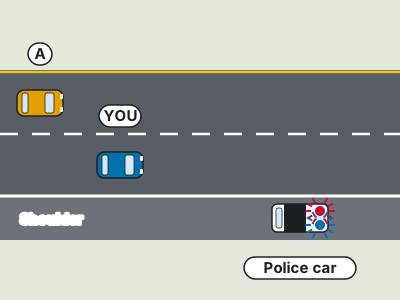
16. You approach a stopped emergency vehicle with flashing lights on a multilane road. What is required if safe?
- Change into a lane that is not next to the emergency vehicle
- Remain beside it while matching the posted speed
- Stop in the lane next to the emergency vehicle
- Pass on the shoulder without reducing speed
Show answer
Change into a lane that is not next to the emergency vehicle. When an emergency, police, tow, or incident response vehicle is stopped with lights flashing, reduce speed below the posted limit and proceed cautiously. On a road with two or more lanes moving in the same direction, also change to a lane that is not adjacent when that maneuver is safe. Staying alongside the vehicle leaves the roadside crew exposed. Stopping in the adjacent lane creates another hazard, while using the shoulder at speed ignores the required caution. Scan early and create lateral space.
Study this in the handbook: Emergency vehicles and the move over law
17. What shape and color identify most warning signs in Idaho?
- Black lettering on white rectangles
- White lettering on green rectangles
- Black symbols or lettering on yellow, usually diamond-shaped
- Blue symbols on circular signs
Show answer
Black symbols or lettering on yellow, usually diamond-shaped. Most Idaho warning signs use black on yellow and a diamond shape. This visual combination alerts drivers that an unexpected condition may be ahead, so they should look for the hazard and prepare to slow or take another safe action. Green rectangles normally provide guide information, white regulatory signs communicate rules, and blue signs commonly identify services. The diamond is the quick recognition cue. Read the symbol or wording next, then adjust speed before reaching the condition described.
Study this in the handbook: Warning signs
18. How does Idaho define daylight for a driver under 16?
- Sunrise to sunset only
- 6:00 a.m. to 8:00 p.m. local time
- 5:00 a.m. to 10:00 p.m. local time
- 7:00 a.m. to 9:00 p.m. local time
Show answer
5:00 a.m. to 10:00 p.m. local time. For the under-16 restriction, Idaho defines daylight as 5:00 a.m. through 10:00 p.m. local time. That definition is more specific than using sunrise and sunset, which change throughout the year. The rule also permits travel outside that period when a valid licensed driver at least 21 sits beside the young driver in the front seat. The time window and the adult-supervision exception should be remembered together, because either detail can change whether a trip is allowed.
Study this in the handbook: Driver training and instruction permits
19. At a pedestrian hybrid beacon, what must a driver do when two solid red lights are displayed?
- Stop only if a crossing guard is present
- Slow down but continue if the crosswalk appears empty
- Turn right without stopping because the beacon is not a standard signal
- Stop completely at the stop line
Show answer
Stop completely at the stop line. Two solid red lights in the pedestrian hybrid beacon sequence require vehicles to stop completely at the stop line. The handbook compares this phase with a steady red requirement, so an apparently empty crosswalk does not authorize a driver to roll through. A pedestrian hybrid beacon's unusual design does not make its red phase optional, and the rule does not depend on a crossing guard standing nearby. Stop at the marked line, remain alert for the next signal phase, and move only when the crossing and indication permit it.
Study this in the handbook: Stopping at red lights and pedestrian beacons
20. At a pedestrian hybrid beacon, what does a flashing yellow phase tell an approaching driver to do?
- Stop at once and remain stopped until the beacon goes dark
- Slow down as you approach the crosswalk
- Proceed at normal speed because pedestrians have not entered yet
- Continue without reducing speed until the light turns solid red
Show answer
Slow down as you approach the crosswalk. In the pedestrian hybrid beacon sequence, the first illuminated phase is a flashing yellow light. Idaho explains that it warns approaching drivers to slow down before the crosswalk. It is an advance warning, not yet the complete stop instruction delivered by the later steady red lights, so stopping at once and waiting for the beacon to go dark misreads it. Holding normal speed until solid red appears ignores the warning to slow. Reduce speed, watch the crossing, and be prepared for the next phase, which requires a full stop at the stop line.
Study this in the handbook: Stopping at red lights and pedestrian beacons
QualitySpace is expanding to Idaho
We are a California-based independent insurance brokerage working on licensing in more states. We cannot help with Idaho insurance yet. Leave your email and we will let you know when we can.
Every question is written from the official Idaho Driver's Handbook. Need paper? Printable ID practice test with answer key.
Last verified 2026-10-05. How we check every question · Study all 215 as flashcards
Frequently asked questions
How many questions are on this Idaho practice test?
This fixed set has 20 questions. It is test 5 of 10 from the 215 question Idaho bank. The real ID exam asks 40 questions and you need 34 correct.
What is the passing score for the real Idaho test?
34 of 40 correct; you can miss up to six questions before failing the test That figure comes from the official Idaho source cited on the DMV facts page.
How does this fixed test relate to the full Idaho bank?
Each numbered test is a fixed set of questions in a fixed order, so you can retake the same test later and compare. Every test mixes road signs and the other topics in about the same proportion as the full bank. Tests 1 to 10 together cover 200 of the 215 questions in the Idaho bank, each once. The full practice page mixes the whole bank at random.
Last verified 2026-10-05. See the Idaho DMV facts page for sourced state details.