
Key points
The three second rule is the minimum; increase it at high speeds or in bad weather.
Source: Handbook p. 79
“The three-second following distance rule is the minimum recommended safest procedure to use. At high speeds or in bad weather you will need to increase your following distance.”
Idaho Driver's Handbook, Handbook p. 79When stopped behind a vehicle, leave room to see its rear tires touching the ground.
Source: Handbook p. 71
“leave enough distance between the vehicles to see the rear tires (where they touch the ground) of the vehicle in front of you.”
Idaho Driver's Handbook, Handbook p. 71Park parallel to and within 18 inches of the curb or road edge, facing the direction of traffic.
Source: Handbook p. 80
“you must park parallel to and within 18 inches of the curb or edge of the roadway, facing in the same direction as traffic on your side of the road.”
Idaho Driver's Handbook, Handbook p. 80Facing downhill, turn your front wheels sharply toward the curb or road edge; facing uphill, turn them sharply away from the curb.
Source: Handbook p. 81
“turn your front wheels (1) sharply toward and against the curb or edge of the road if you are facing downhill, or (2) if you are facing uphill, turn your wheels sharply away and against the curb”
Idaho Driver's Handbook, Handbook p. 81Do not park within 50 feet of railroad tracks or within 15 feet of a fire hydrant.
Source: Handbook p. 81
“Within 50 feet of railroad tracks On bridges or overpasses In front of a driveway Within 15 feet of a fire hydrant”
Idaho Driver's Handbook, Handbook p. 81Do not park within 20 feet of a crosswalk or within 30 feet of a stop sign, yield sign or traffic signal.
Source: Handbook p. 81
“Within 20 feet of a crosswalk Within 30 feet of a stop sign, yield sign, or traffic signal”
Idaho Driver's Handbook, Handbook p. 81Do not park on a freeway or where a sign or red painted curb prohibits it.
Source: Handbook p. 81
“On any controlled-access highway (freeway) Where prohibited by signs or a red-painted curb”
Idaho Driver's Handbook, Handbook p. 81Backing is always prohibited on freeways and other controlled access highways, including the shoulder.
Source: Handbook p. 82
“Backing is always prohibited on freeways, expressways, and other controlled-access highways, including the shoulder.”
Idaho Driver's Handbook, Handbook p. 82If you miss your exit on an interstate, never back up or turn around; go on to the next exit.
Source: Handbook p. 82
“If you have passed your exit on an interstate, never back or try to turn around; go on to the next exit.”
Idaho Driver's Handbook, Handbook p. 82
Numbers to know
| Number | What it means | Manual |
|---|---|---|
| 3 seconds | minimum following distance | Handbook p. 79 |
| 18 inches | maximum distance from the curb when parked | Handbook p. 80 |
| 50 feet | no parking this close to railroad tracks | Handbook p. 81 |
| 15 feet | no parking this close to a fire hydrant | Handbook p. 81 |
| 20 feet | no parking this close to a crosswalk | Handbook p. 81 |
| 30 feet | no parking this close to a stop sign, yield sign or signal | Handbook p. 81 |
Recognize these signs
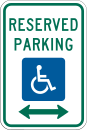
Handicapped parking
3 questions from the Idaho practice test
1. What is Idaho's minimum recommended following-distance procedure?
- Use at least three seconds, adding more time at high speeds or in bad weather
- Keep exactly one second behind the vehicle ahead in all conditions
- Stay within one car length whenever traffic is moving
- Match the vehicle ahead's speed and ignore the road surface
Show answer
Use at least three seconds, adding more time at high speeds or in bad weather. The three-second rule gives a driver a practical minimum gap for reacting to a sudden stop. At higher speeds or in bad weather, the handbook calls for increasing that interval because traction and stopping conditions can worsen. The one-second and one-car-length choices remove needed reaction space, while matching speed alone says nothing about distance. Pick a fixed object, count after the lead vehicle passes it, and enlarge the gap when conditions become demanding.
2. What minimum following interval does the Idaho handbook recommend in normal conditions?
- One car length for every ten miles per hour
- At least three seconds behind the vehicle ahead
- A fixed distance of 20 feet at every speed
- Two seconds, unless the road is dry
Show answer
At least three seconds behind the vehicle ahead. The handbook identifies three seconds as the minimum recommended safest following distance. Choose a fixed object, watch the vehicle ahead pass it, and count before your own vehicle reaches that object. If you arrive sooner, the gap is too short for a sudden stop. The two-second option falls below that minimum, and the manual says that in bad weather the three seconds should be increased several times, not reduced. Increase the interval at high speeds and in bad weather, such as wet, icy, or snowy pavement.
3. What minimum following-distance procedure does the Idaho handbook recommend?
- Follow closely whenever your brakes have recently been tested
- Keep exactly one car length behind the vehicle ahead
- Allow two seconds in rain because wet roads require slower traffic
- Use a three-second gap, increasing it at high speeds or in bad weather
Show answer
Use a three-second gap, increasing it at high speeds or in bad weather. Idaho describes three seconds as the minimum recommended safest following procedure. Choose a fixed object, watch the vehicle ahead pass it, and count before your own vehicle reaches that object. Higher speeds and bad weather require a longer interval because traction, visibility, and stopping distance can worsen. One car length changes dramatically with speed and is not a reliable measure. A recent brake check does not remove the need for space. Use the three-second count as a routine check, then add time when conditions deteriorate.
Practice this topic
Lock it in with safe driving questions from the free Idaho practice test. Every answer comes with a plain English explanation.
Source: the Idaho Driver's Handbook, Traffic Laws & the Rules of the Road. This lesson is a plain English summary, not the law itself; where it differs, the manual and the statute govern. Last checked 2026-09-27.