
Key points
If a pedestrian crosses where there is no crosswalk, stop and let them finish, even if you have the right of way.
Source: Handbook p. 96
“A pedestrian is crossing where there is no painted crosswalk. You must stop and let them finish crossing, even if you technically have the right-of-way.”
Idaho Driver's Handbook, Handbook p. 96Do not pass a vehicle that has stopped for a pedestrian; wait for the pedestrian to cross.
Source: Handbook p. 96
“DO NOT pass the other vehicle. You must wait for the pedestrian to cross and then be sure it is safe to proceed.”
Idaho Driver's Handbook, Handbook p. 96Pedestrian deaths rise dramatically as vehicle speed increases.
Source: Handbook p. 97
“the rate of fatalities increases dramatically with an increase in the speed of a motor vehicle.”
Idaho Driver's Handbook, Handbook p. 97Never sound your horn near a horse; it may frighten the horse and cause an accident.
Source: Handbook p. 98
“Never sound your horn because you may frighten the horse and cause an accident.”
Idaho Driver's Handbook, Handbook p. 98A safe margin when passing a bicyclist is at least 3 feet.
Source: Handbook p. 98
“A safe margin is at least three (3) feet.”
Idaho Driver's Handbook, Handbook p. 98A typical 12 foot lane is not wide enough to share safely with a bicyclist.
Source: Handbook p. 100
“A typical 12-foot-wide travel lane is not wide enough to safely share with a bicyclist.”
Idaho Driver's Handbook, Handbook p. 100In Idaho, bicyclists do not have to stop fully at stop signs but must yield to vehicles at the intersection.
Source: Handbook p. 98
“In Idaho, bicyclists do not need to come to a complete stop at stop signs. They must, however, yield to the right-of-way of vehicles in, or already at, the intersection”
Idaho Driver's Handbook, Handbook p. 98Never honk when close to a bicyclist.
Source: Handbook p. 101
“Never honk when close to a bicyclist; it may startle the bicyclist and cause an unexpected reaction.”
Idaho Driver's Handbook, Handbook p. 101
Numbers to know
| Number | What it means | Manual |
|---|---|---|
| 3 feet | minimum space when passing a bicyclist | Handbook p. 98 |
| 12 feet | a lane this wide is too narrow to share with a bicyclist | Handbook p. 100 |
Recognize these signs

Pedestrian crossing 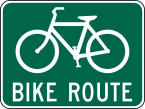
Bicycle
3 questions from the Idaho practice test
1. A pedestrian is crossing outside a painted crosswalk while you have priority. What must you do?
- Stop and let the pedestrian finish crossing
- Continue because a painted crosswalk is required before a pedestrian has priority
- Sound the horn and pass behind the pedestrian without slowing
- Use the left lane to pass another vehicle that has stopped for the pedestrian
Show answer
Stop and let the pedestrian finish crossing. Idaho tells motorists to stop for a pedestrian crossing where there is no painted crosswalk, even when the motorist technically has the right of way. The pedestrian's location is the important cue, not the paint on the pavement. Continuing because the crossing is unmarked risks striking someone who is already in the roadway. Honking does not replace yielding, and passing a vehicle stopped for the person can hide the pedestrian from view. Stop well back, allow the crossing to finish, and proceed only after checking that the path is clear.
2. What should a driver never do when approaching someone riding a horse?
- Stop if necessary to prevent a hazard
- Slow down before passing
- Allow plenty of room
- Sound the horn
Show answer
Sound the horn. Idaho warns drivers never to sound the horn near a horseback rider because the noise may frighten the horse and cause an accident. The other actions are protective responses described for approaching or passing a rider: reduce speed, leave ample space, and stop if needed when the rider is struggling to control the animal. A horn may seem like a useful warning, but it can trigger a sudden and dangerous reaction. Approach quietly, give the rider room, and be prepared to wait until the roadway is safe.
3. Why does the Idaho handbook say a 12 foot lane cannot be shared with a bicyclist?
- Bicycles are banned from 12 foot lanes
- Bicyclists must ride on the sidewalk
- It is not wide enough to pass safely, so change lanes to pass
- Because cyclists ride in the center by law
Show answer
It is not wide enough to pass safely, so change lanes to pass. A typical 12 foot wide travel lane is not wide enough to safely share with a bicyclist, and cycling instructors teach riders to stay away from the edge of the pavement to avoid edge debris and keep room for an emergency maneuver. Move into the next lane or wait for a gap to pass, drive with the expectation that bicyclists are on the road, and look again before turning.
Practice this topic
Lock it in with safe driving questions from the free Idaho practice test. Every answer comes with a plain English explanation.
Source: the Idaho Driver's Handbook, Sharing the Road. This lesson is a plain English summary, not the law itself; where it differs, the manual and the statute govern. Last checked 2026-09-27.