
Key points
For an emergency or police vehicle with a siren or red or blue lights, pull to the right edge, clear of any intersection, and stop.
Source: Handbook p. 70
“STOP for emergency or police vehicles sounding a siren or flashing red or blue lights. Pull over to the nearest edge or curb on the right side of the highway and clear of any intersection”
Idaho Driver's Handbook, Handbook p. 70Stop for a school bus loading or unloading while its red lights flash or its stop arm is out.
Source: Handbook p. 70
“Traffic must stop and remain stopped as long as the red lights near the top of the bus are flashing and/ or the stop arm on the left side of the bus is extended.”
Idaho Driver's Handbook, Handbook p. 70Stay stopped until all children are clear of the roadway and the bus.
Source: Handbook p. 70
“You must remain stopped until all children are clear of the roadway and the bus.”
Idaho Driver's Handbook, Handbook p. 70You need not stop when going the opposite way on a highway with 4 or more lanes, 2 in each direction.
Source: Handbook p. 70
“You do not have to stop if you are traveling in the opposite direction on highways with four or more lanes if two lanes are going in each direction.”
Idaho Driver's Handbook, Handbook p. 70Stop at a railroad crossing when a train is coming or signals, gates or a watchman warn of one.
Source: Handbook p. 70
“STOP at a railway crossing when a train is coming or when wigwag or flashing signals, gates, or a watchman indicate the approach of a train.”
Idaho Driver's Handbook, Handbook p. 70Stop whenever a police officer requests it.
Source: Handbook p. 70
“STOP upon the request of any police officer.”
Idaho Driver's Handbook, Handbook p. 70
Numbers to know
| Number | What it means | Manual |
|---|---|---|
| 4 lanes, 2 each way | highway where opposite direction traffic need not stop for a school bus | Handbook p. 70 |
Recognize these signs
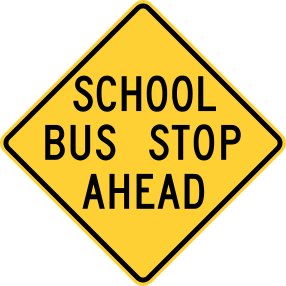
School bus stop ahead
3 questions from the Idaho practice test
1. When must traffic remain stopped for a school bus loading or unloading students?
- Only while the driver can see children crossing
- Only until the bus door closes, even if the lights remain active
- As long as the bus's red lights flash or its stop arm is extended
- For exactly 30 seconds after the bus stops
Show answer
As long as the bus's red lights flash or its stop arm is extended. The school-bus rule is tied to the bus's warning devices. Traffic must stop and remain stopped while the red lights near the top flash and or the stop arm remains extended. Waiting only for visible children or for the door to close can release traffic while students are still at risk. The fixed 30-second choice is not the handbook's test. Watch the bus signals and wait until the active warning has ended and the roadway is clear.
2. When an emergency vehicle approaches with a siren or flashing red or blue lights, where should you stop?
- On the left edge, leaving the right side open for ordinary traffic
- At the nearest curb or right edge of the roadway, remaining stopped until it passes
- In the center of the lane until the emergency vehicle changes direction
- On the shoulder only after the emergency vehicle has passed
Show answer
At the nearest curb or right edge of the roadway, remaining stopped until it passes. An approaching emergency or police vehicle requires an immediate response. Pull to the nearest curb or right edge of the roadway, stop, and remain stopped until the vehicle has passed ahead. Moving left can obstruct the emergency path, while waiting in the travel lane leaves the driver in conflict with the responding vehicle. Delaying the shoulder move until after it passes defeats the warning. Check mirrors quickly, signal your move, stop safely, and watch for additional emergency vehicles.
3. A siren and flashing emergency lights appear while your vehicle is in the intersection. What should you do?
- Reverse through the intersection to make room
- Stop immediately where you are, even if you block cross traffic
- Clear the intersection, then pull to the nearest right edge and stop
- Turn left and continue until the emergency vehicle is out of sight
Show answer
Clear the intersection, then pull to the nearest right edge and stop. The emergency vehicle needs a clear path, so a driver already in the intersection should continue far enough to clear it, then pull to the nearest right edge or curb and stop. Stopping in the intersection can trap the responding vehicle and create conflicting traffic movements. Reversing is unpredictable, and turning left does not reliably move you out of the emergency vehicle’s route. Once stopped, remain there until the vehicle has passed ahead. Think clear the conflict area first, then yield at the right side.
Practice this topic
Lock it in with emergencies questions from the free Idaho practice test. Every answer comes with a plain English explanation.
Source: the Idaho Driver's Handbook, Traffic Laws & the Rules of the Road. This lesson is a plain English summary, not the law itself; where it differs, the manual and the statute govern. Last checked 2026-09-27.