
Key points
When required to stop at a crossing, stop within 50 feet but no less than 15 feet from the nearest rail.
Source: Handbook p. 60
“When required to stop, you should do so within 50 feet but no less than 15 feet from the nearest rail of the crossing.”
Idaho Driver's Handbook, Handbook p. 60A train collision is 40 times more likely to kill or seriously injure than other highway crashes.
Source: Handbook p. 60
“The chance of death or serious injury in a collision between a train and a motor vehicle is 40 times greater than for other highway crashes.”
Idaho Driver's Handbook, Handbook p. 60A 150 car freight train at 50 mph needs 7,000 feet to stop.
Source: Handbook p. 60
“The stopping distance for a 150-car freight train traveling 50 miles per hour is 7,000 feet”
Idaho Driver's Handbook, Handbook p. 60You must stop when crossing lights are actively flashing and go only when it is safe.
Source: Handbook p. 61
“You must stop when the lights are actively flashing and may only proceed when you can do so safely.”
Idaho Driver's Handbook, Handbook p. 61Never shift gears while driving through a crossing.
Source: Handbook p. 61
“Never shift gears while driving through a crossing; this may cause your vehicle to stall on the tracks.”
Idaho Driver's Handbook, Handbook p. 61In a roundabout, all drivers yield to vehicles already in the circle.
Source: Handbook p. 62
“In a roundabout intersection, all drivers must yield the right-of-way to vehicles that are already in the circle.”
Idaho Driver's Handbook, Handbook p. 62Enter the roundabout counter clockwise, whatever direction you are going.
Source: Handbook p. 62
“Drivers must enter the roundabout counter-clockwise and merge into the circle”
Idaho Driver's Handbook, Handbook p. 62Yield to pedestrians and bicyclists when entering and exiting a roundabout.
Source: Handbook p. 62
“Yield to pedestrians and bicyclists when entering and exiting the roundabout.”
Idaho Driver's Handbook, Handbook p. 62
Numbers to know
| Number | What it means | Manual |
|---|---|---|
| 15 to 50 feet | where to stop from the nearest rail | Handbook p. 60 |
| 40 times | greater chance of death or serious injury in a train crash | Handbook p. 60 |
| 150 cars, 50 mph, 7,000 feet | freight train stopping distance | Handbook p. 60 |
Recognize these signs
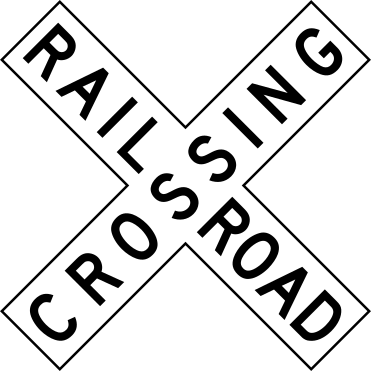
Railroad crossbuck 
Railroad crossing ahead 
Roundabout
3 questions from the Idaho practice test
1. How far from the nearest rail should you stop when a railroad crossing requires a stop?
- Only after the front bumper reaches the crossing gate
- Exactly 5 feet from the first rail
- At least 100 feet and never closer
- Within 50 feet but no less than 15 feet
Show answer
Within 50 feet but no less than 15 feet. At a required railroad stop, the handbook gives a range that protects the vehicle from the track while keeping the driver close enough to observe the crossing. Stop within 50 feet, but no less than 15 feet from the nearest rail. Five feet is dangerously close, and 100 feet may place the vehicle too far back for the stated rule. Never wait with any part of the vehicle on the track. Look and listen, then proceed only when the crossing is safe.
2. What must a driver do before proceeding through a flashing light signal at a railroad crossing?
- Stop while the lights are actively flashing and proceed only when safe
- Slow slightly and cross if no train is visible from the driver's seat
- Drive around the crossbuck because flashing lights are advisory only
- Wait for a green traffic light located beyond the tracks
Show answer
Stop while the lights are actively flashing and proceed only when safe. At a railroad crossing, active flashing lights require a stop. The driver may proceed only after the warning has ended and the crossing can be entered safely. Visibility alone is not enough because a train may be approaching from an unseen direction. Driving around a crossbuck or treating the signal as advice ignores the control device. Do not stop on the track, confirm there is room for the entire vehicle beyond it, and look both ways before moving across.
3. When entering a roundabout, which direction does Idaho require traffic to travel?
- Counter-clockwise around the circle
- Clockwise until the desired exit appears
- Straight across the center island before turning right
- Either direction, depending on which entrance has fewer vehicles
Show answer
Counter-clockwise around the circle. Idaho's roundabout instructions require drivers to enter and merge into the circle counter-clockwise. A clockwise path would place the vehicle against the intended flow. The center island is not a route across the intersection, and drivers cannot choose direction based on traffic volume. Approach slowly, obey signs and pavement markings, yield to traffic already circulating, and signal right as the exit approaches. This sequence keeps entering, circulating, and leaving movements predictable for every road user.
Practice this topic
Lock it in with signals and markings questions from the free Idaho practice test. Every answer comes with a plain English explanation.
Source: the Idaho Driver's Handbook, Highway & Vehicle Knowledge. This lesson is a plain English summary, not the law itself; where it differs, the manual and the statute govern. Last checked 2026-09-27.