
Test 11 of 25 · 20 questions · Free 2026
ID Permit Practice Test 11
Jump to the test ↓A fixed 20 question set from the Idaho bank with answers and plain English explanations. The real ID exam is 40 questions, 85 percent to pass; take the full length version on the main practice page.
Question 1 of 20 · 0 right so far
All 20 questions in test 11
Every question below comes from the Idaho question bank on this page. Open a question to see the correct answer and the explanation. Nothing here is hidden behind a signup.
1. In an Idaho school zone, which speed must you observe?
- Five miles per hour over the posted limit.
- The speed limit posted for the previous road.
- Any speed when no crossing guard is present.
- The posted school zone limit.
Show answer
The posted school zone limit.. Drivers must observe the posted speed limit in an Idaho school zone. Driving five miles per hour over that limit violates the instruction, and the previous road's speed does not replace the school zone posting. The rule also does not depend on a crossing guard being present. Read the sign and any time information on it, then reduce speed to the posted limit before entering the school area. The posted school zone limit controls the vehicle's speed while the zone restriction applies.
Study this in the handbook: Stopping at red lights and pedestrian beacons
2. At a pedestrian hybrid beacon, the signal is dark. What may you do?
- Proceed if the crosswalk is clear
- Stop fully every time you pass one
- Wait until a pedestrian presses the button
- Treat the dark signal as a power failure
Show answer
Proceed if the crosswalk is clear. A pedestrian hybrid beacon stays dark until a pedestrian activates it. When the driver signal is unlit, traffic may proceed as long as the crosswalk itself is clear of people crossing. Picking "Stop fully every time you pass one" would demand a full stop at every dark beacon and disrupt traffic the design intentionally keeps flowing. Pass a dark beacon at normal caution, scanning the crosswalk edges for someone about to enter.
Study this in the handbook: Stopping at red lights and pedestrian beacons
3. Completing a point reduction course removes what from your record?
- Points only, the conviction itself remains
- Both the points and the conviction itself
- The conviction but none of the points
- All record of ever being cited at all
Show answer
Points only, the conviction itself remains. Point reduction courses in Idaho remove points from a driving record, nothing more. The underlying conviction stays on the record even after the points from that violation are taken away by the course. Picking "Both the points and the conviction itself" would erase the conviction along with the points, giving the course a power Idaho does not grant it. Think of the course as lowering a score while the play by play history remains written down.
Study this in the handbook: Points, suspensions and reinstatement
4. Halfway into a pass you realize it cannot be completed safely. What now?
- Accelerate harder to finish the pass anyway
- Stop in the oncoming lane and reassess
- Move onto the far shoulder and continue
- Pull back and wait for another opening
Show answer
Pull back and wait for another opening. A pass that is not working must be abandoned. Pulling back behind the vehicle and waiting for another opening is safer than pressing on against oncoming traffic with shrinking distance and time. Picking "Accelerate harder to finish the pass anyway" would answer danger with more speed and extend your exposure in the opposing lane at the worst moment. The moment the gap ahead stops growing, ease off, drop behind, and let the attempt end without pride.
Study this in the handbook: Passing and slow vehicles
5. Who may park in an Idaho space reserved for handicapped persons?
- Any driver who is making a short delivery to the building
- Any driver who is accompanied by an older passenger
- A vehicle displaying the handicapped symbol on its plate or card
- Any driver who remains inside the vehicle with the engine running
Show answer
A vehicle displaying the handicapped symbol on its plate or card. A reserved handicapped space is open to a vehicle that displays the handicapped symbol on its license plate or on a special card. Non-handicapped drivers are prohibited from using the space and can be fined. A quick delivery, an older passenger, or a driver who waits with the engine running does not satisfy the requirement. The symbol must be on the vehicle's plate or card, not merely mentioned by the driver. Leave the space open unless the vehicle carries the proper display.
Study this in the handbook: Following distance, parking and backing
6. What downhill driving action does Idaho guidance forbid?
- Coasting in neutral with the clutch disengaged
- Using a lower gear on a long descent
- Sounding the horn on a blind curve
- Staying near the right edge of the road
Show answer
Coasting in neutral with the clutch disengaged. Coasting downhill in neutral or with the clutch disengaged removes engine control over vehicle speed. On mountain grades that loss of control compounds quickly, so the gear must stay engaged while descending. Picking "Using a lower gear on a long descent" would ban the recommended lower gear technique that keeps engine braking available throughout the hill. Before any descent, confirm the gear indicator shows a drive gear and keep your foot ready over the brake.
Study this in the handbook: Mountains, open range and winter driving
7. When another driver is passing you, what should you do?
- Speed up so the other driver cannot complete the pass.
- Move left within your lane to reduce the passing space.
- Do not speed up; maintain a steady speed or slow down.
- Brake hard immediately while staying in your lane.
Show answer
Do not speed up; maintain a steady speed or slow down.. When another driver is passing, Idaho tells you to help the maneuver by not increasing speed. Maintain a steady speed or slow down so the passing driver can clear your vehicle. Speeding up keeps the vehicles alongside each other and makes the pass harder. Moving left reduces the space available, while an abrupt hard brake creates a new hazard rather than the measured speed change described. Hold your lane, keep the speed steady or ease off, and let the pass finish.
Study this in the handbook: Passing and slow vehicles
8. For a short freeway trip, what should you know before starting?
- Only the name of your destination city
- The location of every rest area statewide
- Route name plus entrance and exit numbers
- Alternative surface streets for the whole route
Show answer
Route name plus entrance and exit numbers. Freeway travel planning scales to the trip. Before a short trip, know the name, route, entrance, and exit numbers so no last second lane changes are needed at interchanges you could have prepared for. Picking "Only the name of your destination city" would limit preparation to a city name and leave ramp decisions to the final seconds. Say your exit number aloud before entering, then relax into the flow until that number appears.
Study this in the handbook: Speed limits and the basic rule
9. At an unmarked three-way T intersection, what must a driver do before turning onto the cross street?
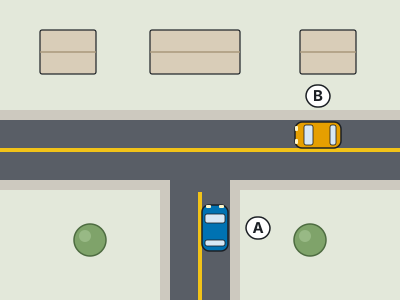
- Yield only to vehicles approaching from the right
- Stop and yield to drivers approaching from the other two directions
- Continue if the nearest lane appears empty
- Stop only when a warning sign is posted
Show answer
Stop and yield to drivers approaching from the other two directions. At a T intersection, the road ending at the cross street does not carry a driver through by default. Idaho requires the driver who must turn right or left to stop and or yield to traffic approaching from the other two directions. The choice “Yield only to vehicles approaching from the right” narrows the duty to one side and can expose the vehicle to cross traffic from the other side. Treat the end of your roadway as a full conflict point and check both directions before entering.
Study this in the handbook: Right of way between drivers
10. What does an Idaho Slow Moving Vehicle sign tell a driver to do?

- Stop and wait until the vehicle leaves the roadway
- Pass immediately before the vehicle reaches a hill
- Slow down and approach the vehicle with caution
- Use the shoulder to travel around the vehicle without checking traffic
Show answer
Slow down and approach the vehicle with caution. The Slow Moving Vehicle sign warns that a vehicle such as farm or construction equipment is ahead. Idaho's instruction is to slow down and approach with caution, allowing time to judge its speed and position. Immediate passing can create a conflict, especially near a hill or limited sight distance. The sign does not require an indefinite stop, and the shoulder is not a shortcut around traffic. Reduce speed early, watch for the operator's movement, and pass only where lawful and visible.
Study this in the handbook: Regulatory and work zone signs
11. Which drink accounted for the largest share of DUI arrests in the studies described?
- Wine accounted for the largest share
- Hard liquor accounted for the largest share
- Flavored malt drinks accounted for the largest share
- Beer accounted for the largest share
Show answer
Beer accounted for the largest share. The handbook says that the greatest percentage of people arrested for driving under the influence had been drinking beer. Wine and hard liquor are not identified as the largest group in that sentence, so choosing either would change the study's reported result. Flavored malt drinks likewise do not match the beverage named in the passage. The nearby alcohol discussion says a jigger of hard liquor, five ounces of table wine, and 12 ounces of beer contain approximately the same amount of alcohol. The reported arrest percentage therefore identifies beer in the study, not a safer drink.
Study this in the handbook: Administrative suspension and how alcohol affects you
12. After serious offenses like DUI, how long must financial responsibility be proven?
- Proof must be provided for one year
- Proof must be provided for three years
- Proof must be provided for six months
- Proof is needed only until reinstatement day
Show answer
Proof must be provided for three years. Drivers reinstating after serious offenses such as reckless driving or driving under the influence must also provide proof of financial responsibility for three years, usually a certified SR 22 insurance statement from their insurer. Picking "Proof must be provided for one year" would end the proof duty after one year, two full years short of the period Idaho requires. Keep the SR 22 filing active without gaps, because a lapse can restart enforcement against your license.
Study this in the handbook: DUI limits, penalties and test refusal
13. Which pedestrian is specifically listed as requiring drivers to yield?
- A pedestrian carrying large shopping bags
- A jogger wearing bright reflective clothing
- Any pedestrian who waves at your vehicle
- A blind person with a white cane or guide dog
Show answer
A blind person with a white cane or guide dog. Motor vehicles must yield to a blind pedestrian walking with a white cane or guide dog. That duty exists because the pedestrian cannot see your vehicle approach or judge its speed visually. Choosing a pedestrian carrying large shopping bags would name a burdened walker, while the named protected case is blindness signaled by cane or dog. Spot a white cane or harness dog early, stop well back, and wait without revving or waving them on.
Study this in the handbook: Right of way between drivers
14. Before a right turn, where should you watch for approaching bicycles?
- In the left lane beside your driver door
- Between your car and the right curb
- Only in the crosswalk directly ahead
- Behind the vehicles waiting across the street
Show answer
Between your car and the right curb. Bicycles often approach a right turning vehicle from the right, in the narrow space between the car and the curb. Checking that strip before turning prevents cutting across a rider who is continuing straight. Picking "In the left lane beside your driver door" would watch the left lane, where a turning conflict with a curb side rider cannot develop at all. Add a right shoulder glance to every right turn, even when the street seems empty behind you.
Study this in the handbook: Turns, signals and U turns
15. A driver fails an Idaho evidentiary test for the second time within five years. What administrative suspension applies?
- 90 days, with no driving for the first 30 days
- Two years with no driving privileges of any kind
- Six months with a work permit
- One year with no driving privileges of any kind
Show answer
One year with no driving privileges of any kind. A second failure of an evidentiary test within five years brings a one year administrative suspension with absolutely no driving privileges of any kind. The 90 day suspension with 30 days of no driving is for a first failure. Two years is the penalty for a second refusal within 10 years, not a second failure. No work permit is available during this absolute suspension.
Study this in the handbook: DUI limits, penalties and test refusal
16. Under Idaho law, who must wear a safety belt in a vehicle that came from the factory with belts?
- All occupants
- Only the driver
- Only people in the front seat
- Only passengers under 18
Show answer
All occupants. Idaho law requires all occupants to wear safety belts or shoulder straps in a vehicle equipped with them by the factory. The rule is not limited to the driver, the front seat, or minors. Young children also need approved child safety seats under the separate child restraint law. Belts reduce the chance of serious injury in a crash by about 50 percent.
Study this in the handbook: Required equipment, seat belts and child seats
17. Who may use a freeway median crossover in Idaho?
- Any driver who missed an exit
- Highway maintenance and emergency vehicles only
- Drivers traveling below the speed limit
- Only drivers with four wheel drive vehicles
Show answer
Highway maintenance and emergency vehicles only. Median crossovers on Idaho freeways are reserved for highway maintenance crews and emergency vehicles. Ordinary drivers have no legal access to them, even after missing an exit or wanting to reverse direction quickly. Picking "Any driver who missed an exit" would treat a restricted work and emergency opening as a public turnaround, which Idaho law forbids for private vehicles. When you spot a crossover, picture a snowplow or ambulance using it and keep your own wheels in the travel lanes.
18. What is the recommended method for making a quick emergency stop in a vehicle without anti-lock brakes?
- Press the brake pedal as hard as possible without locking the wheels
- Stomp down on the pedal until the wheels lock into a slide
- Pump the accelerator pedal while steering back and forth
- Pull the parking brake handle while holding the foot brake down
Show answer
Press the brake pedal as hard as possible without locking the wheels. In a vehicle without ABS, locking the brakes causes the tires to skid across the road, stripping away all steering control and increasing stopping distance. Idaho guidelines direct drivers to press hard on the brake pedal just up to the threshold of locking the wheels. If you feel the brakes begin to lock and slide, quickly ease off slight pressure and reapply smoothly. Threshold braking balances maximum stopping friction with directional steering stability so you can stop safely without losing vehicle control.
Study this in the handbook: Skids, emergency braking and car trouble
19. In Idaho, when may you pass a funeral procession in the right lane on a multi-lane highway?
- When the procession is in the farthest left lane
- Whenever the procession is moving below the limit
- When your lane is clear for at least one block
- When the procession has no police escort
Show answer
When the procession is in the farthest left lane. Idaho allows a right-lane pass only when the procession occupies the farthest left lane. A procession that is moving slowly does not open the right lane, and a clear block or the absence of an escort does not either. The formation has priority, and drivers may not cut between or join its vehicles. Stay behind the procession unless the left-lane condition is met, and never enter an intersection across its path. Patience at the end of the line is the safer choice.
Study this in the handbook: Passing and slow vehicles
20. You have stopped for a school bus that is loading children. When may you start moving again?
- As soon as the bus driver waves traffic past
- When all children are clear of the roadway and the bus
- As soon as your side of the road looks empty
- When the bus begins to close its door
Show answer
When all children are clear of the roadway and the bus. Traffic must stop for a school bus that is loading or unloading students and must remain stopped as long as children are still near the road. The wait ends only when all children are clear of the roadway and the bus, not when the road beside you merely looks empty. A child can step out from behind the bus at the last moment. Keep your foot on the brake and scan both sides of the bus before moving again.
Study this in the handbook: Yielding to pedestrians and funeral processions
Every question is written from the official Idaho Driver's Handbook. Need paper? Printable ID practice test with answer key.
Last verified 2026-10-05. How we check every question · Study all 500 as flashcards
Frequently asked questions
How many questions are on this Idaho practice test?
This fixed set has 20 questions. It is test 11 of 25 from the 500 question Idaho bank. The real ID exam asks 40 questions and you need 34 correct.
What is the passing score for the real Idaho test?
34 of 40 correct; you can miss up to six questions before failing the test That figure comes from the official Idaho source cited on the DMV facts page.
How does this fixed test relate to the full Idaho bank?
Each numbered test is a fixed set of questions in a fixed order, so you can retake the same test later and compare. Every test mixes road signs and the other topics in about the same proportion as the full bank. Tests 1 to 25 together cover every question in the Idaho bank once. The full practice page mixes the whole bank at random.
Last verified 2026-10-05. See the Idaho DMV facts page for sourced state details.