
Test 7 of 10 · 20 questions · Free 2026
ID Permit Practice Test 7
Jump to the test ↓A fixed 20 question set from the Idaho bank with answers and plain English explanations. The real ID exam is 40 questions, 85 percent to pass; take the full length version on the main practice page.
Question 1 of 20 · 0 right so far
All 20 questions in test 7
Every question below comes from the Idaho question bank on this page. Open a question to see the correct answer and the explanation. Nothing here is hidden behind a signup.
1. What does Idaho require of a driver during the GDL supervised instruction period?
- Observe all laws regarding alcohol and other intoxicating substances
- Avoid alcohol only while carrying passengers
- Follow alcohol rules only after dark
- Carry a zero BAC permit from the county
Show answer
Observe all laws regarding alcohol and other intoxicating substances. The supervised period carries a broad obligation concerning alcohol and intoxicating substances. It applies throughout the required practice period, not merely when passengers are present or when driving at night. The handbook also pairs that duty with a licensed adult in the front seat, seat belt use, and at least 50 hours of supervised driving. A county-issued zero BAC permit is not identified as the condition. The useful memory cue is that GDL supervision includes compliance with every alcohol and intoxicating-substance law.
Study this in the handbook: Driver training and instruction permits
2. Under Idaho's open container law, where must an unsealed alcoholic beverage be carried in a vehicle?
- In the trunk, or behind the last upright seat if there is no trunk
- In the glove compartment
- Under the front passenger seat
- Anywhere, as long as only a passenger holds it
Show answer
In the trunk, or behind the last upright seat if there is no trunk. Idaho's open container law bars both drivers and passengers from drinking or possessing an open container of alcohol. An unsealed container must ride in the trunk, or behind the last upright seat in a vehicle with no trunk. The glove compartment and the space under a front seat are inside the passenger area, so they do not meet the rule. Having a passenger hold it does not help, because the law covers passengers too.
Study this in the handbook: Administrative suspension and how alcohol affects you
3. What does a double solid yellow centerline allow?
- Passing is allowed across the lines whenever visibility is good
- Crossing is allowed to merge into the opposite lane before a turn
- Passing a slow vehicle is allowed if the driver signals first
- Crossing is allowed for a safe left turn into or out of a driveway or business entrance
Show answer
Crossing is allowed for a safe left turn into or out of a driveway or business entrance. Two solid yellow lines mark a no-passing condition for both directions. The limited crossing described in the handbook is for a left turn into or out of a driveway or business entrance, and it must be safe. A clear view does not make ordinary passing legal, and signaling first does not create an exception for a slow vehicle. Merging into the opposite lane ahead of a turn is also not the permitted crossing. Use the centerline as a boundary, then wait for a lawful turning opportunity rather than treating it as a passing gap.
Study this in the handbook: Pavement markings
4. What is the safest response when a pedestrian unexpectedly enters the roadway?
- Sound the horn and steer toward the pedestrian to claim the lane
- Maintain speed because pedestrians must always yield outside a marked crosswalk
- Use extreme caution, reduce speed, and be prepared to stop
- Pass a stopped vehicle that is yielding in the adjacent lane
Show answer
Use extreme caution, reduce speed, and be prepared to stop. Idaho emphasizes that pedestrians can appear unexpectedly and that a driver must use extreme caution in areas where they may be present. Slowing and preparing to stop gives the driver time to protect a person who enters the roadway. The marked-crosswalk choice is too broad because the handbook describes situations requiring a stop even where no painted crosswalk exists. A horn or an adjacent-lane pass can startle people or hide them from view. Scan beyond the immediate lane and cover the brake.
Study this in the handbook: Pedestrians, children, horses and bicyclists
5. When an emergency vehicle approaches with a siren or flashing red or blue lights, where should you stop?
- On the left edge, leaving the right side open for ordinary traffic
- At the nearest curb or right edge of the roadway, remaining stopped until it passes
- In the center of the lane until the emergency vehicle changes direction
- On the shoulder only after the emergency vehicle has passed
Show answer
At the nearest curb or right edge of the roadway, remaining stopped until it passes. An approaching emergency or police vehicle requires an immediate response. Pull to the nearest curb or right edge of the roadway, stop, and remain stopped until the vehicle has passed ahead. Moving left can obstruct the emergency path, while waiting in the travel lane leaves the driver in conflict with the responding vehicle. Delaying the shoulder move until after it passes defeats the warning. Check mirrors quickly, signal your move, stop safely, and watch for additional emergency vehicles.
Study this in the handbook: Stopping for school buses and emergency vehicles
6. In an Idaho work zone, what do orange and black warning signs identify?
- Work zone warnings requiring attention to hazards and changing conditions
- A permanent guide route for interstate travelers
- A recreational area where vehicles may stop in any lane
- A special lane where barriers may be moved by motorists
Show answer
Work zone warnings requiring attention to hazards and changing conditions. Orange and black warning signs are associated with work zones, where uneven pavement, narrow lanes, equipment, and gravel can create immediate hazards. Drivers should pay attention and follow the displayed controls. The guide-route choice confuses work-zone coloring with directional information. A work area is not a general stopping place, and drivers must never move its barriers or signs to cross a closure. Slow down, leave space, and expect workers and lane shifts close to traffic.
Study this in the handbook: Regulatory and work zone signs
7. When following a pilot vehicle escorting a large load, what adjustment does the handbook recommend?
- Drive on the shoulder to give the large load more room
- Follow closely so other traffic cannot merge between you and the escort
- Pass the pilot vehicle immediately before it reaches a curve
- Increase your following distance and use extra caution when passing
Show answer
Increase your following distance and use extra caution when passing. Pilot vehicles warn traffic about a large load and help it navigate bridges, curves, and other hazards. A driver following the escort should increase the following distance, preserving time to react to a slow or wide movement. Passing immediately near a curve defeats the warning, and driving on the shoulder is not a substitute for lawful lane control. Following close to prevent merging also removes the space Idaho asks you to create. Treat the amber lights as an early cue to slow, observe the load's path, and wait for a safe opportunity.
Study this in the handbook: Right hooks, motorcycles and large vehicles
8. A driver turning left at an ordinary green circular indication should enter the turn only after:
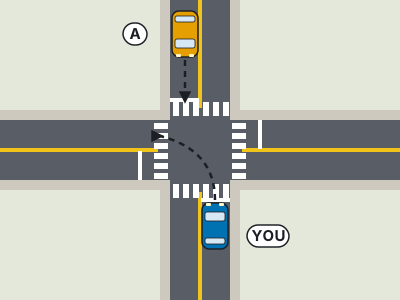
- The driver behind begins honking
- The opposing lane and crosswalk are clear
- The signal changes to a steady red arrow
- All nearby vehicles stop regardless of direction
Show answer
The opposing lane and crosswalk are clear. The green circle allows forward movement but leaves a left turn subject to opposing traffic and pedestrians. The handbook says a driver in the left turn lane must yield to oncoming traffic and pedestrians in crosswalks before turning, then complete the movement without creating a conflict. A horn from behind does not change the rule, and waiting for a red arrow is not required. Stopping every nearby vehicle is also broader than the actual duty. Read the signal together with the lane movement: a turn across traffic needs a clear gap.
Study this in the handbook: Traffic signals
9. At a steady red circular traffic indication, where should you remain stopped before a permitted turn?
- Beside the signal pole with the vehicle angled into cross traffic
- Past the crosswalk so the front tires reach the intersection center
- Behind the stop line, or before the crosswalk if no line is present
- At least one vehicle length beyond the nearest corner
Show answer
Behind the stop line, or before the crosswalk if no line is present. A steady red circular indication requires the vehicle to remain behind the stop line. If no line exists, stop before entering the crosswalk. Only after stopping may a driver make a permitted turn, while yielding to cross traffic and checking for a prohibition. The choices placing the vehicle inside or beyond the intersection defeat the protected stopping position. A useful habit is to identify the line or crosswalk first, stop there, and complete every required yield before turning.
Study this in the handbook: Stopping at red lights and pedestrian beacons
10. When may you move an injured person from a wrecked vehicle after a crash?
- Move the person before checking for injuries
- Leave the person in place unless you have medical training or an immediate danger such as fire exists
- Move the person whenever traffic behind you is impatient
- Move the person if the wreck blocks a driveway
Show answer
Leave the person in place unless you have medical training or an immediate danger such as fire exists. The handbook tells drivers at a crash scene to give any help they can, but not to move an injured person from a wrecked vehicle unless they have the necessary medical training or there is an immediate danger, such as fire. Traffic impatience and a blocked driveway do not create that exception, and checking for injuries does not by itself permit moving the person. Call for police and medical help as soon as possible. Idaho's Good Samaritan law protects you from civil liability if you act in good faith.
Study this in the handbook: Crashes and the law
11. When applying for an Idaho license, what must a driver do with a driver's license issued by another state?
- Mail it to the federal government
- Keep both licenses active
- Surrender it only after passing the skills test
- Surrender the other state license
Show answer
Surrender the other state license. Idaho requires an applicant transferring from another state, territory, or the District of Columbia to surrender the existing driver license or identification card. Keeping both credentials active is not the transition described in the handbook. The surrender occurs as part of applying, rather than waiting for a later skills-test result. The rule supports the one-driver, one-license record concept: once the Idaho credential is issued, the former state credential is not retained as a second active license.
12. During the first six months of an Idaho license, what passenger limit applies to drivers under 17?
- No more than two unrelated passengers under 17
- No passengers under 17 under any circumstances
- No more than one passenger under 17, unless related
- Any number of passengers if everyone wears a seat belt
Show answer
No more than one passenger under 17, unless related. For the first six months after the license date, a driver under 17 may carry no more than one passenger who is under 17. The exception covers passengers related by blood, adoption, or marriage, so the rule is not a blanket ban on younger passengers. Seat belt use remains important but does not remove the passenger cap. Count the age and relationship of the passengers before starting the trip, especially when more than one young friend wants a ride.
Study this in the handbook: Graduated Driver's License rules
13. Does Idaho's special passing allowance apply on a two-lane road posted at 45 miles per hour?
- No, because passing is never allowed on two-lane roads
- Yes, every two-lane road qualifies
- Yes, but only during daylight
- No, the posted limit must be 55 miles per hour or greater
Show answer
No, the posted limit must be 55 miles per hour or greater. The special passing allowance is limited by the posted speed condition, so a 45 mile per hour road does not qualify. The rule is not available on every two-lane road, and it does not ban all passing on such roads. Daylight alone also does not create eligibility. Before considering the allowance, read the sign and confirm that the roadway and vehicle meet every condition for the exception.
Study this in the handbook: Passing and slow vehicles
14. During an Idaho GDL penalty suspension, may the young driver get a restricted permit to drive to school or work?
- Yes, a restricted permit is automatic for school and work
- Yes, but only during daylight hours
- No, GDL penalty suspensions are absolute and allow no driving of any kind
- Yes, if a licensed adult 21 or older rides along
Show answer
No, GDL penalty suspensions are absolute and allow no driving of any kind. The handbook says GDL penalty suspension periods are absolute and do not allow driving privileges of any kind. That rules out an automatic school or work permit. A daylight exception does not exist for these suspensions either. A supervising adult in the car does not help, because the suspension removes all driving privileges. Restricted permits exist for some other suspensions, but not for GDL penalty suspensions.
Study this in the handbook: Points, suspensions and reinstatement
15. You are turning right and a bicyclist is ahead of you. What is the safest way to avoid a right-hook crash?
- Accelerate past the bicyclist before reaching the intersection
- Slow down and remain behind the bicyclist until the bicyclist passes the turn point
- Move into the bike lane early and turn in front of the bicyclist
- Honk at the bicyclist, then turn as soon as the front wheel is beside you
Show answer
Slow down and remain behind the bicyclist until the bicyclist passes the turn point. A right turn across a bicyclist's path can produce a broadside right-hook crash. Idaho advises a driver not to assume the car can beat the bicyclist to the corner. Slow down and stay behind until the bicyclist has gone past the point where the turn will occur. Accelerating around the rider creates the exact conflict the guidance warns about. A horn may startle a bicyclist, and occupying a bike lane does not give permission to cut across someone already traveling there. Look, wait, then turn smoothly.
Study this in the handbook: Right hooks, motorcycles and large vehicles
16. Under Idaho's point system, what action may the department take when a driver collects 8 to 11 points in any 12 months?
- A warning letter
- A 30 day suspension
- A 90 day suspension
- No action until 24 points
Show answer
A warning letter. Idaho's point table starts with a warning letter for 8 to 11 points in any 12 months. A 30 day suspension begins at 12 to 17 points in 12 months, and a 90 day suspension applies at 18 to 23 points in 24 months. The department does not wait until 24 points; 24 or more in 36 months is the top tier, which carries a 6 month suspension. Each moving violation adds one to four points.
Study this in the handbook: Points, suspensions and reinstatement
17. Which color and background combination identifies an Idaho guide sign for motorist services?
- White lettering on green only
- Black lettering on yellow diamond
- White lettering or symbols on blue
- Red and white stripes on a barricade
Show answer
White lettering or symbols on blue. Idaho guide signs for motorist services use white on blue. This category points toward services rather than warning of a hazard or imposing a driving command. Green guide signs provide directional and distance information, while brown signs identify cultural, historical, or scenic points of interest. Yellow diamonds are warning signs, not service signs. When scanning ahead, use the blue background as the clue that the message concerns a service such as fuel, food, or lodging.
Study this in the handbook: Guide signs and barricades
18. When may a rental car be used for an Idaho skills test?
- Any time
- Only if the applicant is already a licensed driver and at least 25
- Never
- Only with the rental company's letter
Show answer
Only if the applicant is already a licensed driver and at least 25. Rental cars are not allowed to be used for a skills test if the applicant is not a licensed driver or is under the age of 25, so a licensed applicant who is at least 25 is the only case left open. Dealer vehicles may be used only by a dealer or full time salesperson with a dealer ID. The vehicle must also carry valid proof of insurance and a signed, unexpired registration during the test.
19. What does the pictured Keep Right of Island sign require when the roadway divides?
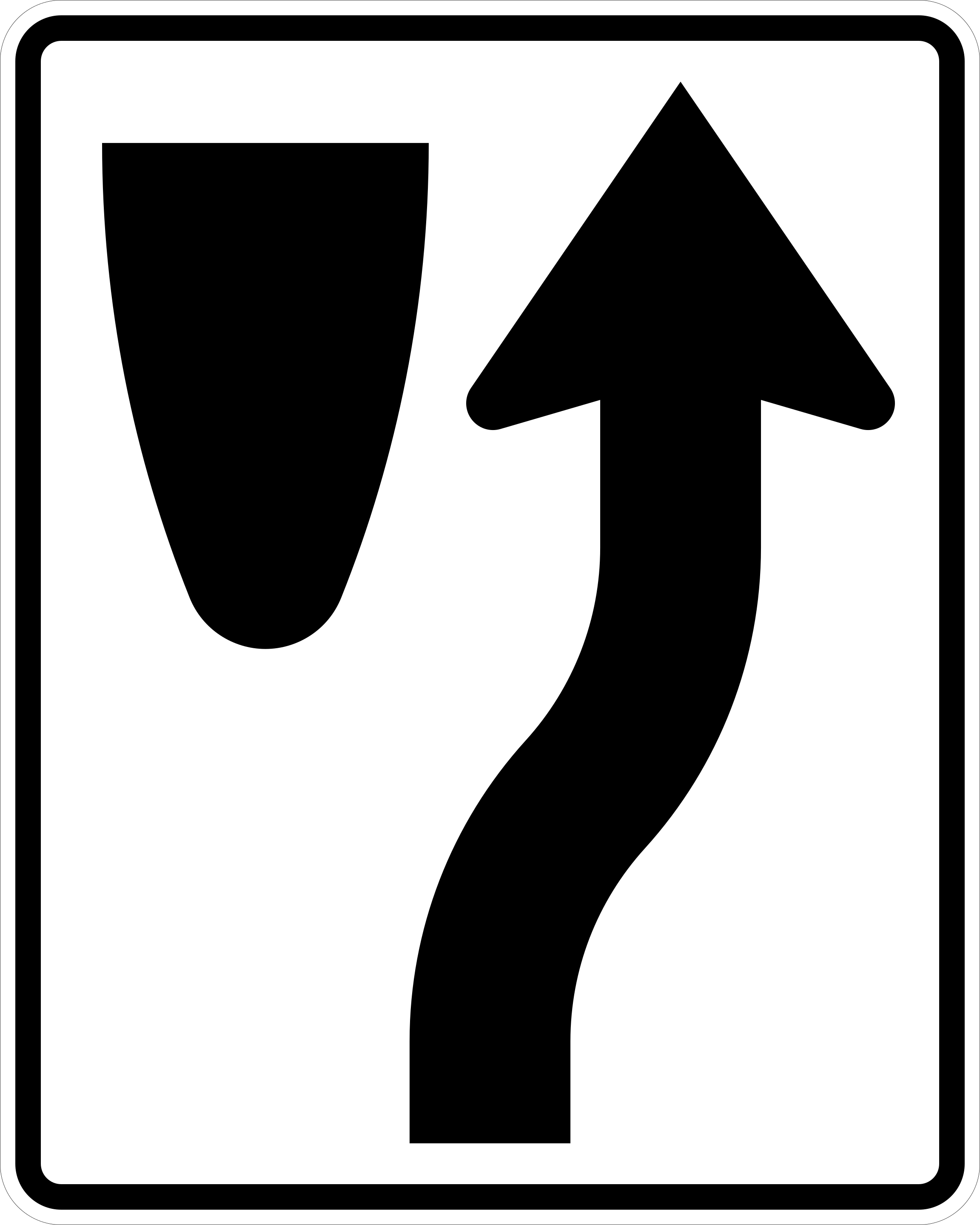
- Remain to the right of the island or barrier
- Cross left of the barrier before the split
- Use the right lane only to pass trucks
- Stop beside the island until traffic clears
Show answer
Remain to the right of the island or barrier. The Keep Right of Island sign marks a divided roadway and directs traffic to stay on the right side of the island or barrier. It does not tell the driver to stop, pass only in a particular lane, or cross to the left before the division. Look ahead for the physical median or obstruction represented by the sign. Position the vehicle on its right side while continuing to obey lane markings and other traffic controls at the split.
Study this in the handbook: Regulatory and work zone signs
20. Which item is one of Idaho’s traffic control devices?
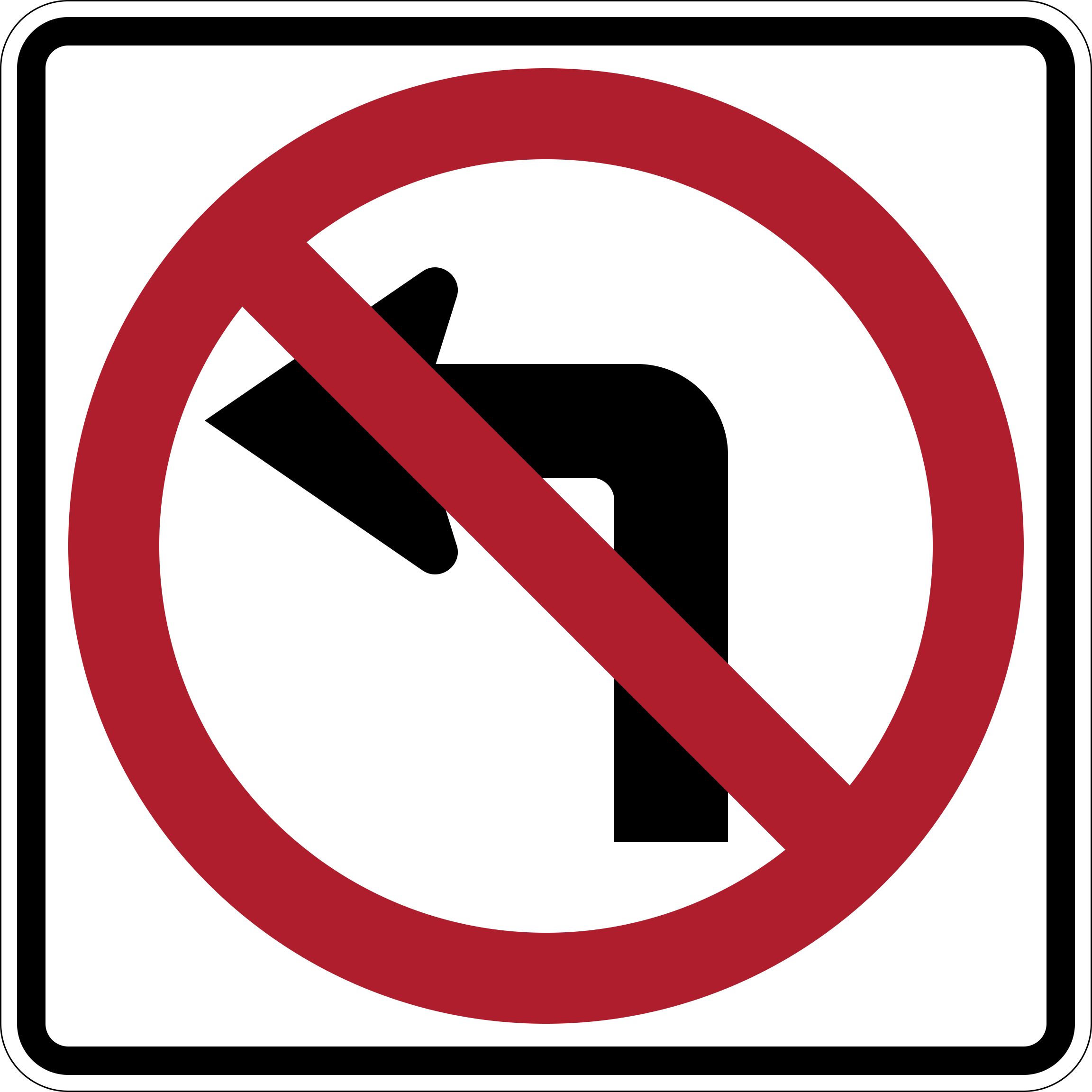
- Pavement markings
- A vehicle’s fuel gauge
- A private driveway light
- A passenger’s route suggestion
Show answer
Pavement markings. Idaho identifies traffic signals, signs, and pavement markings as traffic control devices. Pavement markings include the lines and symbols painted on highways to divide lanes, control passing, identify turn lanes, and show where drivers must stop. A fuel gauge, driveway light, or passenger suggestion may affect a trip, but none directs roadway movement as an official control device. Look at the roadway itself as well as roadside signs and signals, because the painted markings can establish a rule even when no sign is nearby.
Study this in the handbook: Regulatory and work zone signs
QualitySpace is expanding to Idaho
We are a California-based independent insurance brokerage working on licensing in more states. We cannot help with Idaho insurance yet. Leave your email and we will let you know when we can.
Every question is written from the official Idaho Driver's Handbook. Need paper? Printable ID practice test with answer key.
Last verified 2026-10-05. How we check every question · Study all 215 as flashcards
Frequently asked questions
How many questions are on this Idaho practice test?
This fixed set has 20 questions. It is test 7 of 10 from the 215 question Idaho bank. The real ID exam asks 40 questions and you need 34 correct.
What is the passing score for the real Idaho test?
34 of 40 correct; you can miss up to six questions before failing the test That figure comes from the official Idaho source cited on the DMV facts page.
How does this fixed test relate to the full Idaho bank?
Each numbered test is a fixed set of questions in a fixed order, so you can retake the same test later and compare. Every test mixes road signs and the other topics in about the same proportion as the full bank. Tests 1 to 10 together cover 200 of the 215 questions in the Idaho bank, each once. The full practice page mixes the whole bank at random.
Last verified 2026-10-05. See the Idaho DMV facts page for sourced state details.