
Test 21 of 25 · 20 questions · Free 2026
ID Permit Practice Test 21
Jump to the test ↓A fixed 20 question set from the Idaho bank with answers and plain English explanations. The real ID exam is 40 questions, 85 percent to pass; take the full length version on the main practice page.
Question 1 of 20 · 0 right so far
All 20 questions in test 21
Every question below comes from the Idaho question bank on this page. Open a question to see the correct answer and the explanation. Nothing here is hidden behind a signup.
1. What does proper use of an approved child safety seat require?
- Placing the seat loosely so the child can move
- Using the seat only on trips over ten miles
- Letting an older child hold the seat steady
- Fitting the child snugly with the seat straps
Show answer
Fitting the child snugly with the seat straps. Proper protection in an approved child safety seat means fitting the child snugly into the seat with the straps attached to the seat, securing the seat to the vehicle, and using the seat on every trip. A loose fit lets the child shift forward in a sudden stop, which is exactly what the straps exist to prevent. Tighten the straps until they lie flat and snug on every ride, even for a short trip around the block.
Study this in the handbook: Required equipment, seat belts and child seats
2. What does a Low Clearance warning sign tell a driver about the road ahead?
- The road surface may become slippery in wet weather
- Traffic from two highways will soon merge together
- The road ahead divides around a center island
- The overhead clearance above the highway is very low
Show answer
The overhead clearance above the highway is very low. This warning calls out a tight overhead space above the highway. A tall vehicle, a roof load, or a raised bed can strike the bridge or structure if the driver keeps going. Picking "The road surface may become slippery in wet weather" would describe the Slippery When Wet warning, which concerns tire grip rather than height. Before the structure, compare your total vehicle height with the posted clearance and turn off early if you cannot fit safely underneath.
Study this in the handbook: Warning signs
3. What offense applies when someone operates another person's vehicle without consent to temporarily deprive the owner of it?
- The conduct is a misdemeanor when there is no intent to steal the vehicle.
- The conduct is a felony even when the driver does not intend to steal the vehicle.
- The conduct is not an offense if the driver returns the vehicle before the owner asks.
- The conduct is only a civil matter because the owner gave no permission.
Show answer
The conduct is a misdemeanor when there is no intent to steal the vehicle.. Idaho treats operating another person's vehicle without consent as a misdemeanor when the driver intends to temporarily deprive the owner of possession but does not intend to steal the vehicle. Calling that conduct a felony changes the offense level stated in the handbook. Returning the vehicle does not erase the lack of consent or the intent to deprive the owner temporarily. The matter is not merely civil because the handbook identifies a misdemeanor offense. The rule focuses on unauthorized use and the driver's temporary deprivation intent.
Study this in the handbook: Required equipment, seat belts and child seats
4. Traffic is backed up across the tracks. When may you proceed?
- When half your vehicle can clear the rails
- Only with room for your full vehicle length
- As soon as the vehicle ahead begins moving
- After stopping once on the nearest rail
Show answer
Only with room for your full vehicle length. Never proceed across tracks unless there is adequate room for the full length of your vehicle on the far side. Stopping with any part of the vehicle on the track leaves no escape if a train arrives. Picking "When half your vehicle can clear the rails" would accept half clearance and leave your rear over the rails while traffic ahead stays frozen. Wait before the crossing until the space beyond can swallow your whole vehicle plus a margin.
Study this in the handbook: Railroad crossings and roundabouts
5. As your entrance ramp straightens out, how should you handle speed?
- Stay at ramp speed until you are fully in a lane
- Slow down so freeway drivers can pass around you
- Accelerate to match freeway traffic speed
- Accelerate well above traffic speed to get ahead
Show answer
Accelerate to match freeway traffic speed. A straightening entrance ramp is the place to build speed up to the pace of freeway traffic. Matching that pace lets you slip into a gap without forcing others to brake sharply or swerve around you. Picking "Stay at ramp speed until you are fully in a lane" would leave a large speed difference at the merge point, so closing drivers must react suddenly to your slower vehicle. Watch the traffic stream beside you, press the accelerator early, and aim to arrive at the gap already traveling its speed.
6. At a roundabout, when must you yield to pedestrians and bicyclists?
- Only while circulating inside the circle
- Only when a crossing sign is posted
- After you have fully exited the circle
- When entering and exiting
Show answer
When entering and exiting. Roundabout crosswalks sit at both the entrance and the exit legs. Drivers must yield to pedestrians and bicyclists at both moments, including the exit, where attention often shifts back to accelerating. Picking "Only while circulating inside the circle" would limit yielding to circulation, while the crosswalks are actually crossed during entry and exit. Keep scanning crosswalks as you leave the circle, not only while you search for your exit.
Study this in the handbook: Railroad crossings and roundabouts
7. During hard ABS braking you hear noise and feel pedal pulses. What does that mean?
- The brakes are failing and should be released
- A tire has gone flat under hard braking
- The pedal should be pumped to stop the noise
- It is normal ABS operation, keep pressure on
Show answer
It is normal ABS operation, keep pressure on. The ABS pump cycles the brakes many times per second during a hard stop. That action creates pump noise and a noticeable pedal pulse, which is normal and should not scare the driver into releasing pressure. Picking "The brakes are failing and should be released" would read normal cycling as brake failure and lift off at the moment maximum braking is needed. Expect the buzzing pedal in a panic stop, hold firm pressure, and use the steering that remains available.
Study this in the handbook: Skids, emergency braking and car trouble
8. Another driver is passing you. How can you help the pass succeed?
- Speed up slightly to shorten the maneuver
- Move right in your lane to give room and view
- Move left to block the passing lane briefly
- Brake suddenly to drop behind the passer
Show answer
Move right in your lane to give room and view. A driver being passed should help the maneuver succeed. Moving to the right side of your lane gives the passing driver more room and a better view of the road ahead for a safe return. Picking "Speed up slightly to shorten the maneuver" would speed up during the pass and stretch the time the other driver spends in the opposing lane. Hold your speed steady, edge right, and leave the passer a clean window to come back in.
Study this in the handbook: Passing and slow vehicles
9. A driver under 16 wants to travel between 10 p.m. and 5 a.m. What condition allows it?
- A parent follows the vehicle in a second vehicle.
- The driver carries written permission from a guardian.
- A licensed driver age 21 sits beside the driver.
- The driver stays within five miles of home.
Show answer
A licensed driver age 21 sits beside the driver.. For a driver under sixteen, Idaho allows travel outside the defined daylight period only when a valid licensed driver at least twenty-one years old sits in the front seat beside the driver. A parent following in another vehicle is not beside the young driver, and written guardian permission does not replace the required licensed adult. Staying within five miles of home does not create the nighttime exception. The supervising adult must be a qualified licensed driver seated beside the young driver, not merely nearby or authorized on paper.
Study this in the handbook: Driver training and instruction permits
10. You are traveling opposite a stopped school bus with flashing red lights. Which road layout allows you to continue without stopping?
- A highway with four or more lanes, with two lanes in each direction.
- A two-lane highway with one lane in each direction.
- A four-lane highway with three lanes in the bus's direction.
- A divided highway with one lane in each direction.
Show answer
A highway with four or more lanes, with two lanes in each direction.. When you travel opposite a stopped school bus displaying flashing red lights, Idaho's exception applies only on a highway with at least four lanes and two lanes going in each direction. A two-lane road does not meet that layout. Four total lanes are not enough when three belong to the bus's direction, and a divided road with one lane each way has only two lanes. If the road does meet the four-lane, two-each-direction condition, opposing traffic does not stop for the bus.
Study this in the handbook: Yielding to pedestrians and funeral processions
11. You meet an oncoming pilot vehicle escorting a large load. What should you do?
- Speed up to clear the load before it arrives.
- Hold the center of your lane at normal speed.
- Slow down and move as far right as possible.
- Follow closely behind the pilot vehicle.
Show answer
Slow down and move as far right as possible.. When a pilot vehicle approaches from the opposite direction, reduce speed and move as far right as possible. That gives the pilot vehicle and the oversize load more room to pass safely. Speeding toward the load reduces the available time and space, while holding the lane center leaves less room for the meeting. Following closely behind the pilot vehicle is a different situation and does not answer an oncoming encounter. Slow down, move right, and allow the escorted load room to pass.
Study this in the handbook: Right hooks, motorcycles and large vehicles
12. How is pavement often marked in advance of a railroad crossing?
- With an X and the letters RR painted ahead
- With a white diamond and the word SLOW
- With double white lines across the lane
- With a green arrow pointing to the tracks
Show answer
With an X and the letters RR painted ahead. Highway departments give advance warning before rails cross the road. Paint on the pavement often shows an X with the letters RR before the crossing, backed by crossbuck signs, flashing lights, or gates at busier sites. Picking "With a white diamond and the word SLOW" would invent a marking that does not announce rails. When the painted X appears, lift off the speed, look both ways for a train, and prepare to stop short of the nearest rail.
Study this in the handbook: Railroad crossings and roundabouts
13. A rider ahead is having trouble controlling a horse. How should you pass?
- Quickly before the horse becomes startled
- With extreme caution, stopping if needed
- While sounding the horn to warn the rider
- Closely beside the horse at normal speed
Show answer
With extreme caution, stopping if needed. Horses can shy at vehicles that rush or crowd them. When a rider struggles to control an animal, drivers pass with extreme caution and stop when needed to stay out of the hazard. Horn use near a horse can frighten the animal and create the crash drivers hope to avoid. Picking "Quickly before the horse becomes startled" would add speed beside an already unsettled animal. Slow early, give the widest berth the road allows, and wait for the rider to settle the horse.
Study this in the handbook: Pedestrians, children, horses and bicyclists
14. May an Idaho driver park in a marked bike lane?
- No, parking in a bike lane is prohibited
- Yes, if no bicycle is visible
- Yes, for up to five minutes
- Only while the driver stays inside the vehicle with the engine running
Show answer
No, parking in a bike lane is prohibited. Bike lanes appear on Idaho's list of places where parking is not allowed. A short stop, an empty lane, or a driver who stays behind the wheel does not turn the space into a loading zone. The lane is reserved for bicycle travel, and a parked car forces riders into the traffic lane. Look for the bicycle symbol and the lane markings before you pull over. If you need to stop briefly, find a legal curb space or lot rather than using the bike lane.
Study this in the handbook: Following distance, parking and backing
15. On a two-way Idaho road, what does a pair of solid yellow center lines mean?
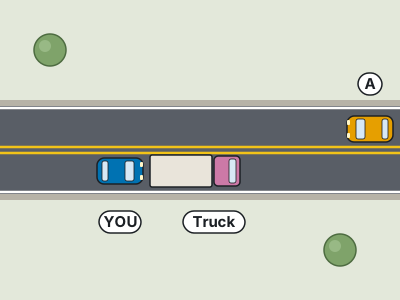
- The lines mark a center turn lane that may be used for extended travel
- Passing is permitted for traffic traveling in both directions
- Only vehicles next to the left line may pass slower traffic
- Passing is prohibited, although a driver may cross safely to turn into a driveway
Show answer
Passing is prohibited, although a driver may cross safely to turn into a driveway. Two solid yellow lines separate opposing traffic where passing is not allowed. The handbook makes a narrow distinction: a driver may cross the lines when it is safe to turn left into or out of a driveway or business entrance. That exception is a turning movement, not permission to overtake. A dashed line would allow a safe crossing for passing, and the shared center lane has a different marking pattern. Treat the double solid lines as a no-passing warning, then wait for a legal, visible opportunity elsewhere.
Study this in the handbook: Pavement markings
16. A second no insurance offense within five years requires proof for how long?
- One year of financial responsibility proof
- Five years of financial responsibility proof
- Three years of financial responsibility proof
- No proof if insurance is bought later
Show answer
Three years of financial responsibility proof. A first Idaho no insurance offense requires one year of financial responsibility proof. Committing a second offense inside a five year period raises that obligation to three years of continuous certified coverage. Picking "One year of financial responsibility proof" would keep the first offense one year term for a repeat violation Idaho treats more seriously. Count any repeat insurance lapse in dollars and years before deciding to risk driving uninsured again.
Study this in the handbook: DUI limits, penalties and test refusal
17. A 35 year old is convicted of a first DUI in Idaho. What license suspension does the handbook list?
- Exactly 30 days, with a work permit from day one
- One year with no driving privileges of any kind
- At least 90 days and up to 180 days, with no driving at all for the first 30 days
- Two years with no driving privileges of any kind
Show answer
At least 90 days and up to 180 days, with no driving at all for the first 30 days. For an adult's first DUI conviction the license suspension is mandatory and runs at least 90 days and up to 180 days, with absolutely no driving privileges for the first 30 days. Thirty days is only the no driving part, not the whole suspension, and no work permit is available during it. One year is the first offense suspension for a driver under 21. Two years is the under 21 suspension for a second conviction.
Study this in the handbook: Emergency vehicles and the move over law
18. May you drive between vehicles in a funeral procession?
- Not unless a police officer authorizes it
- Yes, if you signal before slipping between them
- Yes, when your exit is only a block away
- Only during daylight hours on wide highways
Show answer
Not unless a police officer authorizes it. Drivers must not drive between or join vehicles in a funeral procession unless authorized by a police officer. Procession vehicles run headlights and tail lights, with flashing warning lights marking the first and last cars. Picking "Yes, if you signal before slipping between them" would let a signal substitute for police authorization to break into a protected formation. Wait for the last vehicle with flashing lights to pass, then merge behind the procession respectfully.
Study this in the handbook: Passing and slow vehicles
19. You do not want to drive at freeway speed. What should you do?
- Use the freeway right lane well below speed
- Choose another kind of road
- Drive the shoulder so others can pass easily
- Enter only during overnight low traffic hours
Show answer
Choose another kind of road. Freeway flow depends on vehicles traveling near the posted speed. A driver who cannot or will not drive at that speed should choose another kind of road rather than create a rolling obstruction among faster traffic. Picking "Use the freeway right lane well below speed" would place a slow vehicle in the right lane indefinitely, forcing constant passing around it. Pick the parallel highway or frontage route when your vehicle or comfort cannot hold freeway pace.
20. What may happen to a non handicapped driver who parks in a reserved space?
- They receive a warning for a first stop
- They may be fined for the violation
- They may park free for under fifteen minutes
- They must display a note explaining the stop
Show answer
They may be fined for the violation. Spaces marked with the handicapped symbol are reserved for vehicles displaying that symbol on a plate or special card. Non handicapped drivers are prohibited from parking there and may be fined for violations, even briefly. A warning for a first stop would soften the ban into a courtesy notice that reserved space rules do not contain for anyone. Treat every marked accessible space as occupied by its intended user, even when it looks empty.
Study this in the handbook: Following distance, parking and backing
Every question is written from the official Idaho Driver's Handbook. Need paper? Printable ID practice test with answer key.
Last verified 2026-10-05. How we check every question · Study all 500 as flashcards
Frequently asked questions
How many questions are on this Idaho practice test?
This fixed set has 20 questions. It is test 21 of 25 from the 500 question Idaho bank. The real ID exam asks 40 questions and you need 34 correct.
What is the passing score for the real Idaho test?
34 of 40 correct; you can miss up to six questions before failing the test That figure comes from the official Idaho source cited on the DMV facts page.
How does this fixed test relate to the full Idaho bank?
Each numbered test is a fixed set of questions in a fixed order, so you can retake the same test later and compare. Every test mixes road signs and the other topics in about the same proportion as the full bank. Tests 1 to 25 together cover every question in the Idaho bank once. The full practice page mixes the whole bank at random.
Last verified 2026-10-05. See the Idaho DMV facts page for sourced state details.