
Test 3 of 10 · 20 questions · Free 2026
ID Permit Practice Test 3
Jump to the test ↓A fixed 20 question set from the Idaho bank with answers and plain English explanations. The real ID exam is 40 questions, 85 percent to pass; take the full length version on the main practice page.
Question 1 of 20 · 0 right so far
All 20 questions in test 3
Every question below comes from the Idaho question bank on this page. Open a question to see the correct answer and the explanation. Nothing here is hidden behind a signup.
1. Under Idaho's basic rule, which driving behavior can violate the law even when the vehicle is below the posted limit?
- Driving at the posted limit during clear weather
- Driving 5 mph below the limit on an empty road
- Driving slowly enough to impede the safe flow of traffic
- Driving below the limit while leaving extra space
Show answer
Driving slowly enough to impede the safe flow of traffic. Idaho treats speed as a safety judgment, not merely a comparison with a sign. A driver can violate the basic rule by moving so slowly that existing traffic cannot flow safely, even though the speedometer is below the limit. The choice “Driving 5 mph below the limit on an empty road” changes the rule into a five mile per hour threshold that the handbook never creates. Watch the traffic behind you, the surface, visibility, intersections, and other hazards, then choose a speed that remains reasonable and prudent for the whole situation.
Study this in the handbook: Speed limits and the basic rule
2. When may a pedestrian have to yield to a motor vehicle?
- Whenever the pedestrian is walking more slowly than traffic
- Whenever the driver sounds the horn first
- Only when the pedestrian is outside a city
- When crossing where there is no crosswalk or intersection, or when directed by a traffic signal
Show answer
When crossing where there is no crosswalk or intersection, or when directed by a traffic signal. Idaho lists two circumstances in which a pedestrian must yield to motor vehicles: crossing a street where there is no crosswalk or intersection, and being directed to yield by a traffic signal at an intersection or crosswalk. The horn choice invents a condition that does not change right-of-way. City limits do not determine the rule, and walking slowly has no such legal effect. Still scan carefully, because a driver must respond to pedestrians who enter unexpectedly and may need to stop even when the person has technically yielded.
Study this in the handbook: Yielding to pedestrians and funeral processions
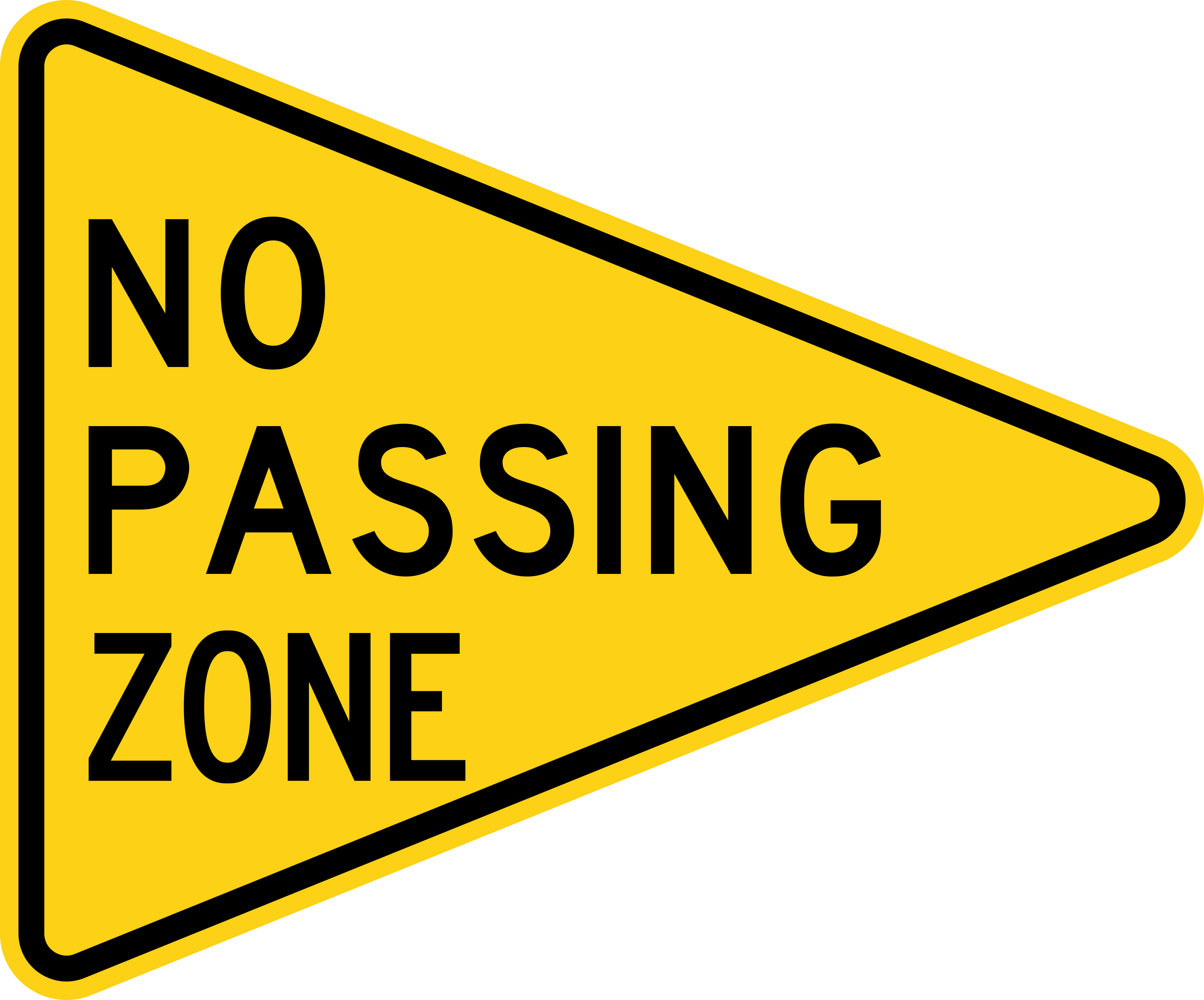
3. Where is the pennant-shaped No Passing Zone sign placed, and what does it warn?
- On the right side, marking a permitted passing section
- On the left side, warning that passing is prohibited for your lane
- Above the road, identifying a mandatory truck route
- At the shoulder, showing that a bridge is open to bicycles only
Show answer
On the left side, warning that passing is prohibited for your lane. Idaho uses the unusual pennant shape for a No Passing Zone warning. It is placed on the left side of the road or highway and reinforces a Do Not Pass sign or pavement marking for your lane. The right-side choice reverses the handbook's placement and changes the meaning to permission. The truck-route and bicycle-bridge choices refer to facilities, not passing control. When the pennant appears, stay in your lane and wait for a legal, visible opportunity beyond the restricted area.
Study this in the handbook: Warning signs
4. Two vehicles reach a four-way stop at exactly the same time. Which driver must yield?
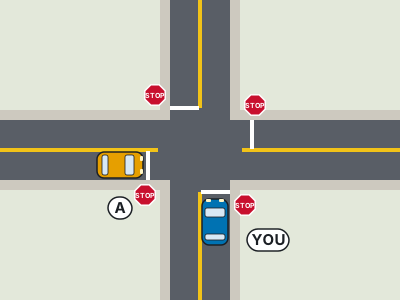
- The driver on the left yields to the driver on the right
- The driver on the right yields to the driver on the left
- The driver turning left always goes first
- The larger vehicle has priority
Show answer
The driver on the left yields to the driver on the right. When arrival is simultaneous at a four way stop, the vehicle on the left must yield to the vehicle on the right. The handbook states this tie breaking rule without any exception for vehicle size or for the direction a driver plans to go. Turning left does not earn the first move; elsewhere the handbook tells a driver making a left turn to yield to oncoming traffic. The reversed version, in which the right vehicle yields, is the opposite of the rule. Stop completely, compare positions, and let the vehicle on the right proceed first.
Study this in the handbook: Right of way between drivers
5. In an unfenced open range area, what does Idaho's warning sign say about livestock?
- Livestock have the right-of-way and may roam freely
- Livestock must remain behind a fence at all times
- Only wild animals may enter the highway
- Drivers automatically receive payment for any collision
Show answer
Livestock have the right-of-way and may roam freely. Idaho's Open Range warning identifies an area where livestock have the right-of-way and are allowed to roam without fencing. That warning changes the driver's expectation: animals may be on or near the roadway, and a driver must reduce risk rather than assume a fence will keep them away. The payment choice invents a guarantee that the sign does not provide. Slow down, scan the shoulders, and be prepared for an animal to move unpredictably.
Study this in the handbook: Mountains, open range and winter driving
6. How often may an Idaho driver use an approved course to remove points from a driving record?
- Once every year
- Once every five years
- As often as the driver completes a course
- Once every three years
Show answer
Once every three years. Idaho lets a driver remove points by completing either a Defensive Driving Course or a Traffic Safety Education Course, but only once every three years. A yearly option is more frequent than the rule allows, and five years is longer than the stated limit. Repeating courses back to back does not keep erasing points. Both courses remove points only, not the conviction.
Study this in the handbook: Points, suspensions and reinstatement
7. What is Idaho's minimum recommended following-distance procedure?
- Use at least three seconds, adding more time at high speeds or in bad weather
- Keep exactly one second behind the vehicle ahead in all conditions
- Stay within one car length whenever traffic is moving
- Match the vehicle ahead's speed and ignore the road surface
Show answer
Use at least three seconds, adding more time at high speeds or in bad weather. The three-second rule gives a driver a practical minimum gap for reacting to a sudden stop. At higher speeds or in bad weather, the handbook calls for increasing that interval because traction and stopping conditions can worsen. The one-second and one-car-length choices remove needed reaction space, while matching speed alone says nothing about distance. Pick a fixed object, count after the lead vehicle passes it, and enlarge the gap when conditions become demanding.
Study this in the handbook: Following distance, parking and backing
8. When facing a steady yellow circular light and able to stop safely, what should a driver do?
- Stop before entering the intersection
- Speed up and enter before the red light appears
- Continue at the same speed because yellow means go
- Back up if already inside the intersection
Show answer
Stop before entering the intersection. A steady yellow circular indication warns that the signal is about to change to red. If the driver has not entered the intersection and can make a safe stop, stopping is the appropriate response. Accelerating turns a warning into a race with the signal, and continuing automatically ignores the caution. A vehicle already in the intersection should clear it safely, so backing up is also unsafe. Look ahead early enough to stop smoothly rather than braking at the line.
Study this in the handbook: Traffic signals
9. Which category is explicitly listed among Idaho's traffic sign types?
- Warning signs
- All of these categories
- Work zone signs
- Guide signs
Show answer
All of these categories. The handbook lists regulatory, warning, work zone, guide, and other signs as traffic sign types, so every category named in the choices “Warning signs”, “Guide signs” and “Work zone signs” belongs on that list. The broader answer captures the full set presented by the question. A warning sign concerns an unexpected condition, a guide sign supplies travel or service information, and a work zone sign marks road work conditions. Learn each category by its colors, shapes, messages, and symbols so you can identify its purpose before reaching it.
Study this in the handbook: Regulatory and work zone signs
10. When must a driver report a motor vehicle crash to police under the Idaho handbook rule?
- Only when every vehicle involved cannot be driven
- When someone is injured or property damage exceeds $1,500
- Only when the crash occurs on an interstate
- Whenever a driver receives a traffic citation at the scene
Show answer
When someone is injured or property damage exceeds $1,500. Idaho requires a police report when a motor vehicle crash causes an injury or more than $1,500 in property damage. The rule is not limited to interstate crashes, and a vehicle does not have to be disabled before reporting becomes mandatory. A citation is also not the trigger. In addition to calling for police and medical help as soon as possible, involved drivers must exchange identifying, license, witness, and insurance information. Remember the threshold and the injury condition when deciding what to do after impact.
Study this in the handbook: Crashes and the law
11. How long after moving to Idaho must a new resident apply for an Idaho driver's license?
- Within 60 days of moving household goods
- Within 10 days of signing a lease
- Within 30 days of residing in Idaho
- By the next license renewal date
Show answer
Within 30 days of residing in Idaho. A person who moves to Idaho must apply for an Idaho driver's license within 30 days of residing there. The deadline is tied to residence, not to signing a lease, transporting belongings, or the expiration of an out-of-state credential. The handbook expressly says the rule applies whether the other license has expired or not. A new resident should treat the 30-day period as the planning window for the county licensing process and required documents.
Study this in the handbook: Driver training and instruction permits
12. After a first failure administrative license suspension ends in Idaho, how long must an ignition interlock be installed on any vehicle the driver drives?
- 30 days
- One year
- 90 days
- Five years
Show answer
One year. After a first failure of an evidentiary test, the driver serves a 90 day suspension and then must have an ignition interlock on any vehicle driven for one year after the suspension ends. Thirty days is the no driving part of the suspension, and 90 days is the whole suspension, not the interlock period. Five years is the look back window for a second test failure. The driver pays the interlock installation and monthly fees.
Study this in the handbook: DUI limits, penalties and test refusal
13. How many supervised driving hours must be completed at night during Idaho's GDL period?
- 5 hours
- 10 hours
- 15 hours
- 20 hours
Show answer
10 hours. The GDL supervised period requires at least 50 hours of driving time, with 10 of those hours at night. The nighttime portion is included within the total, rather than added on top of 50. Five, 15, and 20 hours are not the handbook's specified nighttime figure. When recording practice, a family should track both the overall total and the night subset so that reaching 50 daytime-heavy hours does not leave the separate night requirement unfinished.
Study this in the handbook: Graduated Driver's License rules
14. What problem is tailgating most directly associated with in the Idaho handbook?
- It is a common cause of crashes because it leaves too little room to stop
- It improves fuel economy by reducing air resistance behind another vehicle
- It gives the following driver priority to pass at an intersection
- It makes braking safer when the road is wet or icy
Show answer
It is a common cause of crashes because it leaves too little room to stop. Tailgating means driving too close to the vehicle ahead, leaving inadequate space to respond if traffic slows or stops. Idaho identifies it as a common cause of crashes and says the driver must leave enough room to stop in any situation. Wet, icy, or snowy pavement makes the shortage of space more dangerous, not safer. Following closely also does not create a passing right or a traffic priority. Use a fixed object and the three-second count to measure a usable gap, then enlarge it when conditions worsen.
Study this in the handbook: Passing and slow vehicles
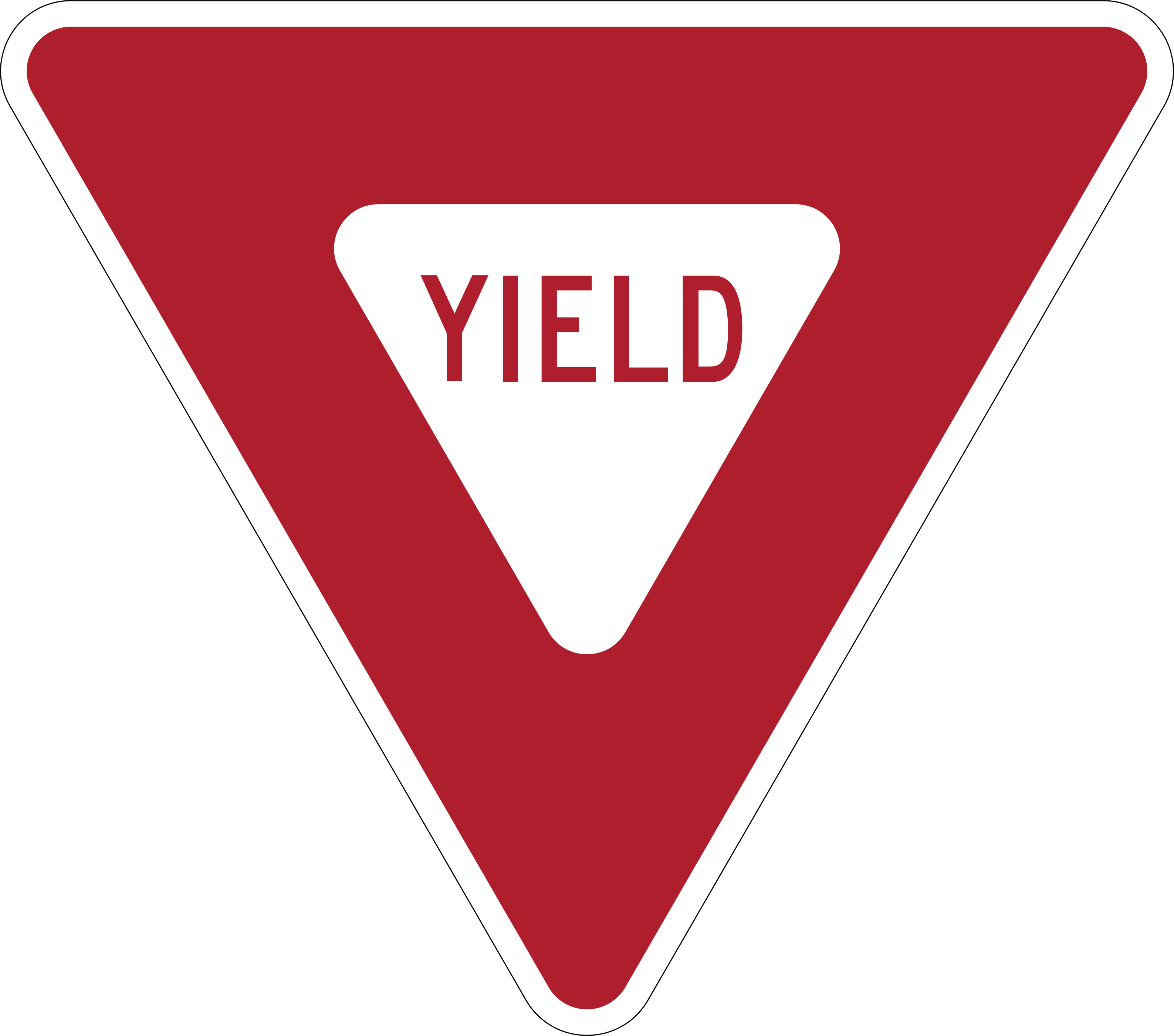
15. What does an Idaho yield sign require when a driver approaches an intersection or highway?
- Accelerate to enter before other traffic
- Slow down and yield to vehicles and pedestrians
- Stop every time even when the way is clear
- Yield only to vehicles, never to pedestrians
Show answer
Slow down and yield to vehicles and pedestrians. A yield sign requires a driver to slow down and give the right-of-way to vehicles and pedestrians in the intersection being crossed or the highway being entered. A complete stop may be necessary when traffic or people make it unsafe to continue, but stopping every time is broader than the sign’s basic instruction. Accelerating defeats the purpose of yielding, and pedestrians are expressly included. Approach with enough control to stop if needed, scan both directions, and proceed only after the crossing path is clear.
Study this in the handbook: Regulatory and work zone signs
16. Is beer safer than hard liquor, according to the Idaho handbook?
- Yes, beer has far less alcohol
- Yes, wine is the only strong drink
- No, a 1.5 ounce jigger of liquor, five ounces of wine and 12 ounces of beer each contain about an ounce of alcohol
- Only light beer is safer
Show answer
No, a 1.5 ounce jigger of liquor, five ounces of wine and 12 ounces of beer each contain about an ounce of alcohol. A jigger, 1.5 ounces, of 80 proof hard liquor, five ounces of table wine, or 12 ounces of beer all contain approximately the same amount of alcohol, about an ounce each, and studies found the greatest share of people arrested for DUI had been drinking beer. Alcohol passes directly into the blood, and only time removes it, so the container does not matter.
Study this in the handbook: Administrative suspension and how alcohol affects you
17. A School Crossing warning sign is ahead. Which response matches Idaho guidance?
- Pass any vehicle that slows near the sign before reaching the crossing
- Maintain speed unless a child is already in your lane
- Stop in the crosswalk to improve visibility for approaching children
- Watch for children, reduce speed, and obey crossing guard signals
Show answer
Watch for children, reduce speed, and obey crossing guard signals. The school crossing warning calls for active observation and a lower approach speed, not waiting until a child occupies the lane. Crossing guard signals also control the movement and must be obeyed. Stopping in the crosswalk blocks the very space children need, while passing a slowing vehicle can hide a child or guard from view. Use the sign as an early cue to scan sidewalks and the crossing, cover the brake, and leave room to stop before the marked area.
Study this in the handbook: Warning signs
18. Under Idaho law, which children must be properly protected in approved child car safety seats in a non-commercial vehicle?
- Only children who weigh less than 40 pounds
- Only children younger than 2 years of age
- Children younger than 13 years only when seated in front
- Children 6 years of age or younger
Show answer
Children 6 years of age or younger. Idaho requires anyone carrying children age 6 or younger in a non-commercial motor vehicle to properly protect them in approved child car safety seats. The rule is not limited to toddlers, a front-seat situation, or a particular weight threshold. The handbook also recommends reading the seat and vehicle instructions for height and weight limits, but those recommendations do not replace the legal age scope. Before driving, secure the child snugly, attach the seat correctly, and use the restraint on every trip.
Study this in the handbook: Required equipment, seat belts and child seats
19. How quickly can a small stream become dangerous in an Idaho flash flood, according to the handbook?
- It takes hours to rise
- It rarely exceeds 6 inches
- It can swell to over 12 inches deep and 80 feet wide in less than five minutes
- Streams do not flood in Idaho
Show answer
It can swell to over 12 inches deep and 80 feet wide in less than five minutes. Flash floods follow intense rain in a short time, often during or right after a severe thunderstorm, and small streams a few feet wide and a few inches deep can swell to over 12 inches deep and 80 feet wide in less than five minutes. Six inches of fast water can knock you down, and two feet can wash a vehicle away, so never drive into flooded roads.
Study this in the handbook: Night, fog, rain and flash floods
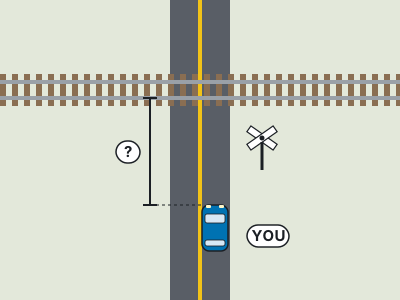
20. How far from the nearest rail should you stop when a railroad crossing requires a stop?
- Only after the front bumper reaches the crossing gate
- Exactly 5 feet from the first rail
- At least 100 feet and never closer
- Within 50 feet but no less than 15 feet
Show answer
Within 50 feet but no less than 15 feet. At a required railroad stop, the handbook gives a range that protects the vehicle from the track while keeping the driver close enough to observe the crossing. Stop within 50 feet, but no less than 15 feet from the nearest rail. Five feet is dangerously close, and 100 feet may place the vehicle too far back for the stated rule. Never wait with any part of the vehicle on the track. Look and listen, then proceed only when the crossing is safe.
Study this in the handbook: Railroad crossings and roundabouts
QualitySpace is expanding to Idaho
We are a California-based independent insurance brokerage working on licensing in more states. We cannot help with Idaho insurance yet. Leave your email and we will let you know when we can.
Every question is written from the official Idaho Driver's Handbook. Need paper? Printable ID practice test with answer key.
Last verified 2026-10-05. How we check every question · Study all 215 as flashcards
Frequently asked questions
How many questions are on this Idaho practice test?
This fixed set has 20 questions. It is test 3 of 10 from the 215 question Idaho bank. The real ID exam asks 40 questions and you need 34 correct.
What is the passing score for the real Idaho test?
34 of 40 correct; you can miss up to six questions before failing the test That figure comes from the official Idaho source cited on the DMV facts page.
How does this fixed test relate to the full Idaho bank?
Each numbered test is a fixed set of questions in a fixed order, so you can retake the same test later and compare. Every test mixes road signs and the other topics in about the same proportion as the full bank. Tests 1 to 10 together cover 200 of the 215 questions in the Idaho bank, each once. The full practice page mixes the whole bank at random.
Last verified 2026-10-05. See the Idaho DMV facts page for sourced state details.