
Test 1 of 10 · 20 questions · Free 2026
ID Permit Practice Test 1
Jump to the test ↓A fixed 20 question set from the Idaho bank with answers and plain English explanations. The real ID exam is 40 questions, 85 percent to pass; take the full length version on the main practice page.
Question 1 of 20 · 0 right so far
All 20 questions in test 1
Every question below comes from the Idaho question bank on this page. Open a question to see the correct answer and the explanation. Nothing here is hidden behind a signup.
1. What should you do on seeing a steady yellow circular traffic indication before entering the intersection?
- Stop safely if you have not entered the intersection
- Accelerate because yellow guarantees extra crossing time
- Treat it as permission to turn without checking traffic
- Stop only if a pedestrian is visible
Show answer
Stop safely if you have not entered the intersection. A steady yellow circular light warns that the signal is about to change to red. If you have not entered the intersection and can make a safe stop, stop rather than accelerating to beat the change. Yellow is not a promise of extra crossing time and does not remove the need to check for pedestrians or other traffic. If you are already inside, continue moving and clear the intersection safely. The key decision is whether you can stop safely before entering.
Study this in the handbook: Traffic signals
2. Who may attend Idaho's Alive at 25 defensive driving course?
- Drivers over 65
- Only drivers with a DUI
- Drivers who are 15 through 24 years old
- Only commercial drivers
Show answer
Drivers who are 15 through 24 years old. Alive at 25 is a defensive driving course offered for those who are 15 through 24 years old, presented by law enforcement with traffic safety strategies for young drivers who are over represented in crash statistics. The course emphasizes responsible choices and decision making while driving or riding as a passenger. It is not built for older drivers, DUI offenders, or commercial drivers, and registration is through the course website.
Study this in the handbook: Defensive driving, distractions and fatigue
3. A driver stops on the highway because the vehicle has stalled. Which action helps other drivers see it?
- Leave the vehicle unmarked with the hood closed
- Stand in the travel lane and wave vehicles around
- Park just beyond a hill so approaching traffic cannot react
- Turn on the emergency flashers and lift the hood
Show answer
Turn on the emergency flashers and lift the hood. For a stalled vehicle, Idaho advises pulling completely off the road when possible, turning on the emergency flashers, and lifting the hood so approaching drivers recognize the problem. Parking beyond a hill reduces sight distance, and standing in a live lane creates a personal hazard. Leaving the car unmarked removes useful warning information. The cue is visibility: get out of traffic, activate the vehicle's warning system, and make the problem apparent from behind.
Study this in the handbook: Skids, emergency braking and car trouble
4. How should a driver respond to a flashing yellow circular traffic signal?
- Stop and remain stopped until a green light appears
- Treat it as a flashing red signal and yield after stopping
- Accelerate because cross traffic must stop
- Slow down, check carefully for hazards, and proceed with caution
Show answer
Slow down, check carefully for hazards, and proceed with caution. A flashing yellow circular indication is a caution signal, so the driver should reduce speed, scan for conflicts, and continue only when the path is safe. It does not impose the complete stop required by a flashing red indication. The tempting red-signal choice changes the meaning of the light and could cause an unnecessary stop, while accelerating removes the time needed to spot a hazard. Use the signal as a prompt to look carefully, especially for vehicles, pedestrians, or road conditions that are not immediately obvious.
Study this in the handbook: Traffic signals
5. On the main road, what does the pictured merging-traffic warning tell the driver to anticipate?

- A prohibition on allowing another vehicle ahead
- A lane that ends before any vehicles can join
- Other cars and trucks entering the driver's lane
- A mandatory turn into the nearest side street
Show answer
Other cars and trucks entering the driver's lane. The merging-traffic warning is directed at a driver on the main road and signals that other cars or trucks may enter that lane. The response is to watch the joining traffic, maintain room, and adjust speed or position safely as needed. It does not prohibit a merge, require a side-street turn, or say that the lane ends. Check mirrors and the adjacent area early so a vehicle entering from the side is not discovered at the last moment.
Study this in the handbook: Warning signs
6. What roadway feature is beginning where the pictured Divided Highway Begins sign appears?

- The road will become a railroad crossing
- All lanes will change to one-way travel without separation
- A center strip will separate opposing traffic
- The shoulder will become a mandatory passing lane
Show answer
A center strip will separate opposing traffic. The Divided Highway Begins warning means the two-way traffic ahead will be separated by a center strip. Drivers should anticipate the median and remain on the side appropriate to their direction of travel. It does not mean opposing traffic will share one undivided lane, nor does it create a railroad crossing or authorize shoulder passing. Look for the physical separation as the roadway changes and follow the lane markings around the new division.
Study this in the handbook: Warning signs
7. You are already in an intersection when a circular signal changes from yellow toward red. What should you do?
- Stop immediately in the intersection and wait for the next green light
- Continue moving and clear the intersection safely
- Continue through without checking for cross traffic because the light changed
- Accelerate into the cross street before the red indication appears
Show answer
Continue moving and clear the intersection safely. The handbook separates entering from clearing an intersection. If the driver has not entered and can make a safe stop, stopping is appropriate for a yellow circular indication. Once the vehicle is already inside, the driver should continue moving and clear the intersection safely. Stopping in the middle blocks other road users, and clearing it still means watching for cross traffic rather than driving through blindly. Accelerating into the cross street is not the controlled clearing the handbook describes. The practical cue is your location when the signal changes.
Study this in the handbook: Traffic signals
8. What category does the pictured curved-arrow sign represent?

- A motorist-service sign
- A guide sign
- A warning sign
- A regulatory parking sign
Show answer
A warning sign. The pictured curved arrow is presented as a warning sign, a category used to alert drivers to an unexpected condition ahead. Warning signs help a driver prepare for a hazard or roadway change before reaching it. A guide sign gives route or destination information, a motorist-service sign identifies facilities, and a parking regulation controls where a vehicle may stand. The yellow diamond shape is the useful visual cue here. After recognizing the category, look for the specific road condition and adjust speed or position as needed.
Study this in the handbook: Warning signs
9. When approaching a stopped emergency vehicle with flashing lights, what must you do on a multilane road?
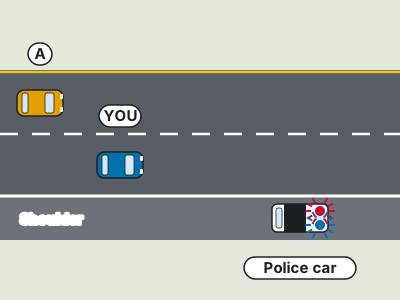
- Keep the posted speed and pass in the lane closest to the vehicle
- Reduce below the posted speed and change to a nonadjacent lane when safe
- Stop directly behind the emergency vehicle until its lights turn off
- Move onto the shoulder and continue at the same speed
Show answer
Reduce below the posted speed and change to a nonadjacent lane when safe. For a stopped emergency vehicle, Idaho requires an immediate reduction below the posted speed limit and cautious travel. On a road with at least two lanes moving in the same direction, the driver must also move into a lane that is not adjacent when doing so is safe. The close-lane choice leaves the greatest exposure. A full stop behind the vehicle and a same-speed shoulder maneuver are not the stated response. Check mirrors, signal, create space, and pass carefully.
Study this in the handbook: Emergency vehicles and the move over law
10. Which description matches an Idaho regulatory sign rather than a warning sign?
- It uses white on green to show direction and distance
- It is always a black symbol on a yellow diamond warning of a hazard
- It generally uses black and white, or red and white, to state a rule
- It uses white on brown to identify a scenic or historic point
Show answer
It generally uses black and white, or red and white, to state a rule. Regulatory signs communicate rules drivers must follow and are generally black and white, although some are red and white. Yellow diamond signs instead warn about unexpected conditions. White on green is used for directional and distance guide information, while white on brown identifies cultural, historical, or scenic points of interest. Color is not a substitute for reading the message, but it gives a useful first cue. When you see the regulatory color family, look for the required action or restriction and comply before proceeding.
Study this in the handbook: Regulatory and work zone signs
11. How soon must an Idaho driver complete a point reduction course accepted at the time of citation?
- Within one year
- Within 10 days
- There is no deadline
- Within 45 days of the citation
Show answer
Within 45 days of the citation. For points to be removed, the course must be offered by law enforcement and accepted by the driver at the time of citation, and it must be completed within 45 days of the citation. The points removed match the points on that citation. Idaho assigns one to four points per moving violation, and approved courses are listed on the DMV website.
Study this in the handbook: Points, suspensions and reinstatement
12. What minimum following-distance procedure does the Idaho handbook recommend?
- Follow closely whenever your brakes have recently been tested
- Keep exactly one car length behind the vehicle ahead
- Allow two seconds in rain because wet roads require slower traffic
- Use a three-second gap, increasing it at high speeds or in bad weather
Show answer
Use a three-second gap, increasing it at high speeds or in bad weather. Idaho describes three seconds as the minimum recommended safest following procedure. Choose a fixed object, watch the vehicle ahead pass it, and count before your own vehicle reaches that object. Higher speeds and bad weather require a longer interval because traction, visibility, and stopping distance can worsen. One car length changes dramatically with speed and is not a reliable measure. A recent brake check does not remove the need for space. Use the three-second count as a routine check, then add time when conditions deteriorate.
Study this in the handbook: Following distance, parking and backing
13. At a four-way stop, which vehicle goes first when it arrived noticeably before the others?
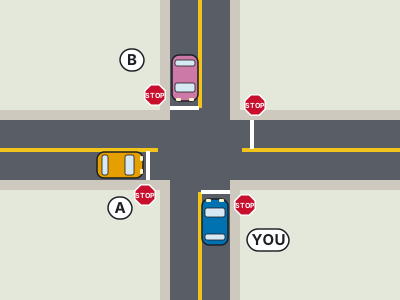
- The first vehicle to arrive
- The vehicle on the right even if it arrived later
- The vehicle going straight
- The largest vehicle
Show answer
The first vehicle to arrive. At a four-way stop, Idaho gives priority to the first vehicle that arrives. The right-side rule becomes important when two vehicles arrive at the same time, not when one vehicle clearly got there first. The straight-ahead and largest-vehicle choices have no general priority under this rule. Approach every stop fully, note the order of arrival, and proceed only after yielding to any vehicle that reached the intersection earlier.
Study this in the handbook: Right of way between drivers
14. How should drivers handle an intersection when a traffic signal is completely dark because of a power outage?
- Treat it as a two-way stop
- Treat it as a four-way stop
- Proceed without yielding because the signal is off
- Wait for a police officer before any vehicle may move
Show answer
Treat it as a four-way stop. A dark signal removes the normal signal directions, so drivers must use stop-control judgment rather than treating the intersection as uncontrolled. The practical response is to handle it like a four-way stop, stopping and yielding in the ordinary order. The choice “Proceed without yielding because the signal is off” is unsafe because a failed signal does not grant free passage. Approach slowly, account for every direction, and make sure the intersection is clear before moving through it.
Study this in the handbook: Traffic signals
15. How does an Idaho Administrative License Suspension relate to criminal DUI penalties?
- It begins only after a criminal conviction
- It replaces the criminal case after a failed test
- It applies only to commercial drivers
- It is a separate civil penalty from criminal penalties imposed by a court
Show answer
It is a separate civil penalty from criminal penalties imposed by a court. An ALS is an Idaho Transportation Department action tied to failure of an evidentiary test over the legal limit. The handbook describes it as a civil penalty that is separate from criminal penalties imposed through the court system. The conviction-only choice is wrong because the suspension process does not wait for the criminal case to finish. A driver receiving an ALS must meet its requirements and still appear in court for the separate DUI charges.
Study this in the handbook: Administrative suspension and how alcohol affects you
16. How many hours of classroom instruction are required in an approved Idaho Driver Training program?
- 30 hours
- 20 hours
- 6 hours
- 50 hours
Show answer
30 hours. An approved Idaho Driver Training program includes 30 hours of classroom instruction. That number is separate from the six hours of in-car observation and six hours of behind-the-wheel practice also listed in the program description. The 50-hour figure belongs to supervised driving under the GDL program, while 20 hours is not the classroom requirement in this passage. Keeping the three training totals separate prevents a common mix-up: classroom is 30, each in-car component is 6.
Study this in the handbook: Driver training and instruction permits
17. A 17 year old with an Idaho Class D Instruction Permit may practice driving only when accompanied by whom?
- An adult 18 or older who holds a valid driver's license
- Any passenger 16 or older
- A certified driver training instructor and no one else
- Any adult, licensed or not
Show answer
An adult 18 or older who holds a valid driver's license. The Class D Instruction Permit lets an applicant 17 or older practice for one year when accompanied by an adult, meaning someone 18 or older, who holds a valid driver's license. A 16 year old passenger is not an adult under this rule. The permit is not limited to a driver training instructor. An unlicensed adult does not qualify because the companion must hold a valid license. Do not confuse this with the GDL supervised period for drivers under 17, where the supervising driver must be at least 21.
Study this in the handbook: Driver training and instruction permits
18. How much tread should each Idaho vehicle tire have?
- At least 1/32 of an inch
- At least 2/32 of an inch
- At least 4/32 of an inch
- At least 6/32 of an inch
Show answer
At least 2/32 of an inch. The handbook says each tire should have at least 2/32 of an inch of tread, and the skills test vehicle check uses the same 2/32 figure. One thirty second is below that minimum, while four and six thirty seconds are not the stated benchmark. A driver checking the car should inspect every tire rather than relying on the appearance of one good tire. The handbook also advises replacing tires as soon as they become worn to reduce the chances of hydroplaning on wet roads.
Study this in the handbook: Required equipment, seat belts and child seats
19. After an Idaho officer serves a notice of administrative license suspension for a failed test, how long does the driver have to request a hearing?
- Within 7 days of the date on the notice
- Within 30 days of the date on the notice
- Within 45 days of the arrest
- Only after the criminal DUI case ends
Show answer
Within 7 days of the date on the notice. An Idaho driver who fails an evidentiary test can request an administrative hearing within seven days of the date on the notice of suspension. Thirty days is when the suspension takes effect, not the hearing deadline. Forty five days is the deadline for finishing a Traffic Safety Education Course after a citation. The administrative suspension is separate from the criminal case, so the hearing does not wait for the court.
Study this in the handbook: Points, suspensions and reinstatement
20. When passing on a two lane road in Idaho, you must complete the pass before coming within how many feet of oncoming traffic?
- 50 feet
- 200 feet
- 100 feet
- 500 feet
Show answer
200 feet. The handbook says to complete a pass before coming within 200 feet of oncoming traffic. One hundred feet is the no passing distance near an intersection, railroad crossing, or obstructed bridge or tunnel. Fifty feet leaves far too little room at highway speeds. Five hundred feet is the high beam dimming distance before meeting a vehicle, not the passing rule.
Study this in the handbook: Passing and slow vehicles
QualitySpace is expanding to Idaho
We are a California-based independent insurance brokerage working on licensing in more states. We cannot help with Idaho insurance yet. Leave your email and we will let you know when we can.
Every question is written from the official Idaho Driver's Handbook. Need paper? Printable ID practice test with answer key.
Last verified 2026-10-05. How we check every question · Study all 215 as flashcards
Frequently asked questions
How many questions are on this Idaho practice test?
This fixed set has 20 questions. It is test 1 of 10 from the 215 question Idaho bank. The real ID exam asks 40 questions and you need 34 correct.
What is the passing score for the real Idaho test?
34 of 40 correct; you can miss up to six questions before failing the test That figure comes from the official Idaho source cited on the DMV facts page.
How does this fixed test relate to the full Idaho bank?
Each numbered test is a fixed set of questions in a fixed order, so you can retake the same test later and compare. Every test mixes road signs and the other topics in about the same proportion as the full bank. Tests 1 to 10 together cover 200 of the 215 questions in the Idaho bank, each once. The full practice page mixes the whole bank at random.
Last verified 2026-10-05. See the Idaho DMV facts page for sourced state details.