
Test 6 of 10 · 20 questions · Free 2026
ID Permit Practice Test 6
Jump to the test ↓A fixed 20 question set from the Idaho bank with answers and plain English explanations. The real ID exam is 40 questions, 85 percent to pass; take the full length version on the main practice page.
Question 1 of 20 · 0 right so far
All 20 questions in test 6
Every question below comes from the Idaho question bank on this page. Open a question to see the correct answer and the explanation. Nothing here is hidden behind a signup.
1. Which Idaho vehicles must have flashing electric turn signals?
- All vehicles regardless of age
- Only vehicles built after 1980
- Only commercial vehicles
- All motor vehicles built after January 1, 1955, visible from 100 feet front and rear
Show answer
All motor vehicles built after January 1, 1955, visible from 100 feet front and rear. All motor vehicles built after January 1, 1955 must have flashing electric left and right turn signals on the front and rear, visible from 100 feet, with a driver controlled switch. Brake lights must be red or amber and visible 100 feet to the rear in sunlight, vehicles built before 1956 and motorcycles need at least one red rear light, and trailers need two red rear lights visible from 500 feet.
Study this in the handbook: Required equipment, seat belts and child seats
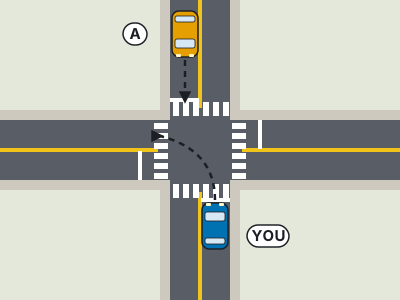
2. When making a left turn, which traffic must you yield to unless a device directs otherwise?
- No traffic because the turning vehicle has priority
- Only vehicles stopped behind you
- Vehicles approaching from the same direction only
- Oncoming traffic in the intersection
Show answer
Oncoming traffic in the intersection. A left turn crosses the path of vehicles coming toward you, so the turning driver must wait for that traffic to clear. The rule also allows a traffic-control device to direct a different movement, which is why a protected arrow can change the situation. Cars behind you are not the primary conflict, and traffic traveling with you does not describe the opposing path. Do not enter the turn merely because your signal is on. Signal, check the intersection, yield to approaching vehicles, and turn only when the crossing movement is safe.
Study this in the handbook: Passing and slow vehicles
3. After stopping at a steady red light, when may a driver generally turn right?
- After yielding to cross-traffic, unless a sign prohibits the turn
- Whenever the driver has waited at least five seconds
- Before stopping, if no pedestrian is visible
- Only when a green arrow appears, even if no restriction is posted
Show answer
After yielding to cross-traffic, unless a sign prohibits the turn. Idaho permits a right turn at a steady red light after the driver stops and yields to cross-traffic, unless the location is posted otherwise. The stop is a prerequisite, not an optional courtesy, and the driver must still check pedestrians and other road users before moving. A timed wait does not create permission, and an empty-looking crosswalk does not justify rolling through the red. Look for a no-turn-on-red sign, stop behind the line, yield, and turn only when the path is clear.
Study this in the handbook: Stopping at red lights and pedestrian beacons
4. What should a driver never do when approaching someone riding a horse?
- Stop if necessary to prevent a hazard
- Slow down before passing
- Allow plenty of room
- Sound the horn
Show answer
Sound the horn. Idaho warns drivers never to sound the horn near a horseback rider because the noise may frighten the horse and cause an accident. The other actions are protective responses described for approaching or passing a rider: reduce speed, leave ample space, and stop if needed when the rider is struggling to control the animal. A horn may seem like a useful warning, but it can trigger a sudden and dangerous reaction. Approach quietly, give the rider room, and be prepared to wait until the roadway is safe.
Study this in the handbook: Pedestrians, children, horses and bicyclists
5. How far before a turn or lane change must a signal begin in a business or residential area?
- Only after the front wheels begin turning
- At least 25 feet before the movement
- At least 100 feet before the movement
- Exactly five seconds before the movement in every area
Show answer
At least 100 feet before the movement. Idaho requires a turn signal to start at least 100 feet before a turn or lane change in a business or residential area. On freeways or highways, the handbook uses a five-second measure instead, so the location matters. Waiting until the wheels begin turning gives other road users no useful advance notice, and 25 feet is shorter than the stated urban distance. Signal before the decision point, keep the signal active through the movement, and cancel it after the vehicle is established in its new path.
Study this in the handbook: Turns, signals and U turns
6. How far does a 150 car freight train at 50 mph need to stop, according to the Idaho handbook?
- 7,000 feet, about 1 and 1/3 miles
- 500 feet
- One car length
- 10 miles
Show answer
7,000 feet, about 1 and 1/3 miles. The stopping distance for a 150 car freight train traveling 50 miles per hour is 7,000 feet, or 1 and 1/3 miles, and the chance of death or serious injury in a collision between a train and a motor vehicle is 40 times greater than for other highway crashes. It is up to you to protect your passengers at a crossing: slow, look both ways, and never start across unless you can clear the tracks.
Study this in the handbook: Pavement markings
7. During daytime fog that reduces vision to 500 feet or less, which lights are required?
- Parking lights only, because headlights create too much glare
- Headlights, with low beams preferred
- High beams only, regardless of surrounding traffic
- Emergency flashers while continuing at normal speed
Show answer
Headlights, with low beams preferred. Idaho requires headlights during the daytime when vision is reduced to 500 feet or less, and recommends low beams in those conditions. Parking lights do not provide the required forward lighting. High beams can worsen glare and are not the universal choice, while moving with emergency flashers can make other drivers think the vehicle is stopped. Reduce speed, turn on low beams early, and pull off the road if visibility becomes too poor to continue safely.
Study this in the handbook: Mountains, open range and winter driving
8. What does a no-passing-zone pennant sign warn a driver about?
- A lane reserved for buses during peak hours
- A mandatory detour around a closed bridge
- A no-passing zone for the driver's lane
- A minimum speed requirement for the roadway
Show answer
A no-passing zone for the driver's lane. The pennant-shaped sign is placed on the left side of the road and warns that the driver's lane is in a no-passing zone. It may appear with a Do Not Pass sign or matching pavement markings. The other choices describe lane use, closure, or speed controls that the pennant does not communicate. When you see this shape, stay behind the vehicle ahead and wait for a lawful, visible passing opportunity beyond the restricted area.
Study this in the handbook: Warning signs
9. How long is an Idaho Driver Training Permit valid for a holder who is 17 1/2 or older?
- 6 months, or 180 days
- One year
- Two years
- 30 days
Show answer
6 months, or 180 days. A Driver Training Permit held by someone 17 and a half years of age or older expires after 6 months, or 180 days, while a younger teen's Driver Training Permit expires 5 days after the 18th birthday. While a teen is enrolled in a driver training program, the permit is valid only to operate a vehicle with a driver training instructor. One year is the practice period for a separate Class D Instruction Permit, two years is far longer than the stated period, and 30 days is far shorter than 180 days.
Study this in the handbook: Driver training and instruction permits
10. What equipment must an Idaho vehicle use to keep the windshield clear of rain, snow, or other moisture?
- A roof-mounted warning beacon
- A rear fog lamp
- Two auxiliary spotlights
- Windshield wipers
Show answer
Windshield wipers. Idaho requires every motor vehicle to have windshield wipers for clearing rain, snow, and other moisture from the windshield. Spotlights, fog lamps, and warning beacons do not perform that required visibility function. A driver should make sure the wipers work before entering wet or snowy conditions, since a clear windshield is necessary for seeing traffic controls and hazards. This equipment rule concerns the windshield itself, not the number of lights mounted elsewhere on the vehicle.
Study this in the handbook: Required equipment, seat belts and child seats
11. How long must an Idaho applicant wait after failing a Class D knowledge test?
- Three days
- One day
- Five days
- Thirty days
Show answer
Three days. A failed Class D knowledge test creates a three-day waiting period before retesting. The applicant must also pay the knowledge test fee again. The handbook does not use a one-day, five-day, or month-long delay for this retest rule. The waiting period is a scheduling requirement, while repayment is a separate financial consequence. Mark both items after a failure so the next appointment is not arranged too soon and the applicant arrives prepared to pay the repeated fee.
Study this in the handbook: The vision, knowledge and skills tests
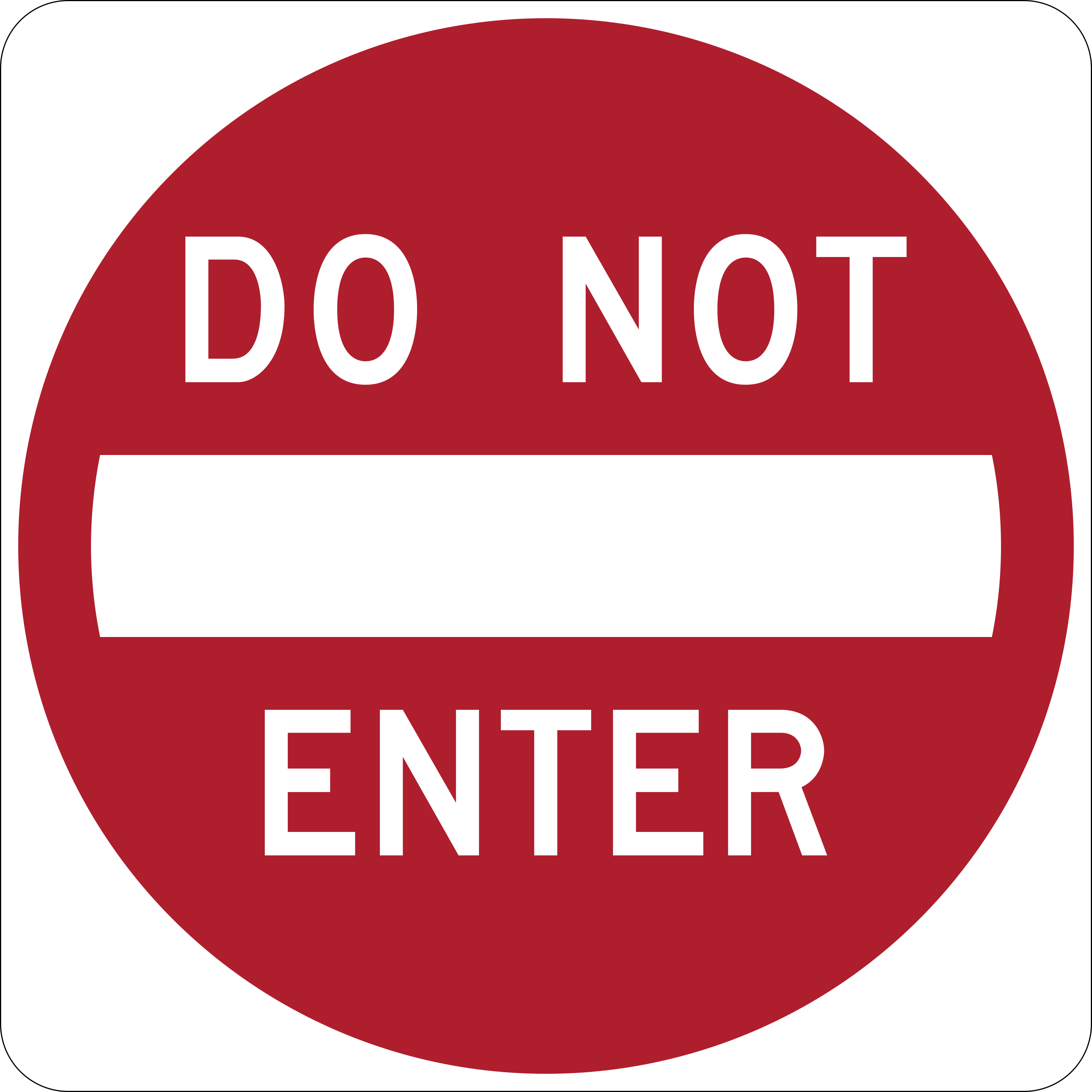
12. What movement is forbidden by the pictured Do Not Enter sign?
- Leaving the roadway at the next exit
- Entering that section from your direction of travel
- Turning into a marked parking space
- Passing a slower vehicle on the left
Show answer
Entering that section from your direction of travel. The Do Not Enter sign bars entry into that section of highway from the direction the driver is traveling. It is not a parking restriction, an instruction about leaving at an exit, or a command about passing a slower vehicle. The practical cue is the direction of your intended movement: if the sign faces you at the entrance, find another lawful route rather than driving past the sign. Learn signs like this one by color and shape as well as the message they carry, so you recognize it before reaching the entrance.
Study this in the handbook: Regulatory and work zone signs
13. What right-of-way warning accompanies the pictured pedestrian-crossing sign?

- Pedestrians must yield to every approaching vehicle
- People crossing have the right-of-way, and stopping may be required
- The sign marks sidewalk repairs rather than a crossing
- Only bicyclists may use the crossing
Show answer
People crossing have the right-of-way, and stopping may be required. A pedestrian-crossing warning tells drivers to watch for people crossing the road. The handbook gives pedestrians the right-of-way and says a driver may have to stop for them. That makes the sign a prompt to scan the crossing and prepare to yield, not a declaration that pedestrians must wait for every vehicle. Sidewalk construction and bicycle-only restrictions are different messages. Reduce speed early enough that a person entering the crossing can be protected without a hard last-second maneuver.
Study this in the handbook: Warning signs
14. At what blood alcohol concentration is a driver under 21 considered to be driving under the influence in Idaho?
- .04 or more
- .08 or more
- .02 or more
- .10 or more
Show answer
.02 or more. Idaho sets three BAC thresholds: .02 or more for drivers under 21, .04 or more for anyone operating a commercial vehicle, and .08 or more for drivers 21 or older. The .04 figure is the commercial vehicle limit, and .08 is the adult limit, so neither applies to an under 21 driver in a car. The figure .10 is not an Idaho legal limit; the handbook uses it only to say crash risk is six times as great at that level. A young driver can be over the limit after very little alcohol.
Study this in the handbook: DUI limits, penalties and test refusal
15. What GDL penalty does an Idaho driver under 17 face for a third conviction for a moving traffic violation?
- A second warning letter
- A 30 day suspension of driving privileges
- A one year suspension of driving privileges
- A 60 day suspension of driving privileges
Show answer
A 60 day suspension of driving privileges. For drivers under 17, a third or later moving violation conviction brings a 60 day suspension. A warning letter is given only after the first conviction, so a second letter is not the penalty. Thirty days is the penalty for the second conviction. One year is not in the GDL penalty list. These suspensions are added on top of any permit cancellation or court ordered suspension.
Study this in the handbook: Points, suspensions and reinstatement
16. What type of information does a brown guide sign normally identify?
- Motorist services such as fuel or lodging
- Directional and distance information
- Cultural, historical, or scenic points of interest
- A prohibition against entering a roadway
Show answer
Cultural, historical, or scenic points of interest. Idaho uses brown guide signs for cultural, historical, or scenic points of interest. Green guide signs provide directional and distance information, while blue guide signs identify motorist services. A prohibition against entering a roadway belongs to a regulatory sign, not a guide sign. When a brown panel appears, expect information about a destination or attraction rather than a command governing the vehicle’s movement. Read the wording for the specific place, then plan any lane change early and safely.
Study this in the handbook: Guide signs and barricades
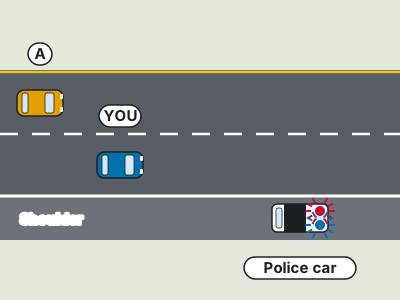
17. On a road with two or more lanes in your direction, what must you do near a stopped emergency vehicle with flashing lights?
- Move to a nonadjacent lane as soon as possible when safe, and slow below the posted limit
- Stay in the adjacent lane if you activate your hazard lights
- Change lanes only after the emergency vehicle operator signals you
- Stop in the lane beside the emergency vehicle
Show answer
Move to a nonadjacent lane as soon as possible when safe, and slow below the posted limit. The roadside protection rule combines two duties. First, immediately reduce speed below the posted limit and proceed cautiously. Second, when two or more lanes travel in your direction, change into a lane that is not adjacent to the emergency vehicle as soon as possible if safe. Hazard lights do not replace the lane change, and the operator does not need to wave traffic over. Stopping beside the vehicle creates a dangerous obstruction. Look ahead so the maneuver can be smooth rather than abrupt.
Study this in the handbook: Emergency vehicles and the move over law
18. What principle should guide a driver who technically has priority at an intersection?
- Yield only when another driver sounds a horn
- Insist on proceeding because priority removes the duty to watch
- Treat priority as something to give rather than something to take
- Accelerate so other road users cannot enter first
Show answer
Treat priority as something to give rather than something to take. Idaho describes right-of-way as something a driver gives, not something to take. That principle supports defensive driving: remain alert, recognize another road user’s mistake, and avoid turning a legal priority into a collision. Insisting on moving because a rule appears to favor you can leave no margin for a driver who fails to yield. A horn is not a substitute for observation, and acceleration does not establish safety. The practical cue is to protect the intersection even when traffic law appears to favor your movement.
Study this in the handbook: Right of way between drivers
19. When a solid yellow line is paired with a dashed yellow line, which traffic may cross to pass?
- Traffic in either lane whenever the road is straight
- Only traffic in the lane beside the dashed line
- Only traffic beside the solid line
- Neither lane, except for a legal U-turn
Show answer
Only traffic in the lane beside the dashed line. A solid yellow line beside a dashed yellow line divides the passing permissions by lane. Only vehicles traveling in the lane next to the dashed line may cross the markings to pass, and they still must confirm that the maneuver is safe. The lane beside the solid line cannot cross to pass. A straight road does not erase the marking, and the rule is about passing rather than granting a general U-turn exception. Identify which side contains the dashed line before considering any crossing movement.
Study this in the handbook: Pavement markings
20. What happens during the first 30 days of an Idaho first failure administrative license suspension?
- Full privileges continue
- Absolutely no driving privileges during the first 30 days of the 90 day suspension
- Work driving only
- A $250 fine replaces the suspension
Show answer
Absolutely no driving privileges during the first 30 days of the 90 day suspension. For a first failure of an evidentiary test, driving privileges are suspended for 90 days, with absolutely no driving privileges during the first 30 days of that suspension. After the suspension ends, an ignition interlock device is required on any vehicle you drive for one year. The administrative suspension is a civil penalty separate from any criminal court penalty for DUI, and a hearing can be requested within seven days of the notice.
Study this in the handbook: Administrative suspension and how alcohol affects you
QualitySpace is expanding to Idaho
We are a California-based independent insurance brokerage working on licensing in more states. We cannot help with Idaho insurance yet. Leave your email and we will let you know when we can.
Every question is written from the official Idaho Driver's Handbook. Need paper? Printable ID practice test with answer key.
Last verified 2026-10-05. How we check every question · Study all 215 as flashcards
Frequently asked questions
How many questions are on this Idaho practice test?
This fixed set has 20 questions. It is test 6 of 10 from the 215 question Idaho bank. The real ID exam asks 40 questions and you need 34 correct.
What is the passing score for the real Idaho test?
34 of 40 correct; you can miss up to six questions before failing the test That figure comes from the official Idaho source cited on the DMV facts page.
How does this fixed test relate to the full Idaho bank?
Each numbered test is a fixed set of questions in a fixed order, so you can retake the same test later and compare. Every test mixes road signs and the other topics in about the same proportion as the full bank. Tests 1 to 10 together cover 200 of the 215 questions in the Idaho bank, each once. The full practice page mixes the whole bank at random.
Last verified 2026-10-05. See the Idaho DMV facts page for sourced state details.