
Test 7 of 25 · 20 questions · Free 2026
PA Permit Practice Test 7
Jump to the test ↓A fixed 20 question set from the Pennsylvania bank with answers and plain English explanations. The real PA exam is 18 questions, 83 percent to pass; take the full length version on the main practice page.
Talk to Kevin
714-666-6669Call now →California policies handled directly by Kevin Vu (CDI #4037122). New Jersey and Pennsylvania policies handled in cooperation with licensed partner producer Sean Vu (Allstate). QualitySpace Insurance Agency does not bind coverage in NJ or PA directly.
Question 1 of 20 · 0 right so far
All 20 questions in test 7
Every question below comes from the Pennsylvania question bank on this page. Open a question to see the correct answer and the explanation. Nothing here is hidden behind a signup.
1. What happens if a Pennsylvania learner does not pass the road test within three years of the physical exam?
- They lose driving privileges for a year
- They get a one year extension
- They receive a license automatically
- They must start over with a new permit application and retake the knowledge test
Show answer
They must start over with a new permit application and retake the knowledge test. If you have not taken or successfully completed the road test within three years of your physical examination date, you must start over with another Non Commercial Learner's Permit Application and retake the knowledge test. Under 18, the road test also requires a signed parent or guardian certification of 65 hours of behind the wheel training. Schedule the test online or by phone.
Study this in the handbook: Learner's permit, knowledge test and road test
2. A vehicle is taller than the height shown on a Pennsylvania LOW CLEARANCE sign. What should its driver do?
- Do not enter the underpass, tunnel, or garage
- Enter slowly if the roof appears flexible
- Use the shoulder to pass beneath the sign
- Follow a taller vehicle to judge clearance
Show answer
Do not enter the underpass, tunnel, or garage. A LOW CLEARANCE sign gives the height limit for an underpass, tunnel, or parking garage. A vehicle taller than that listed measurement should not enter, even if the driver thinks the roof might flex or another vehicle appears to fit. The shoulder is not an alternate route under a fixed structure, and following someone else does not change the vehicle's height. Read the number before committing to the entrance, then choose a route with enough vertical room.
3. What is Pennsylvania's chemical test refusal restoration fee for a second offense?
- $250
- $100
- $1,000, compared with $500 for a first and $2,000 for a third
- There is no fee
Show answer
$1,000, compared with $500 for a first and $2,000 for a third. The chemical test refusal restoration fee is $500 for a first offense, $1,000 for a second offense, and $2,000 for a third or subsequent offense, and it is charged in addition to the restoration fee required under the Vehicle Code. Refusal can also mean a suspension of up to two and a half years if you are convicted of DUI. A judge may add up to 150 hours of community service.
Study this in the handbook: DUI, chemical tests and zero tolerance
4. Pennsylvania law requires headlights when you cannot see pedestrians or vehicles on the highway for what distance ahead?
- 300 feet
- 100 feet
- 1,000 feet
- 500 feet
Show answer
1,000 feet. Pennsylvania's headlight law lists several conditions, including when you cannot see pedestrians or vehicles on the highway for a distance of 1,000 feet ahead. Headlights are also required on gray days or in heavy traffic, in rain, snow, sleet, hail, fog, smoke or smog, between sunset and sunrise, in work zones, and whenever the wipers are in use because of weather. Daytime running lights are not enough because tail lights must be on too. The 100, 300 and 500 foot figures are not the visibility test.
Study this in the handbook: Speed, night driving and bad weather
5. At a two-way stop, about what gap in traffic do you need to cross a 30 mph street?
- About a 6-second gap in both directions
- About a 2-second gap from the left only
- About a 20-second gap from the right only
- No gap is needed once you have stopped
Show answer
About a 6-second gap in both directions. To cross an intersection with a two-way stop sign, the manual says you need about a 6-second gap in both directions to cross a 30 mph street, or about a block of clear space to the right and left. At the stop sign, look left, then right for a safe gap, then quickly left again before going. Two seconds is far too little, checking only one direction misses traffic from the other side, and stopping first does not give you the right-of-way.
Study this in the handbook: Right of way at intersections and roundabouts
6. How little water on a flooded road can cause you to lose control of your vehicle?
- At least two feet
- At least three feet
- As little as six inches
- Water never affects control at low speed
Show answer
As little as six inches. On flooded roadways, even at low speeds, as little as six inches of water can cause you to lose control of a car or truck and can float some small vehicles. Two feet of water will carry away most vehicles, including SUVs, so two feet is the carry-away depth, not the point where control is first lost. Three feet overstates the danger threshold, and low speed does not make standing water safe. If water is moving across the road, the safest choice is another route.
Study this in the handbook: Skids, blowouts, floods and brake trouble
7. How many crashes a year does falling asleep at the wheel cause nationally, according to the Pennsylvania manual?
- At least 100,000, with almost half involving drivers ages 15 to 24
- About 1,000
- About 10 million
- About 500
Show answer
At least 100,000, with almost half involving drivers ages 15 to 24. Every year across the United States, falling asleep while driving causes at least 100,000 crashes, in which 1,500 people die and 40,000 are injured, and almost half of those crashes involve drivers between 15 and 24 years of age. The manual also notes that being awake for 18 hours impairs your driving about as much as a .05 blood alcohol level, and teens who sleep less than eight hours a night are at increased risk. The best thing to do if you begin to feel tired while driving is to stop driving.
Study this in the handbook: Space cushion, following distance and scanning
8. When must a Pennsylvania driver turn on headlights because of weather-related wiper use?
- Only when the wipers have been running for 30 minutes
- Only when high beams are selected
- Only when driving after sunset
- Whenever the vehicle's wipers are in continuous or intermittent use
Show answer
Whenever the vehicle's wipers are in continuous or intermittent use. Pennsylvania’s headlight and windshield-wiper rule links the two controls whenever weather requires continuous or intermittent wiper use. The driver must turn on headlights during that period, and daytime running lights alone are not enough because the tail lights must also be illuminated. Sunset is a separate trigger, not a waiting period, and high beams are not required. When rain or another weather condition starts the wipers, use the headlights at the same time and verify the rear lights are on.
Study this in the handbook: Speed, night driving and bad weather
9. You are boxed in by a pack of highway traffic with no space cushion. What small speed adjustment does Pennsylvania recommend?
- Match the fastest vehicle regardless of the limit
- Increase speed by 10 mph
- Stop in the travel lane
- Reduce speed by two or three mph
Show answer
Reduce speed by two or three mph. When a group of vehicles leaves you in a blind spot without an emergency space cushion, Pennsylvania suggests reducing speed by two or three mph. That modest change can let surrounding vehicles spread out and reopen space. Accelerating by 10 mph can create a new hazard and may exceed the posted limit, while stopping in a travel lane is dangerous. Watch the vehicles beside and behind you, ease off slightly, and use the resulting gap to restore visibility and maneuvering room.
Study this in the handbook: Speed, night driving and bad weather
10. After a Pennsylvania suspension ends and the driving privilege is restored, how many points will the record show in most cases?
- Zero points
- Five points, regardless of the earlier total
- The same total as before the suspension
- Eleven points
Show answer
Five points, regardless of the earlier total. When a Pennsylvania driving privilege is restored after a suspension, the record is set to five points, whatever it showed before. The record is not wiped to zero, and it does not keep the old total. Eleven points is not a figure in the manual. The exceptions are a 15 day suspension from a hearing for a second accumulation of six points and a suspension for failing to respond to a citation. Three points then come off for every 12 months without a violation.
Study this in the handbook: Points, insurance and crash duties
11. A 16-year-old fails the Pennsylvania Road Test. How long must the teen wait to retake it?
- The next business day
- 30 days
- Seven days
- Six months
Show answer
Seven days. Pennsylvania law requires a driver under 18 who fails the Road Test to wait seven days before trying again, time meant for more practice. The next business day is the retest rule for the Knowledge Test. Thirty days and six months are not the retest wait; six months is the waiting period from the permit issue date before the first Road Test. Each learner's permit allows three Road Test attempts before the permit must be extended.
Study this in the handbook: Learner's permit, knowledge test and road test
12. For a Pennsylvania driver of legal drinking age, which BAC range is labeled General Impairment?
- .02 to .079
- .16 and higher
- .10 to .159
- .08 to .099
Show answer
.08 to .099. The manual's DUI table places a legal-age driver's General Impairment tier at BAC .08 through .099. The .02 range is used for Pennsylvania's under-21 rule, while .10 through .159 belongs to the High Rate tier and .16 or more is the Highest Rate tier. The question asks for the named range, so do not substitute the starting point of another category. Match the driver's age and the label attached to the numerical band.
13. When entering a Pennsylvania public highway from a private driveway, when may the driver proceed?
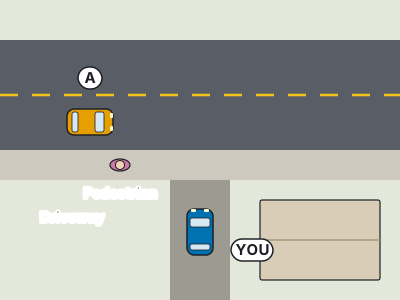
- Only after yielding to traffic approaching from the left
- As soon as the vehicle's turn signal is activated
- After waiting until the main road is clear
- Before checking because driveway traffic has priority
Show answer
After waiting until the main road is clear. Pennsylvania's yield list says a vehicle entering a public highway from an alley, private road, or driveway must wait until the main road is clear. Signaling communicates an intention but does not create a gap or give the emerging driver priority, and driveway traffic never gets priority over the main road. Looking only to the left can miss traffic arriving from the other direction. The same list also requires drivers to yield to pedestrians walking on a sidewalk that crosses a driveway or alley, so check both the walkway and the road before pulling out.
Study this in the handbook: Right of way at intersections and roundabouts
14. What traffic pattern does this MERGING TRAFFIC warning identify?

- Traffic may enter the major roadway from another road or ramp
- The driver's lane ends immediately at the sign
- All entering traffic must stop and wait for a police escort
- Merging is prohibited for the remainder of the highway
Show answer
Traffic may enter the major roadway from another road or ramp. The MERGING TRAFFIC warning tells drivers on a major roadway that vehicles may be entering from another roadway or ramp. In the manual's example, entering traffic comes from the right and must yield to traffic already on the major road. This is not a lane-ending sign and does not prohibit merging. Watch the entry point, maintain a usable space cushion, and adjust speed smoothly so the joining vehicle can enter without a sudden brake or swerve.
15. What does the pennant-shaped NO PASSING ZONE sign mark, and where is it placed?
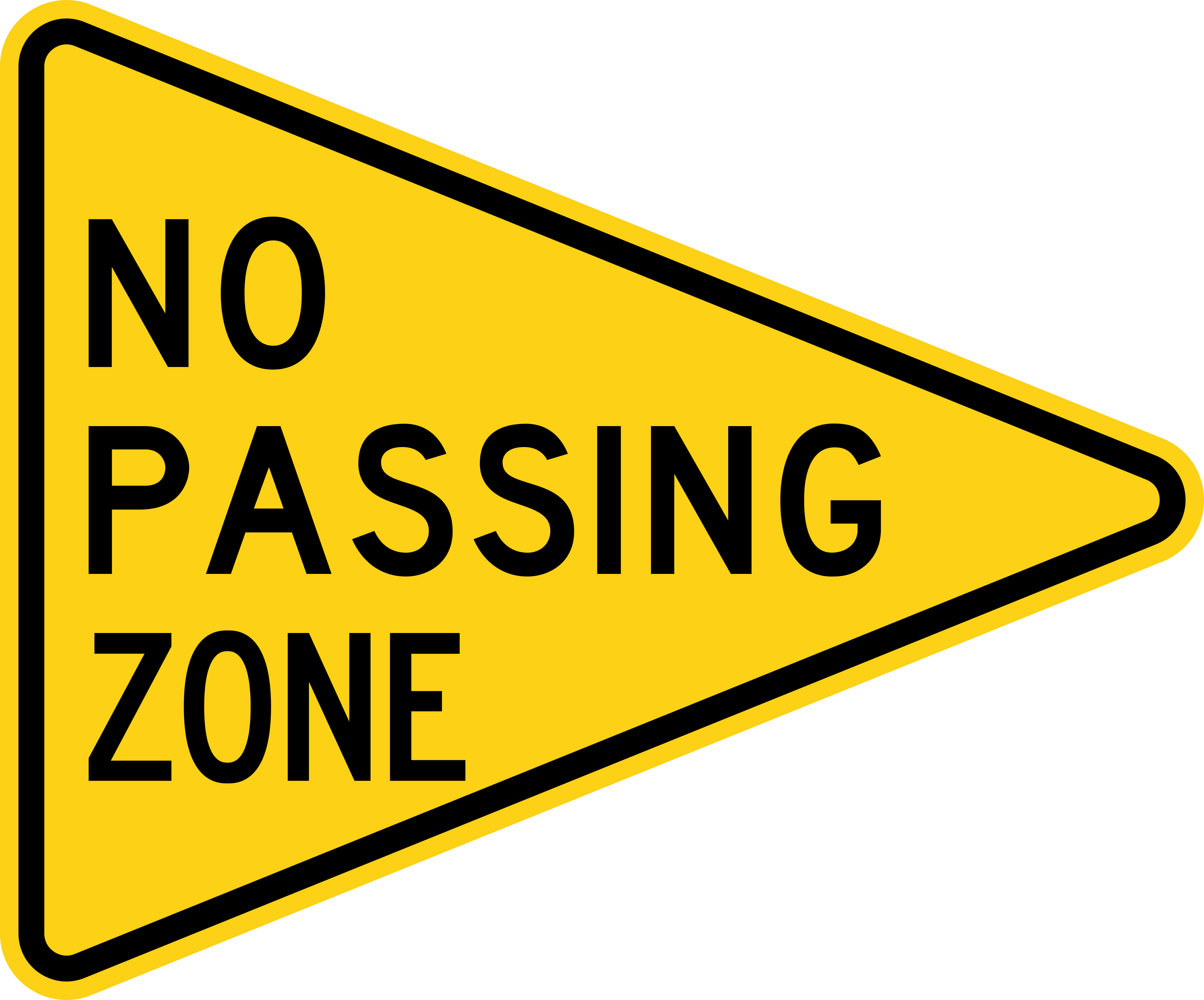
- At the end of a no-passing zone beside a picnic area
- At the beginning of a no-passing zone on the left side of the road
- At the start of a divided highway on the right side
- At a school crossing where passing is encouraged
Show answer
At the beginning of a no-passing zone on the left side of the road. The pennant is the distinctive warning sign that marks the beginning of a no-passing zone, and it faces drivers from the left side of the road. The end-of-zone choice reverses the message, while the picnic and divided-highway descriptions belong to other roadway information. Passing becomes unsafe where sight distance or another condition is restricted, so the sign should prompt the driver to remain behind the vehicle ahead. The recognition cue is unusual shape and placement together: a pennant on the left means the restriction is starting.
16. What condition does the skidding-car warning sign identify?

- A roadway that is especially slippery when wet
- A gravel surface that is always dry
- A lane reserved for vehicles with traction control
- A designated area for racing vehicles
Show answer
A roadway that is especially slippery when wet. The skidding-car symbol warns of pavement that becomes especially slippery when wet. It does not mark a racing area, and the gravel choice invents a surface description that the sign does not provide. When rain begins, reduce speed and leave more room because available traction and braking performance can change quickly. A useful cue is to connect the car’s sliding tires with a wet-weather response: smooth steering, gentle braking, and extra space. The warning deserves attention even if the road looked normal before precipitation started.
17. What does Pennsylvania's 2006 snow and ice law provide?
- A fine for driving in snow without chains
- Severe fines if snow or ice falling from your vehicle injures or kills another motorist or pedestrian
- Nothing, clearing snow is voluntary
- A requirement to wash the car after storms
Show answer
Severe fines if snow or ice falling from your vehicle injures or kills another motorist or pedestrian. Under a law that went into effect July 10, 2006, motorists face severe fines if snow or ice that falls from their vehicle causes injury or death to other motorists or pedestrians. Clear the roof, hood, trunk and windows before driving. A separate 2007 law requires headlights whenever the wipers are in continuous or intermittent use because of weather, with a $25 fine for violations.
Study this in the handbook: Speed, night driving and bad weather
18. How far from the steering wheel does the Pennsylvania manual say you should sit in case the air bag deploys?
- At least 2 inches
- At least 5 inches
- At least 24 inches
- At least 10 inches
Show answer
At least 10 inches. Pennsylvania advises sitting at least 10 inches from the steering wheel so a deploying air bag does not injure you, while still reaching the pedals and controls. Two and 5 inches are too close to the air bag. Twenty four inches is not the manual's figure, and you still need to reach the pedals and controls. Hold the wheel at 9 and 3 or 8 and 4, and seat children 12 and under in the rear.
Study this in the handbook: Seat belts, child seats and the anti-texting law
19. What is the fine for a Pennsylvania texting while driving conviction?
- $10
- $50
- $250
- $1,000
Show answer
$50. Pennsylvania's anti texting law is a primary, summary offense, and a conviction carries a $50 fine. Ten dollars is too low. Two hundred fifty dollars is the fine for driving around a road closure for hazardous conditions, and $1,000 is far higher than the texting penalty. The ban does not cover GPS devices, systems built into the vehicle, or devices fixed to a bus or school bus.
Study this in the handbook: Seat belts, child seats and the anti-texting law
20. What does a flashing yellow traffic signal tell a Pennsylvania driver to do?
- Stop and remain stopped until a green light appears
- Slow down, look, and proceed with care
- Accelerate to clear the intersection quickly
- Ignore the signal because it has no legal meaning
Show answer
Slow down, look, and proceed with care. A flashing yellow light signals caution while allowing traffic to continue. Pennsylvania directs the driver to slow down, look, and proceed with care. The stop-and-wait choice treats the signal like a red light, and acceleration reduces the time available to identify a hazard. Ignoring the display is not safe because it is an active warning. Reduce speed before entering the intersection, check for cross traffic and pedestrians, and continue only after the route has been assessed.
Study this in the handbook: Traffic signals and lane signals
Insurance in Pennsylvania
Pennsylvania policies are handled in cooperation with licensed partner producer Sean Vu. QualitySpace Insurance Agency does not bind coverage in Pennsylvania directly. Contact us and we will route you to the right person.
Every question is written from the official Pennsylvania Driver's Manual (PUB 95). Need paper? Printable PA practice test with answer key.
Last verified 2026-10-05. How we check every question · Study all 500 as flashcards
Frequently asked questions
How many questions are on this Pennsylvania practice test?
This fixed set has 20 questions. It is test 7 of 25 from the 500 question Pennsylvania bank. The real PA exam asks 18 questions and you need 15 correct.
What is the passing score for the real Pennsylvania test?
15 of 18 correct to pass the test That figure comes from the official Pennsylvania source cited on the DMV facts page.
How does this fixed test relate to the full Pennsylvania bank?
Each numbered test is a fixed set of questions in a fixed order, so you can retake the same test later and compare. Every test mixes road signs and the other topics in about the same proportion as the full bank. Tests 1 to 25 together cover every question in the Pennsylvania bank once. The full practice page mixes the whole bank at random.
Last verified 2026-10-05. See the Pennsylvania DMV facts page for sourced state details.
Return to the full Pennsylvania practice test · Study road signs