
Test 4 of 25 · 20 questions · Free 2026
PA Permit Practice Test 4
Jump to the test ↓A fixed 20 question set from the Pennsylvania bank with answers and plain English explanations. The real PA exam is 18 questions, 83 percent to pass; take the full length version on the main practice page.
Talk to Kevin
714-666-6669Call now →California policies handled directly by Kevin Vu (CDI #4037122). New Jersey and Pennsylvania policies handled in cooperation with licensed partner producer Sean Vu (Allstate). QualitySpace Insurance Agency does not bind coverage in NJ or PA directly.
Question 1 of 20 · 0 right so far
All 20 questions in test 4
Every question below comes from the Pennsylvania question bank on this page. Open a question to see the correct answer and the explanation. Nothing here is hidden behind a signup.
1. You change your address within Pennsylvania. How soon must you notify PennDOT?
- Within 30 days
- Within 60 days
- Within 15 days
- At your next renewal
Show answer
Within 15 days. Pennsylvania requires notice to PennDOT within 15 days of a name or address change, even when moving out of state. Thirty days is too long. Sixty days is the deadline for a new resident to get a Pennsylvania license, so it belongs to a different rule. Waiting until renewal ignores the requirement. The change can be reported online or by phone, and a non commercial driver gets an update card at no fee, which must be carried with the license.
Study this in the handbook: Points, insurance and crash duties
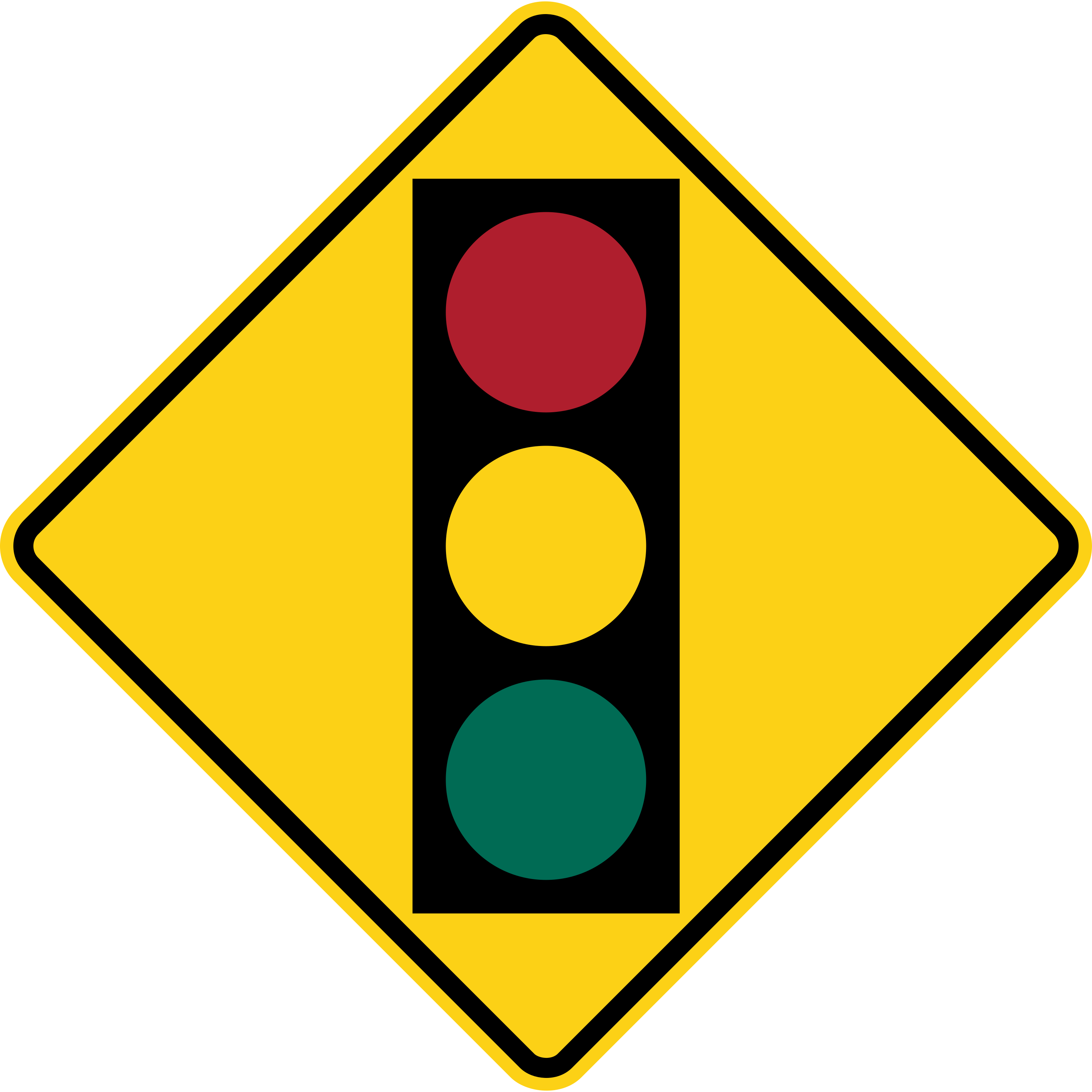
2. Why should a driver slow after seeing the TRAFFIC SIGNAL AHEAD warning sign?
- A streetlight is broken and the road is closed beyond the sign
- A signalized intersection is ahead and may be hidden by a curve or hill
- A police checkpoint requires an immediate stop on the shoulder
- A railroad signal will control access to a nearby siding
Show answer
A signalized intersection is ahead and may be hidden by a curve or hill. TRAFFIC SIGNAL AHEAD warns of a signal at the intersection ahead. The light may be hidden by a curve or hill, and stopped vehicles may be waiting beyond the driver's view. Those conditions are why the manual tells drivers to slow down and prepare to stop if necessary. The sign does not announce a broken streetlight, a police checkpoint, or railroad access. Cover the brake, scan beyond the obstruction, and expect the queue or red indication before entering the intersection.
3. What should a driver expect after passing the pictured STOP SIGN AHEAD warning?

- A stop sign is ahead, possibly hidden by a curve, hill or obstruction
- Stopping is prohibited on the shoulder for the next mile
- A green signal will replace the next stop sign automatically
- The current roadway has ended and no traffic control follows
Show answer
A stop sign is ahead, possibly hidden by a curve, hill or obstruction. STOP SIGN AHEAD tells the driver that a stop sign is at the intersection ahead. A curve, hill, or another obstruction may hide it, and a queue of stopped vehicles may also be out of sight. The warning does not prohibit shoulder stopping or promise that a signal will replace the stop sign. Reduce speed while approaching, then make the full stop at the actual sign, stop line, or crosswalk before checking traffic and proceeding.
4. What does the WINDING ROAD warning sign indicate?

- A rough pavement section with repeated bumps
- Three or more curves in a row are ahead
- A place where strong crosswinds are expected
- A single curve followed by a long straightaway
Show answer
Three or more curves in a row are ahead. The WINDING ROAD sign means at least three curves occur in succession on the road ahead. The bumpy-road choice concerns pavement condition, and the high-wind choice confuses the word winding with wind. Treat the sign as a speed-management warning for a continuing sequence, not a single bend that ends immediately. Reduce speed before the first curve and keep the vehicle under control through the series. A practical cue is to count the repeated changes in direction represented by the symbol and avoid accelerating between them.
5. If an oncoming vehicle suddenly enters your lane and a crash cannot be avoided, what does the manual advise?
- Swerve left toward the other vehicle
- Accelerate to reduce the time of impact
- Brake firmly and steadily
- Release the steering wheel and close your eyes
Show answer
Brake firmly and steadily. When an oncoming driver occupies your lane, the manual says to try escaping to the right when possible. If impact cannot be avoided, brake firmly and steadily. Swerving left can place both vehicles on the same path, and acceleration increases impact speed rather than protecting the occupants. Releasing control abandons the driver’s best chance to reduce harm. Sound the horn, look for a right-side escape, and keep braking in a controlled line if no route remains.
Study this in the handbook: Right of way at intersections and roundabouts
6. On a wet Pennsylvania roadway, which speed and spacing adjustment is recommended?
- Maintain dry-road speed and shorten the gap
- Accelerate before the tires encounter water
- Reduce speed and increase following distance
- Use the shoulder to avoid slowing traffic
Show answer
Reduce speed and increase following distance. Wet pavement reduces the margin available for braking and steering, so the manual pairs a lower speed with more space behind the vehicle ahead. The choice to keep dry-road speed assumes traction remains unchanged, while shortening the gap leaves less time to respond. Acceleration near water can worsen a loss of grip, and the shoulder is not a routine travel lane. When rain begins, ease off the accelerator early, enlarge the time gap, and make turns and stops smoothly.
Study this in the handbook: Speed, night driving and bad weather
7. What share of people in Pennsylvania crashes in 2017 were wearing seat belts, and which age group used them least?
- 80.2 percent, with drivers ages 16 to 24 having the lowest use and the most unbuckled injuries
- 99 percent, with seniors lowest
- 50 percent, with children lowest
- 25 percent, with truck drivers lowest
Show answer
80.2 percent, with drivers ages 16 to 24 having the lowest use and the most unbuckled injuries. In 2017, 80.2 percent of people involved in Pennsylvania crashes were wearing seat belts, and drivers ages 16 to 24 had the highest number of unbuckled injuries and fatalities of any age group and the lowest seat belt use. The belt is the single most effective protection in a crash, and the state's seat belt, child restraint and air bag rules are in Chapter 5.
Study this in the handbook: Seat belts, child seats and the anti-texting law
8. For the first six months on a Pennsylvania junior license, with no parent, guardian, person in loco parentis, or spouse aged 18 or older in the car, how many passengers under 18 who are not immediate family may a driver carry?
- No more than two
- No more than three
- An unlimited number
- No more than one
Show answer
No more than one. During the first six months of a Pennsylvania junior license, the driver may carry no more than one passenger under 18 who is not an immediate family member, unless a qualifying adult is in the vehicle. Two, three, and unlimited choices exceed the initial cap. The later three-passenger allowance is conditional and cannot be applied early. When studying this rule, separate the first six months from the expanded period and check whether the question supplies the adult exception.
Study this in the handbook: Junior permit and junior license limits
9. What is the minimum age for a Pennsylvania Class A or Class B license, and what does Class B cover?
- Age 16 for both
- Age 18, with Class B covering any single vehicle rated over 26,000 pounds such as a large motor home
- Age 21, covering motorcycles
- Age 18, covering only buses
Show answer
Age 18, with Class B covering any single vehicle rated over 26,000 pounds such as a large motor home. Class A, minimum age 18, is required for any combination of vehicles with a gross weight rating of 26,001 pounds or more where the towed vehicle exceeds 10,000 pounds; the manual's example is a recreational vehicle setup where the towing vehicle is rated at 11,000 pounds and the towed vehicle at 15,500 pounds. Class B, also minimum age 18, is required to operate any single vehicle rated in excess of 26,000 pounds, such as a motor home rated at 26,001 pounds or more. Ordinary cars, pickups, and vans fall under the Class C license.
Study this in the handbook: Junior permit and junior license limits
10. A Pennsylvania driver refuses a first chemical test and is later found not guilty of DUI. What license consequence remains?
- An automatic one-year suspension of the driving privilege
- A written warning with no loss of driving privilege
- An automatic five-year revocation
- No suspension because the DUI case ended in acquittal
Show answer
An automatic one-year suspension of the driving privilege. The Implied Consent law imposes a one year suspension for a first refusal of a breath or blood test, even when the driver is not convicted of DUI. The acquittal choice confuses the criminal outcome with the separate licensing consequence. A warning does not describe the statutory action, and five years is not the first-refusal period. A prior DUI conviction or prior refusal changes the later penalty, but it does not erase the first-refusal rule.
Study this in the handbook: DUI, chemical tests and zero tolerance
11. Pennsylvania law requires low beams within what distance of an oncoming vehicle, and of a vehicle you are following?
- 500 feet of an oncoming vehicle and 300 feet of a vehicle ahead
- 1,000 feet oncoming and 500 feet following
- 200 feet oncoming and 100 feet following
- 300 feet oncoming and 500 feet following
Show answer
500 feet of an oncoming vehicle and 300 feet of a vehicle ahead. Pennsylvania requires low beams within 500 feet of an oncoming vehicle and when following within 300 feet of another vehicle. One thousand feet is the visibility test for when headlights must be on at all, not the dimming distance. Two hundred and 100 feet are too close. Three hundred feet oncoming and 500 following swaps the two numbers. If an oncoming driver does not dim, look toward the right side of the road rather than into the glare.
Study this in the handbook: Speed, night driving and bad weather
12. How long can a Pennsylvania driver's privilege be suspended for refusing a chemical test and then being found guilty of DUI?
- 30 days
- Up to two and a half years, depending on the BAC at arrest
- Six months
- Ten years
Show answer
Up to two and a half years, depending on the BAC at arrest. If you refuse to take a chemical test and you are found guilty of DUI, your driving privilege may be suspended for two and a half years depending on your BAC level at the time of arrest. A chemical test refusal restoration fee also applies, $500 for a first offense, $1,000 for a second and $2,000 for a third or later, on top of the regular restoration fee.
Study this in the handbook: DUI, chemical tests and zero tolerance
13. On packed snow, how should a Pennsylvania driver adjust speed?
- Keep the dry-road speed
- Stop in the travel lane
- Increase speed by half
- Decrease speed by half
Show answer
Decrease speed by half. The manual distinguishes packed snow from ordinary wet pavement and says to decrease speed by half. Keeping dry-road speed ignores the loss of tire traction, while increasing speed makes steering and braking less predictable. Stopping in the travel lane can expose the vehicle to following traffic and is not the listed adjustment. Reduce speed before the tires lose grip, leave much more space ahead, and make every steering and braking input gently. Packed snow is the cue for the half-speed rule.
Study this in the handbook: Speed, night driving and bad weather
14. How many points does a Pennsylvania driver receive for exceeding the speed limit in a school zone?
- No points, only a fine
- Two points, with no fine
- Six points and an automatic suspension
- Three points, plus a fine
Show answer
Three points, plus a fine. School zone signals are flashing yellow lights on the school zone speed limit signs, and you must travel no faster than 15 mph while they flash or during the posted time periods. Exceeding that limit puts three points on your driving record, and you will also be fined. A fine alone, or two points without a fine, understates the penalty. Six points is the level at which PennDOT begins corrective action for a whole record, not the penalty for one school zone violation.
Study this in the handbook: Traffic signals and lane signals
15. A Pennsylvania driver faces a steady red light and wants to turn right. What must happen first?
- Stop, check for pedestrians and traffic, then turn if permitted
- Roll through if no vehicle is approaching
- Wait for a green arrow even when no sign prohibits the turn
- Turn without yielding because right turns have priority
Show answer
Stop, check for pedestrians and traffic, then turn if permitted. Pennsylvania allows a right turn on red unless a NO TURN ON RED sign prohibits it, but the maneuver begins with a complete stop. The driver must check for and yield to pedestrians and other traffic before turning. A rolling approach is not the required stop, and a green arrow is unnecessary when the red-turn exception is available. No driver receives automatic priority simply because the intended movement is rightward. Look for the prohibition sign, stop at the line or crosswalk, then reassess the crossing area.
Study this in the handbook: Traffic signals and lane signals
16. What should a Pennsylvania driver do if the vehicle's brake system warning light appears and braking weakens?
- Turn the ignition to lock and coast without steering
- Accelerate to restore hydraulic pressure
- Push harder on the pedal, shift to a lower gear, and move toward the roadside or next service station
- Steer into a parked vehicle to stop immediately
Show answer
Push harder on the pedal, shift to a lower gear, and move toward the roadside or next service station. With a brake warning light and reduced braking, a newer split system may still brake two of the four wheels. The pedal may travel farther, so press harder, recognize that stopping distance has increased, and shift to a lower gear to help slow the vehicle. The manual notes that steering and braking take more effort with the ignition off, and accelerating or striking a parked car is not a controlled response. Keep the vehicle aimed safely and pull off toward a service station when possible.
Study this in the handbook: Skids, blowouts, floods and brake trouble
17. A tow truck is stopped on the Pennsylvania shoulder while responders work nearby. What does the Move Over law require?
- Move over only if the truck is displaying blue lights
- Maintain speed because the truck is outside the travel lane
- Stop in the adjacent lane until the tow truck leaves
- Move to a nonadjacent lane when possible, or reduce speed at least 20 mph below the posted limit
Show answer
Move to a nonadjacent lane when possible, or reduce speed at least 20 mph below the posted limit. Pennsylvania's Move Over law covers towing and recovery personnel and disabled vehicles marked with warning devices. Drivers should move into a lane that is not adjacent to the response area when traffic permits. If changing lanes is impossible or unsafe, reduce speed to at least 20 mph below the posted limit. Maintaining speed ignores the protected roadside activity, while stopping in the next lane creates another hazard. Look ahead, signal early, and choose the safe alternative.
Study this in the handbook: Speed, night driving and bad weather
18. What general instruction applies to the places Pennsylvania lists as prohibited stopping, standing, or parking locations?
- Stop there briefly whenever hazard lights are on
- Never stop, stand, or park there except in an emergency or when directed by a police officer
- Park there if the vehicle is attended
- Use those locations only after midnight
Show answer
Never stop, stand, or park there except in an emergency or when directed by a police officer. Pennsylvania begins its list of prohibited stopping, standing, and parking locations with an important exception. A driver must not use those places unless there is an emergency or a police officer tells the driver to do so. Hazard lights, an attended vehicle, or the time of day does not create a general permission to stop there. Apply the rule before considering the individual location, such as a hydrant, intersection, or crosswalk. This keeps the driver from treating a short pause as automatically lawful.
Study this in the handbook: Parking rules and distances
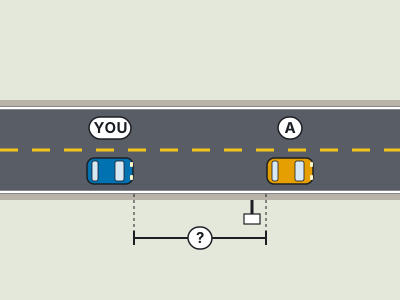
19. On dry pavement, what following distance does Pennsylvania's manual recommend as a safe space cushion?
- One car length regardless of speed
- A one-second gap at every speed
- A four-second following distance
- No gap when traffic is moving steadily
Show answer
A four-second following distance. On dry pavement, the Pennsylvania manual recommends a four second following distance so you can steer or brake to avoid a hazard safely. To measure it, watch the rear bumper of the vehicle ahead pass a road marking or a roadside object such as a telephone pole and count the seconds until you reach the same spot; under four seconds means you are following too closely. If you follow too closely and the vehicle ahead stops or slows suddenly, you will not be able to avoid a crash. Allow even more space on wet or slippery roads.
Study this in the handbook: Space cushion, following distance and scanning
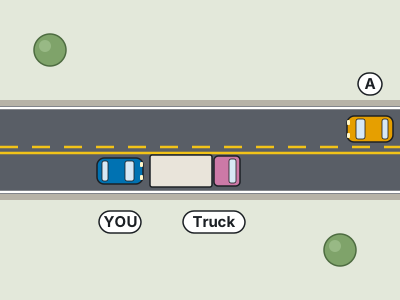
20. On a Pennsylvania two-way road, the centerline has a solid yellow line on your side and a broken yellow line on the other side. May you pass?
- Yes, passing is always permitted from either side
- Yes, because the line marks a one-way road
- Yes, but only trucks may pass from your side
- No, passing is prohibited from your side
Show answer
No, passing is prohibited from your side. A solid yellow line on your side of a combination centerline means you may not pass. The driver facing the broken yellow line may pass when conditions are safe, but that permission does not cross over to your lane. The truck-only option invents a vehicle exception, and the one-way option misreads a centerline that separates opposing traffic. Before passing, read the line nearest your vehicle and obey the restriction shown there.
Study this in the handbook: Pavement markings and lane use signs
Insurance in Pennsylvania
Pennsylvania policies are handled in cooperation with licensed partner producer Sean Vu. QualitySpace Insurance Agency does not bind coverage in Pennsylvania directly. Contact us and we will route you to the right person.
Every question is written from the official Pennsylvania Driver's Manual (PUB 95). Need paper? Printable PA practice test with answer key.
Last verified 2026-10-05. How we check every question · Study all 500 as flashcards
Frequently asked questions
How many questions are on this Pennsylvania practice test?
This fixed set has 20 questions. It is test 4 of 25 from the 500 question Pennsylvania bank. The real PA exam asks 18 questions and you need 15 correct.
What is the passing score for the real Pennsylvania test?
15 of 18 correct to pass the test That figure comes from the official Pennsylvania source cited on the DMV facts page.
How does this fixed test relate to the full Pennsylvania bank?
Each numbered test is a fixed set of questions in a fixed order, so you can retake the same test later and compare. Every test mixes road signs and the other topics in about the same proportion as the full bank. Tests 1 to 25 together cover every question in the Pennsylvania bank once. The full practice page mixes the whole bank at random.
Last verified 2026-10-05. See the Pennsylvania DMV facts page for sourced state details.
Return to the full Pennsylvania practice test · Study road signs