
Test 12 of 25 · 20 questions · Free 2026
PA Permit Practice Test 12
Jump to the test ↓A fixed 20 question set from the Pennsylvania bank with answers and plain English explanations. The real PA exam is 18 questions, 83 percent to pass; take the full length version on the main practice page.
Talk to Kevin
714-666-6669Call now →California policies handled directly by Kevin Vu (CDI #4037122). New Jersey and Pennsylvania policies handled in cooperation with licensed partner producer Sean Vu (Allstate). QualitySpace Insurance Agency does not bind coverage in NJ or PA directly.
Question 1 of 20 · 0 right so far
All 20 questions in test 12
Every question below comes from the Pennsylvania question bank on this page. Open a question to see the correct answer and the explanation. Nothing here is hidden behind a signup.
1. Which repeat licensing offense appears on Pennsylvania's partial list of violations that bring suspension or revocation?
- A first parking ticket within five years
- Driving one mile per hour over the limit twice
- A second or additional offense of driving without a valid driver's license within a five-year period
- Renewing a registration one day late
Show answer
A second or additional offense of driving without a valid driver's license within a five-year period. The partial list of violations leading to suspension or revocation includes a second or additional offense of driving without a valid driver’s license within a five-year period. Controlling manual language: Second or any additional offense of driving without a valid driver’s license within a 5-year period. That wording points to "A second or additional offense of driving without a valid driver's license within a five-year period."
Study this in the handbook: Points, insurance and crash duties
2. Where must items never be stored inside a Pennsylvania vehicle, under pre-drive guidance?
- On the rear window deck
- In the trunk, secured with seat belts
- Under a latched cargo cover
- Inside a closed glove compartment
Show answer
On the rear window deck. In a crash, loose items become projectiles that continue at the speed the vehicle was traveling before impact. Put heavier objects such as backpacks, luggage and tools in the trunk whenever possible, or secure them with the vehicle’s seat belts. Never store items on the rear window deck. Manual wording for this rule: Vehicle’s seat belts. By contrast, the manual recommends putting heavier objects in the trunk whenever possible, or securing them with the vehicle’s seat belts.
Study this in the handbook: Seat belts, child seats and the anti-texting law
3. On a two lane, two way street, where should left and right turns begin?
- Left turns from the right edge, right turns from the centerline
- Both turns from the exact middle of the roadway
- Both turns from the shoulder regardless of direction
- Left turns from as close to the centerline as possible, right turns from as close to the right edge as possible
Show answer
Left turns from as close to the centerline as possible, right turns from as close to the right edge as possible. On two-lane, two-way streets or highways, begin left turns as close to the centerline as possible and right turns as close to the right edge of the roadway as possible. Position your vehicle in the proper lane before turning. Controlling manual language: On two-lane, two-way streets or highways, make left turns from as close to the centerline as possible. Make right turns from as close to the right edge of the roadway as possible.
Study this in the handbook: Pavement markings and lane use signs
4. A Pennsylvania court handles an underage drinking case. Besides the fine, what may the court require of the young person?
- Nothing beyond the fine in every case
- Immediate license revocation for life
- Evaluation of involvement with alcohol, and successful completion of an alcohol education, intervention, or counseling program if required
- Community service at a brewery
Show answer
Evaluation of involvement with alcohol, and successful completion of an alcohol education, intervention, or counseling program if required. In addition to a fine of up to $500 plus court costs, a court may require evaluation of a young person’s involvement with alcohol. It may also require successful completion of an alcohol education, intervention, or counseling program. The passage behind this item: The courts may require you to be evaluated to determine the extent of your involvement with alcohol and may also require you to successfully complete a program of alcohol education, intervention or counseling.
Study this in the handbook: DUI, chemical tests and zero tolerance
5. Why can a bulky winter coat make a child car seat less safe in Pennsylvania guidance?
- Thick coats compress in a crash and create slack in the harness, which must stay snug on the child body
- Coats make the vehicle too warm for children
- Coats block the LATCH anchors from view
- Coats void the car seat manufacturer warranty
Show answer
Thick coats compress in a crash and create slack in the harness, which must stay snug on the child body. All coats and clothing compress in a crash. Thick winter coats can compress enough to create significant slack in the harness. The car seat harness keeps the child secure and must be snug on the child’s body to provide the best protection in a crash. Cited handbook wording: Clothing will compress in a crash, but thicker winter coats can compress enough to create significant slack in the harness. The car seat harness keeps the child secure in the car seat and must be snug on the child's body.
Study this in the handbook: Seat belts, child seats and the anti-texting law
6. How much moving floodwater can float many cars in Pennsylvania's guidance?
- Six inches of moving water
- Twelve inches of moving water
- Three feet of moving water
- Water reaching the door handles only
Show answer
Twelve inches of moving water. Twelve inches of moving water can float many cars. Six inches can cause some cars to lose control or stall and can float some small vehicles. Two feet of moving water can move most SUVs and pickup trucks. Find another route and do not attempt to cross a flooded roadway. The passage behind this item: Twelve inches of moving water can float many cars.
Study this in the handbook: Skids, blowouts, floods and brake trouble
7. You demonstrate your skills on a motor-driven cycle for a Pennsylvania Class M license. What does the 8 restriction bar you from doing?
- Riding the motor-driven cycle after dark
- Operating a motorcycle
- Operating any motor-driven cycle
- Carrying a passenger on the motor-driven cycle
Show answer
Operating a motorcycle. Testing on a motor-driven cycle results in an 8 restriction on the driver’s license. The manual states that this restriction prohibits operating a motorcycle. The restriction described concerns vehicle type, rather than nighttime riding or passenger carriage. Cited handbook wording: If you test on a motor-driven cycle, an "8" restriction will appear on our driver's license. This restriction prohibits you from operating a motorcycle.
Study this in the handbook: Junior permit and junior license limits
8. A Pennsylvania applicant fails to meet the vision standards at the Driver License Center. What does the examiner provide, and what happens next?
- A temporary license restricted to daylight driving for 30 days
- A waiver that removes vision screening from the application
- A DL-102 Report of Eye Examination Form to be completed by an eye professional, after which the applicant may return to continue testing
- A referral that requires restarting with a new DL-180 application
Show answer
A DL-102 Report of Eye Examination Form to be completed by an eye professional, after which the applicant may return to continue testing. If your vision fails to meet the standards, the examiner gives you a Report of Eye Examination Form, DL-102. Have an optometrist, ophthalmologist, or family physician test your vision and complete the form. You may then return to the Driver License Center to continue testing. Manual wording for this rule: With side mirrors. If your vision fails to meet the vision standards, the examiner will give you a Report of Eye Examination Form (DL-102). You should have an optometrist, ophthalmologist or family physician test your vision and complete this.
Study this in the handbook: Learner's permit, knowledge test and road test
9. You begin parallel parking at a right-hand curb in Pennsylvania. How should you first position your vehicle next to the vehicle ahead of the space?
- Stop one car length behind it, touching distance away
- Stop even with it, two feet away from it
- Angle in nose-first from the traffic lane
- Stop even with the vehicle behind the space
Show answer
Stop even with it, two feet away from it. Begin by stopping even with the vehicle ahead of the space, two feet away from it. Turn the wheels sharply right and back slowly toward the vehicle behind. As your front door passes the back bumper of the vehicle ahead, straighten the wheels quickly and continue backing straight. The passage behind this item: Stop even with the vehicle ahead and two (2) feet away from it.
Study this in the handbook: Parking rules and distances
10. Children are playing near the street ahead in Pennsylvania. How should you adjust your driving?
- Maintain speed; children must stay on the sidewalk
- Sound the horn continuously until you pass
- Reduce speed and use extra caution, since children may run out without looking
- Speed up to clear the area quickly
Show answer
Reduce speed and use extra caution, since children may run out without looking. Always reduce speed and use extra caution when children are nearby. They may not understand the danger and may run in front of you without looking. Manual wording for this rule: Always reduce speed, and use extra caution when children are in the vicinity. They may fail to understand the danger and may run out in front of you without looking. By contrast, the prescribed response is to reduce speed and use extra caution, not to sound the horn continuously.
Study this in the handbook: Motorcycles, bicycles, trucks and pedestrians
11. What is the purpose of an acceleration lane beside a Pennsylvania highway entrance ramp?
- Room to accelerate to the speed of traffic before entering the highway
- A place to stop and check the vehicle
- A passing lane for exiting traffic
- A parking area for disabled vehicles
Show answer
Room to accelerate to the speed of traffic before entering the highway. Acceleration lanes run beside the main traffic lanes and should allow you to reach traffic speed before entering the highway. While looking for a gap on an entrance ramp, look over your shoulder and in your side mirror. The passage behind this item: Lanes and should be long enough to allow you to accelerate to the speed of traffic before you enter the highway.
Study this in the handbook: Signaling, turning, U-turns and passing
12. If a WRONG WAY sign faces a driver who has just entered a ramp, what does it indicate?
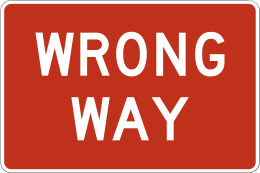
- A detour requires the driver to continue until the next exit
- The lane is reserved for commercial trucks during rush hour
- The pavement ahead is rough but the travel direction is correct
- The vehicle is traveling against the permitted direction on the one-way street or ramp
Show answer
The vehicle is traveling against the permitted direction on the one-way street or ramp. The WRONG WAY sign is placed farther down a one-way street or ramp, beyond the DO NOT ENTER sign at its beginning. The manual says it is placed there to catch your attention if you accidentally turn onto the street or ramp, so seeing it face you means you are traveling against the permitted direction. It is a direct warning about travel direction, not a detour, a pavement condition, or a vehicle classification. Treat it as urgent: the manual warns that turning onto a one-way street in the opposite direction is likely to lead to a head-on collision.
Study this in the handbook: Pavement markings and lane use signs
13. A DO NOT PASS sign is posted on a Pennsylvania road. Which companion sign often appears with it?
- A green EXIT ONLY panel
- A white steady two-way left-turn arrow
- An orange FLAGGER AHEAD sign
- A yellow pennant-shaped NO PASSING ZONE sign
Show answer
A yellow pennant-shaped NO PASSING ZONE sign. A DO NOT PASS sign marks an area where you may not pass vehicles going in the same direction. It is often accompanied by a yellow pennant-shaped NO PASSING ZONE sign. Manual wording for this rule: This sign may be placed in areas where you may not pass any vehicles going in the same direction. It is often accompanied by the yellow pennant-shaped sign that says NO PASSING ZONE.
Study this in the handbook: Pavement markings and lane use signs
14. Your accelerator sticks and you must slow or stop quickly using the ignition. How should you turn the key, and why?
- Turn it to LOCK so the engine cuts fastest
- Turn the ignition to OFF, not to LOCK, because LOCK removes steering ability; then apply the brakes, expecting more effort to steer and brake
- Remove the key completely while moving
- Turn it to ACCESSORY and coast without brakes
Show answer
Turn the ignition to OFF, not to LOCK, because LOCK removes steering ability; then apply the brakes, expecting more effort to steer and brake. If you need to slow or stop quickly with a stuck accelerator, turn the ignition to OFF, not LOCK, because LOCK removes steering ability. Then apply the brakes; steering and braking will require more effort with the ignition off. Cited handbook wording: Need to slow or stop quickly, turn your ignition to “OFF.” Do not turn it to “LOCK” because you will lose steering ability. Then, apply your brakes. It will require more effort to steer and brake with your ignition off.
Study this in the handbook: Skids, blowouts, floods and brake trouble
15. You have mounted the spare and threaded all lug nuts by hand. How tightly should the lug wrench snug them before the vehicle is lowered?
- Fully torque them while the wheel hangs in the air
- Use minimal pressure only; do not fully torque the nuts at this time
- Leave them finger-tight until after a test drive
- Tighten only two opposite nuts and skip the rest
Show answer
Use minimal pressure only; do not fully torque the nuts at this time. Once all lug nuts are correctly threaded by hand, tighten them with the lug wrench using only minimal pressure. Do not fully torque them yet. Slowly lower the vehicle to the ground without removing the jack, then consult the owner’s manual for the proper torque sequence and specifications and tighten the nuts. Manual wording for this rule: The nuts are correctly threaded on the lugs, the lug wrench may be used to tighten the nuts; but only use minimal pressure (do not fully torque the nuts at this time).
Study this in the handbook: Skids, blowouts, floods and brake trouble
16. What does Pennsylvania law actually do about right-of-way at intersections?
- It awards the right-of-way to the largest vehicle
- It awards the right-of-way to whoever arrives second
- It only says who must yield, and even a driver who was owed a yield must still stop or yield as necessary to avoid a crash
- It lets the faster driver claim the intersection
Show answer
It only says who must yield, and even a driver who was owed a yield must still stop or yield as necessary to avoid a crash. The law does not give anyone the right-of-way at intersections; it says who must yield. Even if another driver is required to yield and fails to do so, you must still stop or yield as necessary to avoid a crash. Never insist on having the right-of-way. Controlling manual language: It only says who must yield. Even when one driver is legally required to yield right-of-way, if they fail to do so, other drivers are still required to stop or yield as necessary to avoid a crash.
Study this in the handbook: Right of way at intersections and roundabouts
17. How must vehicles in a Pennsylvania funeral procession display themselves while moving in the procession?
- Headlights and emergency flashers on, bearing a flag or other insignia
- Headlights on only
- Purple light only, with lights off in daylight
- A flag only, with no lights required
Show answer
Headlights and emergency flashers on, bearing a flag or other insignia. A funeral procession announces itself as a unit: every vehicle runs with headlights and emergency flashers turned on and bears a flag or other insignia marking it as part of the procession, and vehicles may also display a flashing or revolving purple light. Headlights alone omit the flashers and insignia that tell other drivers the line of cars travels together. A purple light by itself, or a flag without lights, understates the required display. That marking matters because, once the lead vehicle clears an intersection lawfully, following vehicles may continue through with other traffic yielding.
Study this in the handbook: Right of way at intersections and roundabouts
18. On a large green highway guide sign, the small green EXIT number plaque sits on the left side of the top edge. What does that placement tell you?
- The exit leaves from the right side of the highway
- The exit is a left-hand merge onto another interstate
- The exit leaves from the left side of the highway
- The exit number is a route number, not an exit
Show answer
The exit leaves from the left side of the highway. The small green EXIT number sign is on the left side of the larger guide sign when the exit is on the left side of the highway, and on the right side when the exit is on the right. If the sign has white arrows, they point in the direction of the exit. The passage behind this item: The small green EXIT number sign on top of the green rectangular sign will be on the left side of the sign, if the exit is on the left side of the highway.
19. What happens to fines for certain violations, including speeding, in an active Pennsylvania work zone?
- They are cut in half for local drivers
- Only headlight fines are doubled
- Nothing changes inside a work zone
- Fines are doubled
Show answer
Fines are doubled. Certain violations committed in an active work zone carry doubled fines, and speeding sits expressly inside that doubled group. Halving fines for local drivers invents a residency discount the rule never grants. Doubling arrives with company: headlights, not merely daytime running lights, must burn while driving through active zones, with a fine for failure, and certain violations also bring license suspension. Headlight penalties are separate from the doubling provision rather than its only subject. Workers stand on or near the roadway in active zones, so slow early, double your following distance, and expect narrow or shifting lanes.
20. Overhead lane signals on a Pennsylvania roadway show a steady yellow X above your lane. What must you do?
- Stop in the lane until the X clears
- Speed up before the lane closes
- Use the lane freely until a red X appears
- Change lanes, because travel direction for that lane is about to be reversed
Show answer
Change lanes, because travel direction for that lane is about to be reversed. A steady yellow X means you must change lanes because that lane’s direction of travel is about to reverse. Get ready to leave the lane safely. A steady downward green arrow means the lane may be used, while a steady red X means it may not be used. Manual wording for this rule: A steady yellow “X” over a traffic lane means you must change lanes because the direction of travel for that lane is about to be reversed.
Study this in the handbook: Traffic signals and lane signals
Insurance in Pennsylvania
Pennsylvania policies are handled in cooperation with licensed partner producer Sean Vu. QualitySpace Insurance Agency does not bind coverage in Pennsylvania directly. Contact us and we will route you to the right person.
Every question is written from the official Pennsylvania Driver's Manual (PUB 95). Need paper? Printable PA practice test with answer key.
Last verified 2026-10-05. How we check every question · Study all 500 as flashcards
Frequently asked questions
How many questions are on this Pennsylvania practice test?
This fixed set has 20 questions. It is test 12 of 25 from the 500 question Pennsylvania bank. The real PA exam asks 18 questions and you need 15 correct.
What is the passing score for the real Pennsylvania test?
15 of 18 correct to pass the test That figure comes from the official Pennsylvania source cited on the DMV facts page.
How does this fixed test relate to the full Pennsylvania bank?
Each numbered test is a fixed set of questions in a fixed order, so you can retake the same test later and compare. Every test mixes road signs and the other topics in about the same proportion as the full bank. Tests 1 to 25 together cover every question in the Pennsylvania bank once. The full practice page mixes the whole bank at random.
Last verified 2026-10-05. See the Pennsylvania DMV facts page for sourced state details.
Return to the full Pennsylvania practice test · Study road signs