
Test 14 of 25 · 20 questions · Free 2026
PA Permit Practice Test 14
Jump to the test ↓A fixed 20 question set from the Pennsylvania bank with answers and plain English explanations. The real PA exam is 18 questions, 83 percent to pass; take the full length version on the main practice page.
Talk to Kevin
714-666-6669Call now →California policies handled directly by Kevin Vu (CDI #4037122). New Jersey and Pennsylvania policies handled in cooperation with licensed partner producer Sean Vu (Allstate). QualitySpace Insurance Agency does not bind coverage in NJ or PA directly.
Question 1 of 20 · 0 right so far
All 20 questions in test 14
Every question below comes from the Pennsylvania question bank on this page. Open a question to see the correct answer and the explanation. Nothing here is hidden behind a signup.
1. A 19-year-old is arrested for underage drinking in Pennsylvania and taken for a breath test. Is parental consent needed for the test?
- Yes, the test cannot happen without it
- No, but the police will notify the parents of the arrest
- Yes, unless the minor is 18 or older
- No, and parents are never told
Show answer
No, but the police will notify the parents of the arrest. In Pennsylvania, when someone under 21 is arrested and held for blood, breath, or urine testing, parental consent is not required, but police will notify the parents of the arrest. The test does not wait for a parent's approval, and being 18 or older does not change the rule for underage drinking. Parents are told, so saying they are never informed is wrong. The penalty for underage drinking is a fine of up to $500 plus court costs, and courts may order alcohol education.
Study this in the handbook: DUI, chemical tests and zero tolerance
2. What two vehicle types may a Pennsylvania Class C license holder drive without a Class M qualification?
- Any motorcycle with more than two wheels, enclosed or open
- A motor-driven cycle with automatic transmission and cylinder capacity of 50 CC or less, or a three-wheeled motorcycle with an enclosed cab
- Any motor-driven cycle regardless of transmission or engine size
- A three-wheeled motorcycle with an open cab only
Show answer
A motor-driven cycle with automatic transmission and cylinder capacity of 50 CC or less, or a three-wheeled motorcycle with an enclosed cab. A Class C license permits driving a motor-driven cycle with an automatic transmission and cylinder capacity of 50 CC or less, or a three-wheeled motorcycle with an enclosed cab. The passage behind this item: To drive a motor-driven cycle with an automatic transmission and cylinder capacity of 50 CC’s or less or a threewheeled motorcycle with an enclosed cab. That wording points to "A motor-driven cycle with automatic transmission and cylinder capacity of 50 CC or less, or a three-wheeled motorcycle with an enclosed cab."
Study this in the handbook: Junior permit and junior license limits
3. Which child may legally ride in an open truck bed during a Pennsylvania parade?
- A child who is a participant in an officially sanctioned parade, only during the course of the parade
- Any child waving to the crowd on a parade route
- A child seated on the truck cab roof for a better view
- A child riding along the route to watch the parade pass
Show answer
A child who is a participant in an officially sanctioned parade, only during the course of the parade. A child participating in an officially sanctioned parade may ride in an open truck bed during the course of that parade. Being a spectator or simply riding along the route is not the stated parade exception. Controlling manual language: A child, who is a participant in an officially sanctioned parade, only during the course of the parade. That wording points to "A child who is a participant in an officially sanctioned parade, only during the course of the parade."
Study this in the handbook: Skids, blowouts, floods and brake trouble
4. What hazard does a TRUCK ROLLOVER warning sign identify?
- A truck stop entrance around the bend
- Curves where trucks traveling at excessive speeds have a potential to roll over
- A weigh station that inspects cargo securement
- A low clearance that trucks cannot pass
Show answer
Curves where trucks traveling at excessive speeds have a potential to roll over. A TRUCK ROLLOVER sign identifies curves where trucks traveling at excessive speeds have the potential to roll over. It warns about rollover risk on a curve, not a truck stop, inspection station, or low clearance. The cited manual passage: This sign identifies curves where trucks traveling at excessive speeds have a potential to rollover. That wording points to "Curves where trucks traveling at excessive speeds have a potential to roll over."
5. How are traffic signal colors ordered when the signal is arranged vertically and when it is arranged horizontally?
- Vertically red is always on top and green on the bottom; horizontally red is always on the left and green on the right
- Vertically red is on the bottom; horizontally green is on the left
- Vertically green is on top; horizontally yellow is on the left
- The order changes from intersection to intersection
Show answer
Vertically red is always on top and green on the bottom; horizontally red is always on the left and green on the right. Signal placement follows a fixed pattern so position reinforces color. Arranged vertically, red is always on top and green on the bottom. Arranged horizontally, red is always on the left and green on the right. That consistency lets position reinforce color at every intersection. Any memory that flips red to the bottom, puts green first horizontally, or treats placement as a local choice will misread real intersections. Picture a vertical stack: stop sits highest, go sits lowest, every time.
Study this in the handbook: Traffic signals and lane signals
6. You must steer sharply around a hazard in a Pennsylvania emergency. How much steering wheel movement does evasive steering typically require?
- A quarter turn in one direction only
- At least one-half turn in one direction, then back almost a full circle the opposite way
- Two full turns in the same direction
- No more than a few inches of wheel movement at any speed
Show answer
At least one-half turn in one direction, then back almost a full circle the opposite way. The manual describes evasive steering as a quick turn of at least one-half turn in one direction, followed by almost a full circle in the opposite direction after clearing the object. Then return to center steering. Hold the wheel with both hands; at higher speeds, less steering input is needed to move left or right. The cited manual passage: Evasive steering requires you to turn the steering wheel quickly at least one-half turn in one (1) direction, and then turn the wheel back almost a full circle in the opposite direction, once you clear the object.
Study this in the handbook: Skids, blowouts, floods and brake trouble
7. Who is responsible for securing children into an approved restraint system and ensuring children under 18 are buckled in Pennsylvania?
- Each child passenger personally
- The vehicle owner only when not driving
- The oldest passenger in the back seat
- The driver
Show answer
The driver. Drivers are responsible for securing children in an approved child passenger restraint system and ensuring children under age 18 are buckled up. The manual specifies child safety seats for children under four, booster seats for children four through seven, and seat belts for children eight through seventeen. Violators may be fined and will be responsible for court costs. The passage behind this item: Drivers are responsible for securing children into an approved child passenger restraint system and ensuring children under age 18 are buckled up.
Study this in the handbook: Seat belts, child seats and the anti-texting law
8. How much greater are your chances of being killed if you are thrown from the vehicle in a Pennsylvania crash?
- About twice as great
- About five times greater
- Almost 25 times greater
- No greater than staying inside
Show answer
Almost 25 times greater. Staying inside the vehicle is survival math: your chances of being killed are almost 25 times greater if you are thrown from the vehicle. Ejection usually means passing through the windshield and landing on something hard, with collision forces strong enough to fling a body as much as 150 feet, about 15 vehicle lengths, into a street where passing traffic adds a second threat. Twice or five times understates the multiplier badly. Pennsylvania adds that four of five people killed after being thrown clear would have lived had they stayed inside, which seat belts make possible.
Study this in the handbook: Points, insurance and crash duties
9. A DIVIDED HIGHWAY sign marks your road crossing a divided highway. Which turns are allowed at each roadway?
- Left at the first roadway, right at the second
- Right at the first roadway, left at the second
- Either turn at either roadway
- Right turns only at both roadways
Show answer
Right at the first roadway, left at the second. A divided highway has two one-way roadways separated by a median or guide rail. Where your road intersects it, you can turn only right at the first roadway and only left at the second. Reversing those turns would send you against the direction of traffic. Cited handbook wording: At the first roadway, you can only turn right, and at the second roadway, you can only turn left.
Study this in the handbook: Pavement markings and lane use signs
10. At 65 mph on a Pennsylvania highway, about how far does a vehicle travel each second?
- About 30 feet per second
- About 200 feet per second
- About 65 feet per second
- About 100 feet per second
Show answer
About 100 feet per second. Speed feels abstract until it becomes distance swallowed between blinks. At 65 mph a vehicle covers almost 100 feet per second, so less than one second of drift can put it off the road, a fact tied to fatal run off crashes involving speeding and fatigue. Thirty feet understates the pace, sixty five copies the speed number into the wrong unit, and two hundred doubles the stated rate. On highways, a one second glance away spends almost 100 feet of road.
Study this in the handbook: Signaling, turning, U-turns and passing
11. Where are Pennsylvania lane use control signs placed, and what do they show?
- At or near intersections above the traffic lane they control, showing which maneuvers are permitted from that lane
- On the shoulder, showing parking hours for the block
- At county lines, showing the route number ahead
- Inside tunnels only, showing the toll amount due
Show answer
At or near intersections above the traffic lane they control, showing which maneuvers are permitted from that lane. Directional lane use control signs are placed at or near intersections above the traffic lane they control. They show which maneuver or maneuvers are permitted from that lane. The passage behind this item: The following LANE USE CONTROL SIGNS (Directional) are placed at or near intersections above the traffic lane they control to show what maneuver(s) are permitted from that lane. That wording points to "At or near intersections above the traffic lane they control, showing which maneuvers are permitted from that lane."
Study this in the handbook: Pavement markings and lane use signs
12. At a three-lane intersection, signs and markings show a right-turn-only arrow in the right lane, a left-turn-only arrow in the left lane, and both left-turn and straight-ahead arrows in the center lane. What may the center lane do?
- Turn right across the right lane
- Reverse to change lanes behind the stop line
- Make a U turn through the center
- Turn left or go straight through the intersection
Show answer
Turn left or go straight through the intersection. In this marked lane pattern, the right lane must turn right and the left lane must turn left. The center lane’s arrows permit a left turn or straight travel through the intersection. Manual wording for this rule: If you are in the center lane, you may either turn left or go straight through the intersection. That wording points to "Turn left or go straight through the intersection."
Study this in the handbook: Right of way at intersections and roundabouts
13. After stopping for an emergency vehicle, where should a Pennsylvania driver remain?
- Across the nearest crosswalk
- On the railroad tracks if traffic is stopped
- Clear of intersections
- Directly beside the emergency vehicle
Show answer
Clear of intersections. When yielding to an emergency vehicle, Pennsylvania instructs drivers to stay clear of intersections while stopped. An intersection must remain available for the response vehicle to turn or continue through, so stopping across a crosswalk or beside the emergency vehicle can obstruct its movement. Railroad tracks are never a safe waiting place and may create a separate collision hazard. Pull toward the roadside, stop parallel to the curb, and check that the emergency route is open before moving again.
Study this in the handbook: School buses, emergency vehicles and the Move Over law
14. After a Pennsylvania crash, which information should you get from the other drivers involved?
- Only their vehicle colors and models
- Only the name of their insurance company
- Names and addresses, telephone numbers, registration numbers, and insurance company names with policy numbers
- Their employers and home towns
Show answer
Names and addresses, telephone numbers, registration numbers, and insurance company names with policy numbers. Get the other drivers’ names and addresses, telephone numbers, registration numbers, and insurance company names and policy numbers. Also get the names and addresses of other people involved and witnesses. Call the police if anyone is hurt or dies, or if a vehicle needs towing. If police do not investigate such a crash, send a Driver’s Accident Report Form within five days.
Study this in the handbook: Points, insurance and crash duties
15. What share of fatal highway crashes involve rear-end collisions in Pennsylvania?
- 5 percent
- 20 percent
- 50 percent
- 35 percent
Show answer
20 percent. Of fatal crashes on highways, 20 percent involve rear-end collisions, and driver inattention and following too closely account for most of them. Staring fixedly ahead without scanning, called highway hypnosis, leaves a driver blind to traffic slowing or stopping in front. Five percent badly understates the pattern, while half and 35 percent inflate it beyond the stated share. The defense is active scanning: eyes moving ahead, behind, and around the vehicle, plus a following gap that survives a surprise stop at highway speed.
Study this in the handbook: Signaling, turning, U-turns and passing
16. When is it safe to stop halfway across a street while crossing traffic in Pennsylvania?
- Any time the first half of the road is clear
- Whenever you can see both directions from the middle
- Only when a turning lane in the center median is large enough to hold your entire vehicle
- At night when traffic is light
Show answer
Only when a turning lane in the center median is large enough to hold your entire vehicle. A halfway pause is safe only with a real refuge. Stopping halfway across a street is safe only when there is a turning lane provided in the center median large enough to hold your entire vehicle. A clear first half says nothing about where you wait, visibility from the middle cannot protect a vehicle stranded in live lanes, and darkness never converts a travel lane into shelter. If no median lane fits the whole vehicle, stay at the edge until a gap lets you cross completely without stopping midstream.
Study this in the handbook: Signaling, turning, U-turns and passing
17. Before leaving your parked vehicle in Pennsylvania, what should you do besides checking for traffic behind you before getting out?
- Leave the engine running and doors unlocked
- Set the flashers and leave the key inside
- Turn off the engine, remove the key, and lock all doors
- Shift to neutral and release the parking brake
Show answer
Turn off the engine, remove the key, and lock all doors. Before leaving your vehicle, turn off the engine, remove the key and lock all doors. Check for traffic behind you before getting out. Set the parking brake and select Park for an automatic transmission, or Reverse or First for a manual transmission. Controlling manual language: Before leaving your vehicle, turn off the engine, remove the key and lock all doors. Check for traffic behind you before you get out.
Study this in the handbook: Parking rules and distances
18. From 2013 to 2017, what was the most frequent crash type for 16-year-old drivers in Pennsylvania, and how many such crashes were recorded?
- Rear-end crashes in highway traffic, 1,204 crashes
- Left-turn crashes at signals, 2,410 crashes
- Sideswipes on interstates, 3,291 crashes
- Single-vehicle run-off-the-road crashes, 3,291 crashes
Show answer
Single-vehicle run-off-the-road crashes, 3,291 crashes. Pennsylvania counted 3,291 single-vehicle run-off-the-road crashes for 16-year-old drivers across 2013 to 2017, with 20 people killed, making that pattern the most frequent for the youngest drivers. The figure underlines why curve speed and lane discipline matter so early in a driving career: no other vehicle needs to be involved. Rear-end and left-turn totals quoted here invent different numbers and crash types. Sideswipes borrow the right count but attach it to the wrong event. Leaving the roadway without another vehicle involved is the documented danger for this age group.
19. You approach a Pennsylvania school bus on an undivided roadway while its red signals flash. Which stopping rule applies?
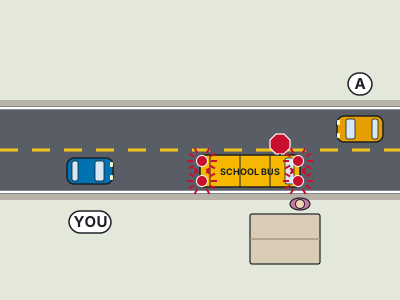
- Slow to 15 mph and pass after checking mirrors
- Stop only when approaching behind the bus
- Pass on the left if no child is visible
- Stop at least 10 feet away until the red signals stop, the arm retracts, and children are safe
Show answer
Stop at least 10 feet away until the red signals stop, the arm retracts, and children are safe. On an undivided Pennsylvania roadway, traffic approaching from either direction must stop for the bus described. The vehicle must remain at least 10 feet away until the red signals stop, the stop arm is withdrawn, and the children have reached a safe place. The two passing options ignore the all-vehicle stopping requirement, while the rear-only option incorrectly excludes oncoming traffic. Use the physical divider exception only on a divided highway separated by a barrier or other median.
Study this in the handbook: School buses, emergency vehicles and the Move Over law
20. Your record dropped below six points and has now reached six or more points for a second time. What must you do?
- Attend a Departmental hearing
- Take the written special point examination again
- Surrender your license for 15 days at once
- Wait for a third accumulation before any action
Show answer
Attend a Departmental hearing. A second rise to six or more points after the record has fallen below that line brings a Departmental hearing. The written special point examination belongs to the first arrival at six points, so repeating it here understates the escalation. Surrender for a fixed period is not the step named for this second accumulation, and waiting for a third ignores the hearing already triggered. Track the pattern rather than the total alone: dipping below six and climbing back changes the response from testing to a hearing. Further accumulations can bring more hearings or suspensions.
Study this in the handbook: Points, insurance and crash duties
Insurance in Pennsylvania
Pennsylvania policies are handled in cooperation with licensed partner producer Sean Vu. QualitySpace Insurance Agency does not bind coverage in Pennsylvania directly. Contact us and we will route you to the right person.
Every question is written from the official Pennsylvania Driver's Manual (PUB 95). Need paper? Printable PA practice test with answer key.
Last verified 2026-10-05. How we check every question · Study all 500 as flashcards
Frequently asked questions
How many questions are on this Pennsylvania practice test?
This fixed set has 20 questions. It is test 14 of 25 from the 500 question Pennsylvania bank. The real PA exam asks 18 questions and you need 15 correct.
What is the passing score for the real Pennsylvania test?
15 of 18 correct to pass the test That figure comes from the official Pennsylvania source cited on the DMV facts page.
How does this fixed test relate to the full Pennsylvania bank?
Each numbered test is a fixed set of questions in a fixed order, so you can retake the same test later and compare. Every test mixes road signs and the other topics in about the same proportion as the full bank. Tests 1 to 25 together cover every question in the Pennsylvania bank once. The full practice page mixes the whole bank at random.
Last verified 2026-10-05. See the Pennsylvania DMV facts page for sourced state details.
Return to the full Pennsylvania practice test · Study road signs