
Test 8 of 25 · 20 questions · Free 2026
PA Permit Practice Test 8
Jump to the test ↓A fixed 20 question set from the Pennsylvania bank with answers and plain English explanations. The real PA exam is 18 questions, 83 percent to pass; take the full length version on the main practice page.
Talk to Kevin
714-666-6669Call now →California policies handled directly by Kevin Vu (CDI #4037122). New Jersey and Pennsylvania policies handled in cooperation with licensed partner producer Sean Vu (Allstate). QualitySpace Insurance Agency does not bind coverage in NJ or PA directly.
Question 1 of 20 · 0 right so far
All 20 questions in test 8
Every question below comes from the Pennsylvania question bank on this page. Open a question to see the correct answer and the explanation. Nothing here is hidden behind a signup.
1. A 19-year-old is convicted of DUI for the first time in Pennsylvania. Which penalties apply?
- Six months probation and a $300 fine
- A warning and an alcohol class
- 2 days to 6 months in jail, a full year suspension, and a fine of $500 to $5,000
- 90 days to 5 years in prison
Show answer
2 days to 6 months in jail, a full year suspension, and a fine of $500 to $5,000. Under Pennsylvania's Zero Tolerance law, a driver under 21 is under the influence at .02 BAC, and a first DUI conviction carries 2 days to 6 months in jail, a full year suspension, and a fine of $500 to $5,000. Those are the High Rate penalties, which apply to under 21 drivers even at low BAC levels. Six months probation and $300 is the adult General Impairment first offense, so it does not apply. A warning understates it, and 90 days to 5 years is for repeat offenders.
Study this in the handbook: DUI, chemical tests and zero tolerance
2. How early may a Pennsylvania vehicle be inspected before its sticker expires?
- Only in the month it expires
- Up to 30 days before
- Up to one year before
- Up to 90 days before the expiration date
Show answer
Up to 90 days before the expiration date. A Pennsylvania vehicle may be inspected up to 90 days before its next expiration date, and inspections are required every 12 months. Waiting for the expiration month is allowed but not required, and 30 days understates the window. One year early would defeat the 12 month cycle. If an officer notices faulty equipment, you may have five days to fix it to avoid a citation, and many counties also require an emissions inspection.
Study this in the handbook: Parking rules and distances
3. A Pennsylvania driver ignores an out-of-state traffic citation. What happens to the Pennsylvania driving privilege?
- Nothing, because the ticket came from another state
- It is suspended indefinitely until the driver responds to the citation
- Two points are added automatically
- It is suspended for exactly 30 days
Show answer
It is suspended indefinitely until the driver responds to the citation. Under the Driver's License Compact, Pennsylvania treats many out of state offenses as if they happened at home. Ignoring an out of state citation leads to an indefinite suspension of the Pennsylvania driving privilege that lasts until the driver responds to the place listed on the citation. Being from another state offers no protection. The consequence is not automatic points or a fixed 30 day suspension; it continues until the response is made.
4. How much space must you leave when passing a bicyclist in Pennsylvania?
- At least two feet
- At least three feet
- At least four feet
- At least six feet
Show answer
At least four feet. Pennsylvania requires at least four feet between your vehicle and a bicycle when passing, and you may cross the center double yellow line to keep that clearance if it is safe. Two feet is far too close. Three feet is the gap the manual suggests bicyclists keep from parked cars to stay out of the door zone, not the passing rule. Six feet is not the legal figure. Drivers also may not turn into the path of a bicyclist going straight.
Study this in the handbook: Parking rules and distances
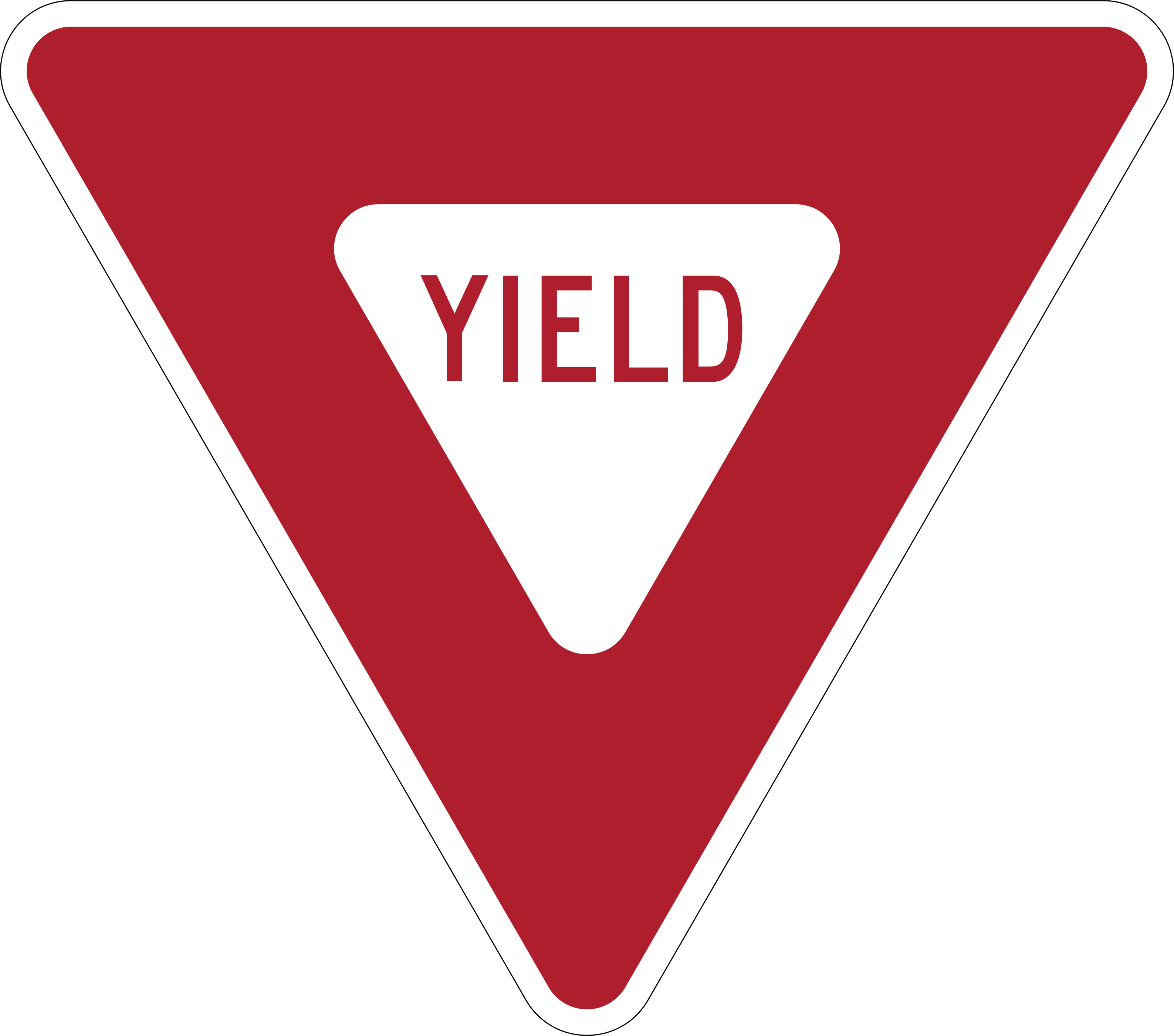
5. At a Pennsylvania YIELD sign, what is the driver’s duty?
- Stop every time for five seconds
- Accelerate to enter before approaching traffic
- Ignore pedestrians if the lane is open
- Slow down, check traffic, and give the right-of-way when needed
Show answer
Slow down, check traffic, and give the right-of-way when needed. A YIELD sign requires the driver to slow down, check for traffic, and give the right-of-way to pedestrians and approaching cross traffic. A complete stop is needed only when conditions require it, so the fixed five-second choice adds an unsupported requirement. Accelerating into a gap can force another road user to brake, and an open lane does not erase pedestrian priority. Look for a sufficient gap, proceed without interfering with normal traffic, and stop if the scan shows that yielding is necessary.
Study this in the handbook: Regulatory, warning and work zone signs
6. Under Pennsylvania rules, who is required to report certain medical conditions that could impair safe driving?
- The driver's employer
- The diagnosing physician
- The driver's insurance company only
- The county court after a crash
Show answer
The diagnosing physician. Pennsylvania places the reporting duty on physicians who diagnose a patient with a condition that could impair safe driving. The rule is not assigned to an employer, an insurer, or a court waiting for a collision. The manual gives conditions such as seizure disorders, diabetes, and heart problems as examples of health issues that can affect driving ability. If a question names a diagnosed condition and asks who reports it, connect that fact to the physician and PennDOT rather than to a workplace or courtroom process.
Study this in the handbook: Space cushion, following distance and scanning
7. A driver under 18 in Pennsylvania who accumulates 6 or more points, or is convicted of driving 26 mph or more over the posted limit, faces what mandatory suspension for a first occurrence?
- 90-day suspension
- 120-day suspension
- 1-year suspension
- 30-day suspension
Show answer
90-day suspension. A driver under 18 receives a mandatory 90-day suspension for a first occurrence involving six or more points, or a conviction for driving at least 26 mph over the posted limit. The 120-day period applies to additional occurrences, while 30 days and one year are not the periods specified here. Do not confuse this young-driver consequence with the separate adult point-examination process. When the question says first occurrence, select 90 days and remember the repeat increase to 120 days.
Study this in the handbook: Points, insurance and crash duties
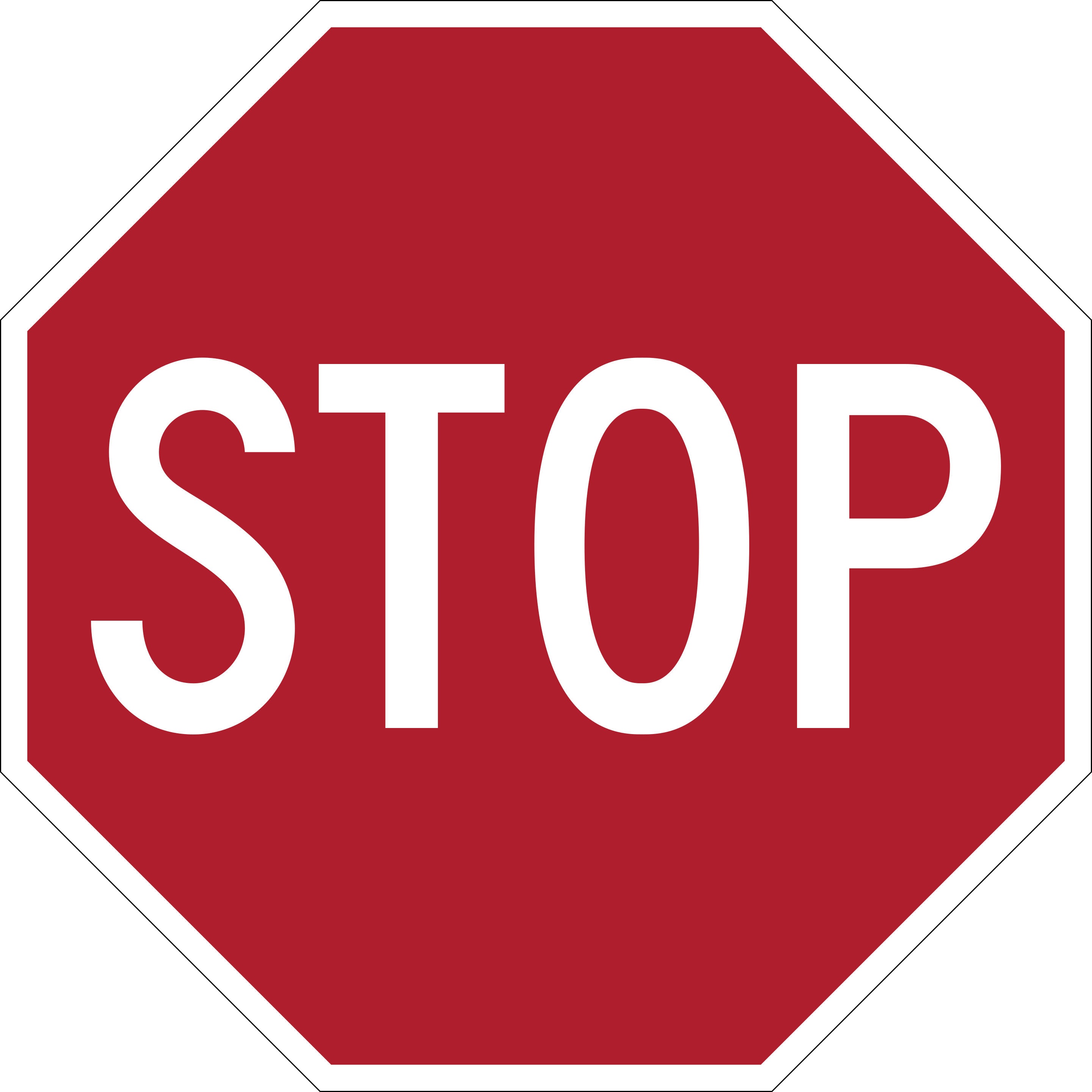
8. A red, eight-sided sign appears ahead. What action does its shape identify?
- Yield to traffic without stopping
- Stop
- Do not enter the roadway
- Railroad crossing ahead
Show answer
Stop. The STOP sign is the only octagon-shaped, eight-sided sign used on the highway, so the shape alone tells you to stop. It is not a yield sign, a prohibition against entering, or a railroad advance warning. At the sign you must stop completely; slowing down without a full stop is illegal. When there is a crosswalk or stop line, stop before the front of your vehicle reaches the first painted line. Then check for pedestrians and cross traffic, and go only when the intersection is clear.
Study this in the handbook: Regulatory, warning and work zone signs
9. You fail the Pennsylvania Knowledge Test. When may you take it again?
- The following business day, since the test may be taken only once per day
- Immediately, at a different Driver License Center
- After seven days
- After 30 days
Show answer
The following business day, since the test may be taken only once per day. A failed Pennsylvania Knowledge Test can be retaken the following business day. The manual adds that the test may be taken only one time on any day regardless of location, so driving to another center for a same day retry does not work. Seven days is the wait for a failed Road Test by someone under 18, not the knowledge test. Thirty days is not a Pennsylvania waiting period. Bring your application and consent forms back with you.
Study this in the handbook: Learner's permit, knowledge test and road test
10. After a tire blowout, what should a Pennsylvania driver do first?
- Hold the steering wheel tightly and stay off the brake
- Steer sharply onto the shoulder
- Brake hard to stop before the tire comes apart
- Accelerate to stabilize the damaged tire
Show answer
Hold the steering wheel tightly and stay off the brake. A blowout can pull the vehicle or make one corner drop, so the first response is to keep firm control of the steering wheel. Pennsylvania warns drivers to stay off the brake because braking after the blowout can cause a skid and loss of control. A sharp move toward the shoulder adds a steering disturbance, and acceleration does not repair the tire. After stabilizing the direction, ease off the gas, steer smoothly, and use gentle braking only when the vehicle has slowed.
Study this in the handbook: Skids, blowouts, floods and brake trouble
11. What does the Pennsylvania manual count as one drink?
- A 16 ounce beer
- Two shots
- Any amount under 8 ounces
- 1.5 ounces of 80 proof liquor, 12 ounces of beer or 5 ounces of wine
Show answer
1.5 ounces of 80 proof liquor, 12 ounces of beer or 5 ounces of wine. Pennsylvania's manual says you should consider one drink to be 1.5 ounces of 80 proof liquor, 12 ounces of regular beer, or 5 ounces of wine. A 16 ounce beer and two shots are both more than one drink, and there is no rule that any amount under 8 ounces counts as one. The manual also warns that small amounts matter: a 110 pound female reaches a .03 BAC after just 8 ounces of light beer, and a 140 pound male reaches .025 after a full 12 ounce light beer. It takes an average person at least an hour to process each drink.
Study this in the handbook: DUI, chemical tests and zero tolerance
12. What should you do if traffic ahead leaves you without enough room to clear a railroad crossing?
- Follow the vehicle ahead onto the crossing
- Enter and stop on the tracks
- Wait before driving onto the tracks
- Use the shoulder to bypass the queue
Show answer
Wait before driving onto the tracks. A driver must have enough room to get completely across the tracks before entering a railroad crossing. If traffic slows ahead, wait for it to clear rather than becoming trapped. Stopping on the tracks or blindly following another vehicle creates a direct collision risk, and using the shoulder is not a safe workaround. Look beyond the rails, judge the available exit space, and move only when your vehicle can leave the crossing without stopping.
Study this in the handbook: Motorcycles, bicycles, trucks and pedestrians
13. When the roadway is wet or visibility is poor, how should a Pennsylvania driver respond to the posted speed limit?
- Treat the posted number as a required minimum
- Drive below the posted limit
- Keep the same speed unless a police car is present
- Use the posted limit only after visibility improves
Show answer
Drive below the posted limit. Pennsylvania says drivers should travel below the posted speed limit when the road is wet or slippery, visibility is reduced, or another condition is less than perfect. The posted number is not a promise that the same speed is safe in every environment. Waiting for police enforcement or for visibility to improve delays the needed adjustment. Read the surface and sight distance early, ease off the accelerator, and select a speed that leaves enough room to stop and stay in control.
Study this in the handbook: Speed, night driving and bad weather
14. What share of Pennsylvania's roughly 1,500 yearly highway deaths are attributed to aggressive driving?
- About 5 percent
- About 60 percent, around 900 deaths
- About 25 percent
- Nearly all
Show answer
About 60 percent, around 900 deaths. Of the approximately 1,500 highway deaths in Pennsylvania each year, about 60 percent, or around 900, are attributed to aggressive driving. The manual's advice is not to retaliate or try to teach another driver a lesson. If you meet an aggressive driver, make every attempt to get out of the way, avoid eye contact, do not block the passing lane, and call the police or 911 only if you have a hands free device and can do it safely, or have a passenger call. If the driver pursues you, go to a police station rather than home.
Study this in the handbook: Skids, blowouts, floods and brake trouble
15. What must you do before passing another vehicle in Pennsylvania?
- Check mirrors and blind spots for a vehicle already passing you
- Rely only on the rearview mirror
- Move out immediately if the passing lane looks empty ahead
- Sound the horn and ignore the side mirrors
Show answer
Check mirrors and blind spots for a vehicle already passing you. Before beginning a pass, Pennsylvania directs the driver to check the side and rearview mirrors and quickly inspect blind spots for vehicles that may already be passing. Looking only ahead does not reveal a vehicle beside or behind you, and a horn cannot replace a visual check. Make sure the passing lane is clear in front, behind, and beside your vehicle, then signal before changing lanes. This short scan prevents a lane change into another driver who has already started to pass.
Study this in the handbook: Signaling, turning, U-turns and passing
16. When you can either brake or steer to avoid a collision, which does the Pennsylvania manual usually prefer, especially above 25 mph?
- Braking hard, because steering is never safe
- Shifting into neutral
- Doing nothing and bracing for impact
- Steering to avoid the hazard
Show answer
Steering to avoid the hazard. When you have a choice between braking and steering to avoid a collision, the manual says it is usually better to steer around the hazard than to brake, particularly at speeds above 25 mph, because your reaction time to swerve is faster than your reaction time to brake. Braking is not always wrong, but at higher speeds the stopping distance can be too long. Doing nothing is the worst option; in a review of 12,000 crashes, 37 percent of drivers took no avoiding action. Shifting into neutral does not steer you out of danger.
Study this in the handbook: Skids, blowouts, floods and brake trouble
17. To pass on a two-lane road, about how much faster than the vehicle being passed do you need to travel?
- About 2 mph faster
- About 25 mph faster
- About 10 mph faster
- The same speed is enough
Show answer
About 10 mph faster. Passing on a two-lane road means using the oncoming lane, so the pass must be quick. The Pennsylvania manual says you need to be going about 10 mph faster than the vehicle or vehicles you are passing, and at 45 mph that works out to about a quarter mile of clear road. Two mph faster would keep you in the oncoming lane far too long, and matching speed would never get you past. Twenty five mph faster is not the guidance and would push you well over most speed limits.
Study this in the handbook: Signaling, turning, U-turns and passing
18. You are driving 35 mph or faster in Pennsylvania. How far before a turn must you signal?
- At least 50 feet
- At least 1,000 feet
- At least 100 feet
- At least 300 feet
Show answer
At least 300 feet. Pennsylvania ties the signaling distance to your speed. Below 35 mph you must signal at least 100 feet before turning, and at 35 mph or more you must signal at least 300 feet before turning. At higher speeds the extra distance gives drivers behind you time to react. One hundred feet is the rule only for slower speeds, 50 feet is too short at any speed, and 1,000 feet is not the legal figure. A signal tells others what you plan to do but does not give you the right to turn.
Study this in the handbook: Signaling, turning, U-turns and passing
19. How far ahead of a Pennsylvania work zone may warning signs, advance warning vehicles or message boards be placed?
- At least 5 miles before the work zone
- Exactly 20 feet before the work zone
- Only inside the work zone
- A minimum of 200 feet before the work zone
Show answer
A minimum of 200 feet before the work zone. Work zones are marked with orange cones and other temporary traffic control devices, and you may meet a flagger in reflective clothing. Warning signs, advance warning vehicles or variable message boards may be placed a minimum of 200 feet before a work zone. When you see the first sign, pay strict attention to the road, vehicles, equipment and people ahead. Twenty feet would give no warning, the signs are meant to appear before the zone rather than only inside it, and five miles is not the stated figure.
20. How much open space should you keep on at least one side of your vehicle as an escape path?
- At least eight feet
- At least two feet
- At least 20 feet
- No side space is needed if you keep four seconds ahead
Show answer
At least eight feet. Pennsylvania's space management advice says to keep as much room as possible beside your vehicle. If you do not have at least eight feet of space on at least one side to use as an escape path, you need to allow more space to the front by increasing your following distance. Two feet is too narrow to steer into, and 20 feet is far more than the manual asks for. Side space and following distance work together, so a good gap ahead does not excuse being boxed in.
Study this in the handbook: Space cushion, following distance and scanning
Insurance in Pennsylvania
Pennsylvania policies are handled in cooperation with licensed partner producer Sean Vu. QualitySpace Insurance Agency does not bind coverage in Pennsylvania directly. Contact us and we will route you to the right person.
Every question is written from the official Pennsylvania Driver's Manual (PUB 95). Need paper? Printable PA practice test with answer key.
Last verified 2026-10-05. How we check every question · Study all 500 as flashcards
Frequently asked questions
How many questions are on this Pennsylvania practice test?
This fixed set has 20 questions. It is test 8 of 25 from the 500 question Pennsylvania bank. The real PA exam asks 18 questions and you need 15 correct.
What is the passing score for the real Pennsylvania test?
15 of 18 correct to pass the test That figure comes from the official Pennsylvania source cited on the DMV facts page.
How does this fixed test relate to the full Pennsylvania bank?
Each numbered test is a fixed set of questions in a fixed order, so you can retake the same test later and compare. Every test mixes road signs and the other topics in about the same proportion as the full bank. Tests 1 to 25 together cover every question in the Pennsylvania bank once. The full practice page mixes the whole bank at random.
Last verified 2026-10-05. See the Pennsylvania DMV facts page for sourced state details.
Return to the full Pennsylvania practice test · Study road signs