
Test 3 of 25 · 20 questions · Free 2026
PA Permit Practice Test 3
Jump to the test ↓A fixed 20 question set from the Pennsylvania bank with answers and plain English explanations. The real PA exam is 18 questions, 83 percent to pass; take the full length version on the main practice page.
Talk to Kevin
714-666-6669Call now →California policies handled directly by Kevin Vu (CDI #4037122). New Jersey and Pennsylvania policies handled in cooperation with licensed partner producer Sean Vu (Allstate). QualitySpace Insurance Agency does not bind coverage in NJ or PA directly.
Question 1 of 20 · 0 right so far
All 20 questions in test 3
Every question below comes from the Pennsylvania question bank on this page. Open a question to see the correct answer and the explanation. Nothing here is hidden behind a signup.
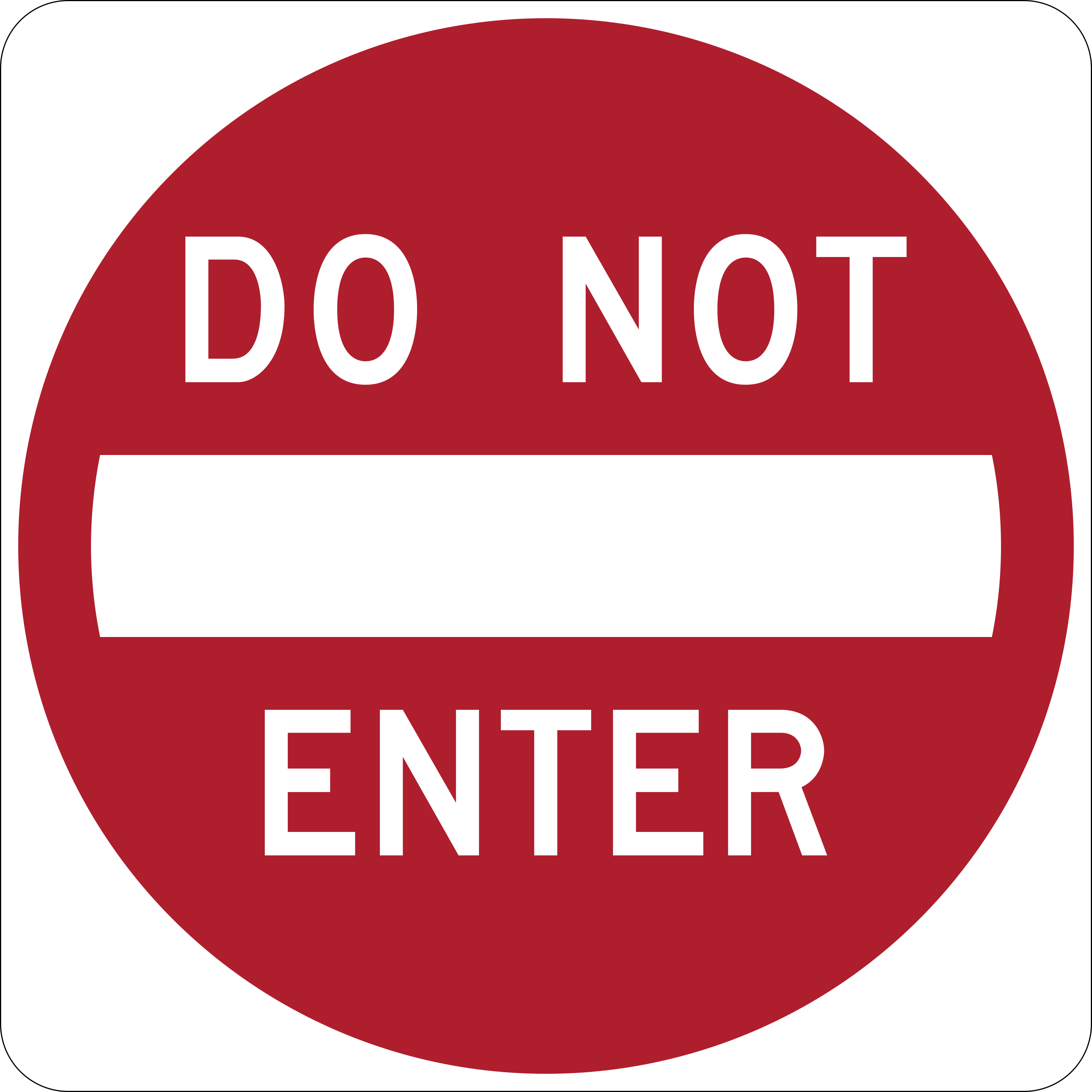
1. A red and white DO NOT ENTER sign is placed at the beginning of what type of roadway access?
- A parking area where vehicles may enter only during daylight
- A two-way roadway where trucks must use the shoulder
- A one-way street or ramp entered from the prohibited direction
- A dead-end street that is open only to local residents
Show answer
A one-way street or ramp entered from the prohibited direction. DO NOT ENTER marks the beginning of a one-way street or ramp in the direction the driver is facing. Entering there would place the vehicle against the authorized flow, creating a head-on collision risk. The parking and dead-end descriptions concern different roadway information and do not explain the red and white prohibition. Look for the sign at a ramp mouth or the start of a one-way route, and choose another legal approach before proceeding.
Study this in the handbook: Pavement markings and lane use signs
2. What occurs when a Pennsylvania driver's tires hydroplane on a wet roadway?
- The engine overheats because water enters the radiator
- The brakes gain extra traction from standing water
- The tires lose grip and ride like skis on a film of water
- The vehicle slips only because the steering wheel is misaligned
Show answer
The tires lose grip and ride like skis on a film of water. Hydroplaning is a loss of tire grip in which the tires ride like skis on a film of water. Speed makes the tires less effective at wiping water away, and the manual notes that the problem can begin at 35 mph when water is only one tenth of an inch deep. A blowout, overheating, or misalignment describes a different problem. Reduce speed on wet pavement, especially when tire tread is worn.
Study this in the handbook: Speed, night driving and bad weather
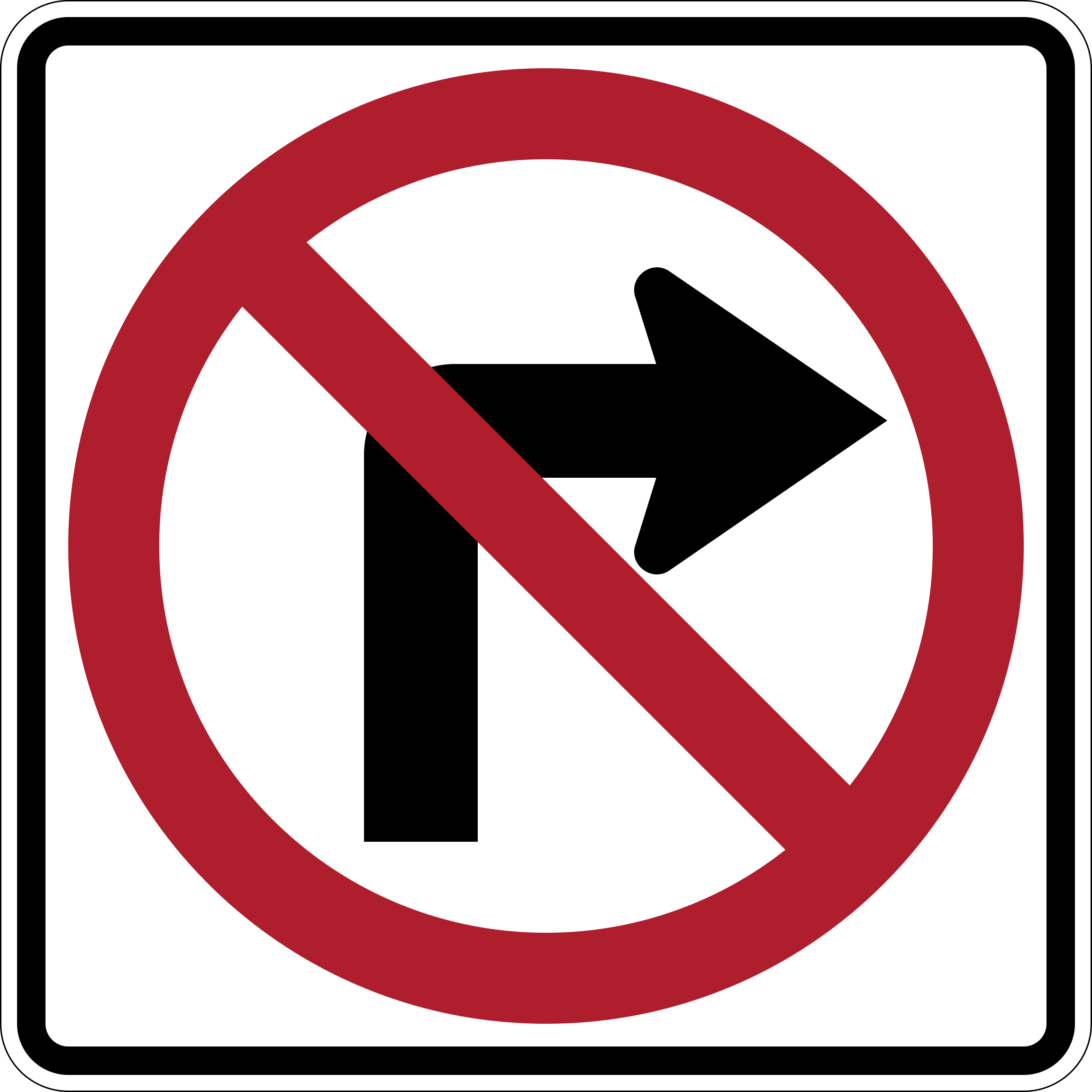
3. A red slash over a right-turn arrow means a driver may not do what?
- Travel straight through the intersection
- Make a right turn at that intersection
- Park on the right side of the street
- Turn left after yielding to pedestrians
Show answer
Make a right turn at that intersection. The right-turn symbol with a red slash indicates that right turns are prohibited at the intersection. The manual's instruction is specific to the movement drawn, so it does not ban straight travel, regulate ordinary parking, or prohibit a left turn shown by a different symbol. A useful test cue is to name the arrow direction before reading the slash as a restriction. Keep the vehicle on a permitted path and follow any separate signal or lane-control instruction that applies.
Study this in the handbook: Pavement markings and lane use signs
4. What does Pennsylvania's driver manual list as the minimum penalty for underage drinking?
- Exactly $100 with no court costs
- Up to $500 plus court costs
- Up to $1,000 and an automatic two-year suspension
- A warning unless a vehicle was involved
Show answer
Up to $500 plus court costs. For a person under 21, Pennsylvania makes buying, consuming, possessing alcohol, or having it in the vehicle unlawful. The minimum penalty described in the manual is a fine of up to $500 plus court costs. The $100 option changes the amount, and the warning option wrongly makes the rule depend on driving. The manual also notes possible evaluation and alcohol education, so the consequence is not limited to a traffic stop. Remember that this rule applies even when no vehicle is involved.
Study this in the handbook: DUI, chemical tests and zero tolerance
5. What share of 16 year old Pennsylvania drivers were in reportable crashes in 2017?
- 50 percent
- 0.5 percent
- 7.2 percent
- 25 percent
Show answer
7.2 percent. For 2017, 7.2 percent of all 16 year old Pennsylvania drivers were in reportable crashes in the state, and in over one third of crashes involving 16 year olds the teen was pulling out from a stop sign or turning left across traffic. About 92 percent of crashes and 93 percent of crash deaths come from just four crash types, which the manual's driving skills section targets.
Study this in the handbook: Space cushion, following distance and scanning
6. After establishing Pennsylvania residency, how soon must a new resident obtain a Pennsylvania driver's license?
- Within 15 days
- Within 60 days
- At the next annual vehicle inspection
- Within 30 days
Show answer
Within 60 days. A person who moves into Pennsylvania and establishes residency must obtain a Pennsylvania driver's license within 60 days and surrender the out-of-state license. Fifteen and 30 days are shorter intervals that do not match this resident-transfer rule, and inspection timing is unrelated to licensing. The clock begins with the move and establishment of Pennsylvania residency, not with the next renewal date from the former state. Remember 60 days as the transition window for the driver's license.
Study this in the handbook: Learner's permit, knowledge test and road test
7. What is the maximum fine for littering from a vehicle in Pennsylvania?
- Up to $25
- Up to $300
- Up to $100
- Up to $5,000
Show answer
Up to $300. Pennsylvania's anti littering law allows a fine of up to $300 on conviction. The driver can be fined even when a passenger does the littering, because the law covers conduct by others in the vehicle. Twenty five dollars and $100 understate the maximum, and $5,000 is far above it. The law covers dropping trash on highways, on public or private property without consent, and into the state's waters.
Study this in the handbook: Parking rules and distances
8. What fine range applies in Pennsylvania for unlawfully parking in a space for persons with disabilities?
- $10 to $25
- $300 to $500
- $50 to $200
- $1,000 to $2,500
Show answer
$50 to $200. Parking unlawfully in a Pennsylvania disabled parking area is a summary offense with a fine between $50 and $200, and the vehicle may be towed and released only after the towing costs are paid. Ten to 25 dollars is too low. Three hundred to five hundred dollars is not this offense, and $1,000 and $2,500 are the fines for adults who knowingly supply alcohol to minors. Parking there legally requires a disabled plate or placard and that the vehicle be operated by or for the disabled person.
Study this in the handbook: Parking rules and distances
9. After how long of driving on a junior license may the passenger limit increase to no more than three non-family passengers under age 18?
- After the first 30 days
- After the first six months
- Only after turning 21
- After one full year
Show answer
After the first six months. Pennsylvania increases the junior-license limit to no more than three passengers under age 18 who are not immediate family members after the driver has completed the first six months of driving on that license. The one-month and one-year choices use time periods not stated for this increase, while turning 21 is unrelated to the junior-license milestone. The increase also has an important qualification: it does not apply if the junior driver has been partly or fully responsible for a crash or has been convicted of a driving violation. Check the six-month mark and the driver’s record together.
Study this in the handbook: Junior permit and junior license limits
10. What is Pennsylvania's maximum speed limit under the posted-speed guidance in PUB 95?
- 55 mph
- 75 mph
- 65 mph
- 70 mph
Show answer
70 mph. Pennsylvania's manual identifies 70 mph as the maximum speed limit in the state. That does not mean every interstate or rural highway automatically permits 70; drivers must follow the number posted for that roadway and reduce speed when conditions are poor. The 55 and 65 choices are lower limits that may appear on particular roads, while 75 exceeds the statewide maximum cited here. Use the posted sign at the location, with 70 as the ceiling described in this section.
Study this in the handbook: Speed, night driving and bad weather
11. What should a driver do after missing a highway exit in Pennsylvania?
- Take the next exit
- Cross the median and turn around
- Swerve across lanes at the last second
- Stop and back up on the highway
Show answer
Take the next exit. If you miss an exit, Pennsylvania directs you to take the next one. Stopping or backing on the highway, crossing the median, or swerving across several lanes can cause a high-speed collision and is illegal or hazardous. Continue with the traffic flow, maintain control, and use the next exit to reroute. The cue is simple: a missed ramp is a navigation problem, not an emergency that justifies reversing or making a sudden cross-lane maneuver.
Study this in the handbook: Signaling, turning, U-turns and passing
12. A first-time DUI offender is accepted into Pennsylvania's Accelerated Rehabilitative Disposition (ARD) program. How many hours of Alcohol Highway Safety School must the offender attend?
- 2 hours
- 100 hours
- 40 hours
- 12 and a half hours
Show answer
12 and a half hours. Pennsylvania's manual lists what a driver accepted into the ARD program must do: lose the license for up to 90 days, undergo alcohol and drug evaluation, remain under court supervision for six months, undergo rehabilitation treatment if necessary, participate in 12 and a half hours of Alcohol Highway Safety School, and pay a fine of $300 to $5,000 plus fees. Two hours is far too little, and 40 or 100 hours overstate it. Outside ARD, the manual adds that alcohol highway safety school is required for first or second DUI offenses at any level of impairment.
13. What should a Pennsylvania driver do during heavy fog?
- Pull off the road if possible and wait for visibility to improve
- Stop in the travel lane with no lights
- Follow the vehicle ahead more closely
- Use high beams and continue at the normal speed
Show answer
Pull off the road if possible and wait for visibility to improve. Pennsylvania recommends getting off the road, preferably into a parking lot, and waiting when fog makes travel unsafe. Continuing at normal speed with high beams can worsen glare and shorten the usable view, while stopping unlit in a lane creates a collision target. Following closely removes stopping space. If you must continue briefly, slow enough to stop within what you can see, use low beams, and choose a safe place to wait rather than pressing into dense fog.
Study this in the handbook: Speed, night driving and bad weather
14. What must a Pennsylvania driver do at the yield line before entering a roundabout?
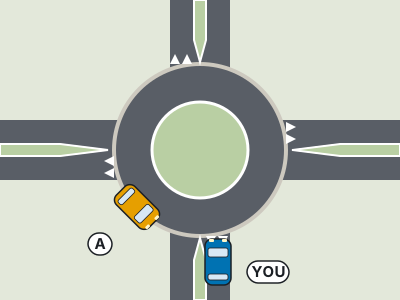
- Yield to circulating traffic and enter only when there is an adequate gap
- Enter immediately because entering traffic has priority
- Use the truck apron to bypass the yield line
- Stop in the circle and wait for entering traffic to clear
Show answer
Yield to circulating traffic and enter only when there is an adequate gap. Every Pennsylvania roundabout entry has a YIELD sign and a yield line painted on the pavement. Pull up to the yield line, look to your left, and give the right-of-way to traffic already circulating, then enter only when there is an adequate gap. Entering traffic has no priority, and the manual tells drivers never to stop in the roundabout itself. Traffic moves counterclockwise, so the vehicles you yield to approach from your left. The manual also notes that failing to yield before entering is the most frequent cause of roundabout crashes.
Study this in the handbook: Right of way at intersections and roundabouts
15. When this LANE ENDS sign appears, what must drivers in the closing lane anticipate?

- A new lane will open and traffic may spread across both lanes
- The right lane becomes a shoulder reserved for emergency vehicles
- The lane may continue indefinitely if the driver maintains speed
- Their lane will end ahead and they must merge into the remaining lane
Show answer
Their lane will end ahead and they must merge into the remaining lane. A LANE ENDS sign warns that one lane on a multilane roadway will end ahead. In the manual's example, vehicles in the right lane must merge left. The sign does not announce a new lane, convert the lane into an emergency shoulder, or allow it to continue past the point where markings end. Signal early, check mirrors and blind spots, and select a safe gap before the lane narrows. The warning is time to merge smoothly, not permission to wait until the last moment.
16. When following a horse-drawn vehicle in Pennsylvania, what spacing practice is important?
- Leave plenty of room because the vehicle may roll backward after stopping
- Sound the horn repeatedly to keep the horse moving
- Pass immediately before the vehicle reaches a hill
- Follow closely so the driver can see your headlights
Show answer
Leave plenty of room because the vehicle may roll backward after stopping. The manual advises leaving plenty of room behind a horse-drawn vehicle because it can roll backward after stopping. Following closely reduces the other driver’s ability to see you and leaves little room to pass safely. Repeated horn use can frighten the horse, and passing before a hill is not a general safety rule. Keep a generous gap, approach quietly, and wait for a clear opportunity if passing is permitted. The cue is the possibility of backward movement after a stop.
Study this in the handbook: School buses, emergency vehicles and the Move Over law
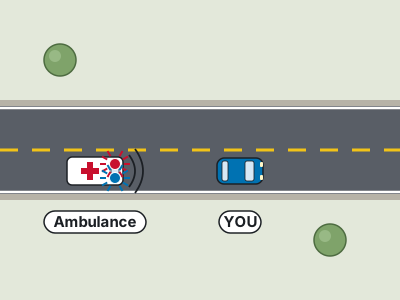
17. What action is required when an emergency vehicle approaches with flashing red or red-and-blue lights?
- Continue in the lane because the emergency vehicle can pass
- Follow the emergency vehicle closely after it passes
- Stop in the center of the intersection
- Pull to the curb or side of the road and stop, staying clear of intersections
Show answer
Pull to the curb or side of the road and stop, staying clear of intersections. When an emergency vehicle approaches with flashing red or red-and-blue lights, Pennsylvania drivers must pull toward the curb or roadside and stop. They should drive parallel and as near to the curb as possible, remain clear of intersections, and wait until the vehicle passes. Stopping in an intersection blocks the emergency route, while following closely violates the required 500-foot gap after passage. Notice the lights early, signal your move, and stay stopped until the route is clear.
Study this in the handbook: School buses, emergency vehicles and the Move Over law
18. When a school bus is stopped with red lights flashing and its stop arm extended, when may opposing traffic continue?
- When no children are visible near the bus
- When the driver can pass at less than 15 mph
- When following traffic is close behind
- When traveling on the opposite side of a divided highway
Show answer
When traveling on the opposite side of a divided highway. The school-bus stopping rule has one exception. If the bus is on the opposite side of a divided highway separated by a concrete or metal barrier, guide rail, or a median such as grass, the approaching driver does not have to stop. The driver must still reduce speed and continue with caution. Visibility of children, a low passing speed, or pressure from following traffic does not create an exception. First identify the flashing red lights and extended arm, then look for a physical separation between roadways.
Study this in the handbook: School buses, emergency vehicles and the Move Over law
19. In what situations were over a third of Pennsylvania crashes involving 16 year old drivers occurring?
- Pulling out from a stop sign or turning left across traffic
- Backing out of driveways
- Parallel parking
- Driving on interstates
Show answer
Pulling out from a stop sign or turning left across traffic. In over one third of the crashes involving 16 year old drivers in Pennsylvania, the teen driver was pulling out from a stop sign or turning left across traffic. That is why the manual calls intersections places where teenage drivers have a high percentage of their crashes. The law does not give anyone the right of way at intersections; it only says who must yield, and drivers turning left must yield to oncoming vehicles going straight ahead. Backing, parallel parking, and interstate driving are not the situations this teen crash fact names.
Study this in the handbook: Right of way at intersections and roundabouts
20. Which Pennsylvania violation is listed with a 30-day suspension?
- Failure to stop for a school bus with its stop arm extended
- Driving 26 mph over the limit while under 18
- Failure to comply with a railroad crossing gate or barrier
- Failure to comply with the Move Over Law
Show answer
Failure to comply with a railroad crossing gate or barrier. The driving-record list assigns a 30-day suspension to failure to comply with a railroad crossing gate or barrier. The school-bus violation is paired with a 60-day suspension, so its presence in the same list can make it an easy number to confuse. The speeding choice is not the listed match, and the Move Over entry does not provide this 30-day figure in the quoted passage. A lowered gate or active barrier means stop and wait for the crossing to reopen.
Study this in the handbook: Points, insurance and crash duties
Insurance in Pennsylvania
Pennsylvania policies are handled in cooperation with licensed partner producer Sean Vu. QualitySpace Insurance Agency does not bind coverage in Pennsylvania directly. Contact us and we will route you to the right person.
Every question is written from the official Pennsylvania Driver's Manual (PUB 95). Need paper? Printable PA practice test with answer key.
Last verified 2026-10-05. How we check every question · Study all 500 as flashcards
Frequently asked questions
How many questions are on this Pennsylvania practice test?
This fixed set has 20 questions. It is test 3 of 25 from the 500 question Pennsylvania bank. The real PA exam asks 18 questions and you need 15 correct.
What is the passing score for the real Pennsylvania test?
15 of 18 correct to pass the test That figure comes from the official Pennsylvania source cited on the DMV facts page.
How does this fixed test relate to the full Pennsylvania bank?
Each numbered test is a fixed set of questions in a fixed order, so you can retake the same test later and compare. Every test mixes road signs and the other topics in about the same proportion as the full bank. Tests 1 to 25 together cover every question in the Pennsylvania bank once. The full practice page mixes the whole bank at random.
Last verified 2026-10-05. See the Pennsylvania DMV facts page for sourced state details.
Return to the full Pennsylvania practice test · Study road signs