
Test 10 of 25 · 20 questions · Free 2026
PA Permit Practice Test 10
Jump to the test ↓A fixed 20 question set from the Pennsylvania bank with answers and plain English explanations. The real PA exam is 18 questions, 83 percent to pass; take the full length version on the main practice page.
Talk to Kevin
714-666-6669Call now →California policies handled directly by Kevin Vu (CDI #4037122). New Jersey and Pennsylvania policies handled in cooperation with licensed partner producer Sean Vu (Allstate). QualitySpace Insurance Agency does not bind coverage in NJ or PA directly.
Question 1 of 20 · 0 right so far
All 20 questions in test 10
Every question below comes from the Pennsylvania question bank on this page. Open a question to see the correct answer and the explanation. Nothing here is hidden behind a signup.
1. After passing a bicyclist in Pennsylvania, what should you avoid doing immediately?
- Checking the rearview mirror
- Slowing or stopping quickly
- Maintaining a steady course
- Leaving room before returning
Show answer
Slowing or stopping quickly. Pennsylvania warns drivers not to slow down or stop quickly immediately after passing a bicyclist. The cyclist may still be close behind and could collide with the vehicle when its speed changes suddenly. Checking mirrors, holding a steady course, and leaving space are compatible with a safe pass. Once clear, continue smoothly long enough for the bicyclist to regain a safe following distance, then make any needed speed change gradually.
Study this in the handbook: Motorcycles, bicycles, trucks and pedestrians
2. At a steady red light, when may a driver turn right in Pennsylvania?
- Without slowing when cross traffic is absent
- After stopping and yielding, unless a NO TURN ON RED sign prohibits it
- Only when a police officer waves the driver through
- Only after waiting through two green cycles
Show answer
After stopping and yielding, unless a NO TURN ON RED sign prohibits it. A right turn on red is permitted only after the driver stops, checks for pedestrians and other traffic, and yields, unless a NO TURN ON RED sign is posted. The open-road choice skips the required stop, while waiting for extra cycles invents a condition the manual does not require. A police officer can direct traffic, but the ordinary rule does not depend on an officer being present. The practical sequence is stop, scan, yield, then turn when the intersection is clear.
Study this in the handbook: Traffic signals and lane signals
3. When law enforcement may not be present, who may report Move Over Law violations to Pennsylvania authorities?
- Road workers and emergency responders
- Only passing motorists who witnessed the event
- Only the driver who was stopped at the scene
- Any pedestrian who saw a traffic signal change
Show answer
Road workers and emergency responders. Pennsylvania allows road workers and emergency responders to report Move Over Law violations when law enforcement may not be present. The rule gives those people a reporting role because they are directly involved in or protecting the emergency response area. A passing motorist, a stopped driver, or a pedestrian is not the group identified in this passage. Watch for responders and marked activity, move into a nonadjacent lane when possible, and remember that a report can support enforcement even when an officer is not immediately on site.
Study this in the handbook: School buses, emergency vehicles and the Move Over law
4. What share of Pennsylvania flooding deaths since 2006 were related to vehicles, according to the CDC?
- Almost none
- Nearly half
- Nearly all
- About 10 percent
Show answer
Nearly half. According to the Centers for Disease Control and Prevention, since 2006 nearly half of all flooding deaths reported in Pennsylvania were related to vehicles. Never drive into water covering the road; once a vehicle floats off the roadway into deeper water, it may roll and fill with water, trapping the people inside. Turn around and find another route, and if the car stalls in rising water, abandon it for higher ground.
Study this in the handbook: Skids, blowouts, floods and brake trouble
5. On wet Pennsylvania roads, what following interval is advised after reducing speed?
- Reduce the gap to two seconds
- Keep exactly four seconds in every condition
- Increase the gap to five or six seconds
- Follow one car length behind
Show answer
Increase the gap to five or six seconds. The manual gives a concrete wet-road adjustment: reduce speed by 5 to 10 miles per hour and increase following distance to five or six seconds. A two-second gap is too short for the longer stopping distance, and a fixed four-second interval ignores the added space Pennsylvania calls for on wet pavement. Car lengths vary with speed, so they are not a dependable substitute for time. Start counting when the vehicle ahead passes a fixed object, and add room before conditions worsen.
Study this in the handbook: Speed, night driving and bad weather
6. How much more likely are you to die in a crash with a train than with another vehicle, according to the Pennsylvania manual?
- Twice as likely
- About the same
- 40 times more likely
- 10 times more likely
Show answer
40 times more likely. You are 40 times more likely to die in a crash involving a train than in a crash with another vehicle, and most crossings are protected only by an advance warning sign and a crossbuck. Slow down, look and listen at every crossing, never drive around lowered gates, and never stop on the tracks. Most crossings do not have gates, so be especially alert at every one.
Study this in the handbook: Motorcycles, bicycles, trucks and pedestrians
7. Inside a Pennsylvania roundabout, what must a motorist do when a bicyclist is using the roadway?
- Pass on the inside whenever the lane is wide enough
- Do not pass the bicyclist within the roundabout
- Sound the horn until the bicyclist moves aside
- Force the bicyclist onto the shoulder before exiting
Show answer
Do not pass the bicyclist within the roundabout. Pennsylvania's roundabout rules tell motorists to never overtake a bicyclist acting as a vehicle in a roundabout. A rider acting as a vehicle follows the same rules as other traffic, so a motorist stays behind the bicycle in the circulating flow. Extra lane width does not create permission to pass, and a horn cannot replace the no-overtaking rule. Forcing the rider toward the edge defeats the same purpose. Slow behind the bicycle, signal right as you approach your exit, and pass only after you have both left the roundabout and it is safe to do so.
8. How high should the top of a Pennsylvania driver’s head restraint be adjusted?
- Below the base of the neck
- At shoulder height
- At least as high as the top of the driver’s ears
- At the level of the driver’s chin
Show answer
At least as high as the top of the driver’s ears. The manual says to adjust the head restraint so its top is at least as high as the top of your ears. That position helps cushion the back of the head and can reduce neck injuries in a crash. Shoulder height or a low neck-level setting leaves the head less supported, while chin height is not the stated reference. Set the seat first, then raise or lower the restraint until its top reaches the ear line before driving.
Study this in the handbook: Space cushion, following distance and scanning
9. After a full day and night without sleep, a driver is impaired about as much as someone with what blood alcohol level?
- .02 percent
- .05 percent
- .08 percent
- .10 percent
Show answer
.10 percent. Fatigue affects driving much like alcohol. The Pennsylvania manual says being awake for 18 hours impairs you about as much as a .05 percent blood alcohol level, and being awake for 24 hours in a row impairs you as much as a .10 percent level, which is above the adult legal limit of .08. So .05 is the 18 hour comparison, not the 24 hour one, and .02 and .08 do not match either figure. The best response to tiredness at the wheel is to stop driving.
Study this in the handbook: Space cushion, following distance and scanning
10. Where does Pennsylvania post a LOW SHOULDER sign?
- Where parking on the shoulder is allowed
- Where the shoulder is wider than the travel lane
- Where the shoulder is as much as three inches below the road
- Where the shoulder ends at a bridge
Show answer
Where the shoulder is as much as three inches below the road. Shoulder signs warn that the shoulder is lower than the road or soft and unpaved. The LOW SHOULDER sign is used where the shoulder is as much as three inches below the road level, and the SHOULDER DROP OFF sign marks even steeper drops. If a wheel slips onto a low or soft shoulder, do not slam on the brakes or steer sharply back, because you can easily lose control. The sign says nothing about shoulder width, parking, or bridges.
11. A yellow diamond warning sign shows two arrows pointing in opposite directions. What does this TWO-WAY TRAFFIC AHEAD sign tell you?
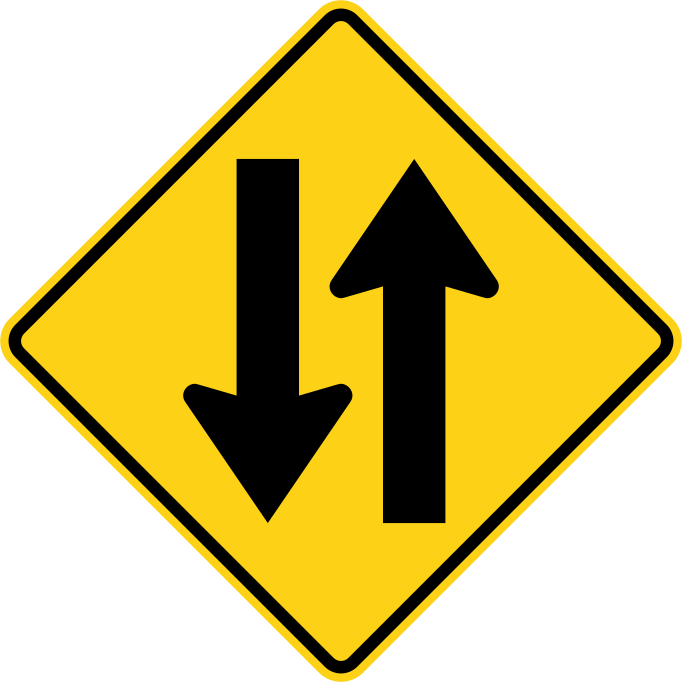
- The one-way road is ending and two-way traffic begins ahead
- Passing is allowed on both sides
- A divided road is ahead
- A U-turn is required at the next intersection
Show answer
The one-way road is ending and two-way traffic begins ahead. The sign warns that a one-way street or roadway is ending and the route ahead carries traffic in opposite directions. The divided-highway choice reverses the message, because a median would separate opposing flows rather than bring them together. The passing choice also overstates what the warning says and does not remove the need to obey pavement markings. After seeing the sign, stay to the right of the centerline and scan for oncoming vehicles. The key cue is the pair of arrows facing opposite ways, which signals a change to two-way travel.
12. At the pictured STOP sign, which action is required before entering the intersection?
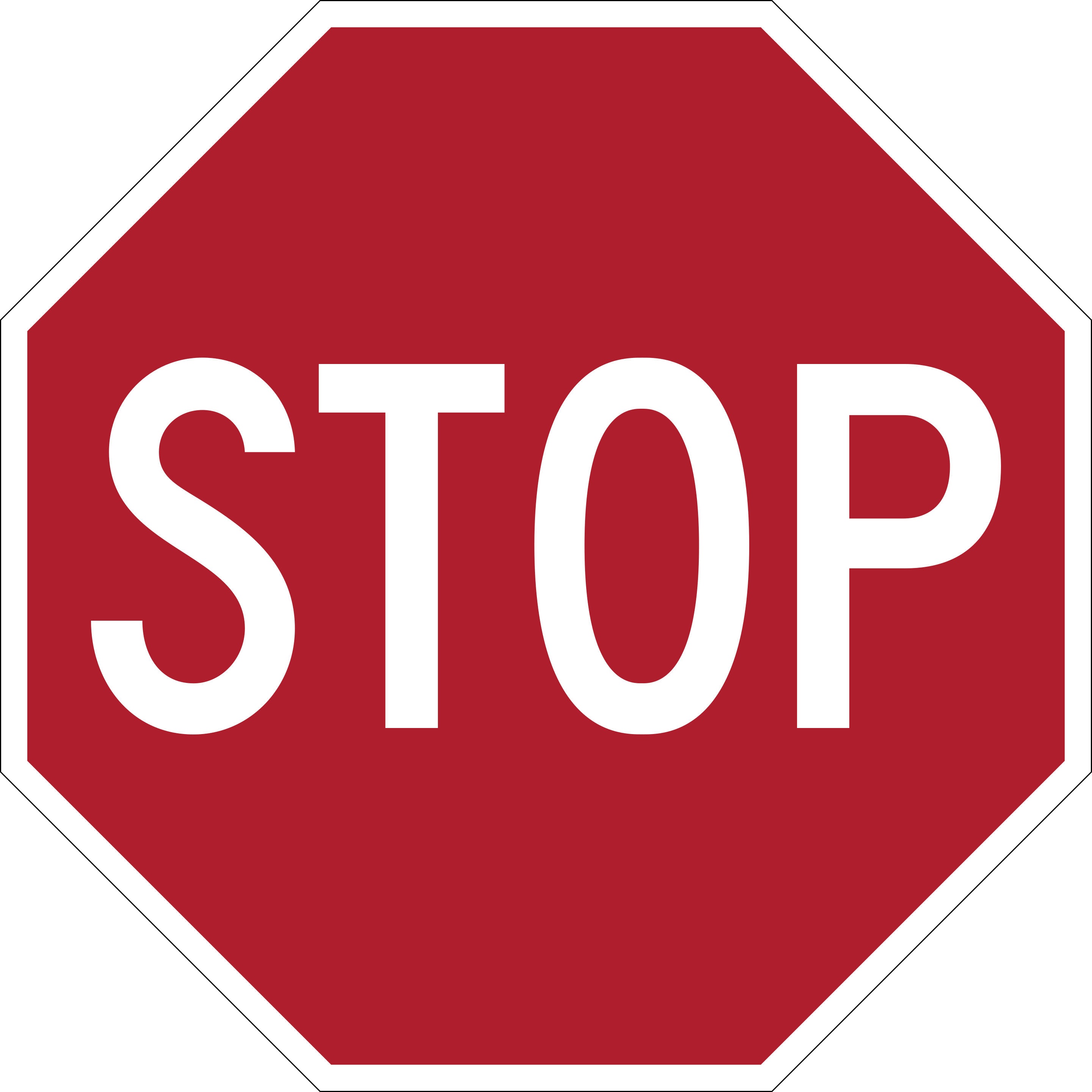
- Make a complete stop before the line or crosswalk, then check and proceed when clear
- Reduce speed and continue if no vehicle is visible
- Stop beyond the crosswalk so the hood reaches the corner
- Wait for a green signal even though no traffic light is present
Show answer
Make a complete stop before the line or crosswalk, then check and proceed when clear. The octagonal STOP sign requires the vehicle to stop completely before the stop line or crosswalk; the manual says slowing down without coming to a full stop is illegal. After checking pedestrians and cross traffic, the driver may move when the intersection is clear. Rolling through because the road appears empty fails the full-stop requirement. Stopping beyond the crosswalk puts the vehicle where crossing pedestrians should be protected. If you cannot see traffic after stopping, yield to pedestrians and then carefully pull forward past the line until you can see clearly.
Study this in the handbook: Regulatory, warning and work zone signs
13. A Pennsylvania Move Over violation causes the death of an emergency responder. What suspension is specified?
- 6 months
- 30 days
- 90 days
- 1 year
Show answer
1 year. When a Move Over violation leads to the death of an emergency responder or a person in or near a disabled vehicle, Pennsylvania imposes a one-year suspension and permits a fine of up to $10,000. The 90-day and six-month choices correspond to lesser injury outcomes described nearby, so they should not be selected for a fatal result. Keep the three consequence levels in order: serious bodily injury to another person, serious injury to a responder or disabled motorist, then death involving those protected people.
Study this in the handbook: School buses, emergency vehicles and the Move Over law
14. What should a driver do when approaching an intersection under a steady yellow light?
- Accelerate to beat the red signal
- Treat yellow exactly like a green light
- Slow down and prepare to stop, continuing only if stopping is unsafe
- Stop inside the intersection before turning
Show answer
Slow down and prepare to stop, continuing only if stopping is unsafe. A steady yellow light means a steady red light will soon appear. A driver approaching the intersection should slow and prepare to stop, while a driver already inside or too close to stop safely may continue through carefully. Accelerating encourages a race against the signal, and treating yellow as green ignores the warning phase. Judge distance, traffic, and traction before braking. The practical cue is to cover the brake and look for a safe stopping point before the crosswalk or stop line.
Study this in the handbook: Traffic signals and lane signals
15. What extra fine applies in Pennsylvania if you are stopped in a work zone with your headlights off?
- An additional $500
- Loss of license for 30 days
- No extra fine
- An additional $25
Show answer
An additional $25. Headlights must be on in every posted work zone, and if you are pulled over for a traffic violation in a work zone and your headlights are not turned on you will be fined an additional $25. The headlight rule covers all posted work zones, not just active ones, because lights make the vehicle more visible to other traffic and to highway workers.
Study this in the handbook: Regulatory, warning and work zone signs
16. You want to appeal a Pennsylvania suspension notice. How long do you have to file in the Court of Common Pleas?
- 30 days from the mailing date of the notice
- 10 days from the offense
- 90 days from the suspension start
- One year from the conviction
Show answer
30 days from the mailing date of the notice. A Pennsylvania suspension, revocation, or disqualification can be appealed in the Court of Common Pleas, Civil Division, in your county, and the appeal must be filed within 30 days of the mailing date of PennDOT's notice. Ten days from the offense is too short and uses the wrong starting point. Ninety days and one year are too long. Sanctions start on the effective date in the notice, and surrendering the license early does not start them early.
Study this in the handbook: Points, insurance and crash duties
17. How many chances does a Pennsylvania learner's permit give you to pass the Road Test?
- One
- Three
- Two
- Unlimited, until the permit expires
Show answer
Three. Each Pennsylvania learner's permit comes with three chances to pass the Road Test before it expires. After the third failure, the permit must be extended with a DL-31 application. One or two attempts understates the allowance, and there is no unlimited retesting on a single permit. If the Road Test is not passed within three years of the physical examination date, the applicant must start over with a new DL-180 and retake the Knowledge Test.
Study this in the handbook: Learner's permit, knowledge test and road test
18. A Pennsylvania driver with a prior DUI conviction refuses a chemical test and is convicted of DUI again. What total suspension follows?
- One year
- 18 months in total
- Two and a half years
- Three years: 18 months for the refusal plus 18 months for the DUI
Show answer
Three years: 18 months for the refusal plus 18 months for the DUI. A driver who refuses chemical testing after a prior DUI conviction or a prior refusal faces an 18 month suspension for the refusal and 18 more months for the DUI conviction, a total of three years. One year is the first refusal suspension, and 18 months counts only one of the two penalties. Two and a half years is the maximum for a first refusal combined with a DUI conviction. Refusal also brings a restoration fee of $500, $1,000, or $2,000 by offense.
Study this in the handbook: DUI, chemical tests and zero tolerance
19. Someone is riding in the open bed of a pickup truck in Pennsylvania. What is the truck's maximum speed?
- 35 mph
- 25 mph
- 45 mph
- 55 mph
Show answer
35 mph. An open-bed pickup truck or open flatbed truck may not be driven faster than 35 mph if any person is in the bed. The truck may not be driven at all with a child under 18 in the bed, apart from listed exceptions such as a farmer's child being carried between parts of a farm to do farm work. Twenty five mph is stricter than the law, and 45 or 55 mph exceed it.
Study this in the handbook: School buses, emergency vehicles and the Move Over law
20. You must park on the roadway itself in Pennsylvania. From how far away should your vehicle be visible?
- At least 50 feet in both directions
- At least 1,000 feet ahead only
- Visibility does not matter if your flashers are on
- At least 500 feet in both directions
Show answer
At least 500 feet in both directions. If a street has a curb, park within 12 inches of it; with no curb, pull as far off the roadway as you can. When you must park on the roadway, use your four-way flashers, leave room for passing vehicles, and make sure your vehicle can be seen at least 500 feet in both directions. Fifty feet gives approaching drivers too little warning, checking one direction ignores traffic from the other, and flashers alone do not satisfy the 500 foot visibility rule.
Study this in the handbook: Signaling, turning, U-turns and passing
Insurance in Pennsylvania
Pennsylvania policies are handled in cooperation with licensed partner producer Sean Vu. QualitySpace Insurance Agency does not bind coverage in Pennsylvania directly. Contact us and we will route you to the right person.
Every question is written from the official Pennsylvania Driver's Manual (PUB 95). Need paper? Printable PA practice test with answer key.
Last verified 2026-10-05. How we check every question · Study all 500 as flashcards
Frequently asked questions
How many questions are on this Pennsylvania practice test?
This fixed set has 20 questions. It is test 10 of 25 from the 500 question Pennsylvania bank. The real PA exam asks 18 questions and you need 15 correct.
What is the passing score for the real Pennsylvania test?
15 of 18 correct to pass the test That figure comes from the official Pennsylvania source cited on the DMV facts page.
How does this fixed test relate to the full Pennsylvania bank?
Each numbered test is a fixed set of questions in a fixed order, so you can retake the same test later and compare. Every test mixes road signs and the other topics in about the same proportion as the full bank. Tests 1 to 25 together cover every question in the Pennsylvania bank once. The full practice page mixes the whole bank at random.
Last verified 2026-10-05. See the Pennsylvania DMV facts page for sourced state details.
Return to the full Pennsylvania practice test · Study road signs