
Test 11 of 25 · 20 questions · Free 2026
PA Permit Practice Test 11
Jump to the test ↓A fixed 20 question set from the Pennsylvania bank with answers and plain English explanations. The real PA exam is 18 questions, 83 percent to pass; take the full length version on the main practice page.
Talk to Kevin
714-666-6669Call now →California policies handled directly by Kevin Vu (CDI #4037122). New Jersey and Pennsylvania policies handled in cooperation with licensed partner producer Sean Vu (Allstate). QualitySpace Insurance Agency does not bind coverage in NJ or PA directly.
Question 1 of 20 · 0 right so far
All 20 questions in test 11
Every question below comes from the Pennsylvania question bank on this page. Open a question to see the correct answer and the explanation. Nothing here is hidden behind a signup.
1. How is a Pennsylvania applicant's Social Security number handled in driver licensing records?
- It is printed on the learner's permit for identification
- It is part of the public driver's record open to anyone
- It replaces the driver's license number on all documents
- It is not part of the public driver's record and will not be printed on the learner's permit or driver's license
Show answer
It is not part of the public driver's record and will not be printed on the learner's permit or driver's license. PennDOT must collect the Social Security number by law, along with height and eye color, and uses it as identifying information meant to minimize driver's license fraud. Collection does not mean publication: the number is not part of the public driver's record, federal law permits state licensing officials to use it for identification, and it will not be printed on the learner's permit or driver's license. Expect to provide the number during application while knowing it will not appear on the card itself.
Study this in the handbook: Learner's permit, knowledge test and road test
2. A Pennsylvania applicant under 18 wants the ORGAN DONOR designation on the driver license. What consent is required?
- No consent beyond the applicant request
- Consent from a family physician only
- Written consent from a parent, guardian, person in loco parentis, or spouse who is 18 or older
- Written consent from an older sibling who is 18 or older
Show answer
Written consent from a parent, guardian, person in loco parentis, or spouse who is 18 or older. Applicants under 18 need written consent from a parent, guardian, person in loco parentis, or spouse who is 18 or older to obtain the ORGAN DONOR designation. Consent may be given by checking the appropriate block on Form DL-180TD. Cited handbook wording: Applicants under 18 years of age may request and obtain the organ donor designation on their driver's license; however, they must have written consent from a parent, guardian, person in loco parentis, or spouse who is 18.
Study this in the handbook: Learner's permit, knowledge test and road test
3. You end up in a lane marked for turns only, but you want to go straight through the intersection. What must you do?
- Go straight slowly with hazard lights on
- Stop and back up to change lanes before the intersection
- Wait for a police officer to redirect you
- You must make the turn; if instead you are in a through lane and want to turn, you must continue straight through
Show answer
You must make the turn; if instead you are in a through lane and want to turn, you must continue straight through. A lane marked for turns only requires making that turn, even when going straight was intended. If you want to turn but end up in a lane marked for through traffic, you must continue straight through the intersection. The cited manual passage: Intersection, you must make the turn. If you want to turn, but end up in a lane marked for through traffic, you must continue straight through the intersection.
Study this in the handbook: Right of way at intersections and roundabouts
4. On a two-way street, a steady red arrow pointing left is lit at a Pennsylvania traffic signal. What is required?
- Treat the arrow as a flashing yellow arrow
- Turn left after yielding to oncoming traffic
- Continue straight through the intersection
- Stop and do not turn left until a permitted signal appears
Show answer
Stop and do not turn left until a permitted signal appears. A STEADY RED ARROW means you must stop and may not turn in the direction the arrow points; wait for a Green Arrow or a Flashing Yellow Arrow before you start the left turn. The manual adds that the same turns-on-red allowed at a steady red light are allowed at a red arrow, but the only left turn on red it permits is from a one-way street onto another one-way street, so it does not apply on a two-way street. Yielding to oncoming traffic is the rule for a flashing yellow arrow, not a red one.
Study this in the handbook: Traffic signals and lane signals
5. Traffic is entering the highway beside you. How can you make room when conditions allow?
- Brake sharply so entrants must stop
- Signal and move to an inside lane, if it is safe
- Hold your lane and speed up beside entrants
- Flash high beams until entrants yield
Show answer
Signal and move to an inside lane, if it is safe. Make room for vehicles entering a highway by signaling and moving to an inside lane if it is safe. Check that the space around your vehicle is clear before changing lanes. Cited handbook wording: Make room for vehicles entering highways by signaling and moving to an inside lane, if it is safe. That wording points to "Signal and move to an inside lane, if it is safe."
Study this in the handbook: Space cushion, following distance and scanning
6. How do work zone signs differ in appearance from ordinary warning signs?
- They are green with white lettering
- They are blue circles with white symbols
- Work zone signs are normally diamond shaped like warning signs, but orange with black lettering instead of yellow with black lettering, identifying maintenance, construction, or utility areas
- They are red rectangles posted only at night
Show answer
Work zone signs are normally diamond shaped like warning signs, but orange with black lettering instead of yellow with black lettering, identifying maintenance, construction, or utility areas. Work zone signs are normally diamond shaped, like warning signs, but orange with black lettering instead of yellow with black lettering. They identify maintenance, construction, or utility areas where workers or equipment may be on or near the roadway. Stay alert and slow down when you see them. Controlling manual language: Work Zone Signs are normally diamond shaped, like warning signs, but they are orange with black lettering instead of yellow with black lettering. These signs identify maintenance, construction or utility areas.
Study this in the handbook: Regulatory, warning and work zone signs
7. A vehicle approaches with its turn signal flashing while you wait to pull out. What should you do?
- Pull out quickly because the signal guarantees a turn
- Assume the signal was left on and ignore it
- Wait until the other driver actually starts to turn before you go
- Enter halfway and force the other driver to slow
Show answer
Wait until the other driver actually starts to turn before you go. Do not pull out in front of an approaching vehicle just because its turn signal is flashing. The driver may intend to turn beyond you, may have changed plans or may have forgotten to cancel the signal. This is especially relevant to motorcycles, whose signals may not cancel themselves. Wait until the driver actually starts to turn before you go. By contrast, a flashing signal does not guarantee the turn will happen.
Study this in the handbook: Signaling, turning, U-turns and passing
8. On a level Pennsylvania highway, how much longer does passing a truck take compared with passing a car?
- No longer than passing a car
- Three to five seconds longer
- Twenty seconds longer
- Half as long as passing a car
Show answer
Three to five seconds longer. Size changes passing math: on a level highway a truck takes only three to five seconds longer to pass than a car, but those seconds stretch the time spent beside a vehicle with large blind spots. Upgrades help because trucks lose speed climbing, while downgrades hurt because momentum pushes the truck faster and may demand more speed from you. Twenty seconds overstates the level-road difference, and claiming no difference ignores the extra length entirely. Pass quickly without lingering alongside, keep both hands firm against turbulence, and do not cut back early.
Study this in the handbook: Motorcycles, bicycles, trucks and pedestrians
9. What movement is banned by the left-turn symbol crossed by a red slash?
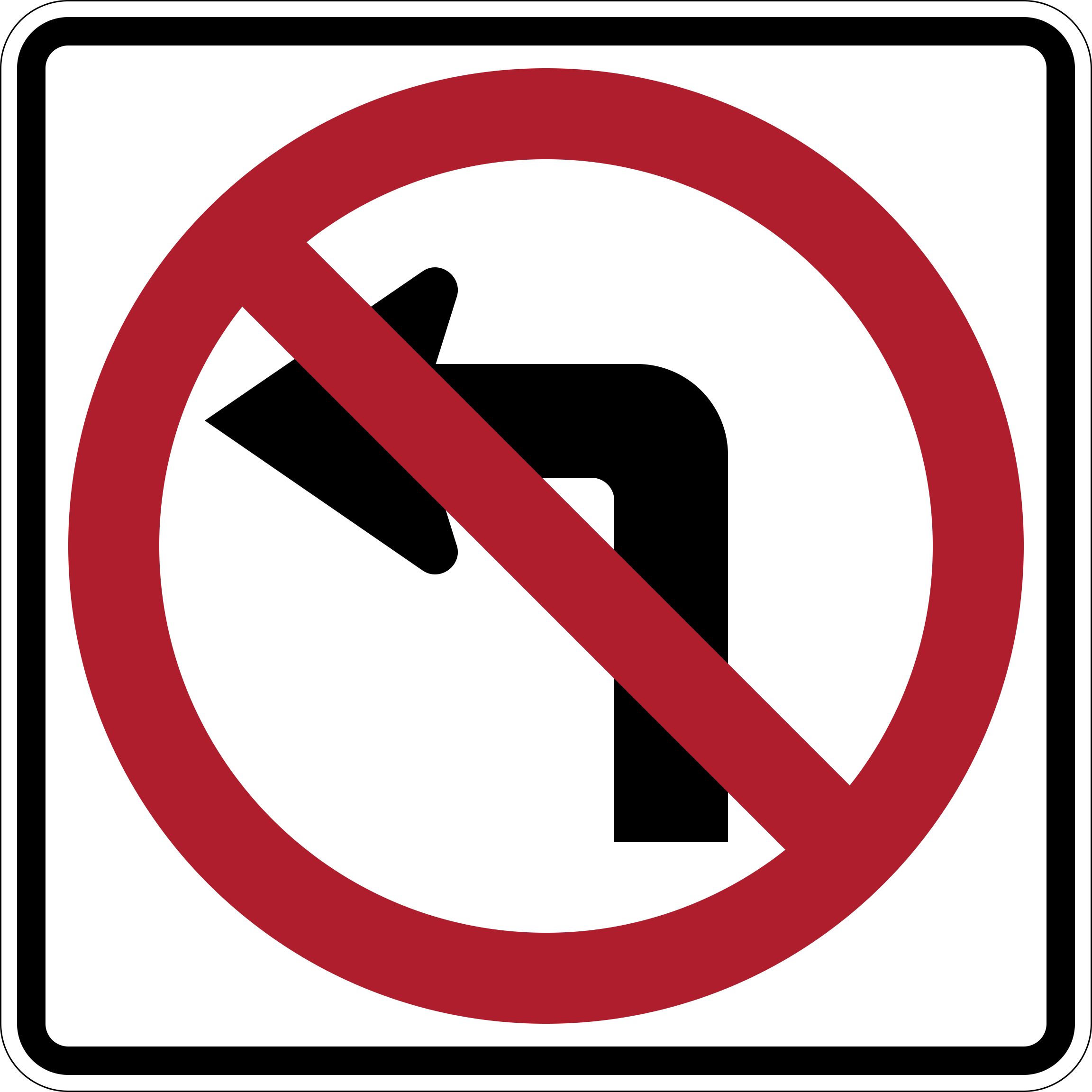
- U-turns everywhere on the roadway
- Straight travel through the intersection
- Left turns at the intersection
- Right turns from the adjoining lane
Show answer
Left turns at the intersection. The manual says the sign with the crossed left-turn arrow indicates that left turns are prohibited and instructs drivers not to make a left turn at that intersection. It does not create a general U-turn ban, block straight travel, or regulate a separate right-turn lane. Identify the arrow's direction first, then apply the red prohibition to that movement. If a left turn is needed, continue to a location where signs and signals permit it and reassess the route there.
Study this in the handbook: Pavement markings and lane use signs
10. A DIVIDED HIGHWAY ENDS sign appears ahead. What changes, and how should you drive?
- You will be on a roadway with two-way traffic; keep right of the centerline and watch for oncoming traffic
- The road becomes one way; keep left of the divider
- Speed limits double until the next town
- Parking opens on the median until the next sign
Show answer
You will be on a roadway with two-way traffic; keep right of the centerline and watch for oncoming traffic. The divided highway ends ahead, and you will be on a roadway with two-way traffic. Keep right of the centerline and watch for oncoming traffic. The passage behind this item: The divided highway on which you are traveling ends ahead. You will then be on a roadway with twoway traffic. Keep to the right of the centerline and watch for oncoming traffic.
11. A Pennsylvania driver with a BAC in the General Impairment range causes a crash with bodily injury. Which penalty table applies instead?
- Table 2, High Rate, rather than Table 1
- Table 1, General Impairment, because the BAC controls
- No table, because injury crashes are civil only
- Table 3, Highest Rate, for every injury crash
Show answer
Table 2, High Rate, rather than Table 1. A driver in the General Impairment BAC range who is involved in a crash resulting in bodily injury, death, or property damage is subject to Table 2, High Rate, rather than Table 1. The manual applies this rule even when the BAC is below the High Rate range. The cited manual passage: If you are involved in a crash resulting in bodily injury, death or property damage, you are subject to the penalties listed in Table 2, “High Rate,” rather than those listed in Table 1, “General Impairment,” even if.
Study this in the handbook: DUI, chemical tests and zero tolerance
12. Besides helping keep occupants inside during a crash, why does Pennsylvania guidance favor locking your doors?
- Locked doors raise fuel economy on highways
- It reduces the likelihood of being carjacked or otherwise victimized at an intersection or in a parking lot
- Locked doors silence the seat belt reminder chime
- It allows windows to stay fully open at stops
Show answer
It reduces the likelihood of being carjacked or otherwise victimized at an intersection or in a parking lot. Locking your doors and wearing your seat belt help keep you from being thrown from the vehicle in a crash. The manual says being thrown from a vehicle increases the chance of death by 75 percent. Locking the doors also reduces the likelihood of being carjacked or otherwise victimized at an intersection or in a parking lot. The passage behind this item: It will also reduce the likelihood of being carjacked or otherwise victimized when you stop at an intersection or pull into a parking lot.
Study this in the handbook: Space cushion, following distance and scanning
13. What should a Pennsylvania driver do to preserve a space cushion in traffic?
- Adjust speed to maintain space around the vehicle
- Drive in another vehicle’s blind spot
- Match the nearest vehicle’s speed without looking ahead
- Close the gap whenever traffic is crowded
Show answer
Adjust speed to maintain space around the vehicle. Pennsylvania advises adjusting speed to maintain a space cushion when surrounding traffic changes. Matching a nearby vehicle without looking ahead can place the driver in a blind spot, and closing the gap removes room for an emergency maneuver. The goal is not to drive faster than the posted limit or to abandon the lane, but to create usable space around the vehicle. If traffic packs together, a small speed reduction can let nearby vehicles clear and restore separation.
Study this in the handbook: Space cushion, following distance and scanning
14. How can Pennsylvania work zone flaggers report an unsafe or speeding motorist to police?
- By radioing a tow company
- By photographing the vehicle for a newspaper
- Flaggers have no way to report drivers
- By using a Police Arrest Form
Show answer
By using a Police Arrest Form. Work zone flaggers can report unsafe motorists, speeders and aggressive drivers to police using a Police Arrest Form. Obey flaggers: their authority overrides conventional traffic control devices. Controlling manual language: Remember: Work Zone Flaggers can report unsafe motorists, speeders, and aggressive drivers to the police using a Police Arrest Form! That wording points to "By using a Police Arrest Form." By contrast, tow companies remove disabled vehicles; they do not take flagger violation reports.
15. Traffic ahead of you slows as you both approach a Pennsylvania railroad crossing. What passing rule applies near the crossing?
- Pass quickly before the tracks
- Never try to pass someone as you approach or enter the crossing
- Pass on the shoulder if the lane is blocked
- Pass only while the other vehicle is on the tracks
Show answer
Never try to pass someone as you approach or enter the crossing. Never try to pass someone as you approach or enter a railroad crossing. Before driving onto the tracks, make sure you have enough room to get all the way across. If traffic ahead slows, wait for it to clear before starting across. Manual wording for this rule: Never try to pass someone as you approach or enter a railroad crossing. That wording points to "Never try to pass someone as you approach or enter the crossing."
Study this in the handbook: Motorcycles, bicycles, trucks and pedestrians
16. How often does a train collide with a vehicle or a pedestrian in the United States, according to Pennsylvania guidance?
- About once a week
- About once a day
- Every twelve hours
- Every hour and a half
Show answer
Every hour and a half. According to the manual, a train collides with a vehicle or pedestrian in the United States every hour and a half. Once a week, once a day and every twelve hours all understate that frequency. Twelve hours is eight times the stated interval. Always look left, right and left again when approaching a railroad crossing. Cited handbook wording: Every hour and a half, a train collides with a vehicle or a pedestrian in the U.S. You are 40 times more likely.
Study this in the handbook: Motorcycles, bicycles, trucks and pedestrians
17. A street excavation with barriers and digging equipment runs along the curb in Pennsylvania. Where may you stop or park relative to that work area?
- Along or opposite the street digging or work area is prohibited
- Alongside the work area if flashers are on
- Directly opposite the work area only
- Inside the work area behind the barriers
Show answer
Along or opposite the street digging or work area is prohibited. Except in emergencies or when directed by a police officer, do not stop, stand or park along or opposite any street digging or work area. The prohibition includes both sides relative to the work area; using flashers is not a listed exception. Manual wording for this rule: Along or opposite any street digging or work area. That wording points to "Along or opposite the street digging or work area is prohibited."
Study this in the handbook: Parking rules and distances
18. A driver under 18 earns a 90-day suspension for six or more points or for driving 26 mph or more over the limit. What follows for an additional occurrence?
- A warning letter with no suspension
- Another 90-day suspension
- A suspension of 120 days
- A one-year suspension
Show answer
A suspension of 120 days. For drivers under 18, the initial suspension tied to six or more points or to driving 26 mph or more over the posted limit lasts 90 days. Any additional occurrence draws a longer suspension of 120 days. Repeating 90 days misses the increase built into the rule, while a warning letter removes a consequence the manual imposes. One year overshoots the stated period for this offense pattern. Remember the pair as an escalating ladder for young drivers: ninety days initially, then one hundred twenty when the behavior happens again.
Study this in the handbook: Points, insurance and crash duties
19. In Pennsylvania, when may the rest of a funeral procession proceed through an intersection?
- After the lead vehicle has cleared the intersection
- Only after every vehicle stops again
- Only when a police officer escorts each car
- Whenever a vehicle behind the procession honks
Show answer
After the lead vehicle has cleared the intersection. Once the lead vehicle of a funeral procession has cleared the intersection, the rest of the procession may proceed through it and other traffic must yield. Requiring every vehicle to stop again would break the procession, while a horn or an absent police escort does not create permission. If you encounter the line, slow down, allow it to pass, and do not cut between vehicles. Look for the lead car’s position before assuming ordinary cross traffic may proceed.
Study this in the handbook: Right of way at intersections and roundabouts
20. You want to warm up your vehicle inside a Pennsylvania garage. What carbon monoxide precaution applies to the garage door?
- Keep the door down so heat stays inside
- Do not warm up the vehicle with the garage door down or partially down; open it completely if the vehicle is running
- Open the door one foot for ventilation
- Garage warming is safe for five minutes with the door closed
Show answer
Do not warm up the vehicle with the garage door down or partially down; open it completely if the vehicle is running. Every gas-powered vehicle produces carbon monoxide, a deadly odorless gas you cannot smell, and a garage traps it around anyone who breathes there. Pennsylvania is absolute about the door: do not warm up your vehicle in the garage with the garage door down or partially down, and open the door completely if the vehicle is running inside. A one-foot crack and a five-minute closed-door warm-up both keep exhaust pooling in an enclosed space. Drowsiness or nausea can signal poisoning; anyone suspecting it should exit, get fresh air, and seek emergency care.
Insurance in Pennsylvania
Pennsylvania policies are handled in cooperation with licensed partner producer Sean Vu. QualitySpace Insurance Agency does not bind coverage in Pennsylvania directly. Contact us and we will route you to the right person.
Every question is written from the official Pennsylvania Driver's Manual (PUB 95). Need paper? Printable PA practice test with answer key.
Last verified 2026-10-05. How we check every question · Study all 500 as flashcards
Frequently asked questions
How many questions are on this Pennsylvania practice test?
This fixed set has 20 questions. It is test 11 of 25 from the 500 question Pennsylvania bank. The real PA exam asks 18 questions and you need 15 correct.
What is the passing score for the real Pennsylvania test?
15 of 18 correct to pass the test That figure comes from the official Pennsylvania source cited on the DMV facts page.
How does this fixed test relate to the full Pennsylvania bank?
Each numbered test is a fixed set of questions in a fixed order, so you can retake the same test later and compare. Every test mixes road signs and the other topics in about the same proportion as the full bank. Tests 1 to 25 together cover every question in the Pennsylvania bank once. The full practice page mixes the whole bank at random.
Last verified 2026-10-05. See the Pennsylvania DMV facts page for sourced state details.
Return to the full Pennsylvania practice test · Study road signs