
Test 5 of 25 · 20 questions · Free 2026
PA Permit Practice Test 5
Jump to the test ↓A fixed 20 question set from the Pennsylvania bank with answers and plain English explanations. The real PA exam is 18 questions, 83 percent to pass; take the full length version on the main practice page.
Talk to Kevin
714-666-6669Call now →California policies handled directly by Kevin Vu (CDI #4037122). New Jersey and Pennsylvania policies handled in cooperation with licensed partner producer Sean Vu (Allstate). QualitySpace Insurance Agency does not bind coverage in NJ or PA directly.
Question 1 of 20 · 0 right so far
All 20 questions in test 5
Every question below comes from the Pennsylvania question bank on this page. Open a question to see the correct answer and the explanation. Nothing here is hidden behind a signup.
1. When driving behind a large vehicle that blocks your view ahead, what should you do?
- Move close to the rear bumper to improve your view
- Pass immediately without checking oncoming traffic
- Use the shoulder to create a wider gap
- Allow extra following distance so you can see and react
Show answer
Allow extra following distance so you can see and react. A truck, bus, van, or vehicle pulling a trailer can hide hazards and may stop suddenly without knowing you are behind it. The manual therefore calls for more space than usual when a large vehicle blocks the view ahead. Following close reduces reaction time, and an immediate pass may expose the driver to unseen traffic. Stay centered in your lane, enlarge the gap, and use the extra distance to see around the vehicle without tailgating. The cue is blocked view, which means added space.
Study this in the handbook: Space cushion, following distance and scanning
2. How must a Pennsylvania driver respond to a flashing red traffic signal?
- Make a complete stop, then proceed only after the intersection is clear
- Yield only to vehicles approaching from the left
- Wait for the signal to turn solid green
- Slow down and continue without stopping
Show answer
Make a complete stop, then proceed only after the intersection is clear. Pennsylvania gives a flashing red light the same force as a STOP sign. The driver must stop completely, look both ways, and move only after the intersection is clear. Merely slowing down leaves the required stop undone, and checking only traffic from the left overlooks hazards from the other direction. Waiting for a solid green is unnecessary because the signal already supplies stop-control instructions. Treat the indication like a stop sign, scan for vehicles and pedestrians, and proceed when the crossing is safe.
Study this in the handbook: Traffic signals and lane signals
3. How often must a Pennsylvania vehicle receive a safety inspection at an authorized inspection station?
- Every 12 months
- Every 24 months
- Only when ownership changes
- Only after a police citation
Show answer
Every 12 months. A Pennsylvania vehicle needs a safety inspection every 12 months at an authorized inspection station. The two-year choice stretches the inspection interval beyond the manual’s requirement, while ownership transfer is not the event that alone determines the recurring due date. A citation can expose faulty equipment, but waiting for police action would leave an ordinary vehicle overdue. Check the date on the inspection sticker and plan service before that date arrives. The recurring annual sticker date is the practical memory cue.
Study this in the handbook: Parking rules and distances
4. Under Pennsylvania's Move Over Law, what should you do when an amber-lit maintenance vehicle blocks part of your lane?
- Ignore the vehicle because amber lights have no legal meaning
- Stop in the travel lane until the maintenance work ends
- Reduce speed to at least 20 mph below the posted limit if moving over is impossible
- Use the shoulder to pass at the posted speed
Show answer
Reduce speed to at least 20 mph below the posted limit if moving over is impossible. Pennsylvania’s Move Over Law asks drivers to move into a lane that is not next to an emergency response area or disabled vehicle. If congestion, weather, or another condition makes that lane change impossible, the fallback is substantial speed reduction: at least 20 miles per hour below the posted limit. Ignoring the warning fails to protect workers, and stopping in the travel lane creates a new obstruction. First look for a safe lane change; if none exists, reduce speed by the stated amount.
Study this in the handbook: School buses, emergency vehicles and the Move Over law
5. What must a vehicle parked in a Pennsylvania space reserved for people with disabilities display?
- A handwritten note from the passenger
- An authorized registration plate or parking placard
- Only the vehicle's hazard lights
- A temporary permit from any neighboring state
Show answer
An authorized registration plate or parking placard. Pennsylvania's reserved-parking sign identifies spaces that require an authorized registration plate or parking placard. Hazard lights, a handwritten note, or an unrelated temporary document do not establish the authorization described by the manual. The restriction protects access for people who have been issued the appropriate credential, so briefly stopping without one is not made acceptable by convenience. At a marked accessible space, look for the required plate or placard before leaving the vehicle there.
Study this in the handbook: Parking rules and distances
6. If a Pennsylvania driver's vehicle starts to hydroplane, which response follows the manual?
- Brake hard and turn toward the shoulder immediately
- Accelerate to push the tires through the water
- Keep both hands on the wheel, ease off the gas, and do not slam the brakes or turn suddenly
- Shift into park while the vehicle is moving
Show answer
Keep both hands on the wheel, ease off the gas, and do not slam the brakes or turn suddenly. If you find yourself hydroplaning, the Pennsylvania manual says to keep both hands on the steering wheel and slowly take your foot off the gas pedal to let the vehicle slow down. Do not slam on the brakes or try to turn suddenly, because this will cause your vehicle to skid. As the vehicle slows, more tire tread touches the road and traction improves. Turn slowly and only as much as necessary to stay on the road, and if you have to use your brakes, brake gently. Hydroplaning can be reduced by driving slower.
Study this in the handbook: Speed, night driving and bad weather
7. Which pedestrian situation requires a Pennsylvania driver to yield even when there is no traffic light?
- Only a person accompanied by a crossing guard
- Only a person in a marked crosswalk with a signal
- A person crossing at an intersection, whether or not a crosswalk is painted
- No person until the driver reaches the intersection center
Show answer
A person crossing at an intersection, whether or not a crosswalk is painted. Pennsylvania requires drivers to yield to pedestrians crossing at any intersection without a traffic light, with or without a marked crosswalk. The painted-line choice narrows the rule too far, and neither a crossing guard nor the driver's position in the intersection determines whether the duty exists. Approach the corner ready to stop, scan both sides, and account for a person crossing even if the pavement has no stripes. A blind pedestrian carrying a white cane or guided by a dog receives an especially strong yield requirement.
Study this in the handbook: Right of way at intersections and roundabouts
8. A first time Pennsylvania DUI offender is accepted into the Accelerated Rehabilitative Disposition (ARD) program. How long can the license be lost?
- At least two years
- Up to 18 months
- No license loss at all
- Up to 90 days
Show answer
Up to 90 days. ARD is an option for a first offense at the high and highest rates of impairment, and a driver accepted into it loses the license for up to 90 days. The offender also undergoes alcohol and drug evaluation, stays under court supervision for six months, attends 12 and a half hours of Alcohol Highway Safety School, and pays a fine of $300 to $5,000 plus fees. Two years is not an ARD figure, and 18 month suspensions belong to repeat offense or refusal penalties. Choosing no license loss ignores the first item on the ARD list.
9. After a Pennsylvania driver completes 12 consecutive months without a qualifying violation or sanction, how many points are removed?
- 1 point
- 3 points
- 4 points
- All points, regardless of the record total
Show answer
3 points. Pennsylvania removes three points after each 12 month stretch in which the driver avoids suspension, revocation, and any new violation that assigns points or causes a sanction. The one point choice understates the credit, and wiping out the entire record ignores the fixed amount. Once the record reaches zero and stays there for another year, a later accumulation is treated as a first accumulation. Mark each clean year as a three point reduction.
Study this in the handbook: Points, insurance and crash duties
10. Which three factors make Pennsylvania DUI penalties more severe?
- Driving in daylight, using a newer vehicle, and carrying passengers
- Higher BAC, more serious crash injuries or damages, and more DUI convictions
- Vehicle color, road width, and the time of day
- A clean record, a low BAC, and no property damage
Show answer
Higher BAC, more serious crash injuries or damages, and more DUI convictions. Pennsylvania identifies three factors that increase the severity of DUI penalties: a higher blood alcohol concentration, more serious injuries or damages from a crash while driving under the influence, and a greater number of DUI convictions. The other choices list circumstances that the cited discussion does not use to rank the penalties. A clean record and low BAC would not describe the escalating conditions. When studying DUI consequences, consider both the seriousness of the event and the driver’s prior conviction history, not just the alcohol measurement alone.
Study this in the handbook: DUI, chemical tests and zero tolerance
11. PennDOT finds that a registered Pennsylvania vehicle lacked insurance for at least 31 days. Which consequence follows?
- Only the registration is suspended for one month
- The vehicle is permanently barred from registration
- The driver receives a warning but no suspension
- The registration is suspended for three months, and the driving privilege may also be suspended for three months
Show answer
The registration is suspended for three months, and the driving privilege may also be suspended for three months. A lapse lasting 31 days or longer suspends the vehicle registration for three months. If the owner operated the vehicle or allowed it to be operated without insurance, the driving privilege also receives a three month suspension. The one month choice changes the statutory period, while the warning choice overlooks the registration action. Restoration requires proof that the vehicle is insured and payment of the required fees, so insurance must remain active on every registered vehicle.
Study this in the handbook: Points, insurance and crash duties
12. During what hours are junior license holders in Pennsylvania generally prohibited from driving, absent an exception for travel to/from employment or volunteer service?
- Midnight to 6 a.m.
- 10 p.m. to 4 a.m.
- 11 p.m. to 5 a.m.
- 9 p.m. to 6 a.m.
Show answer
11 p.m. to 5 a.m.. The ordinary nighttime restriction for a Pennsylvania junior driver's license runs from 11 p.m. until 5 a.m. The other time ranges shift both endpoints and therefore do not describe the junior-license rule. Limited exceptions include being with a qualifying adult or driving for specified employment, public, charitable, or volunteer service with required documentation. For a straightforward exam question, anchor the restriction to 11 at night and 5 in the morning before considering whether an exception is stated.
Study this in the handbook: Junior permit and junior license limits
13. How should a driver approach the intersection types shown by the pictured warning signs?

- With extra caution, searching ahead and preparing to slow if necessary
- At full speed because warning signs control no traffic
- By stopping on the roadway before every intersection
- By moving left immediately to avoid crossing traffic
Show answer
With extra caution, searching ahead and preparing to slow if necessary. Pennsylvania's intersection warning signs show how roads join and warn about possible problems with other vehicles' movements. The manual directs drivers to approach all of these intersection types with extra caution, search ahead, and prepare to slow down if necessary. The signs are not permission to maintain full speed, a command to stop before every crossing, or an instruction to move left. Scan both sides, identify the joining roadway, and adjust speed early enough to respond to entering traffic.
14. What should a Pennsylvania driver do when forced to drive below 40 mph on a limited access highway?
- Use the hazard flashers to warn drivers behind
- Stop and wait for traffic to clear
- Drive on the shoulder
- Flash the high beams
Show answer
Use the hazard flashers to warn drivers behind. If you must drive below 40 mph on a limited access highway, the Pennsylvania manual says to use your hazard four way flashers to warn the drivers behind you. It is part of the manual's advice on communicating your intentions, because crashes often happen when one driver does something another driver does not expect. The same section says that if you are going to brake where other drivers may not expect it, quickly tap your brake pedal three or four times. Stopping, using the shoulder, or flashing high beams is not the warning described.
Study this in the handbook: Signaling, turning, U-turns and passing
15. After yielding to an emergency vehicle, how should a Pennsylvania driver position the vehicle while stopped?
- Angle across the intersection to block one lane
- Drive parallel and as near to the curb as possible
- Stop beside the centerline and face opposing traffic
- Park diagonally on the nearest shoulder
Show answer
Drive parallel and as near to the curb as possible. Pennsylvania directs a driver yielding to an emergency vehicle to drive parallel and as near to the curb as possible while stopping. Angling across an intersection or stopping beside the centerline can obstruct the emergency route. Parking diagonally on a shoulder is not the positioning instruction in the manual. Signal early, move toward the closest safe edge, remain clear of intersections, and stay stopped until the response vehicle has passed. Then resume carefully while preserving the required distance behind it.
Study this in the handbook: School buses, emergency vehicles and the Move Over law
16. To avoid overdriving your low beams on a dark Pennsylvania road at night, what is the fastest speed the manual recommends?
- 25 mph
- 45 mph
- 55 mph
- 65 mph
Show answer
45 mph. Pennsylvania's manual says low beams light only about 250 feet ahead, while a car at 55 mph needs more than 250 feet to stop even on dry pavement. So to avoid overdriving the headlights on a dark road at night, it advises not driving faster than 45 mph. Fifty five and 65 mph outrun the low beam range. Twenty five mph is slower than the manual requires. Always be able to stop within the distance you can see.
Study this in the handbook: Speed, night driving and bad weather
17. Before making a U-turn in Pennsylvania, how far away must drivers coming from all directions be?
- At least 100 feet
- At least 200 feet
- At least 1,000 feet
- At least 500 feet
Show answer
At least 500 feet. A Pennsylvania U-turn is allowed only when it will not endanger other traffic, and drivers coming from every direction must be at least 500 feet away and able to see you clearly. One hundred and 200 feet leave too little room. One thousand feet is the headlight visibility distance, not the U-turn rule. U-turns are also not allowed on curves, near the crest of a hill, or where a no U-turn sign is posted.
Study this in the handbook: Signaling, turning, U-turns and passing
18. What does a posted SPEED LIMIT sign represent under the manual's description?
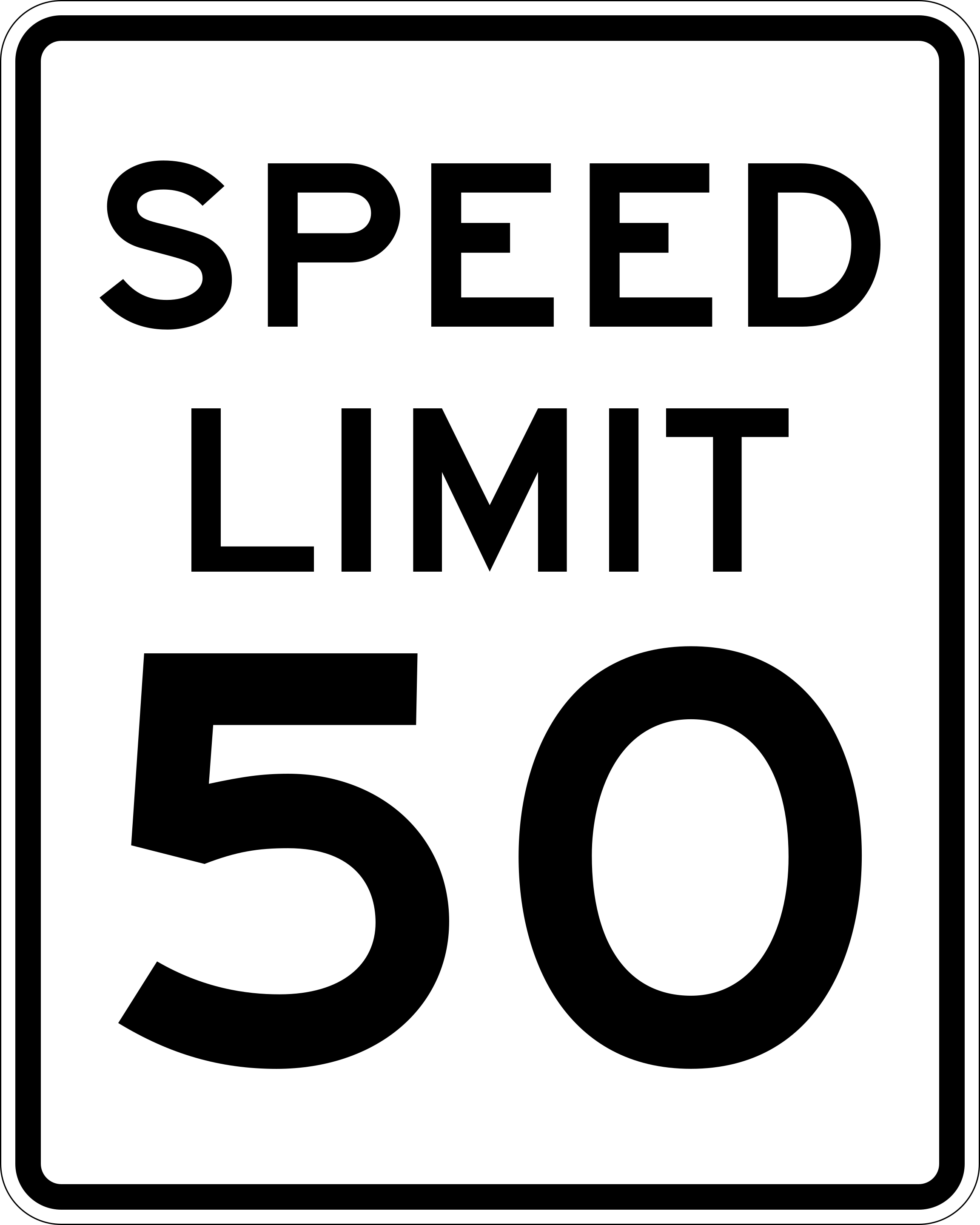
- A suggested speed that may be exceeded whenever traffic is light
- The minimum speed required in every weather condition
- A truck-only speed that does not apply to passenger vehicles
- The maximum safe driving speed under ideal road, traffic and weather conditions
Show answer
The maximum safe driving speed under ideal road, traffic and weather conditions. Pennsylvania's manual says posted speed limits indicate the maximum safe driving speed under ideal road, traffic and weather conditions. It is not an invitation to hold that number during rain, poor visibility, or heavy traffic: in addition to the posted limit, you must consider road conditions, visibility conditions and the flow of other traffic in choosing a safe speed. Calling the number a suggestion that may be exceeded, or a minimum, reverses its meaning. You can be ticketed for driving too fast for conditions even while under the posted limit.
Study this in the handbook: Space cushion, following distance and scanning
19. A Pennsylvania driver has a 12-year-old passenger in the back seat. Must the child wear a seat belt?
- Yes, passengers 8 to under 18 must be belted in any seat
- No, only front seat passengers must be belted
- Only on highways
- No, children over 8 are exempt
Show answer
Yes, passengers 8 to under 18 must be belted in any seat. Pennsylvania requires passengers 8 and older but under 18 to wear seat belts wherever they sit. The front seat rule applies to all drivers and front passengers, but young passengers must also buckle up in the back, so the front seat only choice is wrong. There is no highway only condition, and being over 8 ends the booster seat requirement but not the belt requirement. Drivers are responsible for making sure children under 18 are buckled up.
Study this in the handbook: Points, insurance and crash duties
20. How should a driver respond to the pictured RIGHT CURVE warning sign?

- Turn only at the next signalized junction
- Slow before entering the curve and maintain control through it
- Follow a temporary detour through a work zone
- Maintain highway speed until the bend is visible
Show answer
Slow before entering the curve and maintain control through it. The RIGHT CURVE sign means the road curves ahead to the right. Pennsylvania's manual says to slow down and position your vehicle slightly to the right of the center of your lane as you drive through the right-bending curve. The junction choice mistakes a roadway alignment warning for a mandatory turn, and the detour choice belongs to temporary work-zone routing. Holding highway speed until the bend is visible defeats the purpose of a warning sign, which is posted before the condition so you have time to slow down or change your path.
Insurance in Pennsylvania
Pennsylvania policies are handled in cooperation with licensed partner producer Sean Vu. QualitySpace Insurance Agency does not bind coverage in Pennsylvania directly. Contact us and we will route you to the right person.
Every question is written from the official Pennsylvania Driver's Manual (PUB 95). Need paper? Printable PA practice test with answer key.
Last verified 2026-10-05. How we check every question · Study all 500 as flashcards
Frequently asked questions
How many questions are on this Pennsylvania practice test?
This fixed set has 20 questions. It is test 5 of 25 from the 500 question Pennsylvania bank. The real PA exam asks 18 questions and you need 15 correct.
What is the passing score for the real Pennsylvania test?
15 of 18 correct to pass the test That figure comes from the official Pennsylvania source cited on the DMV facts page.
How does this fixed test relate to the full Pennsylvania bank?
Each numbered test is a fixed set of questions in a fixed order, so you can retake the same test later and compare. Every test mixes road signs and the other topics in about the same proportion as the full bank. Tests 1 to 25 together cover every question in the Pennsylvania bank once. The full practice page mixes the whole bank at random.
Last verified 2026-10-05. See the Pennsylvania DMV facts page for sourced state details.
Return to the full Pennsylvania practice test · Study road signs