
Test 9 of 25 · 20 questions · Free 2026
PA Permit Practice Test 9
Jump to the test ↓A fixed 20 question set from the Pennsylvania bank with answers and plain English explanations. The real PA exam is 18 questions, 83 percent to pass; take the full length version on the main practice page.
Talk to Kevin
714-666-6669Call now →California policies handled directly by Kevin Vu (CDI #4037122). New Jersey and Pennsylvania policies handled in cooperation with licensed partner producer Sean Vu (Allstate). QualitySpace Insurance Agency does not bind coverage in NJ or PA directly.
Question 1 of 20 · 0 right so far
All 20 questions in test 9
Every question below comes from the Pennsylvania question bank on this page. Open a question to see the correct answer and the explanation. Nothing here is hidden behind a signup.
1. How close to a fire hydrant may you park in Pennsylvania?
- No closer than 5 feet
- No closer than 30 feet
- No closer than 15 feet
- No closer than 10 feet
Show answer
No closer than 15 feet. Pennsylvania's list of places where you may never stop, stand or park, except in an emergency or when an officer directs you, includes within 15 feet of a fire hydrant. Other distances on the same list are 20 feet from a crosswalk at an intersection, 20 feet from a fire station driveway, and 30 feet from a flashing signal, stop sign or yield sign at the side of the road. Five and 10 feet are too close, and 30 feet belongs to roadside signals and signs.
Study this in the handbook: Parking rules and distances
2. What category of sign tells Pennsylvania drivers what they must or must not do under law?
- Regulatory signs
- Guide signs
- Warning signs
- Service signs
Show answer
Regulatory signs. Regulatory signs communicate legal requirements such as speed limits, turning restrictions, parking rules, and travel direction. Warning signs serve a different job by identifying hazards or changing roadway conditions ahead, while guide signs help with routes and destinations. A service sign points toward facilities rather than imposing a command. When a sign states a required movement or prohibition, treat it as enforceable traffic control and look for the associated fine or points if the rule is ignored.
Study this in the handbook: Regulatory, warning and work zone signs
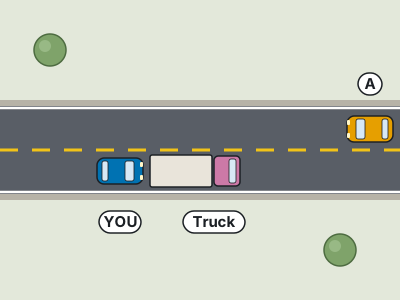
3. When may a driver cross a broken yellow centerline in Pennsylvania?
- Whenever the driver is below the speed limit
- When passing can be completed under safe conditions
- Only during daylight hours
- Only after sounding the horn twice
Show answer
When passing can be completed under safe conditions. The broken yellow marking indicates that a passing maneuver may be made when conditions are safe. Speed below the limit, a horn signal, and daylight do not by themselves make the movement safe or legal. The driver still needs adequate visibility, a clear opposing lane, and enough room to return without forcing another road user to react. Check the line pattern and the full roadway, then abandon the pass if sight distance or traffic leaves any doubt.
Study this in the handbook: Pavement markings and lane use signs
4. According to a roadside survey cited in the Pennsylvania manual, how many drivers tested positive for a drug that could affect driving?
- About 1 in 100
- Nearly 1 in 4
- About 1 in 1,000
- More than 3 in 4
Show answer
Nearly 1 in 4. According to the NHTSA 2013 to 2014 Roadside Survey of Alcohol and Drug Use by Drivers, nearly 1 in 4 drivers tested positive for at least one drug that could affect safe driving skills, and 43 percent of drivers killed in crashes tested positive for drugs while 37 percent tested positive for alcohol. Prescription and over the counter medicines count, so read the label before driving.
Study this in the handbook: DUI, chemical tests and zero tolerance
5. How large is the space for parallel parking on the Pennsylvania Road Test?
- 30 feet long and 10 feet wide
- 20 feet long and 6 feet wide
- 18 feet long and 7 feet wide
- 24 feet long and 8 feet wide
Show answer
24 feet long and 8 feet wide. For the parallel parking test, the examiner uses a space 24 feet long and 8 feet wide between two uprights. The vehicle must end up fully inside the space without touching the uprights, crossing the painted line, or mounting the curb, and you get one attempt with no more than three adjustments. The 30 by 10, 20 by 6, and 18 by 7 foot spaces do not match the manual. A self parking feature must be turned off for the test.
Study this in the handbook: Learner's permit, knowledge test and road test
6. After an emergency vehicle passes, how much following distance should a Pennsylvania driver keep?
- At least 50 feet
- At least 500 feet
- No distance if the siren is silent
- One car length
Show answer
At least 500 feet. Pennsylvania tells drivers to wait for the emergency vehicle to pass and then keep at least 500 feet behind it. That space protects the response route and gives the emergency driver room to brake, turn, or encounter another hazard. Fifty feet and one car length are far shorter than the manual's figure, and a silent siren does not erase the separation requirement. Pull over and stop first, then resume only after checking for another emergency vehicle and preserving the 500-foot gap.
Study this in the handbook: School buses, emergency vehicles and the Move Over law
7. How do rapid starts and hard stops affect fuel use, according to the Pennsylvania manual?
- They save fuel
- They can increase fuel usage by 40 percent while cutting travel time by only 4 percent
- They have no effect
- They double travel time
Show answer
They can increase fuel usage by 40 percent while cutting travel time by only 4 percent. Rapid starts and hard stops can increase fuel usage by 40 percent but reduce travel time by only 4 percent, so aggressive driving buys almost nothing. The same eco driving list says fuel consumption increases about 5 percent for every five miles per hour driven above 60 mph, to use the air conditioner when driving more than 40 mph, and that even on the coldest days it only takes about 30 seconds to get the vehicle ready to drive. Easing up on the pedals saves fuel and money.
Study this in the handbook: Speed, night driving and bad weather
8. A Pennsylvania adult driver with a BAC of .09 causes a crash with property damage. Which penalty table applies?
- Table 2, High Rate, even though the BAC is below that table's usual range
- Table 1, General Impairment, because of the BAC alone
- No table, because .09 is below the limit
- Table 3, Highest Rate, for every crash
Show answer
Table 2, High Rate, even though the BAC is below that table's usual range. A DUI crash that causes bodily injury, death, or property damage moves a Pennsylvania driver into Table 2, High Rate, even when the BAC would otherwise fall in General Impairment at .08 to .099. So the lower Table 1 does not apply here. A BAC of .09 is over the .08 adult limit, so it is not below the limit. Table 3, Highest Rate, is for .16 and up, controlled substances, and refusals, not every crash.
Study this in the handbook: DUI, chemical tests and zero tolerance
9. A 17-year-old Pennsylvania driver has a car with five seat belts. How many passengers may ride along, at most?
- Any number, if the trip is short
- No more than the number of seat belts
- Two more than the number of seat belts
- Only one, at all times
Show answer
No more than the number of seat belts. Pennsylvania drivers under 18, on a permit or a junior license, may not carry more passengers than there are seat belts in the vehicle. A short trip changes nothing, and adding riders beyond the belts is exactly what the rule forbids. Limiting the teen to one passenger at all times confuses this with the separate junior license rule on passengers under 18 who are not immediate family, which starts at one and can rise to three after six months.
Study this in the handbook: Points, insurance and crash duties
10. Besides a 60-day suspension and a fine, what does a Pennsylvania driver get for failing to stop for a school bus with red lights flashing?
- Two points
- Three points
- Five points
- No points
Show answer
Five points. Failing to stop for a Pennsylvania school bus with red lights flashing and stop arm extended brings a 60 day license suspension, five points on the driving record, and a fine. Two points is what a Move Over violation adds, and three points is the amount removed for each clean year, so both come from other rules. The violation clearly carries points. The only exception to stopping is traffic on the opposite side of a divided highway.
Study this in the handbook: School buses, emergency vehicles and the Move Over law
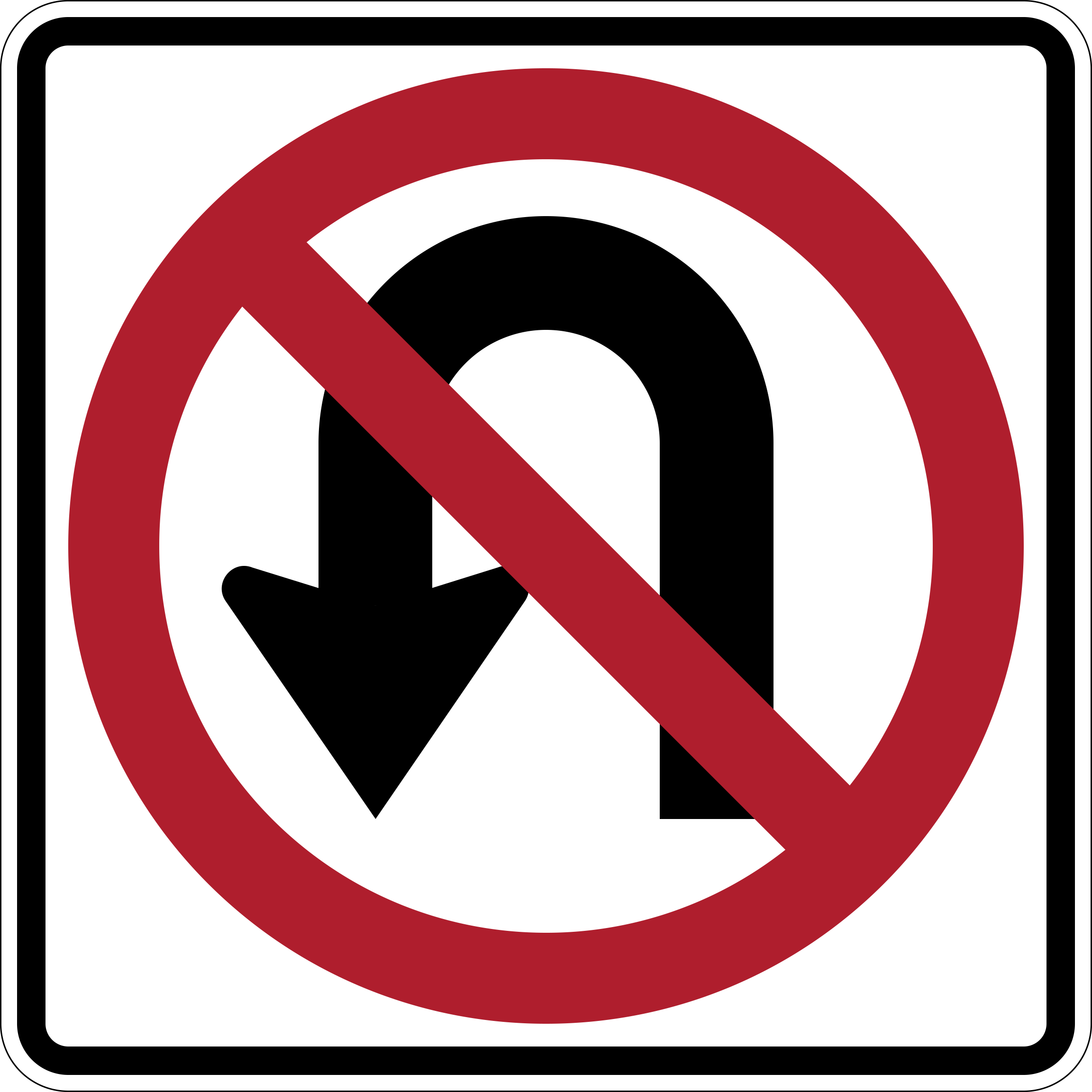
11. Which maneuver is prohibited by the pictured sign?
- U-turns
- Left turns only
- Right turns only
- Passing on a two-lane road
Show answer
U-turns. The pictured sign prohibits U-turns. In the manual, that means the driver must not make a complete turn to travel in the opposite direction. A left-turn or right-turn restriction uses a different arrow, and passing controls use another sign and message. Focus on the curved reverse arrow before interpreting the red slash. At the posted location, continue forward or choose another legal route rather than turning the vehicle back through the roadway.
Study this in the handbook: Pavement markings and lane use signs
12. What does an orange triangle on the back of a Pennsylvania farm tractor indicate?
- The vehicle carries hazardous materials
- The vehicle is part of a funeral procession
- The vehicle travels at 25 mph or less
- The vehicle is wider than a standard truck
Show answer
The vehicle travels at 25 mph or less. An orange triangle identifies a farm tractor or horse-drawn vehicle designed to operate at 25 mph or less, which is slower than normal traffic. It does not identify hazardous cargo, a funeral procession, or vehicle width. Use the emblem as an early warning to reduce speed, increase following space, and wait for a safe passing opportunity. Pennsylvania specifically advises staying a safe distance back and avoiding the horn when preparing to pass these slow-moving vehicles.
Study this in the handbook: Signaling, turning, U-turns and passing
13. What should a Pennsylvania driver do if another vehicle approaches head-on in the driver’s lane?
- Honk and try to escape to the right
- Close the eyes and hold the lane
- Swerve left immediately
- Accelerate toward the other vehicle
Show answer
Honk and try to escape to the right. If another vehicle is coming head-on in your lane, Pennsylvania says to honk first to attract attention and, if needed, try to escape to the right. Swerving left can place both vehicles on the same path if the other driver corrects, while closing your eyes or accelerating removes control. Keep scanning for an open escape route. If a collision cannot be avoided, brake firmly and steadily, since every reduction in speed lessens the impact.
Study this in the handbook: Right of way at intersections and roundabouts
14. When following a truck, how can a Pennsylvania driver tell whether the truck driver can see the car?
- If you are close enough to read its plate
- If the truck’s brake lights are on
- If you can see the truck’s side mirrors
- If you cannot see the truck’s front
Show answer
If you can see the truck’s side mirrors. When following a truck or bus, Pennsylvania explains that if you cannot see its side mirrors, the large-vehicle driver cannot see you. Staying visible in those mirrors also gives you a better view ahead and more time to react. Reading a plate or judging the truck’s brake lights does not answer the visibility question. Drop back or reposition until the mirrors are visible, while maintaining enough distance for the truck’s longer stopping needs.
Study this in the handbook: Motorcycles, bicycles, trucks and pedestrians
15. How far ahead should you be able to identify problem situations while driving in Pennsylvania?
- About 2 to 3 seconds ahead
- About 4 seconds ahead
- About 60 seconds ahead
- About 12 to 15 seconds ahead
Show answer
About 12 to 15 seconds ahead. To avoid last minute moves, the manual says you should be able to identify problem situations 12 to 15 seconds ahead, which is about one block in the city or a quarter of a mile at highway speeds. Two to three seconds leaves no time to react, and four seconds is the recommended following distance, not how far ahead to look. Sixty seconds is unrealistically far. Looking ahead does not mean staring at the center of the road; keep scanning the whole roadway, including its sides.
Study this in the handbook: Space cushion, following distance and scanning
16. According to the Pennsylvania manual, how often does a teenager dialing a cell phone miss an important event on the road?
- 5 percent of the time
- The same as an adult
- 53 percent of the time, compared with 13 percent for an adult
- Never, if the call is short
Show answer
53 percent of the time, compared with 13 percent for an adult. An adult dialing a cell phone misses the same driving event 13 percent of the time, but a teenager dialing a cell phone misses it 53 percent of the time. Inexperience makes distraction far more costly, and the manual lists reading, writing, and texting among the distractions to avoid. Driver distraction adds up to roughly 1.2 million crashes a year.
Study this in the handbook: Space cushion, following distance and scanning
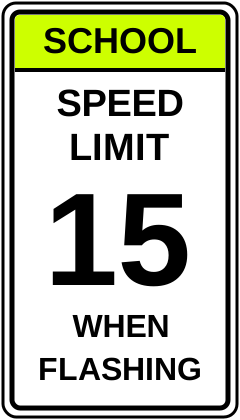
17. When school-zone signals are flashing in Pennsylvania, what speed must a driver not exceed?
- 25 mph
- 35 mph
- 45 mph
- 15 mph
Show answer
15 mph. A Pennsylvania school-zone signal is a flashing yellow signal on the school-zone speed-limit sign. During flashing periods, the driver must travel no faster than 15 mph, or follow the time period shown on the sign. Twenty-five and 35 mph are ordinary roadway figures that do not replace the school-zone limit, and 45 mph is plainly too high for the marked area. Watch the sign’s lights, reduce speed before the zone, and expect children near the roadway.
Study this in the handbook: Regulatory, warning and work zone signs
18. A bicyclist approaches a red traffic light in Pennsylvania. What does the manual require?
- Stop at the red light, just as a motorist must
- Stop only when a police officer is present
- Continue if the bicycle is in a marked bike lane
- Treat the light as advisory during daylight
Show answer
Stop at the red light, just as a motorist must. Pennsylvania treats the bicycle as one of the vehicle types covered by the rules of the road. The manual specifically uses a red light as an example: bicyclists must stop just as motorists do. A bike lane does not create a daylight exception, and the duty does not depend on an officer being nearby. At a red signal, the rider should stop before entering the intersection and wait for the signal or another lawful movement instruction.
19. How much space must Pennsylvania drivers allow a motorcycle to use?
- The center line and half a lane
- Half a lane
- Only the shoulder
- One complete lane
Show answer
One complete lane. Pennsylvania law requires a motorcyclist or moped driver to be allowed one complete lane. A motorcycle’s smaller size does not make it a half-lane vehicle, and drivers must not crowd it or share its lane. The shoulder is not a substitute for the motorcycle’s roadway space. Treat the motorcycle as a full vehicle, maintain a safe position, and change lanes only after checking that the entire adjacent lane is clear.
Study this in the handbook: Motorcycles, bicycles, trucks and pedestrians
20. When a Pennsylvania driving record reaches six or more points for the first time, what notice is sent?
- A mandatory vehicle registration inspection
- An automatic six-month license revocation
- A warning with no examination or hearing
- A written notice allowing a special point examination or Driver Improvement School
Show answer
A written notice allowing a special point examination or Driver Improvement School. At a first accumulation of six or more points, PennDOT offers a choice of a written Special Point Examination or Driver Improvement School. PennDOT's online point system page states that passing the examination removes two points and that successfully completing the school removes four. A later accumulation of six or more points requires a Departmental Hearing and Driver Improvement School, so this first occurrence differs from the rules for subsequent point accumulations.
Study this in the handbook: Points, insurance and crash duties
Insurance in Pennsylvania
Pennsylvania policies are handled in cooperation with licensed partner producer Sean Vu. QualitySpace Insurance Agency does not bind coverage in Pennsylvania directly. Contact us and we will route you to the right person.
Every question is written from the official Pennsylvania Driver's Manual (PUB 95). Need paper? Printable PA practice test with answer key.
Last verified 2026-10-05. How we check every question · Study all 500 as flashcards
Frequently asked questions
How many questions are on this Pennsylvania practice test?
This fixed set has 20 questions. It is test 9 of 25 from the 500 question Pennsylvania bank. The real PA exam asks 18 questions and you need 15 correct.
What is the passing score for the real Pennsylvania test?
15 of 18 correct to pass the test That figure comes from the official Pennsylvania source cited on the DMV facts page.
How does this fixed test relate to the full Pennsylvania bank?
Each numbered test is a fixed set of questions in a fixed order, so you can retake the same test later and compare. Every test mixes road signs and the other topics in about the same proportion as the full bank. Tests 1 to 25 together cover every question in the Pennsylvania bank once. The full practice page mixes the whole bank at random.
Last verified 2026-10-05. See the Pennsylvania DMV facts page for sourced state details.
Return to the full Pennsylvania practice test · Study road signs