
Test 1 of 25 · 20 questions · Free 2026
PA Permit Practice Test 1
Jump to the test ↓A fixed 20 question set from the Pennsylvania bank with answers and plain English explanations. The real PA exam is 18 questions, 83 percent to pass; take the full length version on the main practice page.
Talk to Kevin
714-666-6669Call now →California policies handled directly by Kevin Vu (CDI #4037122). New Jersey and Pennsylvania policies handled in cooperation with licensed partner producer Sean Vu (Allstate). QualitySpace Insurance Agency does not bind coverage in NJ or PA directly.
Question 1 of 20 · 0 right so far
All 20 questions in test 1
Every question below comes from the Pennsylvania question bank on this page. Open a question to see the correct answer and the explanation. Nothing here is hidden behind a signup.
1. At what speed and water depth can a vehicle hydroplane, according to the Pennsylvania manual?
- Only above 70 mph in deep water
- As low as 35 mph in water only one tenth of an inch deep
- Only above 55 mph
- Only in standing water over an inch deep
Show answer
As low as 35 mph in water only one tenth of an inch deep. Pennsylvania's manual says you can hydroplane at speeds as low as 35 mph when water is only one tenth of an inch deep. Hydroplaning happens when the tires lose their grip and ride like skis on a film of water; the faster you drive, the less effective the tires are at wiping water from the road, and worn tires make it worse. Driving slower reduces the risk. If it happens, keep both hands on the wheel, slowly take your foot off the gas, do not slam on the brakes or turn suddenly, and steer only as much as needed to stay on the road.
Study this in the handbook: Speed, night driving and bad weather
2. When parking on a Pennsylvania roadway, what should a driver use and leave for passing vehicles?
- Four-way flashers and enough room for passing vehicles
- Hazard lights only after blocking the travel lane
- High beams and enough room for one parked car
- No lights if the vehicle is visible from 500 feet
Show answer
Four-way flashers and enough room for passing vehicles. When parking on the roadway, Pennsylvania advises using the vehicle’s four-way flashers and leaving enough room for passing vehicles. The rule is about making a stopped vehicle visible and preserving usable roadway space, not about turning on high beams or waiting until the lane is blocked. Waiting until the lane is blocked reverses the safety goal, while showing no lights removes the warning lights the manual calls for. Before leaving the vehicle, check both traffic directions, activate the flashers, and position the car so moving drivers have a clear path around it.
Study this in the handbook: Signaling, turning, U-turns and passing
3. Being awake for 18 hours impairs driving about as much as what blood alcohol level, according to the Pennsylvania manual?
- .02 percent
- .05 percent
- .10 percent
- It has no measurable effect
Show answer
.05 percent. Being awake for 18 hours impairs your driving about as much as a blood alcohol level of .05 percent. Falling asleep while driving causes at least 100,000 crashes a year nationally, killing 1,500 people and injuring 40,000, and almost half of those crashes involve drivers between 15 and 24. When tired you react slower and your judgment and vision suffer.
Study this in the handbook: Space cushion, following distance and scanning
4. What is the maximum fine for a Pennsylvania Move Over violation that causes the death of a responder or a person near a disabled vehicle?
- Up to $10,000
- Up to $1,000
- Up to $5,000
- Up to $500
Show answer
Up to $10,000. The most severe outcome listed for Pennsylvania's Move Over Law is death of an emergency responder or a person in or near a disabled vehicle. That violation can bring a one-year license suspension and a fine of up to $10,000. The $1,000 figure applies when the violation leads to serious bodily injury or death of another person in the less specific category, while $5,000 applies to serious injury of a responder or nearby person. Match the penalty to both the harm and the protected person described.
Study this in the handbook: School buses, emergency vehicles and the Move Over law
5. Two vehicles approach an intersection from different roads at about the same time with no controls. Who yields in Pennsylvania?
- The driver coming from the right yields to the driver coming from the left
- The driver coming from the left yields to the driver coming from the right
- The vehicle on the wider road always proceeds first
- Both vehicles must enter together to claim priority
Show answer
The driver coming from the left yields to the driver coming from the right. At an uncontrolled intersection, Pennsylvania assigns the yield duty to the vehicle approaching from the left when the two vehicles arrive at roughly the same time. The right-side driver is not granted permission to accelerate, and roadway width does not replace the stated position rule. Entering together is unsafe and contrary to the purpose of the rule. Locate the other vehicle relative to your own approach before moving. If it is on your right, wait and let it clear the intersection.
Study this in the handbook: Right of way at intersections and roundabouts
6. What message category is normally shown by a yellow diamond sign in Pennsylvania?
- A mandatory speed or parking regulation
- A route direction to a town or service
- A railroad crossing permit number
- A warning about a roadway condition or hazard ahead
Show answer
A warning about a roadway condition or hazard ahead. Pennsylvania places warning information on yellow diamond signs. These signs alert drivers to hazards, changing alignment, crossings, or other conditions ahead, so the driver can adjust speed and attention. A speed limit or parking command belongs to the regulatory category, while a town or service direction is guide information. The permit-number option is not a roadway sign function. When the yellow diamond appears, scan beyond it and prepare for the condition it previews.
7. At a railroad crossing, how should a driver treat the pictured crossbuck sign?
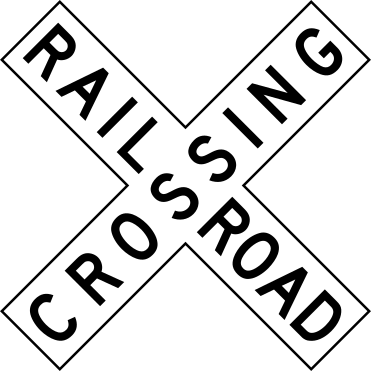
- As a STOP sign requiring a stop even when tracks are empty
- As a YIELD sign, slowing and preparing to stop for an approaching train
- As a warning that trains are prohibited from using the crossing
- As a lane-direction marker for vehicles leaving the crossing
Show answer
As a YIELD sign, slowing and preparing to stop for an approaching train. The railroad crossbuck is placed where the tracks cross the roadway, and the manual says to treat it like a YIELD sign. Slow down, look and listen, and prepare to stop if a train is approaching. It is not an automatic stop in every empty-track situation, nor does it control lane direction. The X shape is the key recognition cue. Never use another vehicle's movement as proof that the crossing is safe; check the tracks yourself.
Study this in the handbook: Regulatory, warning and work zone signs
8. What restraint does Pennsylvania require for a child under age four?
- A booster seat only after age eight
- An adult seat belt without a child seat
- A federally approved child passenger restraint system
- No restraint when the child rides in the back seat
Show answer
A federally approved child passenger restraint system. Pennsylvania requires every child under age four to ride in a federally approved child passenger restraint system, such as a child safety seat. The restraint must be secured with the vehicle seat belt system or the LATCH system, and the rule applies in either the front or back seat. An adult belt alone is not the required protection for this age group. A booster seat belongs to the next age band, beginning at age four and continuing until the child turns eight. Remember the under-four cue as child safety seat, secured to the vehicle, in every seating position.
Study this in the handbook: Seat belts, child seats and the anti-texting law
9. What roadway change is shown by the DIVIDED HIGHWAY BEGINS sign?

- The divided highway ends and oncoming traffic enters your lane
- A three-way intersection requires a turn
- The highway separates into two one-way roadways around a divider
- The road becomes a one-way ramp with no median
Show answer
The highway separates into two one-way roadways around a divider. DIVIDED HIGHWAY BEGINS means the highway ahead becomes two one-way roadways separated by a median or divider. Traffic moving in opposite directions will no longer share one undivided roadway. The oncoming-traffic answer describes the ending sign, while the other options concern an intersection or a ramp and omit the central separation. Keep to the right of the divider or median as the roadway changes, and continue watching for lane markings and vehicles joining the new roadway pattern.
10. What roadway location does the five-sided SCHOOL sign identify?

- A public park entrance with pedestrian priority at all times
- A residential street that permits children to play in the roadway
- A hospital zone where school buses may not stop
- An approaching school zone, or a school-zone crosswalk when paired with a downward arrow
Show answer
An approaching school zone, or a school-zone crosswalk when paired with a downward arrow. The five-sided sign is the roadway's SCHOOL sign. It means a school zone is approaching; when a downward arrow accompanies it, the sign marks the school-zone crosswalk. The park and hospital descriptions assign the pentagon to unrelated facilities. Drivers should slow down, watch for children crossing, and stop if necessary. In Pennsylvania, also obey the reduced school-zone speed limit when its yellow signals flash or during the posted times, so the sign should trigger an immediate safety check.
11. What is the purpose of a center turn lane marked by one solid line and one broken line on each side?
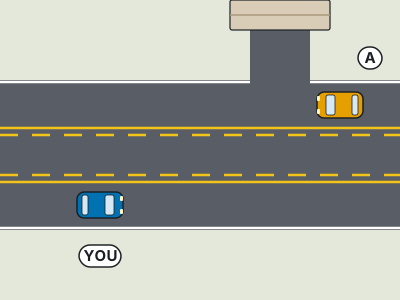
- It is a passing lane for faster traffic
- It is reserved for parking during daylight
- It is a one-way lane for through travel
- It is for left turns from either direction
Show answer
It is for left turns from either direction. Pennsylvania describes a center lane bordered by a solid outer line and a broken inner line as a lane that may only be used for left turns. Drivers from either direction use it to begin a left turn, and entering traffic may use it to finish a turn before joining the roadway. It is not a passing or parking lane. Identify the paired markings, check for opposing traffic, and enter only for the left-turn movement.
Study this in the handbook: Pavement markings and lane use signs
12. Which location is listed as one where a Pennsylvania driver may not stop, stand, or park?
- Within 20 feet of a crosswalk at an intersection
- Within 50 feet of a crosswalk at an intersection
- Within 5 feet of a crosswalk at an intersection
- Only on a crosswalk when pedestrians are present
Show answer
Within 20 feet of a crosswalk at an intersection. Pennsylvania lists the area within 20 feet of a crosswalk at an intersection among places where a driver may not stop, stand, or park, except in an emergency or when directed by a police officer. The five-foot and 50-foot options change the stated distance, while the pedestrians-present answer narrows the rule to the painted crossing itself. As you approach an intersection, keep the crosswalk and its approach clear so pedestrians remain visible and vehicles can turn safely. Remember that this restriction is measured from the crosswalk at an intersection.
Study this in the handbook: Parking rules and distances
13. A Pennsylvania child younger than age two must remain in what type of seat until it is outgrown?
- An adult lap belt in the front seat
- A forward-facing booster from birth
- A rear-facing car seat within its manufacturer limits
- Any seat without a weight limit
Show answer
A rear-facing car seat within its manufacturer limits. Pennsylvania requires children younger than age two to use a rear-facing car seat until they outgrow the seat’s maximum weight and height limits set by the manufacturer. A forward-facing booster from birth does not follow that rule, and an adult belt or an unrestricted seat does not provide the specified protection. Check both manufacturer limits rather than relying on age alone. Children under four must also be secured in a federally approved child safety seat, in the front or back seat.
Study this in the handbook: Seat belts, child seats and the anti-texting law
14. How many points does a Pennsylvania Move Over violation add to the driving record?
- 1 point
- 2 points
- 4 points
- 6 points
Show answer
2 points. A Pennsylvania Move Over conviction adds 2 points to the driving record, on top of a fine of up to $500 for a first offense. One point is too few, and 4 or 6 points overstate it. Six points is the level at which PennDOT begins corrective action. Drivers must move into a lane not next to the emergency response area or disabled vehicle, or slow to at least 20 mph below the posted limit if they cannot move over.
Study this in the handbook: School buses, emergency vehicles and the Move Over law
15. After a Pennsylvania conviction for fleeing or attempting to elude police, which penalty combination is stated in PUB 95?
- Six-month suspension and a $250 fine, with no court costs
- 30-day suspension, restitution only and no possible jail time
- One-year suspension, $500 fine, court costs and possible imprisonment
- Two-year suspension with a $2,000 fine and no other penalty
Show answer
One-year suspension, $500 fine, court costs and possible imprisonment. Pennsylvania treats fleeing or attempting to elude police as a serious driving-record offense. The manual lists a one-year suspension of driving privilege, a $500 fine, court costs and other fees, with imprisonment also possible. The shorter suspension in another choice understates the license consequence, while the larger fine changes the figure actually given. When emergency lights or a police signal require a stop, the safe response is to pull over and remain stopped as directed rather than trying to outrun the officer.
Study this in the handbook: Points, insurance and crash duties
16. A 16-year-old Pennsylvania permit holder has 65 practice hours logged. How long after the permit issue date must the teen wait before taking the Road Test?
- 30 days
- 90 days
- Six months
- One year
Show answer
Six months. A Pennsylvania permit holder under 18 must wait a mandatory six months from the permit issue date and have a signed certificate for the 65 hours of skill building, including 10 at night and 5 in bad weather, before the Road Test. Thirty and 90 days are too short. One year is how long the permit is valid, not the waiting period. Logging the hours early does not shorten the six months, and PennDOT recommends scheduling the test for a date no earlier than the eligibility date printed on the permit.
Study this in the handbook: Learner's permit, knowledge test and road test
17. When is the earliest you can apply for a Pennsylvania learner's permit?
- On or after your 16th birthday
- At 15, with a parent's consent
- At 15 and a half
- At 17, or 16 with driver's education
Show answer
On or after your 16th birthday. Pennsylvania does not issue a learner's permit before the 16th birthday. The physical examination on the application can be done up to six months before that birthday, but the application itself cannot be filed until the applicant turns 16. Fifteen, even with a parent's consent, is too young, and fifteen and a half is not a Pennsylvania threshold. Seventeen is not required either; 16 is also the minimum age for a Class C license.
Study this in the handbook: Learner's permit, knowledge test and road test
18. How much can hosting a drinking party for 17 teenagers cost a Pennsylvania adult, according to the manual's example?
- $500
- Nothing, if no one drives
- $1,700
- $41,000
Show answer
$41,000. Pennsylvania's manual says adults, even parents, convicted of knowingly and intentionally supplying minors with alcohol face a fine of at least $1,000 for the first offense and $2,500 for each additional offense, plus up to one year in jail, and adults are even liable for guests who drink in their homes. Its example: 17 teenagers drinking at a party in your home could cost you $41,000. That is $1,000 for the first teenage drinker and $2,500 for each of the other 16. The cost does not depend on anyone driving.
Study this in the handbook: DUI, chemical tests and zero tolerance
19. What is illegal in a Pennsylvania acceleration lane?
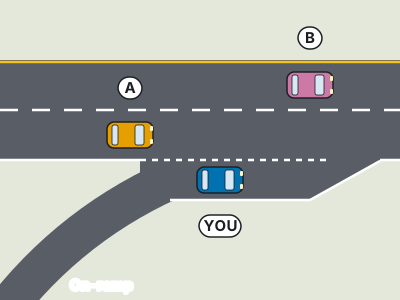
- Passing a vehicle ahead of you
- Looking for a gap in traffic
- Accelerating toward highway speed
- Using the lane before merging
Show answer
Passing a vehicle ahead of you. An acceleration lane gives an entering driver room to build speed and find a safe opening, but Pennsylvania says it is illegal to pass a vehicle ahead in that lane. Accelerating, checking for a gap, and using the lane to merge are its intended functions. Passing there can create conflicting movements near the entrance. Signal, accelerate to the speed of traffic, and merge into an opening without overtaking the vehicle already ahead of you.
Study this in the handbook: Signaling, turning, U-turns and passing
20. If you are driving 35 mph or more in Pennsylvania, when must you signal before turning?
- At least 100 feet before the turn
- At least 25 feet before the turn
- After entering the intersection
- At least 300 feet before the turn
Show answer
At least 300 feet before the turn. At 35 mph or faster, Pennsylvania requires signaling at least 300 feet before turning. The 100-foot distance applies when driving below 35 mph, so using it at the higher speed shortens the warning other drivers receive. Waiting until the intersection is also too late. Treat the speed threshold as the trigger: at or above 35 mph, begin the signal with enough roadway remaining to provide the full 300 feet of notice, then make the turn only after checking traffic and pedestrians.
Study this in the handbook: Signaling, turning, U-turns and passing
Insurance in Pennsylvania
Pennsylvania policies are handled in cooperation with licensed partner producer Sean Vu. QualitySpace Insurance Agency does not bind coverage in Pennsylvania directly. Contact us and we will route you to the right person.
Every question is written from the official Pennsylvania Driver's Manual (PUB 95). Need paper? Printable PA practice test with answer key.
Last verified 2026-10-05. How we check every question · Study all 500 as flashcards
Frequently asked questions
How many questions are on this Pennsylvania practice test?
This fixed set has 20 questions. It is test 1 of 25 from the 500 question Pennsylvania bank. The real PA exam asks 18 questions and you need 15 correct.
What is the passing score for the real Pennsylvania test?
15 of 18 correct to pass the test That figure comes from the official Pennsylvania source cited on the DMV facts page.
How does this fixed test relate to the full Pennsylvania bank?
Each numbered test is a fixed set of questions in a fixed order, so you can retake the same test later and compare. Every test mixes road signs and the other topics in about the same proportion as the full bank. Tests 1 to 25 together cover every question in the Pennsylvania bank once. The full practice page mixes the whole bank at random.
Last verified 2026-10-05. See the Pennsylvania DMV facts page for sourced state details.
Return to the full Pennsylvania practice test · Study road signs