
Test 6 of 25 · 20 questions · Free 2026
PA Permit Practice Test 6
Jump to the test ↓A fixed 20 question set from the Pennsylvania bank with answers and plain English explanations. The real PA exam is 18 questions, 83 percent to pass; take the full length version on the main practice page.
Talk to Kevin
714-666-6669Call now →California policies handled directly by Kevin Vu (CDI #4037122). New Jersey and Pennsylvania policies handled in cooperation with licensed partner producer Sean Vu (Allstate). QualitySpace Insurance Agency does not bind coverage in NJ or PA directly.
Question 1 of 20 · 0 right so far
All 20 questions in test 6
Every question below comes from the Pennsylvania question bank on this page. Open a question to see the correct answer and the explanation. Nothing here is hidden behind a signup.
1. At a steady red light in Pennsylvania, where should you stop before waiting for permission to proceed?
- Before the marked stop line or crosswalk
- At the far side of the intersection after checking traffic
- Only when a vehicle is approaching from the side
- After entering the intersection, beside the cross street
Show answer
Before the marked stop line or crosswalk. Pennsylvania places the stopping point before the marked stop line or crosswalk. If neither is visible, stop before entering the intersection, then wait for a green light. The tempting idea of stopping after entering the junction leaves the vehicle in the conflict area and ignores the stated location. A clear cue is the first painted line: the front of the vehicle must not pass it while stopping. A permitted turn on red does not remove the initial stop or the duty to yield afterward.
Study this in the handbook: Traffic signals and lane signals
2. A Pennsylvania driver goes around a ROAD CLOSED barrier at a flooded road. What penalty applies if no responders are called?
- Two points and a fine of up to $250
- A warning only
- Five points and a 60-day suspension
- A $50 fine and no points
Show answer
Two points and a fine of up to $250. Driving around or through signs or devices that close a road for hazardous conditions, such as flooding, brings 2 points and a fine of up to $250 in Pennsylvania. If emergency responders are called out because of it, the fine rises to up to $500 and the driver must repay the response costs. A warning understates the penalty. Five points and a 60 day suspension is the school bus penalty, and a $50 fine is the texting penalty.
Study this in the handbook: Seat belts, child seats and the anti-texting law
3. If a truck is passing you in Pennsylvania, how should you manage your speed?
- Increase it to stay beside the truck
- Brake hard immediately
- Reduce it slightly and then keep it steady
- Move into the truck’s blind spot
Show answer
Reduce it slightly and then keep it steady. When a truck passes your vehicle, the Pennsylvania manual says you can help the truck driver by keeping to the far side of your lane, reducing your speed slightly, and then keeping your speed steady. It adds that in any event you should not increase your speed while the truck is passing you. Braking hard is not the advice given. Moving into a truck's No-Zone is also wrong, because drivers in a truck's No-Zones cannot be seen by the truck driver.
Study this in the handbook: Motorcycles, bicycles, trucks and pedestrians
4. Which situation also places a Pennsylvania case in the Highest Rate DUI table regardless of BAC?
- Refusal of chemical testing
- A first speeding citation
- Any BAC below .02
- A clean breath test below .08
Show answer
Refusal of chemical testing. Pennsylvania's Highest Rate table begins at BAC .16 and also covers a driver who refuses chemical testing, regardless of the BAC level. A reading below .02 or a clean breath test below .08 cannot place a case in the highest tier, and a first speeding citation is not an impaired driving offense at all. This table carries a first offense fine of $1,000 to $5,000 and a 12 month suspension with interlock. Watch for either the number .16 or the refusal condition when deciding which table applies.
Study this in the handbook: DUI, chemical tests and zero tolerance
5. What is required for a young Pennsylvania driver to qualify for an early unrestricted license before age 18?
- Six months with no tickets and a second road test
- One year without a responsible crash or Vehicle Code conviction, an approved driver-training course, and required adult consent
- A clean three-month record and payment of an early-license fee
- Completion of the permit exam again with no passenger violations
Show answer
One year without a responsible crash or Vehicle Code conviction, an approved driver-training course, and required adult consent. Before age 18, Pennsylvania permits a junior driver to apply for a regular license after holding the junior license for one year and meeting several conditions: completing an approved driver-training course, avoiding a responsible crash for one year, avoiding a Vehicle Code conviction for one year, and obtaining consent from a qualifying adult. Six months, a second road test, or another permit exam leaves out the required record and training conditions. Look for the complete package, not just a clean stretch or a fee.
Study this in the handbook: Junior permit and junior license limits
6. At a railroad crossing with more than one track, when should a Pennsylvania driver start across after a train passes?
- Immediately when the first train clears
- When one track is visibly empty
- After getting a clear view down both tracks
- After following the vehicle ahead without checking
Show answer
After getting a clear view down both tracks. After a train passes at a crossing with multiple tracks, Pennsylvania says to wait until you have a clear view down both tracks before starting. Another train may be approaching on the track hidden by the first train. Moving immediately, checking only one track, or blindly following another vehicle removes the needed second look. Remain stopped, scan both directions, and proceed only when the entire crossing and the route beyond it are clear.
Study this in the handbook: Motorcycles, bicycles, trucks and pedestrians
7. When can driving at Pennsylvania's posted speed limit still result in a ticket?
- Never, if the vehicle is at or below the sign's number
- Only when the driver exceeds the limit by 10 mph
- When wet roads, poor visibility, or other conditions make that speed too fast
- Only inside a marked school zone
Show answer
When wet roads, poor visibility, or other conditions make that speed too fast. Posted speed limits describe the maximum safe driving speed under ideal road, traffic, and weather conditions. Pennsylvania says a driver can still be ticketed for driving too fast for conditions when the road is wet, visibility is poor, or another factor makes the posted speed unsafe. The sign's number is not an exemption from judgment, and a ticket does not require a ten-mph excess or a school zone. Treat changing conditions as a reason to slow below the posted maximum.
Study this in the handbook: Speed, night driving and bad weather
8. If an older vehicle's brakes suddenly fail, which initial response does Pennsylvania recommend?
- Shift to low gear and look for a place to slow to a stop
- Release the steering wheel and coast
- Use the parking brake at full force first
- Turn the ignition to LOCK immediately
Show answer
Shift to low gear and look for a place to slow to a stop. For an older vehicle with sudden brake failure, Pennsylvania lists shifting to low gear and looking for a place to slow to a stop as the first step. Downshifting helps reduce speed while the driver searches for an open place or uphill road. Turning the ignition to LOCK can lock the steering, and releasing control removes the ability to guide the vehicle. The parking brake is a later option if pumping the pedal does not work. Keep steering control and build the response in the manual's order.
Study this in the handbook: Skids, blowouts, floods and brake trouble
9. What determines a safe driving speed in Pennsylvania beyond the posted limit?
- Only the number printed on the speed-limit sign
- Road, visibility, and traffic conditions
- The vehicle's maximum advertised speed
- The speed of the fastest nearby vehicle
Show answer
Road, visibility, and traffic conditions. Pennsylvania says there is no single speed that is safe at all times. A driver must consider the posted limit together with road conditions, visibility, and the flow of other traffic. The sign number is a maximum for ideal conditions, not a promise that the same speed is safe in rain, fog, congestion, or a sharp curve. Matching the fastest vehicle can copy another driver's mistake. Use the roadway and what you can see as active cues, and lower speed when conditions become less than perfect.
Study this in the handbook: Space cushion, following distance and scanning
10. How many questions must an applicant answer correctly to pass Pennsylvania's Knowledge Test?
- 12 of 18
- 16 of 18
- 17 of 18
- 15 of 18
Show answer
15 of 18. Pennsylvania's Knowledge Test contains 18 multiple-choice questions, and an applicant needs 15 correct responses to pass. The option saying 12 of 18 understates the required score, while 16 and 17 set a higher bar than PennDOT's stated threshold. Think of the test as allowing only three missed questions. A practice session that produces 14 correct answers is still short, even though it is more than three quarters of the exam. Keep the pair 18 questions and 15 needed together when checking your result.
Study this in the handbook: Learner's permit, knowledge test and road test
11. At what point total does PennDOT begin to take corrective action on a driving record?
- Three or more points
- Fifteen or more points
- Eleven or more points
- Six or more points
Show answer
Six or more points. Points are added when a driver is found guilty of certain violations, and PennDOT begins to take corrective action when a driving record reaches six or more points. The first time, the driver gets a written notice to take a special point examination; reaching six again after dropping below it brings a Departmental hearing, and further accumulations bring more hearings or suspensions. Three points is the penalty for a single school zone speeding conviction, and 11 or 15 points overstate the starting threshold.
Study this in the handbook: Points, insurance and crash duties
12. Within what distance of an intersection or railroad grade crossing may you not pass in Pennsylvania?
- 100 feet
- 50 feet
- 300 feet
- 500 feet
Show answer
100 feet. Pennsylvania bars passing within 100 feet of or while crossing an intersection or railroad grade crossing, unless an official traffic control device allows it, and the same 100 foot rule applies to bridges, elevated structures, and tunnels. Fifty feet is too short. Three hundred feet is the signal distance at 35 mph or more, and 500 feet is the U-turn clearance, so both belong to other rules. Passing is also barred on curves or hill crests that limit the view.
Study this in the handbook: Signaling, turning, U-turns and passing
13. How close to a flashing signal, stop sign, or yield sign at the side of the road may you park in Pennsylvania?
- No closer than 15 feet
- No closer than 20 feet
- No closer than 50 feet
- No closer than 30 feet
Show answer
No closer than 30 feet. Pennsylvania bars parking within 30 feet of a flashing signal, stop sign, yield sign, or traffic control device at the side of the road. Fifteen feet is the fire hydrant distance. Twenty feet applies to a crosswalk at an intersection and to a fire station driveway. Fifty feet is the distance from the nearest rail at a railroad crossing. Keeping clear of signs lets other drivers see them.
Study this in the handbook: Parking rules and distances
14. What does the arrow on this ONE WAY sign tell motorists about the street?
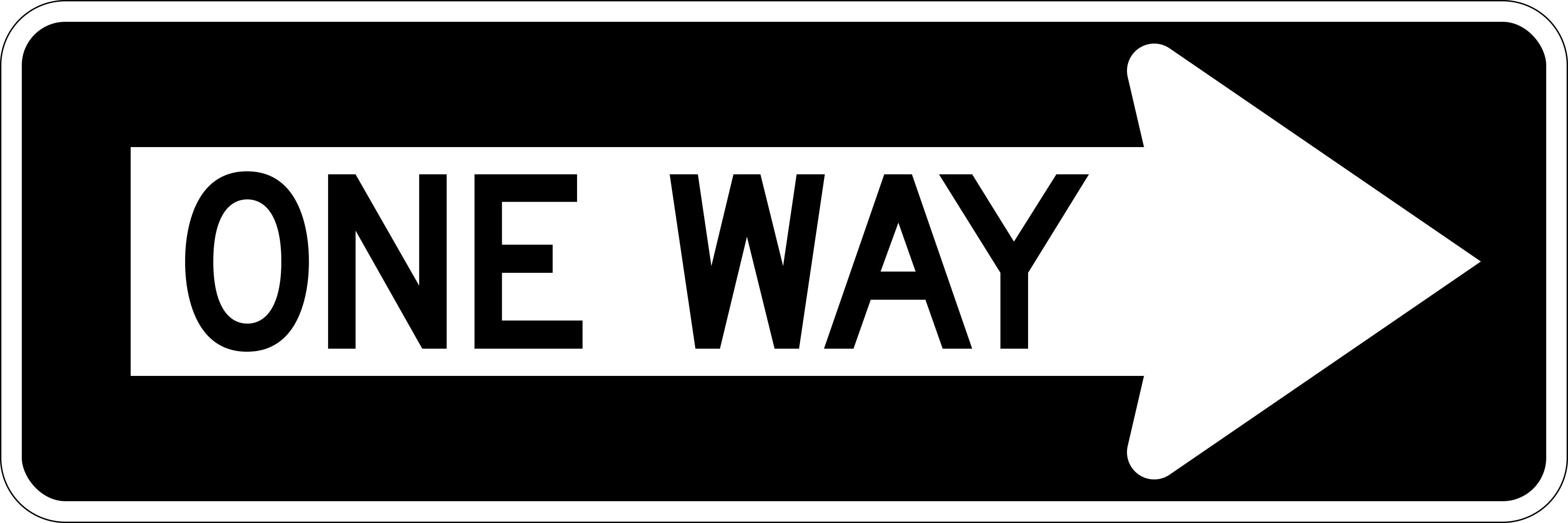
- Drivers may use either direction until a centerline appears
- Only buses may travel in the arrow's direction
- Traffic is allowed to move only in the direction the arrow points
- The arrow identifies the nearest permitted U-turn
Show answer
Traffic is allowed to move only in the direction the arrow points. The ONE WAY sign controls the direction of traffic on that street. The manual says traffic is allowed to move only in the direction the sign is pointing. It does not establish a bus lane, authorize a U-turn, or allow opposing movement before a centerline appears. Turning onto the street in the opposite direction is likely to produce a head-on collision, so compare the arrow with your intended path before entering. Another clue that a road is one way is vehicles parked on both sides of the road headed in the same direction.
Study this in the handbook: Pavement markings and lane use signs
15. What is the sentence range for a first offense at Pennsylvania's Highest Rate of impairment (.16 BAC and up)?
- Six months probation only
- 3 days to 6 months in prison
- 10 days to 2 years in prison
- 1 year to 5 years in prison
Show answer
3 days to 6 months in prison. A first offense at the Highest Rate, BAC .16 and up, carries 3 days to 6 months in prison in Pennsylvania, along with a fine of $1,000 to $5,000 and a 12 month suspension with one year of ignition interlock. Six months probation alone is the General Impairment first offense. Ten days to 2 years is the General Impairment third offense. One to five years is the Highest Rate third offense. The same table covers chemical test refusals.
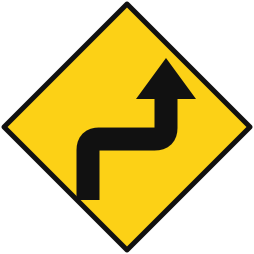
16. What does the RIGHT AND LEFT SHARP TURNS warning tell a driver to expect?
- A one-way street with no opposing traffic
- A T-intersection where the current road ends
- The roadway will turn sharply in one direction and then back
- A straight roadway with no change in alignment
Show answer
The roadway will turn sharply in one direction and then back. The sharp-turn warning describes two substantial direction changes, first one way and then back the other way. It is not a T-intersection, where another road joins and the current route ends, and it does not establish one-way traffic. Because the turns are sharp, reduce speed substantially before the sequence and prepare for the second change in direction. The useful recognition cue is the paired reversal in the arrow pattern. Keep centered in the lane and avoid carrying a highway-speed approach into the first turn.
17. What should a driver begin doing after seeing the round railroad-crossing warning sign?

- Accelerate so the vehicle clears the tracks before a signal changes
- Move immediately to the left lane and pass slower traffic
- Stop on the tracks to inspect the crossing ahead
- Look and listen for a train and be ready to stop before the tracks
Show answer
Look and listen for a train and be ready to stop before the tracks. The round warning sign announces a railroad crossing ahead and gives the driver time to prepare. The manual calls for beginning to look and listen for a train, slowing down if necessary, and stopping before the tracks when conditions require it. Accelerating turns advance warning into a rushed approach, and stopping on the rails creates a severe hazard. Once the sign appears, scan both directions, reduce speed, and ensure the vehicle can clear the entire crossing before entering.
18. How much clear road does the Pennsylvania manual say you need to pass at 45 mph?
- About 50 feet
- About 100 feet
- About 2 miles
- About one quarter mile
Show answer
About one quarter mile. Even with enough clear road ahead, you must judge the space and time to pass, and at 45 mph that translates into a quarter mile of clear roadway needed to pass a slower vehicle safely. Check that no one is passing you, signal, and return only when you can see the passed vehicle in your mirror. Never pass where signs or markings prohibit it.
Study this in the handbook: Signaling, turning, U-turns and passing
19. What can a Pennsylvania driver who ignores the wipers on, headlights on law end up paying?
- $1,000
- A $25 fine that approaches $100 with fees and costs
- Nothing, it is only a recommendation
- A one year suspension
Show answer
A $25 fine that approaches $100 with fees and costs. The law effective January 28, 2007 requires motorists to turn on their headlights any time the wipers are in continuous or intermittent use due to weather. Motorists who do not comply may face a fine of $25, but with fees and other associated costs the penalty would approach $100. Daytime running lights are not enough under this law, and the tail lights must be illuminated as well.
Study this in the handbook: Speed, night driving and bad weather
20. When must Pennsylvania drivers use headlights in a posted work zone?
- Only after sunset
- At any time of day while traveling through the work zone
- Only during rain or snow
- Only when workers are standing in the travel lane
Show answer
At any time of day while traveling through the work zone. Pennsylvania makes headlight use mandatory throughout every posted work zone, regardless of whether the visit occurs during daylight or darkness. The sunset choice is too narrow, and waiting until workers occupy the lane misunderstands the purpose of advance visibility. Rain is another trigger elsewhere in the law, but it is not required for this work-zone rule. Turn the headlights on before entering the signed area and keep them on until the work-zone roadway ends. The cue is simple: posted work zone means lights on.
Study this in the handbook: Regulatory, warning and work zone signs
Insurance in Pennsylvania
Pennsylvania policies are handled in cooperation with licensed partner producer Sean Vu. QualitySpace Insurance Agency does not bind coverage in Pennsylvania directly. Contact us and we will route you to the right person.
Every question is written from the official Pennsylvania Driver's Manual (PUB 95). Need paper? Printable PA practice test with answer key.
Last verified 2026-10-05. How we check every question · Study all 500 as flashcards
Frequently asked questions
How many questions are on this Pennsylvania practice test?
This fixed set has 20 questions. It is test 6 of 25 from the 500 question Pennsylvania bank. The real PA exam asks 18 questions and you need 15 correct.
What is the passing score for the real Pennsylvania test?
15 of 18 correct to pass the test That figure comes from the official Pennsylvania source cited on the DMV facts page.
How does this fixed test relate to the full Pennsylvania bank?
Each numbered test is a fixed set of questions in a fixed order, so you can retake the same test later and compare. Every test mixes road signs and the other topics in about the same proportion as the full bank. Tests 1 to 25 together cover every question in the Pennsylvania bank once. The full practice page mixes the whole bank at random.
Last verified 2026-10-05. See the Pennsylvania DMV facts page for sourced state details.
Return to the full Pennsylvania practice test · Study road signs