
Test 2 of 25 · 20 questions · Free 2026
PA Permit Practice Test 2
Jump to the test ↓A fixed 20 question set from the Pennsylvania bank with answers and plain English explanations. The real PA exam is 18 questions, 83 percent to pass; take the full length version on the main practice page.
Talk to Kevin
714-666-6669Call now →California policies handled directly by Kevin Vu (CDI #4037122). New Jersey and Pennsylvania policies handled in cooperation with licensed partner producer Sean Vu (Allstate). QualitySpace Insurance Agency does not bind coverage in NJ or PA directly.
Question 1 of 20 · 0 right so far
All 20 questions in test 2
Every question below comes from the Pennsylvania question bank on this page. Open a question to see the correct answer and the explanation. Nothing here is hidden behind a signup.
1. For a third or later Pennsylvania Move Over violation without an injury consequence, what maximum fine does the manual list?
- $250
- $500
- $2,000
- $1,000
Show answer
$2,000. Pennsylvania escalates the summary-offense fine for failing to move over or slow down: up to $500 for a first offense, $1,000 for a second, and $2,000 for a third or subsequent offense. The smaller amounts are the earlier steps in that sequence, not the later violation asked about here. A practical memory aid is to pair each repeat level with the next larger figure. Injury-related consequences are separate and can add suspension and higher fines, so this item is limited to the ordinary escalation.
Study this in the handbook: School buses, emergency vehicles and the Move Over law
2. An adult is convicted of knowingly supplying alcohol to a minor in Pennsylvania for the first time. What minimum fine does the manual list for that first offense?
- At least $1,000
- $500, and only if the minor was driving
- $2,500 for a first offense
- $100 for the entire incident
Show answer
At least $1,000. Pennsylvania's manual says adults, even parents, who are convicted of knowingly and intentionally supplying minors with alcohol face a fine of at least $1,000 for the first offense and $2,500 for each additional offense, plus up to one year in jail. The $100 and $500 choices reduce the amount or add a driving condition the rule does not contain, and $2,500 is the figure for additional offenses. The manual's party example shows how fast this adds up: 17 drinking teenagers would cost $41,000, which is $1,000 for the first and $2,500 for each of the other 16.
Study this in the handbook: DUI, chemical tests and zero tolerance
3. After the first 6 months, how many non-family minor passengers may a junior license holder carry (absent a violation history)?
- No more than three passengers under 18 who are not immediate family
- No more than one such passenger forever
- Any number of passengers under 18
- No passengers under 18 under any circumstance
Show answer
No more than three passengers under 18 who are not immediate family. After six months on a junior license, the Pennsylvania limit can increase to no more than three passengers under 18 who are not immediate family, provided the driver has not been involved in a responsible crash or convicted of a driving violation. The one-passenger choice describes the initial period, and unlimited carriage ignores the continuing cap. A clean six-month interval is not the same as an unrestricted license. Check both elapsed time and the driver's record before applying the expanded number.
Study this in the handbook: Junior permit and junior license limits
4. How long is a Pennsylvania learner's permit application valid, and how old may the physical exam be?
- Two years, with any exam date
- Six months, with an exam in the last 30 days
- One year from the physical examination, which may be no more than six months before the 16th birthday
- It never expires
Show answer
One year from the physical examination, which may be no more than six months before the 16th birthday. The Non Commercial Learner's Permit Application, form DL-180, is valid for one year from the date of your physical examination, but the exam date may not be more than six months before your 16th birthday. A health care provider completes the back of the form, and if the examiner cannot tell whether it meets medical standards the permit may be delayed. Applicants under 18 also need the parent consent form.
Study this in the handbook: Learner's permit, knowledge test and road test
5. What following distance should a Pennsylvania driver allow behind a motorcycle or moped?
- Exactly one second
- The same distance as a parked vehicle
- Two car lengths in every condition
- At least four seconds, or more in poor conditions
Show answer
At least four seconds, or more in poor conditions. Pennsylvania advises allowing the same four-second following distance or more behind a motorcycle or moped, with extra space when road or weather conditions are bad. A fixed one-second gap or two car lengths does not account for speed, surface, or the rider’s need to maneuver. Use a stationary roadside object to count four seconds after the motorcycle passes it, then increase the count when rain, ice, or another hazard reduces traction.
Study this in the handbook: Motorcycles, bicycles, trucks and pedestrians
6. A Pennsylvania driver is stopped in traffic before a railroad crossing. Where should the vehicle stop?
- With the front wheels on the nearest rail
- Where the entire vehicle is clear of the railroad tracks
- As close to the crossing as possible, even on the tracks
- Across the tracks if the signal is green
Show answer
Where the entire vehicle is clear of the railroad tracks. Pennsylvania warns drivers never to stop on railroad tracks, whether or not a train is visible. If traffic backs up because of a signal, stop sign, or another cause, the vehicle must remain in a location where it is entirely clear of the tracks. The nearest-rail choice leaves the vehicle exposed, and a green signal does not make occupying the crossing safe. Look beyond the crossing before entering it, and wait behind the line until there is room to clear the rails completely.
Study this in the handbook: Traffic signals and lane signals
7. What does Pennsylvania caution drivers about assuming at an intersection?
- The widest roadway always has priority
- The first vehicle to sound its horn may proceed
- A green light removes every duty to yield
- A driver should not assume an automatic right-of-way
Show answer
A driver should not assume an automatic right-of-way. Pennsylvania explains that intersection law identifies who must yield, but it does not guarantee that another road user will obey. A driver who assumes automatic priority can enter a conflict and turn a legal expectation into a crash. Road width and a horn do not create priority, and a green light does not erase the need to watch for pedestrians or other hazards. Approach with the right-of-way rule in mind, but be prepared to stop whenever another person fails to yield.
Study this in the handbook: Right of way at intersections and roundabouts
8. When parking beside a curb in Pennsylvania, how close must your vehicle be?
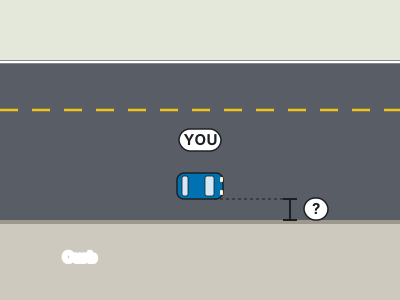
- No more than 3 feet from the curb
- No more than 12 inches from the curb
- At least 24 inches from the curb
- Only close enough for the tires to touch
Show answer
No more than 12 inches from the curb. Pennsylvania says a vehicle parked on a street with a curb should be as close to the curb as possible, but no more than 12 inches away. Three feet leaves the vehicle exposed in the travel area, and moving the tires against the curb is not the stated parking method. If there is no curb, pull as far off the roadway as possible instead. Use the curb distance as a final check before leaving the vehicle, alongside the parking brake and traffic scan.
Study this in the handbook: Parking rules and distances
9. Which shape is used only for Pennsylvania STOP signs?
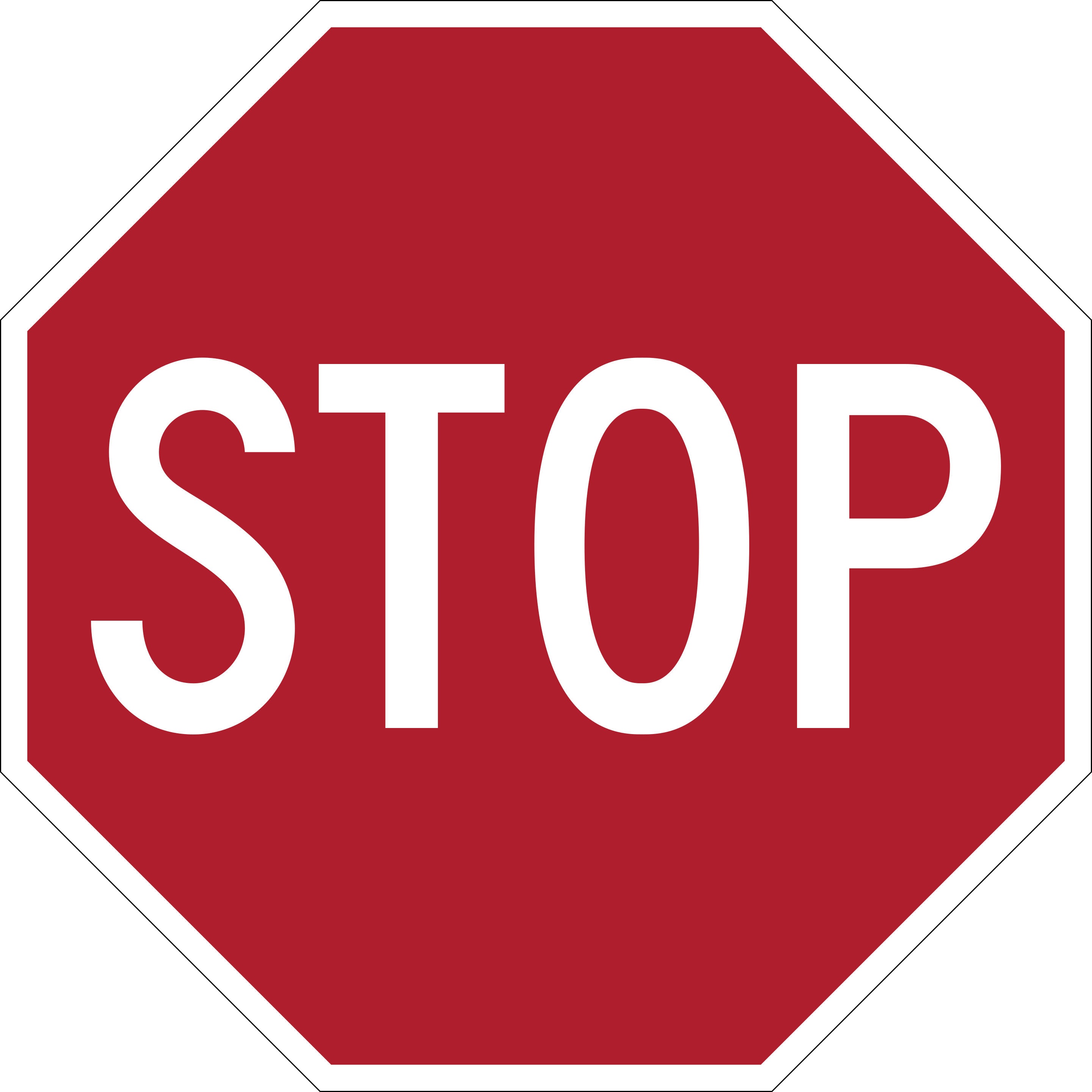
- Pennant
- Triangle
- Octagon
- Circle
Show answer
Octagon. Pennsylvania's manual says the STOP sign is the only octagon-shaped, eight-sided sign you see on the highway. A triangle belongs to a YIELD sign, a pennant marks the beginning of a no-passing zone, and a circle is the round railroad crossing advance warning sign. Because no other sign uses the octagon, the shape alone tells you what is required. At an intersection with a STOP sign you must stop completely, check for pedestrians and cross traffic, and go again only when the intersection is clear. Slowing down without a full stop is illegal.
Study this in the handbook: Regulatory, warning and work zone signs
10. In a review of 12,000 crashes cited by the Pennsylvania manual, how many drivers took no action to avoid the crash?
- 2 percent
- 37 percent
- 90 percent
- None
Show answer
37 percent. In a review of 12,000 crashes, 37 percent of the drivers took no action to avoid the crash, which means more than a third never braked or steered before impact. Scanning far ahead, keeping a space cushion, and deciding in advance where you would go in an emergency give you the time to act. The manual's four second cushion exists so a driver has room to steer or brake around a hazard.
Study this in the handbook: Skids, blowouts, floods and brake trouble
11. When Pennsylvania requires windshield wipers because of weather, what else must be illuminated?
- Only daytime running lights
- Only hazard lights
- High beams and parking lights only
- Headlights and tail lights
Show answer
Headlights and tail lights. Pennsylvania requires both headlights and tail lights whenever weather causes the wipers to operate continuously or intermittently. Daytime running lights alone are not enough, so that choice leaves the rear of the vehicle less visible. Hazard lights are not a substitute for the required lighting, and high beams are not required for this rule. Use the wiper switch as your cue: if weather requires the wipers, turn on the full headlight system before continuing.
Study this in the handbook: Speed, night driving and bad weather
12. What lighting is required when driving through an active Pennsylvania work zone?
- Parking lights only
- High beams at all times
- No lights during daylight
- Vehicle headlights, not just daytime running lights
Show answer
Vehicle headlights, not just daytime running lights. Pennsylvania requires headlights when driving through work zones, and the manual specifically says daytime running lights alone are not enough. Parking lights do not provide the required visibility, high beams can create glare and are not mandated, and daylight does not remove the work-zone rule. Turn on the headlights before entering the active area and keep them on while workers or equipment are nearby. The orange devices and work-zone signs are the cue to check the lighting control.
13. When this KEEP RIGHT sign is posted beside a traffic island, where should traffic pass?
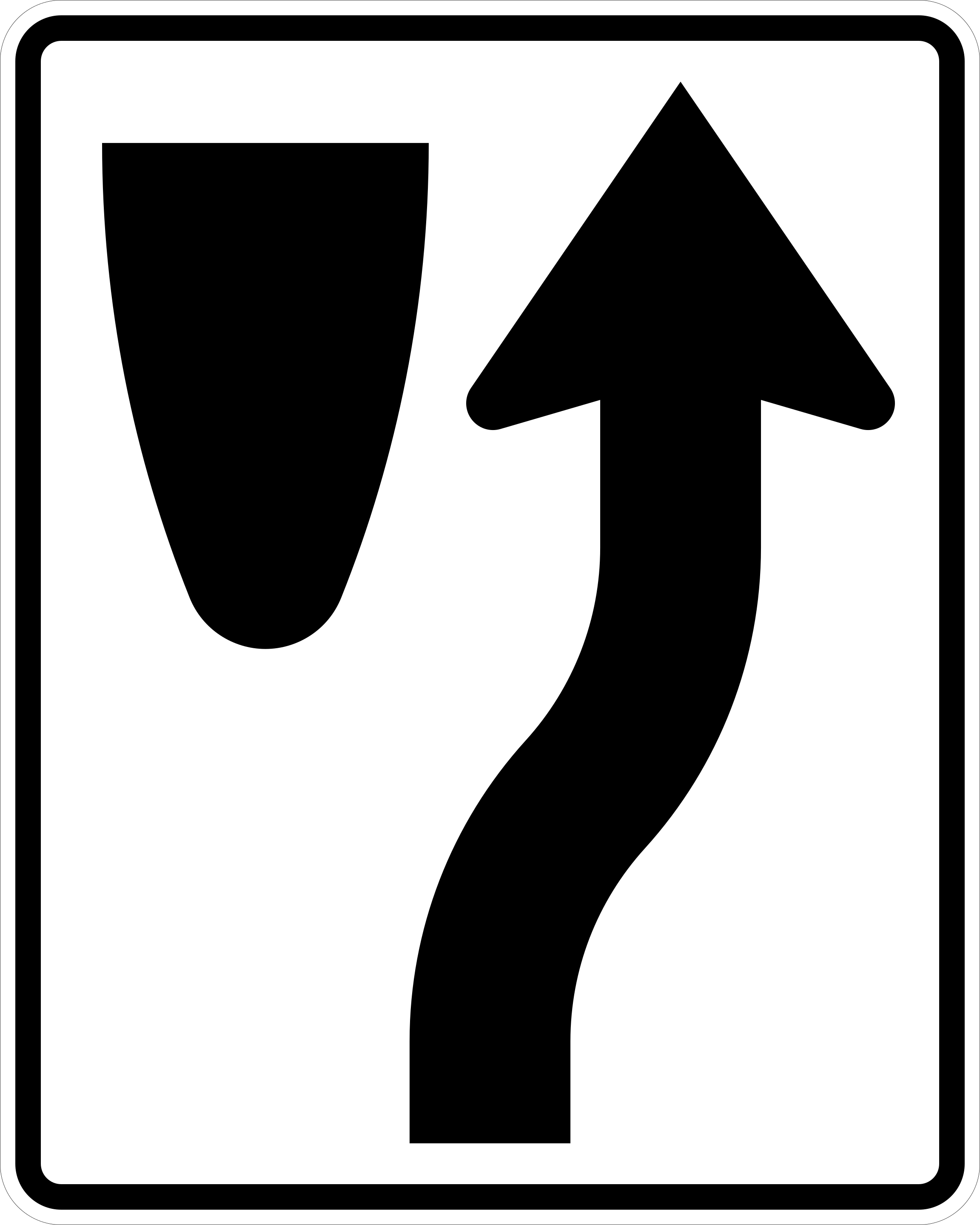
- To the left of the island, regardless of lane markings
- On the shoulder until the obstruction ends
- To the right of the traffic island or divider
- In either direction, because the sign is advisory
Show answer
To the right of the traffic island or divider. KEEP RIGHT signs direct drivers to stay to the right of a traffic island or divider. The instruction concerns the path around the obstruction, not shoulder use or a free choice between sides. Passing left could place the vehicle against the intended channel of traffic, while treating the sign as optional ignores its regulatory direction. Look beyond the sign to locate the island, move into the right-hand route early, and watch for other vehicles entering the same narrowed path.
Study this in the handbook: Pavement markings and lane use signs
14. Before taking the road test for a junior license, a Pennsylvania learner's permit holder must complete at least how many hours of adult-supervised skill-building driving?
- 35 hours, including at least 5 at night and 2 in bad weather
- 50 hours, including at least 10 at night and 5 in bad weather
- 100 hours, including at least 20 at night and 10 in bad weather
- 65 hours, including at least 10 at night and 5 in bad weather
Show answer
65 hours, including at least 10 at night and 5 in bad weather. A Pennsylvania driver under 18 must complete at least 65 hours of behind-the-wheel skill-building before the Road Test. That total must include no less than 10 hours of nighttime driving and five hours in bad weather. The smaller totals leave out required practice, while 100 hours is not the minimum named by the manual. Treat the three numbers as one package: 65 overall, 10 nighttime, and 5 bad-weather hours. The signed certification is part of the road-test preparation for a young driver.
Study this in the handbook: Learner's permit, knowledge test and road test
15. What is the sentence for a first offense General Impairment DUI (.08 to .099 BAC) by a driver 21 or older in Pennsylvania?
- Six months probation, a $300 fine, and no license action
- 5 days to 6 months in prison and a 12-month suspension
- 2 days to 6 months in prison and a $500 fine
- 1 year in prison
Show answer
Six months probation, a $300 fine, and no license action. Pennsylvania's General Impairment table, for adults at .08 to .099, lists six months probation, a $300 fine, and no license action for a first offense. Five days to six months with a 12 month suspension is the second offense. Two days to six months with at least a $500 fine is the first offense at the High Rate. One year in prison is not a first offense sentence. Alcohol highway safety school is required for first or second offenses at any level.
16. If a Pennsylvania vehicle drifts onto a soft shoulder, how fast should it be traveling before returning to the pavement?
- Very slowly, less than 25 mph and preferably closer to 10 mph
- At least 45 mph
- Fast enough to match traffic before steering back
- At the original highway speed
Show answer
Very slowly, less than 25 mph and preferably closer to 10 mph. For a vehicle that has drifted off the pavement, Pennsylvania says to continue slowing gradually until traveling very slowly, less than 25 mph and preferably closer to 10 mph, before easing back onto the road. Returning at highway speed can cause a sharp sideways whip, especially when the shoulder is soft or wet. Do not brake suddenly or jerk the wheel. Keep the vehicle parallel, check behind, signal, and reenter gently when the lane is clear.
Study this in the handbook: Right of way at intersections and roundabouts
17. About how many motorcycle crashes happen on Pennsylvania roads each year, and what causes nearly 40 percent of them?
- About 100, mostly from speeding
- About 4,000, with nearly 40 percent caused by another vehicle turning left in front of the motorcyclist
- About 50,000, mostly from weather
- About 400, mostly from brake failure
Show answer
About 4,000, with nearly 40 percent caused by another vehicle turning left in front of the motorcyclist. Approximately 4,000 motorcycle crashes occur on Pennsylvania roads each year, and nearly 40 percent were caused by the other vehicle turning left in front of the motorcyclist. Motorcycles are narrow and easy to lose in a quick glance, and their speed is hard to judge. Before turning left, look specifically for a motorcycle and wait for it to pass, since its distance is easy to underestimate.
18. What does a flashing yellow arrow permit a Pennsylvania driver to do?
- Turn with protected priority over all traffic
- Turn in the arrow's direction after yielding to oncoming traffic and pedestrians
- Make a U-turn regardless of signs
- Proceed without checking the crosswalk
Show answer
Turn in the arrow's direction after yielding to oncoming traffic and pedestrians. A flashing yellow arrow permits a turn in the arrow’s direction, but the turn is not protected. The driver must first yield to oncoming traffic and pedestrians. Treating it as a protected movement reverses the key distinction, while a U-turn or an unchecked crosswalk is not authorized by the signal. Slow down, scan the opposing lane and crossing area, then turn only when the gap is safe. The flashing arrow means permission with caution, not priority.
Study this in the handbook: Traffic signals and lane signals
19. What does an advisory speed sign placed with a diamond-shaped warning sign communicate?
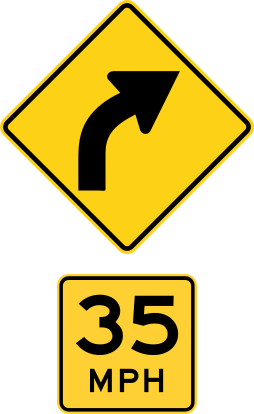
- The highest speed recommended for the warned condition
- The distance to the next fuel station
- A legally binding minimum speed for every vehicle
- A school-zone penalty that applies regardless of location
Show answer
The highest speed recommended for the warned condition. An advisory speed sign gives the highest speed a driver should use around the warned feature, such as a sharp curve. It is paired with a diamond-shaped warning sign to help drivers select a safer speed for that condition. The minimum-speed choice changes a recommendation into a requirement, and the fuel-station and school-zone choices describe unrelated information. Treat the number as a cautionary ceiling for the curve, then reduce farther if rain, darkness, traffic, or visibility makes the roadway more demanding.
20. How should a driver treat an intersection controlled by a non-functioning traffic signal?
- Treat it as a flashing yellow signal
- Give priority to the largest roadway
- Treat it as a four-way STOP sign
- Proceed without stopping if no light is visible
Show answer
Treat it as a four-way STOP sign. Pennsylvania directs drivers to treat a non-functioning traffic signal as though it were a four-way STOP sign. Every approach must stop and then proceed only after checking for conflicting traffic and pedestrians. The flashing-yellow choice would call for caution without the all-way stop treatment, while the largest-roadway choice invents a priority rule. Do not assume a dark signal means unrestricted movement. Approach as an all-way stop, establish the order of travel, and enter only when the intersection is clear.
Study this in the handbook: Traffic signals and lane signals
Insurance in Pennsylvania
Pennsylvania policies are handled in cooperation with licensed partner producer Sean Vu. QualitySpace Insurance Agency does not bind coverage in Pennsylvania directly. Contact us and we will route you to the right person.
Every question is written from the official Pennsylvania Driver's Manual (PUB 95). Need paper? Printable PA practice test with answer key.
Last verified 2026-10-05. How we check every question · Study all 500 as flashcards
Frequently asked questions
How many questions are on this Pennsylvania practice test?
This fixed set has 20 questions. It is test 2 of 25 from the 500 question Pennsylvania bank. The real PA exam asks 18 questions and you need 15 correct.
What is the passing score for the real Pennsylvania test?
15 of 18 correct to pass the test That figure comes from the official Pennsylvania source cited on the DMV facts page.
How does this fixed test relate to the full Pennsylvania bank?
Each numbered test is a fixed set of questions in a fixed order, so you can retake the same test later and compare. Every test mixes road signs and the other topics in about the same proportion as the full bank. Tests 1 to 25 together cover every question in the Pennsylvania bank once. The full practice page mixes the whole bank at random.
Last verified 2026-10-05. See the Pennsylvania DMV facts page for sourced state details.
Return to the full Pennsylvania practice test · Study road signs