
Test 8 of 10 · 20 questions · Free 2026
NM Permit Practice Test 8
Jump to the test ↓A fixed 20 question set from the New Mexico bank with answers and plain English explanations.
Question 1 of 20 · 0 right so far
All 20 questions in test 8
Every question below comes from the New Mexico question bank on this page. Open a question to see the correct answer and the explanation. Nothing here is hidden behind a signup.
1. How does New Mexico handle a ticket for driving without insurance or without vehicle registration?
- It adds 12 points and an automatic one-year suspension
- It carries no points but requires the driver to appear in court
- It adds points, the same way a speeding ticket does
- It is a warning only and never goes to court
Show answer
It carries no points but requires the driver to appear in court. New Mexico uses points for common violations such as speeding or not wearing a seat belt, but offenses like driving without insurance or registration do not carry points. Instead the driver must appear in court, which can lead to more fines and a suspended license. Twelve points confuses these offenses with the point threshold: twelve or more points in twelve months brings a one year suspension. Treating it like a speeding ticket is wrong because these offenses carry no points at all. It also says they require a court appearance, so a warning only answer is wrong.
Study this in the handbook: Renewal, points, seat belts and insurance
2. What do destination signs show drivers?
- Whether a vehicle has liability insurance
- Only the speed that applies in a work zone
- The exact place where passing becomes illegal
- Directions and distance to places such as cities, airports, or state lines
Show answer
Directions and distance to places such as cities, airports, or state lines. Destination signs give route guidance by showing directions and distances to locations such as cities, airports, state lines, parks, historic areas, and museums. They are not used to set work zone speed, mark no-passing boundaries, or show insurance status. The most useful cue is the green or brown rectangular guide sign format, followed by place names or mileage. On a trip, match those signs to your planned route early enough to change lanes calmly instead of making a late maneuver.
Study this in the handbook: Warning, regulatory and guide signs
3. What does a dashed white line between lanes traveling in the same direction allow?
- Changing lanes when it is safe
- Passing into opposing traffic
- Parking beside the line
- Ignoring lane signals above the road
Show answer
Changing lanes when it is safe. A dashed white line separates lanes moving in the same direction and may be crossed to change lanes when the move is safe. It is not permission to enter opposing traffic; yellow markings control lanes with traffic moving opposite ways. Parking beside the line would place the vehicle in a travel lane, and overhead lane signals still matter. The practical cue is color plus pattern: white deals with same-direction lanes, and the dash means a lane change can be made after mirror, blind spot, and signal checks.
Study this in the handbook: Warning, regulatory and guide signs
4. When entering a traffic circle, whom must you yield to?
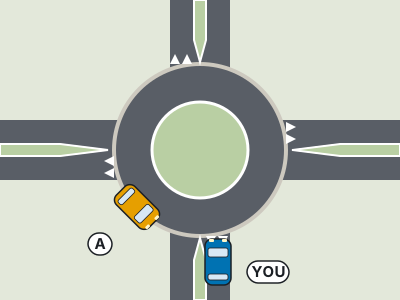
- No one, because entering traffic has priority
- Only drivers waiting outside the circle
- Vehicles behind you approaching the entrance
- Drivers already in the circle
Show answer
Drivers already in the circle. Traffic already circulating has the established path, so an entering driver must wait for a safe opening. Entering first would force circulating traffic to brake or swerve and defeats the yield rule. The choice favoring vehicles outside reverses the intended order. Reduce speed before the entrance, look left and around the circle for moving traffic, and join only when the gap allows a smooth entry without making another driver react.
Study this in the handbook: Right of way at intersections
5. On packed snow, how should a driver adjust speed compared with normal travel?
- Maintain the posted maximum whenever tires have tread
- Reduce speed by about 10 miles per hour
- Cut speed in half
- Slow only to a crawl, as required for ice
Show answer
Cut speed in half. Packed snow calls for cutting speed in half because the tires have less grip and the vehicle needs more room to respond. The choice “Reduce speed by about 10 miles per hour” is the manual's approximate adjustment for a wet road, so applying it to packed snow understates the hazard. The choice “Maintain the posted maximum whenever tires have tread” ignores the need to adjust for slippery conditions, even when tires appear serviceable. The choice “Slow only to a crawl, as required for ice” is the instruction for ice, which is more severe than the packed snow guidance. Treat the surface as soon as snow is packed, reduce the normal speed substantially, and remember that the posted limit assumes better conditions.
Study this in the handbook: Road conditions, sight distance and wildlife
6. If a vehicle begins to hydroplane and the tires lose traction, what does the manual advise first?
- Accelerate sharply to force the tires onto dry pavement
- Brake hard while turning toward the shoulder
- Ease off the gas and keep the steering wheel straight
- Turn the wheel quickly from side to side
Show answer
Ease off the gas and keep the steering wheel straight. When the tires lose traction on a wet road, the manual advises easing off the gas and keeping the steering wheel straight. A turn should be made slowly only if an emergency requires it, and braking or turning before grip returns can worsen the skid. Hard braking and rapid steering create abrupt inputs while the tires are already unable to hold the surface. Reduce the source of acceleration, stay composed, and wait for traction before trying to change direction or stop.
Study this in the handbook: Road conditions, sight distance and wildlife
7. How far from a travel lane should a driver park when possible?
- Close enough to occupy part of the travel lane
- Far enough away to avoid interfering with traffic
- Only one foot from moving traffic
- On the lane line whenever the shoulder is clear
Show answer
Far enough away to avoid interfering with traffic. The parking guidance calls for enough separation from a travel lane that the parked vehicle does not interfere with traffic. A vehicle partly occupying the lane can force approaching drivers to swerve or stop, while a fixed one-foot rule is not the manual's standard. The lane line is a boundary, not a parking target. Select a place that leaves moving traffic a clear path, then check visibility from both directions. This principle applies even when no curb color or temporary sign supplies a more specific restriction.
Study this in the handbook: Parking rules and no parking zones
8. For how long must a New Mexico applicant retain an instructional permit before moving to the next license stage?
- At least six months
- At least three months
- At least nine months
- Until the applicant turns 18, regardless of issue date
Show answer
At least six months. The instructional permit must be retained for at least six months. That period is separate from the applicant's birthday and is not automatically shortened by passing a test or completing a practice drive. The three month choice is too short, while the nine month and age 18 choices add requirements the manual does not state. Track the issue date carefully so the learner does not seek the provisional stage before the full holding period has passed.
Study this in the handbook: Permits and the graduated license
9. What kinds of information can traffic signs provide?

- Only the vehicle's mechanical condition
- Rules, hazards, location, directions, and services
- Only the weather forecast for the next hour
- The identity of every driver using the road
Show answer
Rules, hazards, location, directions, and services. New Mexico explains that traffic signs can communicate rules, hazards, location, directions, and the location of services. Their messages are broader than speed alone and help drivers understand both the road's controls and the route ahead. Signs do not diagnose a vehicle, forecast the weather, or identify every road user. Read the sign type, shape, color, and wording together, then follow the instruction while continuing to observe traffic and roadway conditions.
Study this in the handbook: Traffic signals and arrows
10. If no minimum speed is posted, how should a driver choose a speed?
- Drive so regular traffic flow is not interrupted
- Drive at the lowest possible speed on every road
- Match the fastest vehicle regardless of conditions
- Stop until another vehicle provides a pace
Show answer
Drive so regular traffic flow is not interrupted. When no minimum speed is posted, the manual directs drivers to travel so they do not interfere with regular traffic flow. That does not mean choosing the fastest vehicle's speed or ignoring weather and road conditions. Driving unnecessarily slowly can cause vehicles to bunch up and pass, while stopping in the lane creates a separate hazard. Choose a pace that is safe for the conditions and compatible with ordinary traffic. Keep right when traveling slower than other vehicles, and allow faster traffic to pass safely.
Study this in the handbook: Speed limits
11. What colors and shape are most common for New Mexico warning signs?
- Red with blue symbols, usually octagonal
- White with green letters, usually circular
- Yellow with black lettering or symbols, usually diamond shaped
- Orange with white letters, usually triangular
Show answer
Yellow with black lettering or symbols, usually diamond shaped. The manual describes warning signs as usually yellow with black lettering or symbols, and most are diamond shaped. That combination helps a driver recognize a warning before reading every detail. White and green signs generally serve other information purposes, an octagon is associated with a stop sign, and orange commonly marks work areas. When the yellow diamond appears, reduce speed, scan for the condition ahead, and be prepared to stop if the roadway situation requires it.
Study this in the handbook: Warning, regulatory and guide signs
12. How should a driver respond to the slippery-when-wet warning sign shown?

- By maintaining speed until the vehicle begins to skid
- By reducing speed when rain or another condition makes the roadway slippery
- By braking hard while entering the wettest section
- By moving onto the shoulder to avoid all roadway traffic
Show answer
By reducing speed when rain or another condition makes the roadway slippery. Slippery When Wet is shown as a warning sign, and the manual specifically says to reduce speed when the roadway is slippery, including during rain, snow, or ice. The driver should respond before traction is lost, not wait for a skid. Hard braking on the slick section can worsen control, while the shoulder is not a general escape lane. Ease off the accelerator, increase following distance, and steer smoothly. The sign is an advance cue to prepare for reduced grip.
Study this in the handbook: Warning, regulatory and guide signs
13. If a vehicle begins to skid, what steering response does the manual recommend?
- Turn the wheel opposite the intended path and hold it there
- Steer in the direction the driver wants the vehicle to go
- Lock the wheels with a hard brake application
- Close the eyes and wait for the tires to recover
Show answer
Steer in the direction the driver wants the vehicle to go. During a skid, the driver should stay off the brake and steer toward the desired path. As the vehicle starts to straighten, steering must be corrected back in the other direction so it does not swing into a second skid. A hard brake application can worsen the loss of grip, and holding the wheel opposite the desired route gives up control of where the vehicle travels. Smooth, continuing corrections are safer than one dramatic movement. The best prevention is to reduce speed for wet, snowy, icy, or otherwise changing road conditions.
Study this in the handbook: Vehicle emergencies and skids
14. When should a driver enter an intersection that is partly blocked by traffic ahead?
- After stopping in the center to wait for space
- Whenever the signal is green, even if the exit is blocked
- Only when there is room to get through without stopping
- Only after another driver waves the vehicle forward
Show answer
Only when there is room to get through without stopping. The driver should wait until traffic ahead clears enough space to cross the entire intersection without stopping. Entering a blocked intersection can trap the vehicle across the crossing and interfere with traffic moving from another direction. A green signal does not guarantee an open exit, and a wave from another motorist cannot replace the driver's responsibility to judge the path. Look across the intersection before moving, especially when stopped. The simple cue is to keep the vehicle behind the line until the far side can receive it completely.
Study this in the handbook: Right of way at intersections
15. Which emergency vehicle signals require a driver to yield the right-of-way?
- A turn signal without an audible warning
- A steady white parking light only
- A siren, air horn, or red or blue flashing light
- A vehicle's hazard lamps while parked legally
Show answer
A siren, air horn, or red or blue flashing light. A driver must yield to a police vehicle, fire engine, ambulance, or other emergency vehicle using a siren, air horn, or red or blue flashing light. These signals identify an active emergency response and call for immediate attention. The white-light choice is too narrow and is not the signal combination stated in the manual. Check mirrors, move toward the right edge or as near to the right as possible, and stop when safe. If the vehicle is already in an intersection, clear that intersection before pulling over so the responder has room to proceed.
Study this in the handbook: School buses, emergency vehicles and trains
16. What does a steady yellow traffic light indicate as you approach the intersection?
- The signal has the same meaning as a green arrow
- The driver must accelerate before the red appears
- The driver may stop in the middle of the intersection
- The signal is about to turn red, so stop if safe
Show answer
The signal is about to turn red, so stop if safe. A steady yellow warns that the signal is about to change to red. Stop when doing so is safe. If the vehicle is already in the intersection when yellow appears, continue through rather than stopping in the junction. Accelerating to beat the light is not the prescribed response, and stopping in the intersection can obstruct crossing traffic. The cue is to assess stopping distance immediately, then either stop before the line or clear the intersection smoothly.
Study this in the handbook: Traffic signals and arrows
17. What should a driver assume when wildlife is near the roadway?
- A horn will make every animal move safely
- The animal will always wait for the vehicle
- One animal means no others are nearby
- The animal may not get out of the way
Show answer
The animal may not get out of the way. The manual tells drivers to assume that animals will not get out of the way. That expectation encourages early scanning, lower speed, and readiness to stop instead of relying on an animal to react predictably. The other choices promise behavior the manual specifically warns against or add a horn tactic that is not established here. Watch the road edges, especially at dawn, dusk, and after darkness begins, and remember that more animals may follow the first one across. Leave room to brake without swerving into traffic.
Study this in the handbook: Road conditions, sight distance and wildlife
18. What does New Mexico law say about the driver wearing a safety belt?
- It is illegal to drive without wearing one
- It is required only on interstate highways
- It is required only for drivers under 18
- It is recommended but not required
Show answer
It is illegal to drive without wearing one. The manual states plainly that in New Mexico it is illegal to drive without wearing safety belts. The rule is not limited to interstates or to young drivers. Calling it only a recommendation contradicts the law as stated. The manual also says to wear both the lap and shoulder belt in a two part system, and that all children under 12 must wear appropriate restraints while the vehicle is moving. Failing to wear a seat belt is one of the violations the manual says carries points.
Study this in the handbook: Renewal, points, seat belts and insurance
19. After a school bus stops flashing its red lights, what must a driver do before moving?
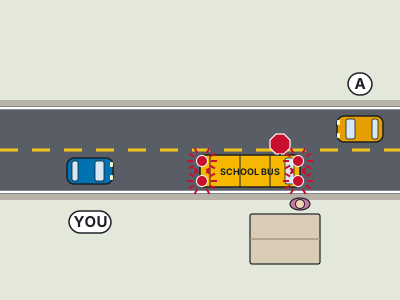
- Proceed immediately because the stop is over
- Continue only if another vehicle moves first
- Pass the bus only after honking twice
- Wait for children to leave the roadway and confirm it is safe
Show answer
Wait for children to leave the roadway and confirm it is safe. Ending the flashing red lights does not guarantee that children have reached a safe place. The driver must watch for children along the roadside and wait until they have completely left the roadway and it is safe to proceed. The immediate-proceed choice overlooks that second check. Treat the bus area as active until the children are clear, then scan both directions before moving, since a child may be outside the driver's expected path.
Study this in the handbook: School buses, emergency vehicles and trains
20. According to the New Mexico manual, alcohol is involved in about what share of traffic crashes in which someone is killed?
- About 40%
- About 10%
- About 25%
- About 75%
Show answer
About 40%. The manual states that alcohol is involved in about 40% of the traffic crashes in which someone is killed. Ten and 25 percent understate the figure, and 75 percent overstates it. The manual follows the statistic with a plain warning not to drink and drive. It also lists the costs: heavy fines, higher insurance rates, loss of license, and jail.
Study this in the handbook: Vision, fatigue, health and distraction
QualitySpace is expanding to New Mexico
We are a California-based independent insurance brokerage working on licensing in more states. We cannot help with New Mexico insurance yet. Leave your email and we will let you know when we can.
Every question is written from the official New Mexico Driver Manual. Need paper? Printable NM practice test with answer key.
Last verified 2026-10-05. How we check every question · Study all 208 as flashcards
Frequently asked questions
How many questions are on this New Mexico practice test?
This fixed set has 20 questions. It is test 8 of 10 from the 208 question New Mexico bank.
How does this fixed test relate to the full New Mexico bank?
Each numbered test is a fixed set of questions in a fixed order, so you can retake the same test later and compare. Every test mixes road signs and the other topics in about the same proportion as the full bank. Tests 1 to 10 together cover 200 of the 208 questions in the New Mexico bank, each once. The full practice page mixes the whole bank at random.
Last verified 2026-10-05. See the New Mexico DMV facts page for sourced state details.
Return to the full New Mexico practice test · Study road signs