
Test 1 of 10 · 20 questions · Free 2026
NM Permit Practice Test 1
Jump to the test ↓A fixed 20 question set from the New Mexico bank with answers and plain English explanations.
Question 1 of 20 · 0 right so far
All 20 questions in test 1
Every question below comes from the New Mexico question bank on this page. Open a question to see the correct answer and the explanation. Nothing here is hidden behind a signup.
1. What shape and colors identify a yield sign?
- A downward-pointing triangle that is red and white with red letters
- An eight-sided red sign with white letters
- A blue circle with a white arrow
- A green rectangle with black lettering
Show answer
A downward-pointing triangle that is red and white with red letters. The manual identifies a yield sign by its downward-pointing triangle, red and white design, and red lettering. Those features distinguish it from an octagonal stop sign, a blue service or regulatory symbol, and a green guide panel. Recognition is useful before the driver reaches the conflict point, because the sign also signals that right-of-way must be given to traffic in the intersection or roadway being entered. Slow early, inspect both directions, and stop if yielding cannot be done safely. The shape is the quickest visual cue when distance or weather makes lettering hard to read.
Study this in the handbook: Warning, regulatory and guide signs
2. How long does a DWI conviction remain on a New Mexico driving record?
- Three years
- Seven years
- Twenty-five years
- Ten years
Show answer
Twenty-five years. The manual says any DWI conviction stays on the driving record for twenty five years. Three, seven, and ten years are all far shorter than the stated period. That long lookback matters because later DWI convictions bring increased fines, more jail time, and longer revocation. A first conviction already brings fines, court costs, possible jail, treatment, and an ignition interlock.
Study this in the handbook: Alcohol, drugs and DWI
3. What does an HOV lane sign tell drivers?
- The lane may be used by any vehicle at every hour
- The lane is reserved for vehicles with more than one person, with signs giving the required number and times
- The lane is only for vehicles carrying hazardous materials
- The lane marks a place where drivers must stop
Show answer
The lane is reserved for vehicles with more than one person, with signs giving the required number and times. HOV means High Occupancy Vehicles. The sign reserves the lane for vehicles carrying more than one person and states the passenger count, days, and hours that apply. Saying any vehicle may use it at all times ignores the posted reservation. Hazardous materials and stop requirements are separate controls. When approaching an HOV lane, read the full sign before entering because the number and time limits determine whether your vehicle qualifies at that moment.
Study this in the handbook: Pavement markings and special lanes
4. If pumping failed brakes does not work, how should you use the parking brake?
- Ignore it and keep driving to a repair shop
- Yank it hard to lock the rear wheels
- Use it only after the vehicle has stopped
- Pull the parking brake handle slowly
Show answer
Pull the parking brake handle slowly. After pumping the brake pedal, the next listed step is to use the parking brake carefully. Pulling the handle slowly helps avoid locking the rear wheels, which could start a skid. Yanking it hard is the tempting panic move, but it creates the exact loss of control the manual warns against. Waiting until the vehicle has stopped misses the purpose of the emergency brake, and continuing to drive without brakes is unsafe. Be ready to release the brake if the vehicle begins to skid.
Study this in the handbook: Vehicle emergencies and skids
5. A New Mexico provisional driver is ready to apply for an unrestricted license. How long before the application must the driver be free of any traffic conviction?
- 30 days
- Six months
- 90 days
- Three years
Show answer
90 days. An unrestricted license applicant must not have been convicted of a traffic violation in the 90 days before applying. Thirty days is too short a window. Six months and three years overstate the lookback in the manual. The same 90 day rule also applies when applying for the provisional license. On top of it, the applicant must have held the provisional license for the preceding 12 months and have no traffic violation pending.
Study this in the handbook: Permits and the graduated license
6. What does a flashing red traffic signal mean?
- Treat it like a flashing yellow and continue without stopping
- Treat it like a stop sign, then proceed when safe
- Stop only if a pedestrian is waiting
- Use it as permission to turn in any direction
Show answer
Treat it like a stop sign, then proceed when safe. A flashing red signal carries the same requirement as a stop sign. Come to a full stop, check crossing traffic and pedestrians, and proceed only when the movement is safe. Treating it like yellow removes the required stop, while a pedestrian’s presence is not the condition that activates the rule. The signal also does not authorize every turn. Use the familiar stop-sign sequence: stop completely, yield as needed, and enter only after the route is clear.
Study this in the handbook: Traffic signals and arrows
7. In a reversible lane, what does a red X over the lane mean?
- The lane is reserved for bicycles
- The lane is open only to left turns
- You may use the lane for passing only
- You cannot use the lane beneath it
Show answer
You cannot use the lane beneath it. A red X over a reversible lane means the lane below it is closed to your direction of travel. The left-turn-only message belongs to a flashing yellow X, while a green arrow is the indication that permits use of the lane. Bicycle reservations are marked by reserved lane signs, not a red X control. Watch overhead signals before entering a reversible lane because its direction can change by time of day. If the X is red, stay out even when the pavement ahead looks clear.
Study this in the handbook: Pavement markings and special lanes
8. What following interval should a New Mexico driver use as the basic check for a safe space ahead?
- Exactly one second at every speed
- At least three seconds behind the vehicle ahead
- One car length regardless of speed
- Only enough room to see the rear bumper
Show answer
At least three seconds behind the vehicle ahead. The manual's three-second rule works at any speed. Watch the vehicle ahead pass a fixed object, then count until your vehicle reaches that same point. Reaching it before the count ends means the gap is too short, so ease back and test again. One car length is unreliable because the needed space grows with speed, while one second leaves little reaction time. The rule is a practical cushion against a sudden stop, and slippery roads or other listed conditions call for even more space. A useful cue is to pick a signpost or pole before traffic compresses.
Study this in the handbook: Road conditions, sight distance and wildlife
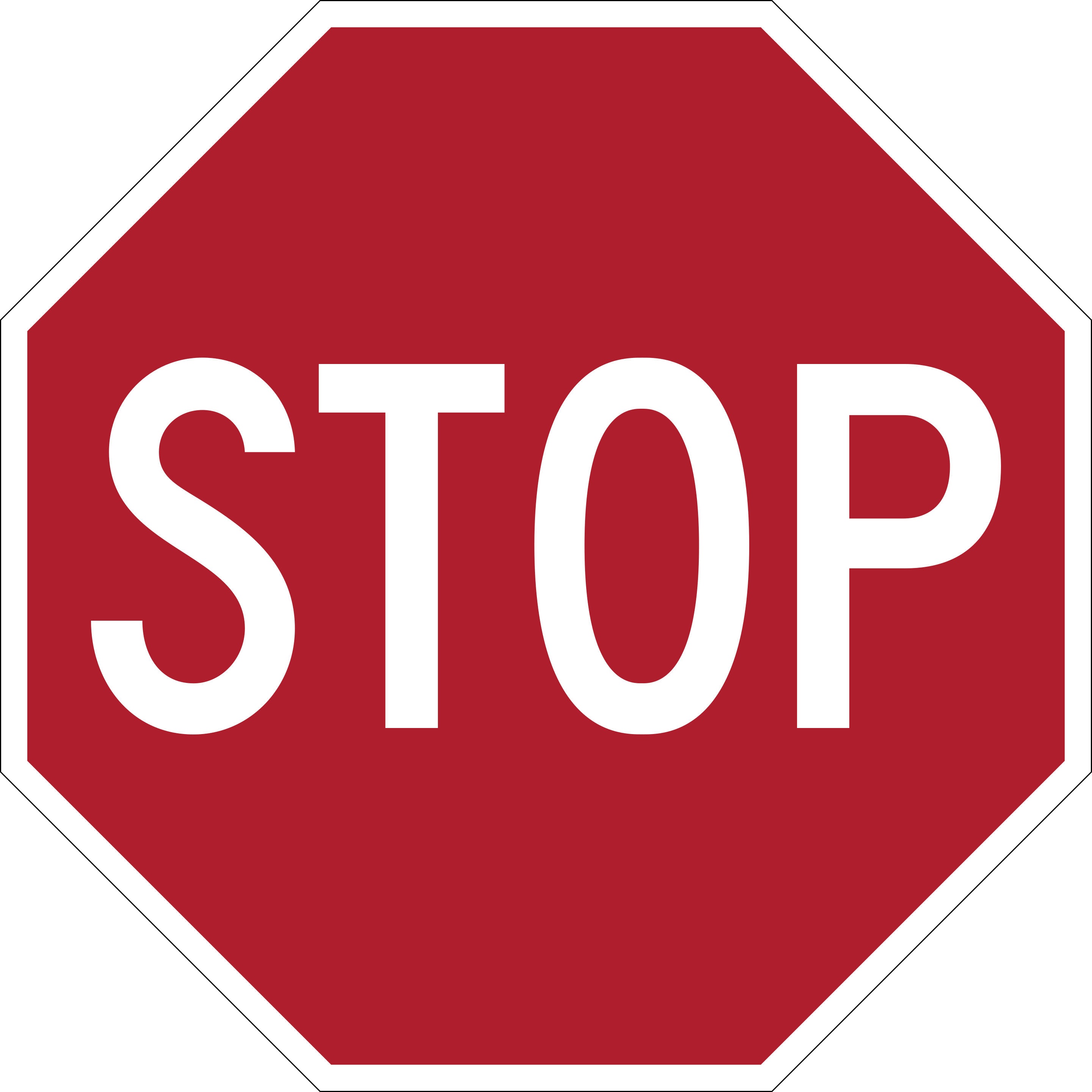
9. At the stop sign shown, where must you stop?
- At least 30 feet beyond the intersection
- After entering the crosswalk so you can see farther
- Only when a crossing vehicle reaches the intersection
- At the stop sign or stop line, if one is present
Show answer
At the stop sign or stop line, if one is present. New Mexico requires a full stop at the stop sign or at the stop line when one is marked. After stopping, wait for crossing vehicles and pedestrians to clear, then pull forward only when it is safe. Stopping past the crosswalk can block people who are crossing and puts the vehicle beyond the control point. The practical cue is to identify the line before braking and stop before it, even if the road appears empty. An empty intersection changes the traffic you must watch, not the duty to make a complete stop.
Study this in the handbook: Warning, regulatory and guide signs
10. What can the shape and color of a traffic sign help a driver identify?

- The type of information the sign provides
- The fuel level of nearby vehicles
- The exact distance to every destination
- Whether all road users must stop immediately
Show answer
The type of information the sign provides. The manual says the shape and color of traffic signs give clues to the type of information they provide. That visual language helps drivers recognize a warning, regulation, direction, or service message quickly. It does not reveal fuel levels or guarantee an exact distance to every destination. Nor does every sign require an immediate stop. Use the sign's visual pattern as an early cue, then read its symbol or wording and respond to the actual instruction and roadway conditions.
Study this in the handbook: Traffic signals and arrows
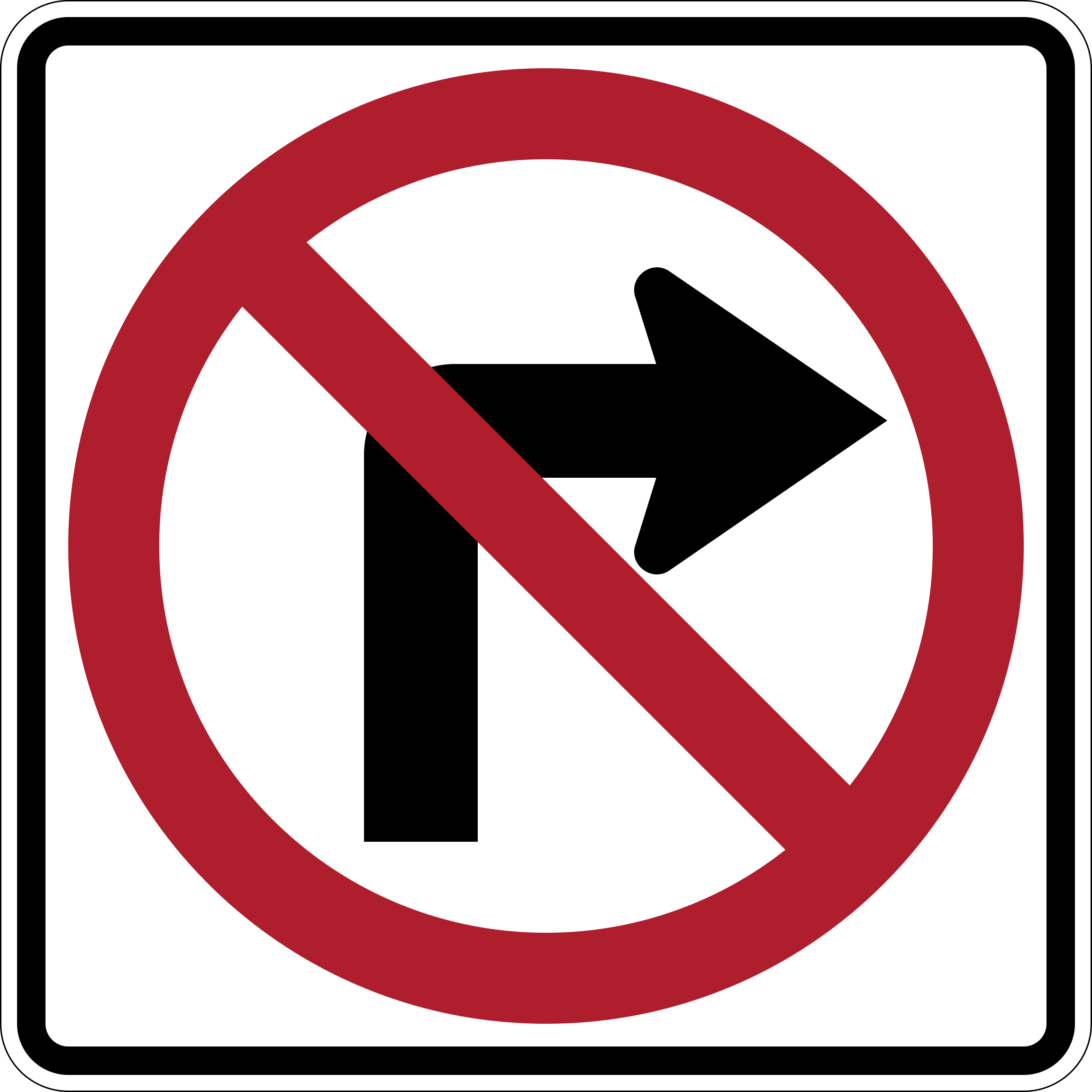
11. If the sign prohibits a right turn, which movement is specifically restricted?
- Parking on the left side of the roadway
- Driving straight through every intersection ahead
- Turning right at that location
- Changing lanes after checking the blind spot
Show answer
Turning right at that location. No right turn is one of the examples the manual gives for regulatory signs with a red slash. The restriction applies to the pictured right-turn action at that location. It does not automatically prohibit going straight, regulate parking on the opposite side, or remove the ordinary duty to check before changing lanes. Read the symbol in combination with the road layout and plan a legal movement before the turn point. A separate sign or marking would be needed to restrict a different action.
Study this in the handbook: Warning, regulatory and guide signs
12. Besides stopping at least 15 feet from a railroad crossing, what must a New Mexico school bus driver do before crossing?
- Open the doors of the school bus
- Turn on the red flashing lights
- Have the children leave the bus
- Sound the horn three times
Show answer
Open the doors of the school bus. School buses, taxis and other vehicles for hire carrying passengers, and trucks hauling explosives, gasoline, or other dangerous materials must stop at least 15 feet from a railroad crossing before proceeding. The manual adds that a school bus driver must open the bus doors before crossing. The manual does not tell the bus driver to turn on the red flashing lights, have the children leave the bus, or sound the horn at a crossing.
Study this in the handbook: Warning, regulatory and guide signs
13. Which passengers must wear appropriate safety restraints while the vehicle is moving?
- Only children younger than 24 months
- Only children riding in the front seat
- All children under the age of 12
- Only passengers who weigh less than 60 pounds
Show answer
All children under the age of 12. New Mexico's restraint section says all children under 12 must wear appropriate safety restraints while the vehicle is in motion. Younger or lighter children must also ride in an approved safety device, but that narrower group is not the full child restraint rule. Limiting the requirement to the front seat is also wrong because children should ride secured in the rear seat. The cue is motion: before the vehicle moves, confirm that every child under 12 is restrained properly.
Study this in the handbook: Renewal, points, seat belts and insurance
14. Near a fire station driveway, where may you not park in New Mexico?
- Within 10 feet on either side of the street
- Within 20 feet on the same side of the street or within 75 feet on the other side
- Within 50 feet on the same side only
- Within 75 feet on the same side or within 20 feet on the other side
Show answer
Within 20 feet on the same side of the street or within 75 feet on the other side. The manual bans parking within 20 feet of a fire station driveway on the same side of the street, or within 75 feet of the driveway on the other side of the street. Ten feet on either side is not the rule. Fifty feet on the same side only drops the opposite side restriction. The choice with 75 feet on the same side swaps the two distances; the larger 75 foot distance applies across the street.
Study this in the handbook: Speed limits
15. An average car at 55 mph can stop in about 400 feet. About how far could a large truck take to stop at the same speed?
- About 200 feet
- About 400 feet, the same as a car
- Almost 800 feet
- About 1,500 feet
Show answer
Almost 800 feet. The manual says a large truck could take almost 800 feet to stop from 55 mph, about twice the car's 400 feet. Two hundred feet is less than a car needs, and saying the truck stops in the same 400 feet ignores that big rigs take longer to stop. Fifteen hundred feet is not the manual's figure. This is why you should never pull in front of a big rig and then slow down or stop suddenly.
Study this in the handbook: Following distance, passing and sharing the road
16. Why can driving at the posted maximum still be unsafe during rain or icy conditions?
- The maximum applies only after sunset
- The maximum assumes ideal conditions, so hazards may require a lower speed
- Rain and ice improve tire grip at the posted speed
- A driver may ignore the limit whenever the road is slippery
Show answer
The maximum assumes ideal conditions, so hazards may require a lower speed. The posted maximum is based on ideal driving conditions, while rain and ice reduce traction and can make it harder to see or stop. That combination means a driver may need to travel below the number on the sign. The sunset choice invents a time restriction, and the claim that wet or icy pavement improves grip is opposite of the manual's safety advice. Slippery conditions do not cancel the speed limit either. Read the sign as a ceiling, then lower speed as needed so the tires, visibility, and stopping distance remain within a safe margin.
Study this in the handbook: Warning, regulatory and guide signs
17. If an emergency vehicle approaches while you are already in an intersection, what should you do before pulling over?
- Turn around and follow the emergency vehicle
- Stop immediately in the middle of the intersection
- Reverse to the approach line before yielding
- Drive through the intersection, then pull over
Show answer
Drive through the intersection, then pull over. The manual specifically says a driver already in an intersection should drive through it before pulling over. Stopping in the middle can obstruct the emergency vehicle and expose the vehicle to crossing traffic. Reversing is difficult to control and following the emergency vehicle is not a yielding maneuver. Continue only far enough to clear the intersection, then move toward the right edge or as near to it as conditions allow and stop for the approaching emergency response.
Study this in the handbook: School buses, emergency vehicles and trains
18. What two documents does the manual say a driver needs when renewing a New Mexico driver license?
- The current license and one other proof of identity
- A vehicle title and a recent fuel receipt
- A school transcript and a road test certificate
- Only a signed statement from an employer
Show answer
The current license and one other proof of identity. For renewal, the manual says to bring the current driver license plus one other proof of identity. A vehicle title or fuel receipt does not replace the identity document, and the general rule does not require an employer statement. Gather both items before visiting the licensing office, while remembering that a vision, knowledge, or driving test may also be required in special cases. The key distinction is identity proof, not proof about the vehicle.
Study this in the handbook: Permits and the graduated license
19. On a wet road, about how much should a driver reduce speed?
- Only enough to match the posted maximum
- About 2 mph
- Exactly half at every speed
- About 10 mph
Show answer
About 10 mph. For wet roads, the manual gives a practical adjustment of reducing speed by about 10 mph. Cutting speed in half applies to packed snow, not ordinary wet pavement, and two mph is too small to account for the reduced grip. Matching the posted maximum ignores the need to adapt to surface conditions. The cue is water on the roadway before traction is fully lost: slow early, increase following distance, and avoid sudden steering or braking that could start a skid.
Study this in the handbook: Road conditions, sight distance and wildlife
20. What must a driver do when approaching a crosswalk where pedestrians are present or about to enter?
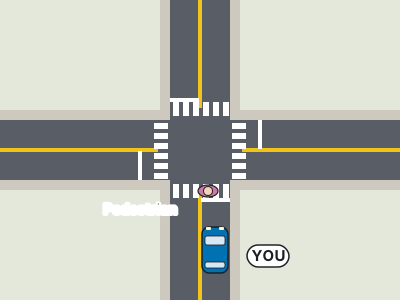
- Yield to pedestrians in or about to enter the crosswalk
- Continue without yielding if the signal favors the vehicle
- Honk so pedestrians leave the crosswalk
- Yield only after a pedestrian reaches the vehicle's lane
Show answer
Yield to pedestrians in or about to enter the crosswalk. A crosswalk is a designated place for people to cross, but a driver must still watch for pedestrians who are entering or already present. Yielding means slowing or stopping early enough to leave the crossing open, not waiting until a person reaches your exact lane. The signal-favors-vehicle choice overlooks people who may be crossing during a permitted phase or outside a perfect signal view. Scan both sides before turning, keep the crosswalk clear, and proceed only after pedestrians are safely out of your path.
Study this in the handbook: Warning, regulatory and guide signs
QualitySpace is expanding to New Mexico
We are a California-based independent insurance brokerage working on licensing in more states. We cannot help with New Mexico insurance yet. Leave your email and we will let you know when we can.
Every question is written from the official New Mexico Driver Manual. Need paper? Printable NM practice test with answer key.
Last verified 2026-10-05. How we check every question · Study all 208 as flashcards
Frequently asked questions
How many questions are on this New Mexico practice test?
This fixed set has 20 questions. It is test 1 of 10 from the 208 question New Mexico bank.
How does this fixed test relate to the full New Mexico bank?
Each numbered test is a fixed set of questions in a fixed order, so you can retake the same test later and compare. Every test mixes road signs and the other topics in about the same proportion as the full bank. Tests 1 to 10 together cover 200 of the 208 questions in the New Mexico bank, each once. The full practice page mixes the whole bank at random.
Last verified 2026-10-05. See the New Mexico DMV facts page for sourced state details.
Return to the full New Mexico practice test · Study road signs