
Test 4 of 10 · 20 questions · Free 2026
NM Permit Practice Test 4
Jump to the test ↓A fixed 20 question set from the New Mexico bank with answers and plain English explanations.
Question 1 of 20 · 0 right so far
All 20 questions in test 4
Every question below comes from the New Mexico question bank on this page. Open a question to see the correct answer and the explanation. Nothing here is hidden behind a signup.
1. In a heavy rain, at about what speed can your tires lose all traction with the road?
- About 15 mph
- About 25 mph
- About 80 mph
- About 50 mph
Show answer
About 50 mph. The manual says that in a heavy rain tires can lose all traction with the road at about 50 mph, riding up on the water like water skis. This is called hydroplaning. Most tires keep good traction on a wet road up to about 35 mph, so 15 and 25 mph are too low for total loss on good tires. Eighty mph is far too high to be safe. Bald or badly worn tires lose traction at much lower speeds, and the best prevention is to slow down when the road is wet.
Study this in the handbook: Road conditions, sight distance and wildlife
2. What must a driver do before moving from a stop sign into the intersection?
- Wait for crossing vehicles and pedestrians to clear
- Move immediately because the stop sign gives priority
- Yield only to vehicles approaching from the left
- Proceed if the driver has waited two seconds
Show answer
Wait for crossing vehicles and pedestrians to clear. Stopping is only the first part of the stop-sign rule. After the vehicle is fully stopped, the driver must wait until crossing traffic and pedestrians have cleared, then pull forward only when the movement is safe. The sign does not grant an immediate priority over people already crossing, and a timed pause or left-side-only scan is not enough. Use the stop as a deliberate viewing point: check the full intersection, then enter when the path is open.
Study this in the handbook: Warning, regulatory and guide signs
3. What is the usual shape of the advance warning sign before a railroad crossing?
- A round yellow sign with an X and black RR letters
- An eight-sided red sign
- A blue rectangle with a white hospital symbol
- A green rectangle showing a route number
Show answer
A round yellow sign with an X and black RR letters. The advance railroad warning is a round yellow sign marked with an X and black RR letters. It alerts drivers before the tracks, while the white crossbuck is located at the crossing itself and carries a yield meaning. An octagon identifies a stop sign, blue identifies services, and green route panels guide travel. Seeing the round railroad symbol should prompt a slower approach, a check up and down the tracks, and confirmation that there is room on the far side before entering.
Study this in the handbook: Railroad crossing signs and rules
4. When standard traffic signal lights are mounted together, where is the green light located?
- Beside the red light
- In the middle
- At the top
- At the bottom
Show answer
At the bottom. New Mexico describes standard signal colors as green, yellow, and red from bottom to top when the lights are mounted together. That places green at the bottom, yellow in the middle, and red at the top. Choosing the top confuses green with the stop indication, while the middle belongs to yellow caution. This layout helps drivers recognize the signal even when glare, distance, or color weakness makes a color harder to identify. Use the vertical position as a backup cue before entering an intersection.
Study this in the handbook: Renewal, points, seat belts and insurance
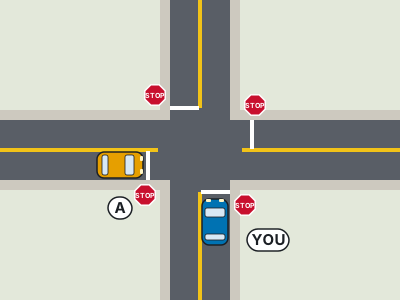
5. At a four way stop, two vehicles arrive at the same time. Which vehicle should go first?
- The vehicle on the right
- The vehicle on the left
- The vehicle traveling faster
- The vehicle with more passengers
Show answer
The vehicle on the right. At a four way stop, every driver must first make a complete stop. When two vehicles reach the intersection at the same time, the vehicle on the right goes first. Arrival order controls when one vehicle clearly reaches the stop before another, but it does not resolve a tie. Do not use vehicle size, speed, or passenger count as a tie breaker. After the vehicle on your right proceeds, check again before entering.
Study this in the handbook: Right of way at intersections
6. A yellow signal is flashing at an intersection. What driving response does the manual call for?
- Stop and remain stopped until a green light appears
- Slow down and proceed with caution
- Speed up because the intersection has priority
- Treat the signal as permission to disregard pedestrians
Show answer
Slow down and proceed with caution. A flashing yellow light calls for reduced speed and cautious progress through the intersection. It is not a stop signal that requires waiting for green, and it does not cancel the driver's duty to watch for pedestrians, crossing traffic, or other hazards. Speeding up removes the time needed to react. Approach with control, scan the complete intersection, and be ready to stop if the conditions make continuing unsafe.
Study this in the handbook: Traffic signals and arrows
7. When a New Mexico instructional permit holder practices with a licensed driver instead of an approved instructor, how long must that supervising driver have been licensed?
- At least one year
- At least six months
- At least five years
- At least three years
Show answer
At least three years. The supervising driver must be 21 or older and must have been licensed for at least three years, in New Mexico or any other state. One year and six months are too short to meet that experience rule. Five years overstates it. The alternative is an approved instructor occupying the seat beside the driver, which is the driver education route. Six months is the permit holding period, a different number that is easy to mix up with this one.
Study this in the handbook: Permits and the graduated license
8. According to the New Mexico manual, with how many drinks in your bloodstream are you impaired and at risk of arrest?
- Four or more
- Six or more
- Two or more
- Only when you feel drunk
Show answer
Two or more. The manual says that with two or more drinks in your bloodstream you are impaired and could be arrested. Four or six drinks set the line far too high. Waiting until you feel drunk is exactly the trap the manual warns about, since alcohol affects judgment and you do not know when you have had too much until it is too late. The manual's rule is that no amount of alcohol is safe, and even one drink can affect your driving.
Study this in the handbook: Alcohol, drugs and DWI
9. How close to a hill or curve that blocks your view may you start to pass, according to the New Mexico manual?
- Within 100 feet of it, if the road looks empty
- Do not start to pass within one-third of a mile of it
- Anywhere, as long as you honk first
- Within one block of it, if the passing zone has not ended
Show answer
Do not start to pass within one-third of a mile of it. The manual says to treat a hill or curve like an oncoming vehicle and not start to pass within one third of a mile of it, which is about 10 seconds of travel. One hundred feet or one block leaves no room if a vehicle appears over the hill. Honking does not warn an oncoming driver you cannot see. Anytime your view is blocked by a curve or hill, assume there is an oncoming vehicle just out of sight.
Study this in the handbook: Following distance, passing and sharing the road
10. When very heavy rain, a snowstorm, or thick fog limits sight distance to about 200 feet, what should a driver do?
- Use high beams and continue at 50 mph
- Increase speed to spend less time in the weather
- Reduce speed to no more than 30 mph and pull off if the view becomes inadequate
- Stop in the active lane with hazard lights on
Show answer
Reduce speed to no more than 30 mph and pull off if the view becomes inadequate. With only about 200 feet of visibility, the manual says a driver cannot safely exceed 30 mph. If a very heavy downpour leaves too little view to drive, the driver should pull off the road in a safe place and wait for conditions to clear. Increasing speed shortens reaction time, and high beams can worsen glare in rain, snow, or fog. Stopping in an active lane exposes the vehicle to following traffic. Slow before visibility collapses, use low beams in the affected weather, and choose a safe place away from moving lanes if the storm overwhelms your sight distance.
Study this in the handbook: Road conditions, sight distance and wildlife
11. What should a driver try first if the brake pedal suddenly stops working?
- Pull the parking brake as hard and fast as possible
- Turn the steering wheel sharply into traffic
- Switch off the engine and remove the key
- Pump the brake pedal several times
Show answer
Pump the brake pedal several times. Repeatedly pumping the pedal may rebuild enough hydraulic pressure to stop the vehicle, so it is the first response listed for brake failure. If that does not work, the driver can apply the parking brake gradually, then shift to lower gears while searching for a safe place off the roadway. A sudden, hard parking-brake pull can lock the rear wheels and produce a skid. Switching off the engine or steering into traffic removes useful control. Keep the vehicle pointed safely and do not continue driving after braking has failed.
Study this in the handbook: Vehicle emergencies and skids
12. What must a driver do at a stop sign or stop line?
- Yield only to vehicles approaching from the left
- Slow down and continue if no vehicle is close
- Stop only with the front wheels past the crosswalk
- Make a full stop and wait until crossing traffic and pedestrians clear
Show answer
Make a full stop and wait until crossing traffic and pedestrians clear. At a stop sign, the driver must come to a full stop at the sign or at the stop line when one is present. The vehicle must remain stopped while crossing vehicles and pedestrians clear, moving forward only when it is safe. A rolling slowdown does not meet the rule, and the location of the stop is not past the crosswalk. Scan in every direction before proceeding because the obligation is to clear both traffic and pedestrians, not just one approaching lane.
Study this in the handbook: Warning, regulatory and guide signs
13. Under current New Mexico law, which children must ride in a child safety seat?
- Only children younger than 12 months
- Children younger than 7 or weighing less than 60 pounds
- Every passenger under 18, without exception
- Children younger than 7 only when seated in front
Show answer
Children younger than 7 or weighing less than 60 pounds. The New Mexico Department of Transportation explains that state law requires children younger than 7, or children who weigh less than 60 pounds, to ride in a child safety seat. Children ages 7 through 12 then ride in a booster seat until an adult seat belt fits them properly. The rule applies wherever the child sits, not just in the front seat. The driver manual still prints an older, narrower under 24 months rule, so follow the current law when you buckle a young passenger.
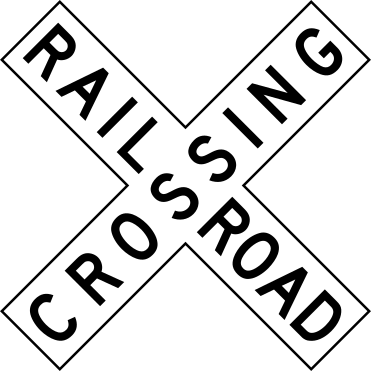
14. What does the railroad crossbuck require at the tracks?
- Drive around a lowered gate if the crossing looks clear
- Stop 100 feet before every track even when no train is present
- Yield to crossing trains
- Shift gears while crossing to gain speed
Show answer
Yield to crossing trains. The white X-shaped crossbuck is located at the railroad crossing and has the same meaning as a yield sign. A driver must yield to crossing trains. The manual also warns never to beat a train, never to start across without room on the far side, and advises against shifting gears on the tracks. Those additional precautions explain why the fixed 100-foot stop and gear-shifting choices are unsafe. The essential cue is to look and wait for a clear crossing with room beyond the rails.
Study this in the handbook: Railroad crossing signs and rules
15. How long must a driver have held a provisional license immediately before applying for an unrestricted driver license?
- Six months
- Nine months
- 12 months
- 24 months
Show answer
12 months. New Mexico requires the driver to have held a provisional license for the 12 month period immediately preceding the unrestricted license application. Six and nine months fall short, while 24 months doubles the stated period. This is a continuous preceding period, not merely time accumulated at any point in the driver's history. Keep the duration distinct from the separate requirement that the applicant have no recent traffic conviction and no pending traffic violations.
Study this in the handbook: Permits and the graduated license
16. When may an injured person be moved after a crash?
- Whenever the person cannot answer questions
- Only when the person is in a burning vehicle or in immediate danger of being hit
- Before emergency help is called
- Whenever moving the person seems more convenient
Show answer
Only when the person is in a burning vehicle or in immediate danger of being hit. After a crash, do not move an injured person unless the person is in a burning vehicle or faces another immediate danger of being hit. Unnecessary movement can worsen injuries, even when the person cannot answer questions. Call police and emergency medical or rescue services, then provide appropriate aid while protecting the person from further danger. The narrow exception is tied to an urgent threat, not convenience or uncertainty about the person's condition.
Study this in the handbook: Breakdowns, crashes and first aid
17. What driving response do New Mexico warning signs call for?

- Ignore the roadway until a regulatory sign appears
- Accelerate before reaching the sign
- Slow down and be prepared to stop if necessary
- Stop immediately in every case
Show answer
Slow down and be prepared to stop if necessary. Warning signs tell drivers to slow down and be prepared to stop if necessary. They provide advance notice of a road condition, but they do not require an immediate stop every time or authorize acceleration toward the hazard. Ignoring the warning until another sign appears gives the driver less time to react. Ease off the accelerator, look for the condition represented by the sign, and decide whether traffic, pedestrians, or the roadway requires a full stop.
Study this in the handbook: Traffic signals and arrows
18. What does a steady red traffic light require?
- A turn in the direction of any arrow
- A stop
- Acceleration through the intersection
- A lane change without checking traffic
Show answer
A stop. A steady red traffic light means stop. The indication controls the approach until the signal changes and the intersection can be entered legally and safely. Acceleration through the intersection treats a prohibition as permission, while a turn is not automatically allowed merely because the road looks empty. A lane change does not answer the signal's command and can create a separate conflict. Stop at the required line or before the crosswalk, then wait for a lawful movement indication and check for people and vehicles.
Study this in the handbook: Traffic signals and arrows
19. What is the minimum age for an instructional permit in New Mexico?
- 15 years
- 14 years
- 15 years and 6 months
- 16 years
Show answer
15 years. The minimum age for a New Mexico instructional permit is 15 years. The 15 years and 6 months figure belongs to the minimum age for a provisional license when the permit has been held for six months. A permit is the earlier supervised stage, so do not apply the later license age to it. Use the age requirement together with the education, testing, consent, and supervision rules before the learner begins practice.
Study this in the handbook: Permits and the graduated license
20. When an emergency vehicle approaches from any direction using a siren or flashing lights, where should a driver pull over?
- To the right edge or as near to the right as possible
- To the left edge, regardless of the roadway
- Into the nearest intersection and stop there
- Onto the shoulder only if the emergency vehicle is behind
Show answer
To the right edge or as near to the right as possible. The right-of-way guidance directs traffic toward the right edge, or as near to it as possible, so the responding vehicle can pass. This duty applies whether the warning comes from ahead, behind, or another direction. Stopping in an intersection can block the emergency path, so a driver already there should clear it first. Check mirrors and the roadway around you, then create space smoothly rather than making a sudden move that could cause another conflict.
Study this in the handbook: School buses, emergency vehicles and trains
QualitySpace is expanding to New Mexico
We are a California-based independent insurance brokerage working on licensing in more states. We cannot help with New Mexico insurance yet. Leave your email and we will let you know when we can.
Every question is written from the official New Mexico Driver Manual. Need paper? Printable NM practice test with answer key.
Last verified 2026-10-05. How we check every question · Study all 208 as flashcards
Frequently asked questions
How many questions are on this New Mexico practice test?
This fixed set has 20 questions. It is test 4 of 10 from the 208 question New Mexico bank.
How does this fixed test relate to the full New Mexico bank?
Each numbered test is a fixed set of questions in a fixed order, so you can retake the same test later and compare. Every test mixes road signs and the other topics in about the same proportion as the full bank. Tests 1 to 10 together cover 200 of the 208 questions in the New Mexico bank, each once. The full practice page mixes the whole bank at random.
Last verified 2026-10-05. See the New Mexico DMV facts page for sourced state details.
Return to the full New Mexico practice test · Study road signs