
Test 3 of 10 · 20 questions · Free 2026
NM Permit Practice Test 3
Jump to the test ↓A fixed 20 question set from the New Mexico bank with answers and plain English explanations.
Question 1 of 20 · 0 right so far
All 20 questions in test 3
Every question below comes from the New Mexico question bank on this page. Open a question to see the correct answer and the explanation. Nothing here is hidden behind a signup.
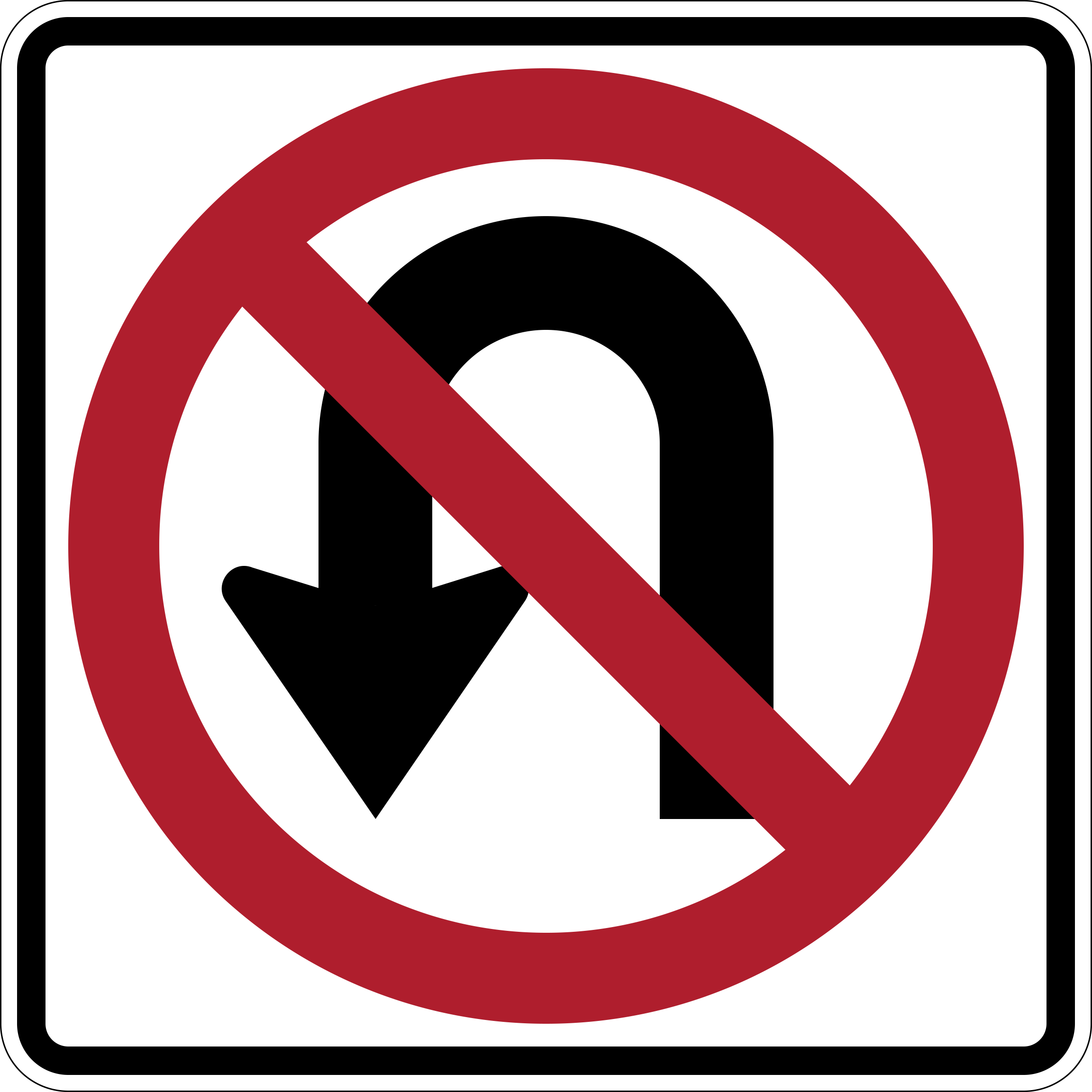
1. What do red circle-and-slash signs such as the one shown generally do?
- Prohibit the pictured action, such as a U-turn
- Recommend the pictured action during heavy traffic
- Identify a route number for a state highway
- Mark a service available at the next exit
Show answer
Prohibit the pictured action, such as a U-turn. A red circle and slash over a symbol is a regulatory prohibition. The manual gives no left turn, no right turn, and no U-turn as examples, so the movement pictured beneath the slash is the action barred at that location. It is not a recommendation or a route marker. Read the symbol itself rather than treating every red sign as a stop instruction. The driving cue is simple: identify the crossed-out movement before entering the intersection and select another legal path.
Study this in the handbook: Warning, regulatory and guide signs
2. What is the lowest BAC threshold for New Mexico's under-21 alcohol driving rule?
- .02%
- .05%
- .08% only
- .12%
Show answer
.02%. The manual says a driver under 21 can be arrested in New Mexico for a BAC of .02%. The .08% figure is also mentioned, but it is the general threshold described for driving with alcohol in the blood, not the special under-21 figure. The other percentages are not the values in this passage. Separate the age condition from the number: the lower threshold applies because the driver is under 21, and it does not make drinking and driving safe.
Study this in the handbook: Alcohol, drugs and DWI
3. A New Mexico provisional licensee needs to drive home from a job at 1:00 AM. What document makes this late drive allowed?
- A copy of a recent pay stub
- A signed statement from a police officer
- A signed statement from the licensee's employer
- No document, because working teens are fully exempt
Show answer
A signed statement from the licensee's employer. Provisional licensees may not drive between midnight and 5:00 AM, but driving to and from work is an exception when it is backed by a signed statement from the employer. A pay stub is not the evidence named in the manual. A statement from a police officer is not one of the listed forms of evidence. The exception is not automatic, so a working teen without the employer's statement has no exemption. Other exceptions use different signers: a parent or guardian for family or medical necessity, and a school, religious official, or parent for school or religious activities.
Study this in the handbook: Permits and the graduated license
4. A New Mexico instructional permit holder is learning to ride a motorcycle. Where must the licensed supervising driver be?
- Following the learner
- Riding as a passenger on the learner's motorcycle
- Riding ahead of the learner to lead the way
- Waiting at the end of the practice route
Show answer
Following the learner. For motorcycles, New Mexico reverses the car arrangement: the licensed driver must follow the learner. In every other vehicle the supervisor sits in the right front seat, but a motorcycle has no such seat beside the rider, so riding as a passenger is not the stated rule. Leading from ahead puts the supervisor where the learner cannot be watched. Waiting at the end of a route is no supervision at all while the learner is riding. The supervisor must still be at least 21 and licensed for that type of vehicle.
Study this in the handbook: Permits and the graduated license
5. About how fast does the body get rid of alcohol, according to the New Mexico manual?
- Three drinks per hour
- One alcoholic drink per hour
- One drink every ten minutes
- Faster if you drink coffee
Show answer
One alcoholic drink per hour. The manual says the body gets rid of one alcoholic drink per hour, and there is no way to sober up quickly. Three drinks per hour and one drink every ten minutes greatly overstate the rate. Coffee does not speed it up; the manual says coffee, fresh air, exercise, and cold showers do not help. Only time sobers a person. A drink means 1 1/2 oz of 80 proof liquor, 12 oz of beer, or a 5 oz glass of wine.
Study this in the handbook: Alcohol, drugs and DWI
6. How far ahead should safer drivers generally scan in city traffic?
- Only the pavement immediately beyond the hood
- At least one block, or about 10 seconds ahead
- About two car lengths ahead
- Only as far as the next traffic signal
Show answer
At least one block, or about 10 seconds ahead. Looking well ahead gives a driver time to recognize a developing problem, choose a lane, or brake smoothly instead of making a panic stop. In city driving, the manual equates 10 seconds with about one block, so the scan should reach at least that far when visibility allows. Watching only the hood area hides stopped traffic and pedestrians until the last moment. The next signal is not a sufficient target because activity between intersections can change quickly. Keep the eyes moving across the road and sides while maintaining that forward view.
7. Before crossing railroad tracks, what must a driver confirm about the far side?
- A gate is absent, so the crossing is automatically clear
- The vehicle can stop on the tracks if traffic is slow
- There is enough room for the vehicle without stopping on the tracks
- The driver can shift gears while crossing to save fuel
Show answer
There is enough room for the vehicle without stopping on the tracks. A driver must wait until there is room on the far side for the entire vehicle, because stopping on the rails creates a severe collision risk. The choice “The vehicle can stop on the tracks if traffic is slow” accepts exactly the condition the manual warns against. An absent gate does not prove that a train is not coming, so the choice “A gate is absent, so the crossing is automatically clear” is unsafe. The choice “The driver can shift gears while crossing to save fuel” adds a mechanical action that can increase the chance of stalling; the manual advises avoiding gear changes on the tracks. Look and listen, confirm the exit is open, and cross only when the vehicle can clear the railroad completely.
Study this in the handbook: Railroad crossing signs and rules
8. After a railroad warning sign, what should a driver remember about the train's apparent speed?
- The train must yield if the warning sign is round
- The train is stopped whenever its engine is hard to see
- The train may be moving faster than it appears
- The train can be outrun when no gate is present
Show answer
The train may be moving faster than it appears. Railroad warnings deserve caution because a train can cover ground faster than its appearance suggests. The choice “The train may be moving faster than it appears” captures that warning. A train is not presumed stopped merely because the engine is difficult to see, and a round sign does not give the train a duty to yield. Trying to outrun a train is specifically contrary to safe crossing practice, whether or not a gate is installed. Slow down, look along the tracks, confirm the far side is open, and wait whenever the crossing or the train's movement is uncertain.
Study this in the handbook: Railroad crossing signs and rules
9. At a stop sign, where should a driver stop when a stop line is present?
- Past the crosswalk so the front bumper reaches cross traffic
- At the stop line, before entering the intersection
- Only after crossing the intersection to see better
- Beside the sign with the vehicle partly in the next lane
Show answer
At the stop line, before entering the intersection. A stop sign requires a full stop, and the manual specifies the stop line when one is present. Stopping beyond the line or in the intersection places the vehicle into the area reserved for crossing traffic and pedestrians. Waiting beside the sign does not establish a proper stopping position. Approach under control, stop at the marked line, then wait until crossing vehicles and pedestrians have cleared before moving forward when safe.
Study this in the handbook: Warning, regulatory and guide signs
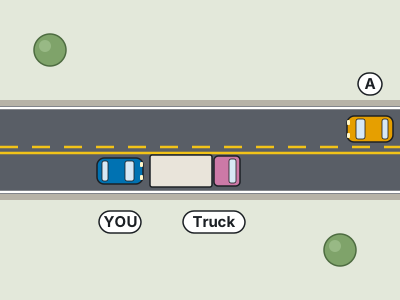
10. A two-lane road has a solid yellow line on your side and a dashed yellow line on the other side. May you pass?
- No, because yellow lines always prohibit both directions
- Yes, because the dashed line is visible across the center
- Yes, but only by using the shoulder
- No, passing is prohibited from your side
Show answer
No, passing is prohibited from your side. With a solid and dashed yellow line separating opposing traffic, the line on the driver's side controls that driver's pass. A solid line on your side means you may not pass, even though the opposite side has a dashed line. The shoulder is never a substitute for a permitted passing lane, and a double solid arrangement is the pattern that bars both directions. Check the line nearest your lane before beginning any maneuver across the center.
Study this in the handbook: Pavement markings and special lanes
11. What should a driver do before entering an intersection when traffic ahead is stopped?
- Enter and wait in the intersection for traffic to move
- Use the shoulder to get around the stopped traffic
- Follow the vehicle ahead closely to reserve a place
- Wait until there is enough room to pass through without stopping
Show answer
Wait until there is enough room to pass through without stopping. A driver must not enter an intersection unless there is room to get all the way through without stopping. Waiting outside keeps the crossing clear for traffic moving in other directions and prevents a vehicle from becoming trapped across the lanes. The choice “Enter and wait in the intersection for traffic to move” creates the exact blockage the rule is intended to prevent. Watch the space beyond the intersection, not merely the signal or the vehicle immediately in front of you, and proceed only when that space is open.
Study this in the handbook: Right of way at intersections
12. Where must a driver stop when a sign or signal requires a stop near a crosswalk?
- After the front bumper enters the crosswalk
- Before reaching the stop line or crosswalk
- In the middle of the intersection
- Beyond the crosswalk so the vehicle is closer to traffic
Show answer
Before reaching the stop line or crosswalk. The required stopping point is before the vehicle reaches the stop line or crosswalk. This keeps the marked pedestrian area open and gives a person room to cross without walking around the front of a stopped vehicle. The after-entry choice places the vehicle where it can block pedestrians and may put its front into conflicting traffic. Brake in time to stop before the marking, check both sides, and move only when the sign or signal and the intersection are clear.
Study this in the handbook: Warning, regulatory and guide signs
13. During the provisional period, what alcohol or drug record condition is required before an unrestricted license?
- Drug offenses count only after the unrestricted license is issued
- One alcohol offense is allowed if no crash occurred
- Only convictions from the last 30 days count
- No adjudication of guilt and no pending offense involving alcohol or drugs
Show answer
No adjudication of guilt and no pending offense involving alcohol or drugs. For an unrestricted license, the driver must not have been found guilty and must not have a pending offense involving alcohol or drugs during the provisional period. The one-offense option is wrong because the manual gives no crash-based exception. Thirty days is also wrong; the condition applies to the provisional period. Drug offenses are included directly with alcohol offenses. When checking unrestricted eligibility, look beyond the holding period and traffic violations to any alcohol or drug matter still attached to the provisional stage.
Study this in the handbook: Permits and the graduated license
14. How close to a railroad crossing may you park in New Mexico?
- No closer than 50 feet
- No closer than 15 feet
- No closer than 25 feet
- No closer than 100 feet
Show answer
No closer than 50 feet. New Mexico's no parking list includes within 50 feet of a railroad crossing, and parking on the tracks is banned outright. Fifteen feet is the distance certain vehicles must stop from a crossing before proceeding, not a parking rule. Twenty five feet is not a railroad crossing distance in the manual. One hundred feet overstates the rule. Signals and stop or yield signs use a separate 30 foot distance.
Study this in the handbook: Speed limits
15. What is a shared center lane intended for?
- Left turns from either direction
- Passing slower traffic
- Parking during brief errands
- Driving straight through an intersection
Show answer
Left turns from either direction. A shared center lane is designed for left turns from either direction, allowing drivers to prepare for that maneuver without using an opposing through lane. It is not a passing lane, a parking strip, or a shortcut for continuing straight through an intersection. Enter only when preparing for a permitted left turn, watch for vehicles approaching from the opposite direction, and leave the lane when the turning movement is complete. The lane's two way design makes an early visual check essential.
Study this in the handbook: Pavement markings and special lanes
16. At night, your headlights let you see about 400 feet ahead. About what speed lets you stop within that distance?
- About 30 mph
- About 65 mph
- About 75 mph
- About 50 mph
Show answer
About 50 mph. The manual says headlights show about 400 feet ahead, and you should drive at a speed that lets you stop within that distance, about 50 mph. Driving faster means overdriving your headlights, so 65 and 75 mph are too fast for the headlight range. Thirty mph matches a sight distance of only about 200 feet, the figure for very heavy rain, snow, or thick fog. The Four Second Sight Distance Rule can be used at night to check this.
Study this in the handbook: Road conditions, sight distance and wildlife
17. When should a driver reduce speed below the maximum shown on a speed limit sign?
- Only when another driver honks
- When roadway or visibility conditions require it
- Never, because the posted number is mandatory in all conditions
- Only after receiving a citation
Show answer
When roadway or visibility conditions require it. The posted maximum is intended for ideal driving conditions, and a driver must slow when rain, snow, ice, slippery pavement, or fog makes the limit unsafe. The sign does not promise that the maximum is suitable at every moment. A horn or citation is not the trigger for adjusting speed. Treat the number as an upper boundary under favorable conditions, then choose a lower speed that preserves control and visibility when the road or weather changes.
Study this in the handbook: Warning, regulatory and guide signs
18. What is the recommended response if a vehicle has a tire blowout?
- Accelerate to make the damaged tire spin faster
- Brake hard and turn sharply toward the shoulder
- Hold the steering wheel firmly, ease off the accelerator, and brake gently after control returns
- Release the steering wheel so the vehicle finds its path
Show answer
Hold the steering wheel firmly, ease off the accelerator, and brake gently after control returns. A blowout can pull the vehicle suddenly, so the first priority is maintaining directional control. Keep a firm grip, ease off the accelerator, and avoid a hard brake or sharp steering input until the vehicle is stable. Once control returns, brake gently and move off the roadway. Braking violently can worsen the loss of control, while acceleration and releasing the wheel surrender the driver’s ability to guide the vehicle. Remember: stabilize first, then slow and exit.
Study this in the handbook: Vehicle emergencies and skids
19. What must a driver do when rain, snow, ice, or fog makes the posted maximum unsafe?
- Use the shoulder at the posted speed to avoid slick pavement
- Drive at the posted maximum because it is always safe
- Wait for a separate weather sign before slowing
- Reduce speed to match the conditions
Show answer
Reduce speed to match the conditions. A posted maximum is not a target that overrides weather. The manual specifically says to reduce speed when the roadway is slippery, during rain, snow, icy conditions, or when fog makes it difficult to see clearly. The posted maximum choice ignores that condition based duty. No separate weather sign is needed before a driver responds to visible danger, and the shoulder is not a substitute travel lane. The practical cue is the surface and sight distance ahead: lower speed early enough to preserve traction, maintain control, and stop within what you can see.
Study this in the handbook: Warning, regulatory and guide signs
20. What does a curve warning require a driver to consider?

- A traffic signal that controls the next intersection
- A straight section where passing is always permitted
- A change in roadway direction that calls for an earlier speed adjustment
- A parking area where the vehicle must stop
Show answer
A change in roadway direction that calls for an earlier speed adjustment. A curve sign is a warning that the road ahead changes direction. The manual explains that a vehicle can travel much faster in a straight line than in a curve, and that a vehicle going too fast for the curve can skid because the tires cannot grip the road. Always slow down before you enter the curve so you do not have to brake in it. The sign does not represent a signal or parking instruction, and a curve is not a place where passing is always allowed. Reduce speed while the vehicle is still straight, then keep a steady path through the bend.
Study this in the handbook: Road conditions, sight distance and wildlife
QualitySpace is expanding to New Mexico
We are a California-based independent insurance brokerage working on licensing in more states. We cannot help with New Mexico insurance yet. Leave your email and we will let you know when we can.
Every question is written from the official New Mexico Driver Manual. Need paper? Printable NM practice test with answer key.
Last verified 2026-10-05. How we check every question · Study all 208 as flashcards
Frequently asked questions
How many questions are on this New Mexico practice test?
This fixed set has 20 questions. It is test 3 of 10 from the 208 question New Mexico bank.
How does this fixed test relate to the full New Mexico bank?
Each numbered test is a fixed set of questions in a fixed order, so you can retake the same test later and compare. Every test mixes road signs and the other topics in about the same proportion as the full bank. Tests 1 to 10 together cover 200 of the 208 questions in the New Mexico bank, each once. The full practice page mixes the whole bank at random.
Last verified 2026-10-05. See the New Mexico DMV facts page for sourced state details.
Return to the full New Mexico practice test · Study road signs