
Test 20 of 25 · 20 questions · Free 2026
NM Permit Practice Test 20
Jump to the test ↓A fixed 20 question set from the New Mexico bank with answers and plain English explanations.
Question 1 of 20 · 0 right so far
All 20 questions in test 20
Every question below comes from the New Mexico question bank on this page. Open a question to see the correct answer and the explanation. Nothing here is hidden behind a signup.
1. Which drugs can affect driving in ways similar to alcohol?
- Illegal drugs and nothing available legally
- Only drugs taken together with alcohol
- Many prescription and nonprescription drugs
- Only drugs whose labels mention sleep
Show answer
Many prescription and nonprescription drugs. Prescription medicines and products sold without a prescription can slow reflexes, blur vision, and dull judgment much as alcohol does. The manual notes that remedies for headaches, colds, hay fever, allergies, and nerves may cause drowsiness. Illegal drugs are not the only concern, and a drug does not need to be combined with alcohol to be dangerous. A label that mentions sleep is one warning sign rather than the whole category. Read the warning panel, ask a pharmacist about side effects, and do not drive until you know how the medicine affects you.
Study this in the handbook: Alcohol, drugs and DWI
2. What kit contents does the manual suggest carrying in your vehicle?
- Jumper cables, bottled water, and a blanket
- Flares, first aid supplies, and basic tools
- A tow strap, extra fuel, and a fire extinguisher
- Spare fuses, motor oil, and a tire pump
Show answer
Flares, first aid supplies, and basic tools. A basic vehicle emergency kit holds emergency flares, first aid supplies and basic tools for a roadside stop. Jumper cables with water and a blanket, a tow strap with extra fuel, and spare fuses with oil and a pump are all plausible trunk items, yet none matches the listed contents. Extra fuel in particular adds a fire risk inside the vehicle. Check flares and bandages twice a year, since desert heat ages both, and replace anything that has dried out or expired.
Study this in the handbook: Renewal, points, seat belts and insurance
3. Why can bridge pavement be icy when nearby road pavement is not?
- Bridges have no earth underneath to insulate them from the cold.
- Bridges stay warmer than roads because traffic crosses them often.
- Ice forms on bridges only after snow has covered every road.
- A bridge cannot freeze until the air stays below zero all night.
Show answer
Bridges have no earth underneath to insulate them from the cold.. Bridge pavement can freeze before nearby pavement because a bridge has no earth underneath it to help insulate the deck from cold. The roadway can therefore be colder and icier even when the approach looks clear. Traffic does not keep the bridge warm, and the manual does not require snow on every road or a full night below zero. Treat a cold bridge as a possible slick surface before your tires reach it.
Study this in the handbook: Road conditions, sight distance and wildlife
4. What insurance and proof must a New Mexico motor vehicle operator have?
- Optional coverage, with proof kept at home
- Collision coverage, with proof in the vehicle
- Liability insurance, with proof carried in the vehicle
- No insurance, if the vehicle is registered
Show answer
Liability insurance, with proof carried in the vehicle. New Mexico's financial responsibility section requires everyone who operates a motor vehicle in the state to have a motor vehicle liability insurance policy. It also requires proof of that insurance to be carried in the vehicle at all times. Optional or collision coverage does not answer the liability requirement, and registration does not remove the insurance duty. The rule has two parts to remember: the required policy is liability insurance, and its proof must travel with the vehicle.
Study this in the handbook: Renewal, points, seat belts and insurance
5. You need to cross traffic and then enter the flow. What space do you need?
- A gap large enough only to reach the middle
- A gap large enough to get all the way across
- Space to turn first and then pause mid road
- Room to enter slowly without reaching speed
Show answer
A gap large enough to get all the way across. Crossing traffic takes a gap large enough to carry you all the way across the road, and entering traffic takes space first to turn and then to get up to speed. A gap that reaches only the middle strands you in opposing lanes, pausing mid road blocks both directions, and entering without reaching traffic speed forces others to brake or swerve around you. Judge the full width plus the acceleration room beyond it before you start. Wait for a larger gap when either part falls short.
Study this in the handbook: Following distance, passing and sharing the road
6. How can grabbing the front brake or jamming the rear brake hurt a motorcycle stop?
- It shortens every stop greatly.
- It keeps the motorcycle stable by locking one brake.
- It makes either tire gain grip immediately.
- It can lock a brake and cause control problems during the stop.
Show answer
It can lock a brake and cause control problems during the stop.. Grabbing the front brake or jamming the rear brake can lock a brake and create control problems. A locked brake does not shorten every stop or stabilize the motorcycle, and a locked tire loses usable grip instead of gaining it. The manual instead says to squeeze the front brake and press down on the rear, using both with controlled pressure. Smooth pressure helps the tires keep traction while the motorcycle slows, especially when a rider needs to stop quickly.
Study this in the handbook: Renewal, points, seat belts and insurance
7. Which balanced steering hand positions does the manual describe?
- Hands at 10 and 2, or at 9 and 3
- Both hands together at the bottom of the wheel
- One hand only at the top center of the wheel
- Fingertips resting lightly on the wheel spokes
Show answer
Hands at 10 and 2, or at 9 and 3. Balanced steering places your hands evenly on opposite sides of the wheel, at 10 and 2 or at 9 and 3 like clock positions. Hands bunched at the bottom, a single hand at the top, or fingertips on the spokes all surrender leverage when you must correct quickly, such as when a tire drops off the pavement edge. Keep a firm grip with knuckles outside the rim so either hand can feed the wheel smoothly through a curve without crossing your arms.
Study this in the handbook: Renewal, points, seat belts and insurance
8. Your view ahead is blocked by a curve. What should you assume while judging a pass?
- The road beyond is empty.
- Assume an oncoming vehicle is just beyond the curve.
- Assume oncoming drivers will swerve away from you before you pass.
- Curves shorten passing distance.
Show answer
Assume an oncoming vehicle is just beyond the curve.. A curve or hill that blocks the view must be treated as if an oncoming vehicle is just beyond it. That assumption prevents a driver from beginning a pass based on an empty-looking piece of pavement. The road may not be empty, and another driver is not required to swerve away. Curves do not shorten the space needed to complete a pass safely.
Study this in the handbook: Following distance, passing and sharing the road
9. When the temperature sits near freezing, how does wet ice compare with colder ice?
- Near freezing ice grips like dry pavement
- Colder ice is always more slippery than wet ice
- Both grip the same at every temperature
- Wet ice near freezing is more slippery than colder ice
Show answer
Wet ice near freezing is more slippery than colder ice. Ice that turns wet near the freezing point slides more than ice in deep cold. Treating both alike underestimates the glossiest surface of a winter morning. Dry pavement grip is nowhere near either case. If the thermometer hovers near freezing after a damp night, test brakes gently on a quiet stretch and double every gap. Brake gently in a straight line first, because steering and stopping together can start a slide on wet ice.
Study this in the handbook: Road conditions, sight distance and wildlife
10. Where should you drive when your speed is slower than the traffic around you?
- In the center lane, to stay visible
- On the right-hand side of the road
- In the left lane, to leave room on the right
- Wherever your speed matches the flow
Show answer
On the right-hand side of the road. A slower vehicle belongs on the right side of the road so faster traffic can pass on the left. The center lane and the left lane put a slow car in the path of drivers who expect to overtake there, and the left lane in particular is meant for passing. Matching the flow is fine when you can do it, but the question is about the case where your speed is lower. Move right early, keep a steady pace, and if a line of vehicles builds behind you, pull off when it is safe and let them go by.
Study this in the handbook: Speed limits
11. What have studies shown about wearing safety belts in an accident?
- Belts raise the chance of serious injury
- Belts matter only above highway speed
- Greatly lower odds of hurt or death
- Belts help only the driver, not passengers
Show answer
Greatly lower odds of hurt or death. Studies link belt use with a greatly reduced chance of injury or death in a crash. Belts spread force and keep occupants inside the vehicle structure. Low speed collisions still throw bodies into dashboards and glass. Passengers gain the same protection as the driver. Treat the click of every buckle as the signal that the vehicle may move. Lap children and loose pets gain nothing from cabin size; belts and carriers remain the proven protection.
Study this in the handbook: Renewal, points, seat belts and insurance
12. On multi-lane roads, what is the left-most lane intended for?
- Passing slower vehicles on multi-lane roads
- Cruise in the left lane at the slowest speed
- Trucks only during the day
- Entering and exiting traffic
Show answer
Passing slower vehicles on multi-lane roads. On a multilane road, the left-most lane is intended for passing slower vehicles. It is not the lane for the slowest cruising, trucks only, or entering and exiting traffic. A driver who is not passing should use the appropriate travel lane and avoid occupying the passing lane unnecessarily. This arrangement leaves the left side available for faster traffic to move around slower vehicles.
13. Before parking on an unfamiliar street, what should you look for first?
- Check for signs that may prohibit or limit parking
- Assume parking is allowed without any sign
- Check whether other cars already park there
- Look for a meter showing free parking time
Show answer
Check for signs that may prohibit or limit parking. Signs along a street may prohibit parking or limit the hours and purposes allowed, so read them before leaving the vehicle. Other parked cars do not grant permission, and a free meter does not override a restriction sign. The manual's cue is the presence of signs that control parking. Check the nearby signs before deciding that the space is available for your stop.
Study this in the handbook: Speed limits
14. What does a pair of solid yellow lines between opposing traffic lanes mean?
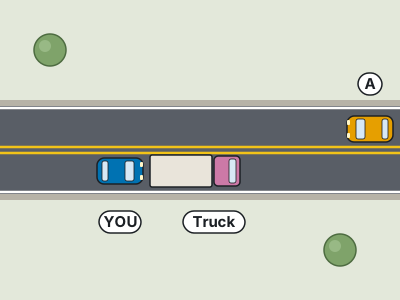
- Passing is allowed during daylight hours
- Both directions may pass after signaling
- Only trucks may cross to pass
- Neither direction may pass
Show answer
Neither direction may pass. Two solid yellow lines separate opposing traffic where passing is prohibited for both directions. The marking is not changed by daylight, vehicle type, or a turn signal. A driver may still cross a solid yellow line to enter a driveway when it is safe, but that limited movement is not permission to overtake another vehicle. When you see the double solid pair, stay in your lane and wait for a marking or sign that permits a legal pass.
Study this in the handbook: Pavement markings and special lanes
15. A blue painted curb marks an open space. What restriction does it carry?
- It reserves the space for handicap parking only.
- It permits ordinary parking without a special restriction.
- It marks a loading zone or another parking restriction.
- It prohibits every vehicle from stopping or standing.
Show answer
It reserves the space for handicap parking only.. A blue painted curb reserves the space for handicap parking only. An open blue curb space is not ordinary unrestricted parking, and a loading zone or another parking restriction is the yellow curb meaning. The manual does not make the blue curb rule a ban on every vehicle stopping or standing there. The blue marking identifies a reserved use, so a driver should use the space only when the vehicle qualifies for handicap parking. The restriction comes from the color's designated purpose, not from whether the space looks available.
Study this in the handbook: Renewal, points, seat belts and insurance
16. What is the legal status of driving under the influence of a drug that makes you drive unsafely?
- Legal when the drug came by prescription
- Legal for trips under five miles in length
- Any drug making you drive unsafely is unlawful
- Unlawful only when combined with alcohol
Show answer
Any drug making you drive unsafely is unlawful. Any drug that makes a person drive unsafely brings the same legal problem as alcohol, whether it arrived by prescription or from a store shelf. Short trips offer no exemption, and mixing with alcohol is not required before the law applies. Read labels for driving warnings and ask a pharmacist when the effect is unclear. If a medicine causes drowsiness, dizziness, or slowed reactions, hand the keys to someone else for every trip that day.
Study this in the handbook: Alcohol, drugs and DWI
17. How does tiredness change a driver behind the wheel?
- Effort sharpens a driver's vision on long drives
- Fatigue sharpens a driver's hearing during long drives
- Long drives improve a driver's memory and alertness
- Fatigue dims sight, slows decisions, and raises irritability
Show answer
Fatigue dims sight, slows decisions, and raises irritability. Fatigue reduces several abilities at once. The manual says a tired driver does not see as well, is not as alert, takes more time to make decisions, and can become more irritable. It also warns that tiredness can lead to falling asleep behind the wheel and crashing. Sharper vision, hearing, or memory is not a protection supplied by fatigue. Seeing these changes as a reason to rest is safer than treating them as a challenge to push through.
Study this in the handbook: Vision, fatigue, health and distraction
18. What riding style does the manual call safest for cyclists among traffic?
- Weave between parked cars on the roadside.
- Ride with traffic as part of the traffic flow.
- Ride quickly on sidewalks beside pedestrians and parked cars.
- Face traffic while riding on the shoulder.
Show answer
Ride with traffic as part of the traffic flow.. The manual calls riding as part of traffic, going with its flow, the safest style for a bicyclist. Weaving among parked cars makes the rider’s path unpredictable, and riding fast on a sidewalk creates a conflict with people walking. Facing traffic also violates the expected direction of travel. Predictable movement within the traffic stream gives motorists more time to see and pass the bicycle.
19. Which direction must bicycle riders travel relative to traffic?
- Against traffic to see cars
- Bicycles may travel either direction on a wide road
- Travel in the same direction as traffic, turning like cars do
- Toward traffic on rural roads
Show answer
Travel in the same direction as traffic, turning like cars do. Bicycle riders should travel in the same direction as traffic and make left and right turns in the same way cars do. Riding against traffic or toward traffic increases closing speed and contradicts the road rule. A wide or rural road does not reverse the direction requirement. Motorists should therefore expect a properly traveling bicycle to use the traffic flow ahead.
20. Over a reversible lane you see a flashing yellow X signal. What does it allow?
- Full through travel at highway speed
- That lane is only for turning
- Parking while waiting for green
- Travel in either direction freely
Show answer
That lane is only for turning. A flashing yellow X means the lane is reserved for turning only. It does not permit through travel, parking, or unrestricted movement in either direction. A red X means no entry, while a green arrow permits normal travel in the indicated direction. Use the flashing yellow X lane only as part of a turn, and watch for other vehicles that may be using it for turns from the opposite direction.
Study this in the handbook: Pavement markings and special lanes
Every question is written from the official New Mexico Driver Manual. Need paper? Printable NM practice test with answer key.
Last verified 2026-10-05. How we check every question · Study all 500 as flashcards
Frequently asked questions
How many questions are on this New Mexico practice test?
This fixed set has 20 questions. It is test 20 of 25 from the 500 question New Mexico bank.
How does this fixed test relate to the full New Mexico bank?
Each numbered test is a fixed set of questions in a fixed order, so you can retake the same test later and compare. Every test mixes road signs and the other topics in about the same proportion as the full bank. Tests 1 to 25 together cover every question in the New Mexico bank once. The full practice page mixes the whole bank at random.
Last verified 2026-10-05. See the New Mexico DMV facts page for sourced state details.
Return to the full New Mexico practice test · Study road signs