
Test 5 of 10 · 20 questions · Free 2026
NM Permit Practice Test 5
Jump to the test ↓A fixed 20 question set from the New Mexico bank with answers and plain English explanations.
Question 1 of 20 · 0 right so far
All 20 questions in test 5
Every question below comes from the New Mexico question bank on this page. Open a question to see the correct answer and the explanation. Nothing here is hidden behind a signup.
1. In a reversible lane, what does a steady yellow X mean?
- The lane is open for normal travel all day
- The lane use is changing, so move out when safe
- The lane is reserved only for buses
- The lane may be used only for parking
Show answer
The lane use is changing, so move out when safe. A steady yellow X over a reversible lane warns that use of that lane is changing. The driver should move out of it as soon as it is safe. It is different from a green arrow, which permits use, and from a flashing yellow X, which limits the lane to turning. Bus-only lanes have reserved lane signs. When overhead lane controls appear, keep checking them while you drive because the lane direction may shift with traffic patterns or time of day.
Study this in the handbook: Pavement markings and special lanes
2. If your headlights suddenly fail at night, what should you try first?
- Try the headlight switch a few times
- Keep driving with only the parking brake ready
- Turn off all vehicle lights immediately
- Brake hard in the travel lane
Show answer
Try the headlight switch a few times. For sudden headlight failure, the first listed action is to try the headlight switch several times. If that restores the lights, the driver can see and be seen long enough to get off the road. Braking hard in the travel lane can surprise drivers behind you, and turning off all lights removes the remaining ways others might see the vehicle. If the switch does not work, use emergency flashers, turn signals, or fog lights, then pull off as soon as possible.
Study this in the handbook: Vehicle emergencies and skids
3. What does a flashing red signal require at an intersection?
- Priority over all cross traffic
- The same response as a green light
- A slow roll without stopping if no vehicle is visible
- A complete stop before proceeding when it is safe
Show answer
A complete stop before proceeding when it is safe. A flashing red indication has the control effect of a stop sign. Come to a complete stop at the required line or before the crosswalk, search for traffic and pedestrians, then proceed only when yielding duties have been satisfied. The slow-roll choice is unsafe because an empty-looking approach does not remove the stop requirement. Make the stop visible and deliberate, especially where sight lines are limited or another driver may be approaching.
Study this in the handbook: Traffic signals and arrows
4. How does the New Mexico manual describe the shape and color of a stop sign?
- Round and yellow with black letters
- Eight-sided and red with white letters
- Downward-pointing triangle with red letters
- Square and blue with white letters
Show answer
Eight-sided and red with white letters. The manual identifies a stop sign by its eight sides and red face with white letters. A round yellow sign is associated with railroad crossing warnings, while the downward triangle is the yield sign. The blue square choice describes neither the stop sign's shape nor its color. Recognizing the octagon helps a driver identify the control even before the wording is fully visible, but the physical appearance does not remove the requirement to make a complete stop.
Study this in the handbook: Warning, regulatory and guide signs
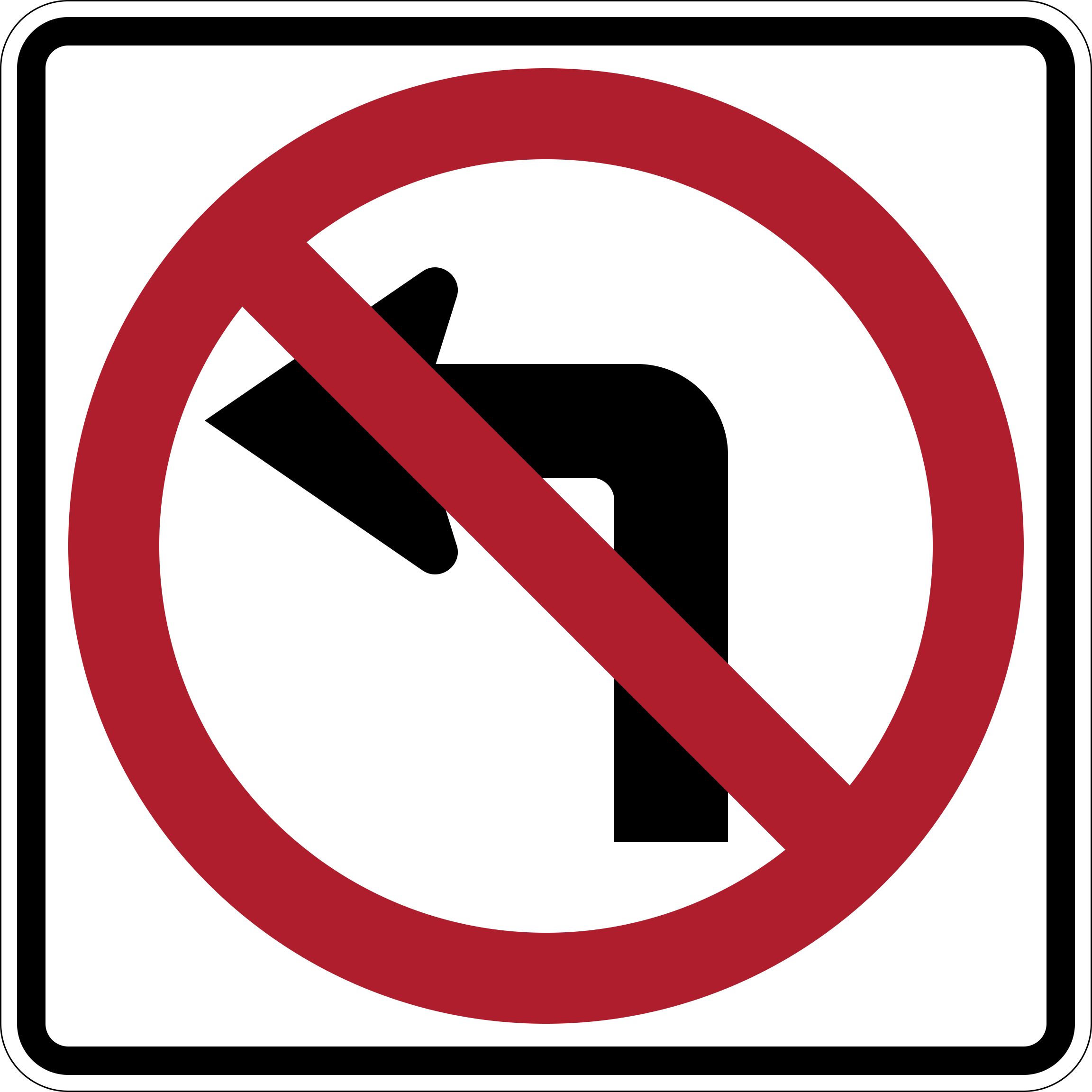
5. What does the crossed-out left-turn symbol tell a driver?
- A left turn is required from the marked lane
- A left turn is prohibited at that location
- A left turn is permitted only after midnight
- A left turn must be made from the shoulder
Show answer
A left turn is prohibited at that location. The manual identifies no left turn as one of the regulatory actions represented by a red slash over a symbol. Because the displayed movement is crossed out, a driver must not make that left turn at the sign. The sign does not require a turn, create a time window, or authorize use of the shoulder. Look for a different permitted route, especially before reaching the intersection. A nearby lane arrow or a green signal cannot cancel a posted prohibition on the movement shown.
Study this in the handbook: Warning, regulatory and guide signs
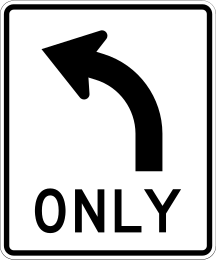
6. What kind of information does a lane-direction sign provide?
- The number of passengers required in the vehicle
- The distance to the next fuel station only
- Where you can go or turn, often shown with an arrow
- The color of the pavement marking beside the lane
Show answer
Where you can go or turn, often shown with an arrow. Lane use control signs tell drivers where they can go and where they can turn. The manual notes that these signs often use an arrow and may be placed beside the road or above the lane. The arrow therefore describes permitted movement from that lane, rather than naming a service or setting a passenger count. Painted arrows may reinforce the instruction, but the sign still needs to be read before the maneuver. Check the lane direction early so a last-second crossing is unnecessary.
Study this in the handbook: Warning, regulatory and guide signs
7. Which condition can prevent a driver from receiving an unrestricted New Mexico license at the time of application?
- The driver completed the required vision screening
- The driver held the provisional license for 12 months
- A traffic violation is still pending
- The driver has no alcohol or drug offense during the provisional period
Show answer
A traffic violation is still pending. An unrestricted license applicant must not have any traffic violations pending at the time of application. The other three choices describe qualifying circumstances or completed requirements rather than disqualifying conditions. Holding the provisional license for the required period is necessary, and a clean alcohol or drug record supports eligibility. Review both convictions and unresolved cases before applying, since a pending matter can matter even when it has not yet produced a final conviction.
Study this in the handbook: Permits and the graduated license
8. A New Mexico driver is involved in a crash and drives away without giving their identity. What license consequence does the manual list?
- None, if no one was injured
- A fine only, with no license action
- A requirement to retake the vision test
- The driver can lose driving privileges
Show answer
The driver can lose driving privileges. Leaving the scene of an accident you are involved in without identifying yourself is on the manual's list of reasons for losing driving privileges. The rule is not limited to crashes with injuries, so the no injury excuse fails. A fine with no license action understates what the manual lists. A vision test is unrelated. The manual adds that a driver in any accident must stop, and if a parked vehicle is hit the driver must try to find the owner or leave a note with contact details and the date and time.
Study this in the handbook: Permits and the graduated license
9. When is a driver not required to stop for a school bus displaying flashing red lights?
- When the driver is running late for work
- When the driver is more than one block from the bus
- When the bus is moving in the opposite direction on a road separated by a median or physical barrier
- When no children are visible near the roadway
Show answer
When the bus is moving in the opposite direction on a road separated by a median or physical barrier. The normal rule is to stop for a school bus with flashing red lights, even when the bus is on the opposite side or at an approaching intersection. The specific exception applies when opposing traffic is divided by a median or another physical barrier. The absence of visible children does not remove the duty to stop. Check the roadway design, not your schedule or a guess about where students are, before proceeding past the bus.
Study this in the handbook: School buses, emergency vehicles and trains
10. What happens to penalties for a second or later DWI conviction in New Mexico, compared with a first?
- Increased fines, more jail time, and a longer license revocation
- The same penalties as a first offense
- Only a larger fine, with no jail
- Only an extra treatment class
Show answer
Increased fines, more jail time, and a longer license revocation. The manual says subsequent DWI convictions bring increased fines, more jail time, and a longer license revocation. Repeating the first offense penalties understates this. A fine alone ignores the added jail time and revocation. A treatment class alone leaves out all three escalations. A first conviction already means stiff fines and court costs, possible jail, ordered treatment, and an ignition interlock, and MVD may revoke the license.
Study this in the handbook: Alcohol, drugs and DWI
11. A New Mexico provisional licensee is driving with no licensed adult in the car. How many passengers under 21 who are not immediate family may ride along?
- None at all, at any time
- No more than one
- Up to two
- Up to three if all are licensed
Show answer
No more than one. A provisional license lets the teen drive without supervision, but it limits young passengers: no more than one passenger under 21 who is not a member of the driver's immediate family. The limit lifts only when a licensed driver who is 21 or older is in the vehicle. A total ban on passengers overstates the rule, since one such passenger is allowed. Two or three young passengers exceed the limit, and being licensed does not make an under 21 passenger exempt. Family members are not counted against this passenger limit.
Study this in the handbook: Permits and the graduated license
12. You miss your exit on a New Mexico highway. What does the manual say about backing up in the travel lane?
- It is allowed if you use your flashers
- It is allowed on the shoulder only
- It is allowed if no car is within 200 feet
- It is illegal; go on to where you can safely turn around
Show answer
It is illegal; go on to where you can safely turn around. The manual says never back a vehicle in any travel lane except to parallel park; it is illegal and unsafe. If you miss your turn or exit, go on to where you can safely turn around. Flashers do not make backing legal. Driving on the shoulder is not allowed unless officials direct it, so backing there is no fix. No distance rule allows backing in a travel lane, because drivers do not expect a vehicle backing toward them.
13. During what hours may a provisional licensee generally not drive on New Mexico public highways?
- 10:00 PM to 4:00 AM
- 11:00 PM to 5:00 AM
- 1:00 AM to 6:00 AM
- Midnight to 5:00 AM
Show answer
Midnight to 5:00 AM. The general nighttime restriction for a provisional license runs from midnight to 5:00 AM. The other time ranges alter one or both endpoints and therefore do not describe the rule. There are exceptions, including being accompanied by a licensed driver at least 21, certain documented family or medical needs, work, school, religious activity, or a medical emergency. First identify the default restricted period, then look for an exception that is actually supported by the stated circumstances.
Study this in the handbook: Permits and the graduated license
14. How far before a turn should a New Mexico driver signal?
- Only after entering the intersection
- At least 25 feet before the turn
- At least 100 feet before the turn
- Only when another driver honks
Show answer
At least 100 feet before the turn. The manual tells drivers to signal at least 100 feet before making a turn. Twenty-five feet gives other road users far less time to react, and signaling after entering the intersection is too late for drivers, bicyclists, and pedestrians to plan around your movement. Waiting for a horn turns a required communication habit into a reaction to someone else's warning. Use the 100 foot cue before braking or changing position so nearby traffic can understand your intent early.
Study this in the handbook: Headlights, horn and turn signals
15. What should a driver do before moving from a stop into an intersection?
- Look both left and right immediately before starting
- Look only toward the vehicle's intended turn
- Trust the signal without checking either side
- Watch the rearview mirror and ignore cross traffic
Show answer
Look both left and right immediately before starting. Before moving from a stop, the driver should look left and right again, even when another signal or stop sign appears to control cross traffic. The manual warns that people may disobey controls or hurry through just after their light changes. Checking only the turn direction leaves an entire approach unseen, while the rearview mirror cannot reveal a vehicle crossing ahead. Make the side-to-side scan part of the start routine, then confirm that the path through the intersection is open and the vehicle will not be trapped inside it.
16. What is the safest practice when a driver must make or take a cell phone call?
- Drive faster so the call ends sooner
- Hold the phone below the steering wheel while moving
- Dial only while stopped at a red light in traffic
- Pull to the side of the road whenever possible
Show answer
Pull to the side of the road whenever possible. The manual identifies both dialing and talking as distractions and recommends pulling to the side of the road whenever possible before placing or taking a call. Holding the phone low still divides attention, and a red light in traffic is not the same as being safely clear of moving lanes. Speeding adds risk rather than removing it. Some New Mexico towns also prohibit handheld use while driving unless a hands-free device is used. The practical habit is to stop in a safe location first, then handle the call without splitting attention between traffic and the device.
Study this in the handbook: Vision, fatigue, health and distraction
17. In very heavy rain, a snowstorm, or thick fog, how fast can you safely drive when you can see only about 200 feet ahead?
- The driver cannot safely drive faster than 30 mph
- The driver may use the posted limit without adjustment
- The driver must stay below 10 mph in every case
- The driver may drive 50 mph if headlights are on
Show answer
The driver cannot safely drive faster than 30 mph. Limited sight distance demands a lower safe speed. Seeing only about 200 feet means a driver cannot safely travel faster than 30 mph in the severe weather described by the manual. The posted limit does not override the visibility problem, and the manual does not impose a universal 10 mph ceiling for these conditions. Headlights help others see the vehicle but do not make 50 mph safe when the driver cannot see far enough to stop. Reduce speed further if visibility or traction worsens, and pull off safely if driving becomes impossible. A clear view of the roadway is the cue for selecting a safe pace.
Study this in the handbook: Road conditions, sight distance and wildlife
18. After a crash, what should the driver do if the vehicle can still be moved?
- Drive away before exchanging information
- Leave it in the travel lane until every report is finished
- Move it off the road so it does not block traffic
- Park it in front of an emergency access route
Show answer
Move it off the road so it does not block traffic. A driver involved in a crash must stop, but stopping does not mean creating another hazard. If the vehicle can move, the manual directs the driver to get it off the road so it will not block traffic or cause another collision. Leaving it in a travel lane can expose everyone at the scene to passing vehicles. Driving away is unlawful and prevents information exchange. Once clear of moving traffic, keep people out of travel lanes, shut off damaged vehicles, and use warning devices so approaching drivers see the scene.
Study this in the handbook: Breakdowns, crashes and first aid
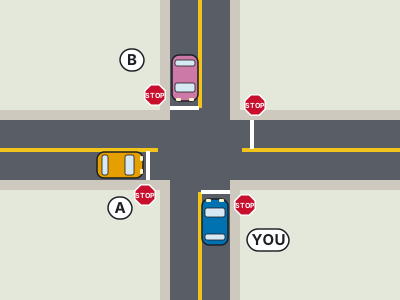
19. At a four-way stop, which driver goes first when vehicles arrive at different times?
- The driver in the largest vehicle
- The driver who reached the intersection first
- The driver approaching from the left
- The driver who flashes headlights first
Show answer
The driver who reached the intersection first. At a four way stop, the driver who reaches the intersection first goes first after coming to a complete stop. Vehicle size, approach from the left, and a headlight signal do not establish priority. If vehicles arrive at the same time, the vehicle on the right goes first. Make the complete stop before applying this order, and remain alert for pedestrians or another road user who may not follow the expected sequence.
Study this in the handbook: Right of way at intersections
20. What is the maximum speed listed for a rural interstate highway unless posted otherwise?
- 75 mph
- 60 mph
- 70 mph
- 55 mph
Show answer
75 mph. The manual lists 75 mph as the maximum speed for rural interstate highways unless a different limit is posted. The 55 mph figure applies to public highways, while 60 and 70 mph are not the listed rural interstate maximums in this table. A posted limit still controls, and drivers must adjust for traffic, weather, vehicle type, and safety. Identify the road category before recalling the number because the manual assigns different maxima to school zones, business or residential areas, public highways, and rural interstates.
Study this in the handbook: Speed limits
QualitySpace is expanding to New Mexico
We are a California-based independent insurance brokerage working on licensing in more states. We cannot help with New Mexico insurance yet. Leave your email and we will let you know when we can.
Every question is written from the official New Mexico Driver Manual. Need paper? Printable NM practice test with answer key.
Last verified 2026-10-05. How we check every question · Study all 208 as flashcards
Frequently asked questions
How many questions are on this New Mexico practice test?
This fixed set has 20 questions. It is test 5 of 10 from the 208 question New Mexico bank.
How does this fixed test relate to the full New Mexico bank?
Each numbered test is a fixed set of questions in a fixed order, so you can retake the same test later and compare. Every test mixes road signs and the other topics in about the same proportion as the full bank. Tests 1 to 10 together cover 200 of the 208 questions in the New Mexico bank, each once. The full practice page mixes the whole bank at random.
Last verified 2026-10-05. See the New Mexico DMV facts page for sourced state details.
Return to the full New Mexico practice test · Study road signs