
Test 2 of 10 · 20 questions · Free 2026
NM Permit Practice Test 2
Jump to the test ↓A fixed 20 question set from the New Mexico bank with answers and plain English explanations.
Question 1 of 20 · 0 right so far
All 20 questions in test 2
Every question below comes from the New Mexico question bank on this page. Open a question to see the correct answer and the explanation. Nothing here is hidden behind a signup.
1. A learner with a New Mexico instructional permit is practicing in a car. Where must the supervising licensed driver sit?
- In the back seat behind the learner
- In the right front seat
- In any seat as long as the supervisor is awake
- Outside the vehicle giving directions
Show answer
In the right front seat. For a vehicle other than a motorcycle, the licensed supervising driver must occupy the right front seat beside the permit holder. That position allows the supervisor to observe the road and respond quickly if needed. Sitting in the back or giving directions from outside does not meet the stated arrangement. Before practice begins, confirm that the supervisor is licensed for that type of vehicle and is seated beside the learner, not merely somewhere inside the car.
Study this in the handbook: Permits and the graduated license
2. What does a red arrow at a New Mexico traffic signal require a driver to do?
- Continue straight without stopping
- Turn after yielding to oncoming traffic
- Stop and wait without traveling in the arrow's direction
- Treat it as a flashing yellow signal
Show answer
Stop and wait without traveling in the arrow's direction. A red arrow requires a stop and prohibits movement in the direction shown by the arrow. The manual says movement may resume when the red arrow goes off and a green arrow or light comes on. A turn after yielding is not allowed during the red arrow, and the signal is not equivalent to a flashing yellow indication. Keep the vehicle stopped at the proper line, watch for the signal change, and obey any separate lane or turn instruction.
Study this in the handbook: Traffic signals and arrows
3. If a vehicle breaks down on a highway, what should the driver do when it is possible?
- Get the vehicle off the road and away from traffic
- Leave it in the travel lane with the engine off
- Stand behind it and wave at approaching vehicles
- Stop just beyond a hill so it is out of sight
Show answer
Get the vehicle off the road and away from traffic. For a highway breakdown, the manual's first protective measure is to get the vehicle off the road and away from traffic whenever possible. Leaving it in a lane exposes the disabled vehicle to a rear-end crash, while standing in the roadway creates danger for the driver. Stopping just beyond a hill hides the problem from approaching traffic. If the vehicle cannot be moved, use emergency flashers and choose a visible location, then warn other road users without entering the travel lane.
Study this in the handbook: Breakdowns, crashes and first aid
4. Which tests must a New Mexico provisional license applicant pass in addition to the vision screening?
- No additional test after holding the permit
- Only a motorcycle skills test
- A fuel economy test and a parking meter test
- A written test and a road test
Show answer
A written test and a road test. The provisional license requirements include passing both a written test and a road test, in addition to a vision screening. Holding an instructional permit does not automatically waive those evaluations. The motorcycle choice changes the vehicle category, while the other distractors describe tests that are not part of the stated requirement. Prepare for both knowledge and behind the wheel performance, because success on only one of them is not enough for this stage.
Study this in the handbook: Permits and the graduated license
5. After a first DWI conviction in New Mexico, what vehicle-related requirement does the manual list in addition to treatment?
- Remove the vehicle's license plates for five years
- Replace the vehicle with a commercial vehicle
- Install a second brake pedal for the driver
- Install an ignition interlock device on the vehicle
Show answer
Install an ignition interlock device on the vehicle. The manual lists treatment and installation of an ignition interlock device after a first DWI conviction. The device is tied to the vehicle and is distinct from jail, fines, or the later authority to revoke a license. Requiring a commercial replacement vehicle invents a condition, while an extra brake pedal has no connection to the alcohol rule. Think of the interlock as a starting control that tests the driver before the vehicle can be operated, not as a change to the vehicle's ordinary braking system.
Study this in the handbook: Alcohol, drugs and DWI
6. When a dashed yellow line separates opposing lanes, what may a driver do?
- Cross it only to park beside the road
- Cross it to pass when the maneuver is safe
- Treat it as a barrier that forbids every crossing
- Use the opposing lane continuously until the next intersection
Show answer
Cross it to pass when the maneuver is safe. A dashed yellow line divides traffic moving in opposite directions and allows a driver to cross for a pass when conditions make the maneuver safe. The choice “Cross it only to park beside the road” confuses a passing marking with a parking permission, which the manual never grants. The choice “Treat it as a barrier that forbids every crossing” describes the restriction created by solid yellow lines, not a dashed line. The choice “Use the opposing lane continuously until the next intersection” turns a temporary passing movement into extended travel against traffic. Before crossing, check sight distance, opposing vehicles, and the condition of the road. A dashed line signals a possible pass, while safety determines whether you may actually use it.
Study this in the handbook: Warning, regulatory and guide signs
7. You have just passed a bicyclist who is riding on your right, and you want to turn right. What should you do?
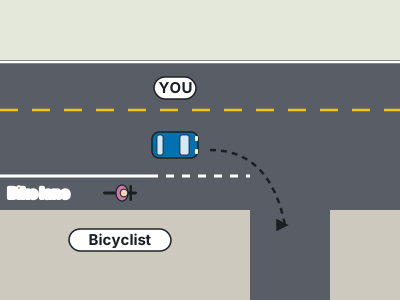
- Turn across the bicyclist's path immediately
- Slow down and merge behind the bicyclist
- Sound the horn and keep turning from the passing lane
- Accelerate so the bicycle cannot reach the corner first
Show answer
Slow down and merge behind the bicyclist. A bicyclist remains a road user whose path must be protected after you pass. The manual directs a motorist to slow down and merge behind the bicycle before turning right, preventing the turn from cutting across the rider's line. The immediate turn is dangerous because it places the vehicle across the bicyclist's path. A horn does not replace a safe position, and acceleration creates a race rather than space. The useful cue is to check where the bicycle will be when the turn begins, not merely where it was during the pass.
8. If the gas pedal sticks and the motor keeps accelerating, what should you do right away?
- Apply the parking brake as the first action
- Reach down and pull the pedal with both hands
- Turn sharply onto the shoulder before looking
- Keep your eyes on the road and shift to neutral
Show answer
Keep your eyes on the road and shift to neutral. A stuck gas pedal demands control before anything else. Keep looking where the vehicle is going, then quickly shift to neutral so engine power no longer drives the wheels. Reaching down for the pedal takes eyes and hands away from control, and a sharp turn before checking the roadway can cause a crash. The parking brake is not listed as the first response for this problem. Once the vehicle is no longer accelerating, pull off when safe and turn off the engine.
Study this in the handbook: Vehicle emergencies and skids
9. How much supervised practice driving is required for a New Mexico provisional license, including nighttime practice?
- 30 hours, including 5 at night
- 40 hours, including 8 at night
- 50 hours, including 10 at night
- 60 hours, including 15 at night
Show answer
50 hours, including 10 at night. A provisional license applicant must complete not less than 50 hours of practice driving, and at least 10 of those hours must be nighttime driving. The 30, 40, and 60 hour combinations change the manual's figures, so they cannot substitute for the required log. The parent or guardian certifies completion of the practice driving portion. On an exam, read both numbers together because the nighttime minimum is included within the total, not added on top of it.
Study this in the handbook: Permits and the graduated license
10. When must a driver use a turn signal?
- When turning or changing lanes
- Only when another vehicle is directly behind
- Only for left turns at traffic signals
- Only after beginning the turn
Show answer
When turning or changing lanes. Signaling communicates a planned turn or lane change before the movement begins, giving other road users time to understand and react. Waiting for a vehicle to appear behind you misses pedestrians, cyclists, and drivers in blind areas. Signaling after the turn starts is also late because it removes useful warning time. Activate the signal in advance, check mirrors and blind spots, complete the movement smoothly, and cancel it when the maneuver is finished.
Study this in the handbook: Headlights, horn and turn signals
11. When parking beside a curb, how should a driver position the vehicle?
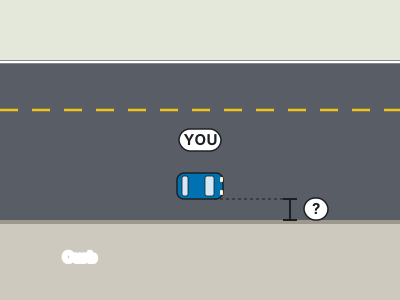
- Partly in the travel lane
- More than 18 inches from the curb
- As close to the curb as possible
- Facing the opposite direction of traffic
Show answer
As close to the curb as possible. New Mexico advises a driver who parks beside a curb to get as close to it as possible. Leaving a large gap can expose the vehicle to moving traffic, while partly occupying the travel lane creates a hazard. The manual also says drivers may not park more than 18 inches from the curb, so the curbside position should be deliberate rather than approximate. Check traffic before opening the door, exit on the curb side when possible, and keep the vehicle clear of the active lane.
Study this in the handbook: Speed limits
12. What do blue service signs with white letters or symbols show?
- A warning that a railroad crossing is immediately ahead
- The posted minimum speed for a high-speed roadway
- A place where all traffic must make a U-turn
- Locations of services such as rest areas, gas stations, campgrounds, or hospitals
Show answer
Locations of services such as rest areas, gas stations, campgrounds, or hospitals. Blue service signs point drivers toward useful services, including rest areas, gas stations, campgrounds, and hospitals. They are informational signs, not speed controls, turning commands, or railroad warnings. A minimum speed would appear on a regulatory sign, and a railroad warning uses its own sign shapes and symbols. When scanning unfamiliar roads, the blue background is the cue that the message is about services nearby. Read the symbol or wording to decide whether the stop fits your route.
Study this in the handbook: Warning, regulatory and guide signs
13. What right of way does a pedestrian have when using a guide dog or carrying a white cane?
- The pedestrian has absolute right of way
- The pedestrian must wait for a vehicle to wave them across
- The pedestrian has priority only in a marked crosswalk
- The pedestrian must yield whenever a vehicle is turning
Show answer
The pedestrian has absolute right of way. A pedestrian using a guide dog or carrying a white cane receives absolute right of way under the manual. Drivers must give that person space and should not use the horn, because the sound could confuse or frighten the pedestrian. The marked-crosswalk choice is too narrow because the protection described is not limited to painted lines. When you notice a guide dog or white cane, stop your vehicle if needed and let the pedestrian complete the crossing safely.
Study this in the handbook: Right of way at intersections
14. What does the round yellow railroad warning sign indicate?

- A school bus stop is on the next block
- A mandatory circular traffic pattern begins immediately
- A no-passing zone ends at the sign
- A railroad crossing is ahead
Show answer
A railroad crossing is ahead. The round yellow sign with a black X and RR letters is placed along the road before a railroad crossing. It gives advance notice, so the driver has time to slow, look in both directions, and confirm that the vehicle can clear the tracks. It is not a roundabout instruction, a passing-zone message, or a school-bus marker. The strongest cue is the RR lettering paired with the X. Treat the approach as a rail crossing even before the crossbuck or tracks come into view.
Study this in the handbook: Railroad crossing signs and rules
15. According to the New Mexico manual, what should you do whenever you turn on your windshield wipers?
- Turn on your high beams
- Turn on your parking lights only
- Turn on your headlights
- Turn on your emergency flashers
Show answer
Turn on your headlights. The manual's rule is simple: if you turn on your wipers, turn on your headlights, because rain, snow, or fog makes your vehicle harder for others to see. High beams reflect back in rain, snow, or fog and cause glare, so the manual says to use low beams in those conditions. Parking lights are for parked vehicles only, and driving on them alone is not allowed. Emergency flashers are for a vehicle that is having trouble and has to stop.
Study this in the handbook: Headlights, horn and turn signals
16. Where may lane-use control signs be located?
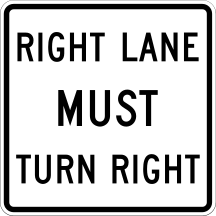
- Only on the rear of a vehicle
- Beside the road or hanging over the lane of travel
- Only at railroad crossings
- Only on the shoulder beyond an intersection
Show answer
Beside the road or hanging over the lane of travel. Lane-use control signs may stand beside the roadway or hang over the lane of travel. Their placement helps a driver connect the instruction with the lane it governs before a turn or lane change begins. The rear-of-vehicle option confuses a traffic sign with a vehicle marking, while the railroad choice assigns the sign to the wrong hazard. The shoulder-only option is too narrow because the manual expressly names both roadside and overhead locations. Look above and beside the lane early, then follow any arrow or movement instruction shown there.
Study this in the handbook: Warning, regulatory and guide signs
17. The do-not-enter symbol shown is used at which location?
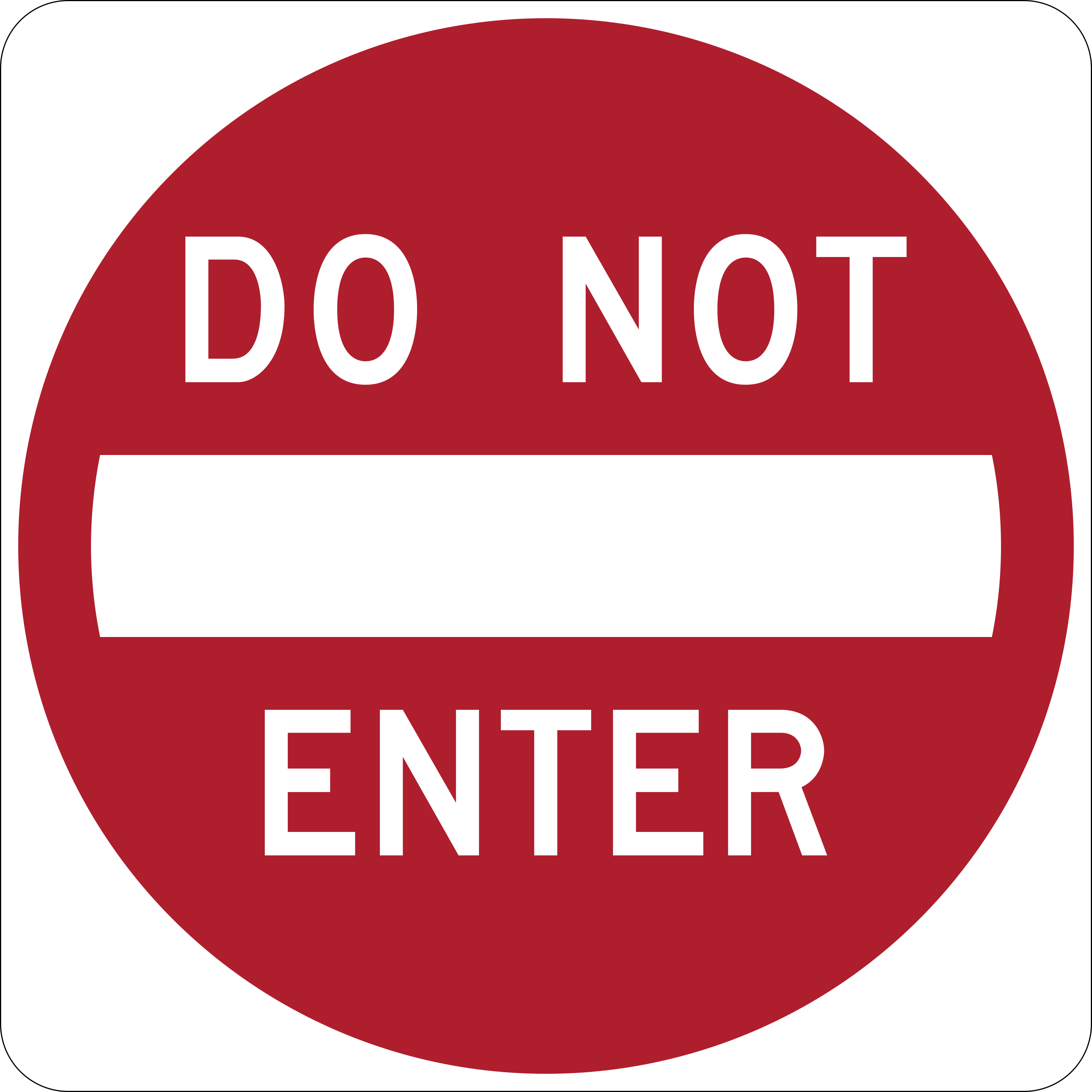
- A roadway opening that drivers should not enter, such as an exit ramp
- A legal parking space beside a fire hydrant
- The beginning of every two-way residential street
- A service area where vehicles must stop for inspection
Show answer
A roadway opening that drivers should not enter, such as an exit ramp. New Mexico describes this square sign with a white horizontal bar inside a red ball as a prohibition on entering. It may appear at an exit ramp where entry would send you against traffic, in a crossover on a divided roadway, or at locations on a one-way street. The sign is about the direction of travel, not parking or inspection. The useful driving cue is to recognize the opening before turning into it and find a legal route that follows the roadway direction.
Study this in the handbook: Warning, regulatory and guide signs
18. Why should a driver avoid dialing or talking on a cell phone while driving?
- It can be a dangerous distraction from safe driving
- It automatically cancels vehicle insurance
- It makes headlights turn off
- It changes the posted speed limit
Show answer
It can be a dangerous distraction from safe driving. The cell phone section warns that dialing or even talking can distract a driver from safe driving. Insurance cancellation, headlight failure, and posted speed changes are not the manual's reason for caution. The important cue is divided attention: handling a call competes with steering, scanning, speed control, and judging gaps. Pulling over remains the better response whenever possible, and some towns require hands-free use. Treat the need to place or answer a call as a reason to leave moving traffic first.
Study this in the handbook: Vision, fatigue, health and distraction
19. How are reserved lanes commonly marked for special vehicle use?
- By a blue curb along the whole road
- By a red flashing light in every lane
- By signs and often a white diamond at the roadside or on the pavement
- By a railroad crossbuck over the lane
Show answer
By signs and often a white diamond at the roadside or on the pavement. Reserved lanes are marked by signs, and they often include a white diamond beside the road or painted on the pavement. A red flashing light would control a signal, not identify a special-use lane. A blue curb points to parking restrictions, while a crossbuck belongs at a railroad crossing. The cue is the diamond paired with words such as bus, bicycle, or HOV. Read the sign before entering because it tells which vehicles may use the lane and when the restriction applies.
Study this in the handbook: Pavement markings and special lanes
20. According to the three-second rule, what should you do if you pass the marker before finishing the count?
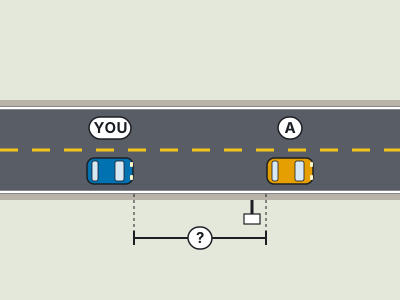
- Drop back and count again at another spot
- Keep the same gap because the rule is only for highways
- Brake hard immediately at the marker
- Change lanes without checking traffic
Show answer
Drop back and count again at another spot. Passing the marker before the count ends means the following gap is too short. The manual directs the driver to drop back and count again at another stationary point, repeating the process until the gap is at least three seconds. Keeping the same distance ignores the test, and hard braking at the marker can create a rear-end conflict. A lane change is unrelated unless traffic conditions separately call for it. Use a sign or pole as the reference, count steadily, and build the space before the vehicle ahead needs to brake.
Study this in the handbook: Following distance, passing and sharing the road
QualitySpace is expanding to New Mexico
We are a California-based independent insurance brokerage working on licensing in more states. We cannot help with New Mexico insurance yet. Leave your email and we will let you know when we can.
Every question is written from the official New Mexico Driver Manual. Need paper? Printable NM practice test with answer key.
Last verified 2026-10-05. How we check every question · Study all 208 as flashcards
Frequently asked questions
How many questions are on this New Mexico practice test?
This fixed set has 20 questions. It is test 2 of 10 from the 208 question New Mexico bank.
How does this fixed test relate to the full New Mexico bank?
Each numbered test is a fixed set of questions in a fixed order, so you can retake the same test later and compare. Every test mixes road signs and the other topics in about the same proportion as the full bank. Tests 1 to 10 together cover 200 of the 208 questions in the New Mexico bank, each once. The full practice page mixes the whole bank at random.
Last verified 2026-10-05. See the New Mexico DMV facts page for sourced state details.
Return to the full New Mexico practice test · Study road signs