
Test 6 of 10 · 20 questions · Free 2026
NM Permit Practice Test 6
Jump to the test ↓A fixed 20 question set from the New Mexico bank with answers and plain English explanations.
Question 1 of 20 · 0 right so far
All 20 questions in test 6
Every question below comes from the New Mexico question bank on this page. Open a question to see the correct answer and the explanation. Nothing here is hidden behind a signup.
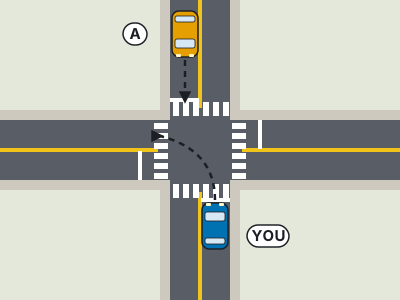
1. A driver turning left at an intersection faces an oncoming vehicle going straight. Who yields?
- Neither driver when both have a green light
- The oncoming driver going straight
- The driver who entered the intersection second
- The driver turning left
Show answer
The driver turning left. The left turning driver must yield to an oncoming vehicle that is continuing straight. A green signal may allow the turn, but it does not remove the need to wait for a safe gap in opposing traffic. The oncoming vehicle does not have to slow merely because the turning vehicle arrived first. Keep the wheels positioned for a controlled turn, watch the approaching lane, and complete the turn only after the through vehicle has cleared.
Study this in the handbook: Right of way at intersections
2. What extra document is required for an instructional permit applicant under 18?
- A work schedule signed by an employer
- A notarized statement from every passenger
- A consent form signed by a parent or guardian
- A court order authorizing night driving
Show answer
A consent form signed by a parent or guardian. An applicant under 18 must have a consent form signed by a parent or guardian when applying for an instructional permit. The employer statement relates to one provisional license exception for driving during restricted hours, not permit issuance. Passenger statements and court orders are not listed for this step. The cue is the applicant's age at the permit stage: once the driver is under 18, the knowledge and vision tests are not enough by themselves. Parental or guardian consent must also be supplied.
Study this in the handbook: Permits and the graduated license
3. What does the Four Second Sight Distance Rule tell a driver to do?
- Speed up whenever an object is visible four seconds away
- Slow down if the vehicle reaches the object before four seconds finish
- Use four seconds only when following a motorcycle
- Count four seconds after crossing a stop line
Show answer
Slow down if the vehicle reaches the object before four seconds finish. The sight-distance rule tests whether speed matches the distance the driver can clearly see. Choose a stationary object ahead and count through four seconds. Reaching it before the count is complete means the vehicle is traveling too fast for the available view, so speed should be reduced. The rule is not a reason to accelerate, and it is not limited to motorcycle following. It applies when hills, curves, darkness, rain, fog, or snow shorten the stopping view. Use the same check at night to avoid overdriving the headlights.
Study this in the handbook: Road conditions, sight distance and wildlife
4. What validity period and renewal window does the manual give for a New Mexico driver license?
- Eight years only, renewable up to six months early
- Two or four years, renewable only during the final week
- Four or eight years, renewable up to 90 days early or 30 days late
- One year, renewable only after the license expires
Show answer
Four or eight years, renewable up to 90 days early or 30 days late. A New Mexico driver license is valid for either four or eight years. The manual permits renewal up to 90 days before expiration or as late as 30 days after expiration. The two-year and one-year options change the stated validity period, while six months early exceeds the listed advance window. Plan around the actual expiration date, and bring the current license plus another proof of identity when renewing because the timing rule does not replace the document requirement.
Study this in the handbook: Renewal, points, seat belts and insurance
5. Which headlights should a driver use in fog or during heavy snow or rain?
- Low beams
- High beams only
- Parking lights only
- No lights until visibility improves
Show answer
Low beams. Low beams are the safer choice in fog and heavy precipitation because high-beam light can reflect back toward the driver. That glare makes the road ahead harder to see, even though the high beams seem brighter. Parking lights do not provide the forward illumination needed for travel, and waiting with no lights makes the vehicle harder for others to detect. Reduce speed as visibility falls and use fog lights if the vehicle has them. The key cue is reflected glare: more light is not automatically more usable light in a dense weather condition.
Study this in the handbook: Headlights, horn and turn signals
6. What does a small bright blinking light in the middle of a red traffic signal tell you?
- It alerts you that the red light means you must stop
- It allows a driver to treat the light as green
- It marks a lane reserved only for buses
- It warns that the signal is out of service
Show answer
It alerts you that the red light means you must stop. A small bright blinking light inside the red indication is an added alert, not permission to proceed. Its purpose is to draw attention to the red light and the duty to stop. Treating it as green reverses the signal, and a bus lane sign would be posted separately rather than hidden inside the red lens. It also is not the same as a dark or failed signal. The cue is the red display itself: stop, then wait for the lawful signal or allowed turn movement.
Study this in the handbook: Traffic signals and arrows
7. A New Mexico driver alters the birth date on a driver license to buy beer. What does the manual say this can lead to?
- Nothing, because it is only a liquor law matter
- A written warning only on the first offense
- Two points but no license action
- Loss of driving privileges
Show answer
Loss of driving privileges. The manual lists attempting to change the information on your license, or using someone else's license, when trying to buy an alcoholic beverage as a reason for losing driving privileges. It is not treated as a liquor matter with no license consequence. The manual does not describe a warning only rule for a first attempt. Nor does it treat this as a points only violation; it appears on the list of offenses that can take the license. The legal age to buy, consume, or possess alcohol in New Mexico is 21.
Study this in the handbook: Permits and the graduated license
8. What maximum speed does the New Mexico manual list within a school zone with a posted speed limit?
- 10 mph
- 15 mph
- 20 mph
- 25 mph
Show answer
15 mph. The manual's speed table lists 15 mph within a school zone with a posted speed limit. Ten mph is lower than the listed figure. Twenty and 25 mph are higher than the figure in New Mexico's table. The same table lists 30 mph in business or residential areas, 55 mph on public highways, and 75 mph on rural interstates, unless posted otherwise.
Study this in the handbook: School buses, emergency vehicles and trains
9. Which statement about a New Mexico instructional permit is true for a 15 year old applicant?
- The applicant needs no supervised practice until age 16
- The applicant may drive alone after passing the vision test
- The applicant may skip the knowledge test if a parent signs consent
- The applicant must be enrolled in an approved driver education course
Show answer
The applicant must be enrolled in an approved driver education course. A person who is 15 or older must be enrolled in and attending a driver education course approved by the Traffic Safety Bureau. Parent consent for a minor does not replace the knowledge test, and an instructional permit does not authorize unsupervised driving. The course also includes DWI education and practice driving. Verify enrollment before treating the permit as active, then follow the separate supervision requirement each time the learner drives.
Study this in the handbook: Permits and the graduated license
10. What should a driver do before entering a railroad crossing?
- Slow down, look both ways along the tracks, and make sure there is room beyond the crossing
- Accelerate so the vehicle spends less time on the tracks
- Stop on the tracks if traffic beyond the crossing is backed up
- Shift gears while crossing to maintain engine power
Show answer
Slow down, look both ways along the tracks, and make sure there is room beyond the crossing. A railroad crossing demands a deliberate check of both directions and the space on the far side. Enter only when your vehicle can clear the rails without stopping. The acceleration choice focuses on speed while ignoring whether the exit is blocked, and stopping on the tracks creates a dangerous position. Reduce speed early, search for trains and warning signals, and keep the vehicle moving smoothly across once the route is open.
Study this in the handbook: Road conditions, sight distance and wildlife
11. If the tires begin to hydroplane, which immediate steering and braking response is advised?
- Brake hard while turning toward the shoulder
- Ease off the gas, keep the wheel straight, and avoid stopping or turning until grip returns
- Accelerate to force the tires through the water
- Shift suddenly and steer across the lane
Show answer
Ease off the gas, keep the wheel straight, and avoid stopping or turning until grip returns. Hydroplaning means the tires have ridden up on water and lost contact with the roadway. The manual's response is to ease off the gas, keep the steering wheel straight, and wait to stop or turn until the tires grip again. Hard braking or a sharp turn can cause a skid while traction is reduced. Acceleration does not restore the contact needed for control, and a sudden lane movement adds another hazard. Slow down whenever rain or standing water threatens traction, keep tires in good condition, and make only a gradual turn if an emergency leaves no alternative.
Study this in the handbook: Road conditions, sight distance and wildlife
12. An emergency vehicle approaches while you are already in an intersection. What should you do?
- Stop in the intersection until the emergency vehicle turns
- Clear the intersection, then pull as far right as possible
- Turn left immediately, regardless of traffic
- Keep driving at the same speed and remain in the lane
Show answer
Clear the intersection, then pull as far right as possible. New Mexico directs a driver in the intersection to continue through it before pulling over. Once clear, move to the right edge or as near to it as possible and yield to the emergency vehicle. Stopping in the intersection can block the responding unit and create a second conflict. A sudden left turn or unchanged lane position also fails to make a predictable path. The cue is clear the junction first, then stop right and wait for the emergency vehicle to pass.
Study this in the handbook: School buses, emergency vehicles and trains
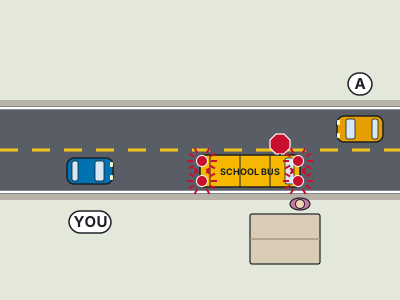
13. When must a driver stop for a school bus with red lights flashing?
- Only when children are visible beside the bus
- Only when the driver is directly behind the bus
- When the bus is stopped on either side of the road, unless a median separates the roadway
- Only on roads with one lane in each direction
Show answer
When the bus is stopped on either side of the road, unless a median separates the roadway. A flashing red school-bus signal requires a stop whether the bus is on your side, across from you, or at an intersection you are approaching. The exception is a roadway divided by a median or another physical barrier, when the bus is traveling toward you on the separated side. Waiting for visible children is unsafe because students may be hidden. After the lights stop, continue only once children have left the roadway and the path is safe.
Study this in the handbook: School buses, emergency vehicles and trains
14. How much space should a New Mexico driver try to give when passing a bicyclist?
- At least five feet
- At least one foot
- At least two feet
- Space is needed only if the bicyclist signals
Show answer
At least five feet. The manual tells drivers to keep a safe distance when passing a bicyclist, trying for at least five feet, and to pass only when safe and legal. One or two feet is far too close. The space is not tied to the bicyclist signaling. Bicycles are legal vehicles with the same rights and responsibilities as cars, and they may take the whole lane when needed, such as to prepare for a left turn or avoid debris.
Study this in the handbook: Following distance, passing and sharing the road
15. What action is required at a red, eight-sided stop sign?
- Make a full stop at the sign or stop line
- Slow briefly and continue if the road looks clear
- Yield only to pedestrians in the crosswalk
- Stop only when another vehicle is approaching
Show answer
Make a full stop at the sign or stop line. The octagonal shape identifies a stop sign, and the required action is a full stop. If a stop line is present, stop before reaching it, then wait until crossing traffic and pedestrians have cleared before moving forward. A brief slowdown does not satisfy the rule, and the duty does not depend on seeing another vehicle. The reliable habit is wheels stopped, scan both directions, and proceed only after the intersection is safe.
Study this in the handbook: Warning, regulatory and guide signs
16. Who must wear a helmet when riding a bicycle, according to the New Mexico manual?
- No one, helmets are only recommended
- Only riders over 65
- Only riders on sharrow streets
- Minors
Show answer
Minors. The manual says adults should, and minors must, wear a well fitting helmet when bicycling. That makes it a requirement for minors, not only a recommendation. There is no rule tied to riders over 65 or to sharrow streets. Do not confuse this with the motorcycle rule, which requires helmets for drivers and passengers under 18. The same section tells bicyclists to wear bright colors, use proper lighting, and be predictable, because bicycles can be hard for motorists to see.
17. What changes may orange work area warnings announce?
- Reduced speeds, detours, or changing road surfaces
- A permanent increase in the posted speed
- A guaranteed open lane through the work area
- A nearby railroad train schedule
Show answer
Reduced speeds, detours, or changing road surfaces. Work area warnings can announce reduced speed, detours, slow-moving construction equipment, or poor and suddenly changing road surfaces. These conditions require extra scanning because workers, equipment, and lane paths may change near the vehicle. The open-lane choice gives false assurance, while the speed-increase choice contradicts the warning's purpose. Slow down, follow signs and cones, and obey a person directing traffic with a sign or flag. Orange signs are the cue that construction, maintenance, or emergency operations may have changed the normal roadway, even when the work itself is not immediately visible.
Study this in the handbook: Warning, regulatory and guide signs
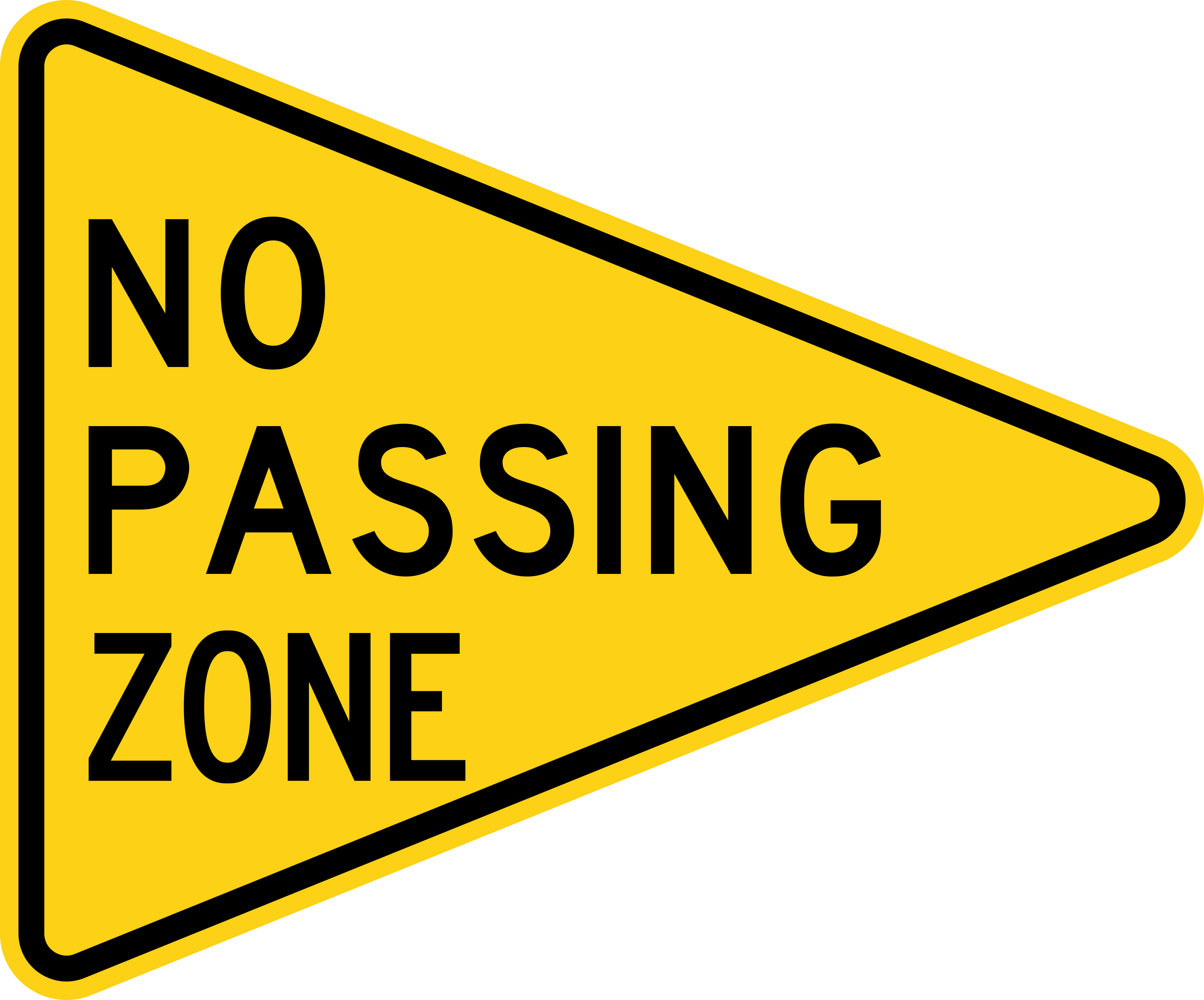
18. What does the yellow pennant-shaped sign mark?
- The beginning of a hospital service area
- A place where passing is not permitted
- A zone where passing is required
- A route for emergency vehicles only
Show answer
A place where passing is not permitted. The pennant identifies a no-passing area, where roadway conditions or hidden hazards make an overtaking maneuver unsafe or prohibited. The sign is not an instruction to pass, and it has no connection with hospitals or emergency-only routes. Even where a passing sign is absent, the driver must still judge sight distance and traffic before overtaking. Treat the pennant as a prompt to remain behind the vehicle ahead until the restriction ends and a legal opportunity appears.
Study this in the handbook: Warning, regulatory and guide signs
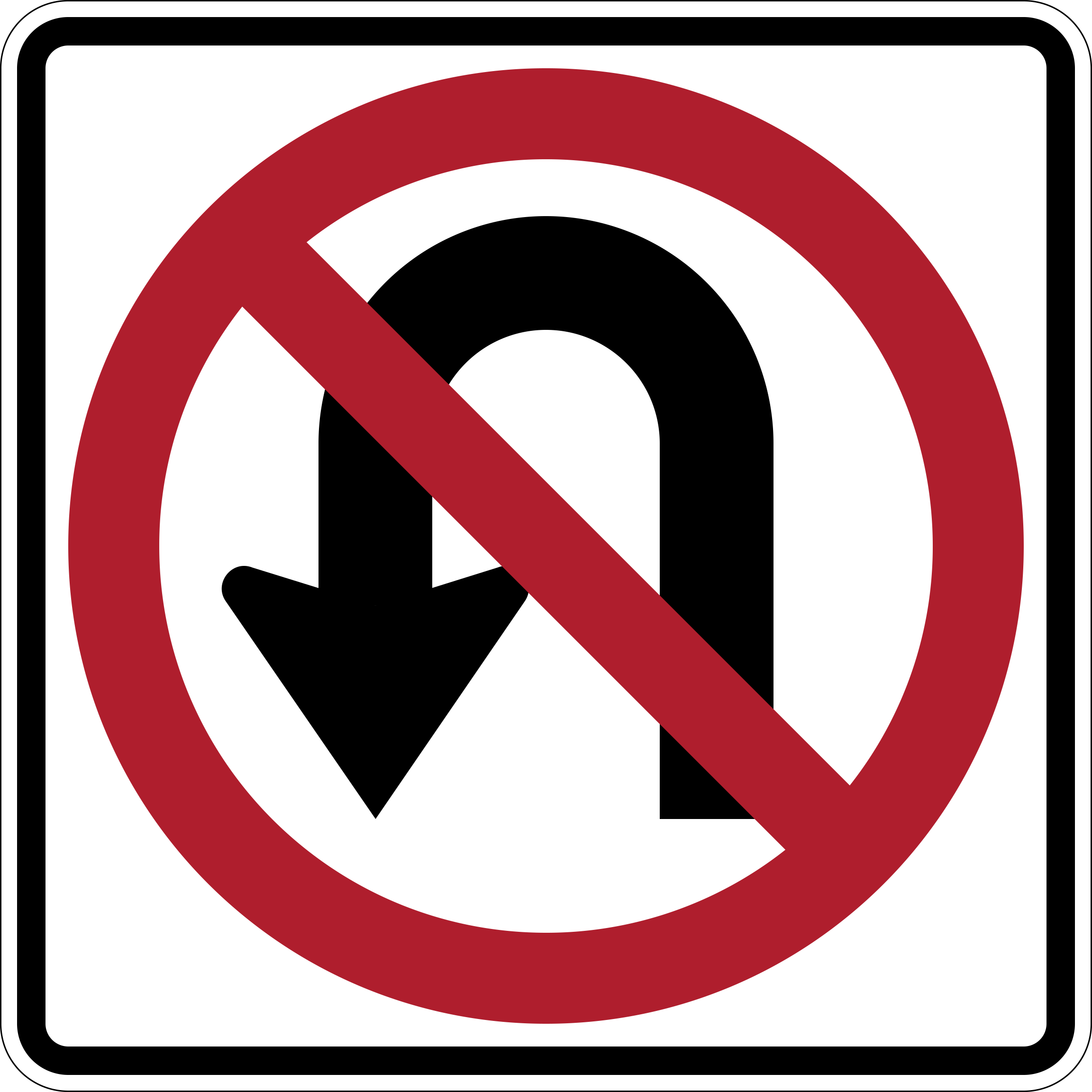
19. What does a red circle with a red slash on a regulatory sign indicate?
- The sign gives directions to a service area
- The pictured action is required immediately
- The route is open only to emergency vehicles
- The pictured action is prohibited
Show answer
The pictured action is prohibited. A red circle with a red slash over a symbol indicates that the pictured action is prohibited. The manual gives no-left-turn, no-right-turn, and no-U-turn signs as examples. The slash does not require the movement, reserve the road for emergency vehicles, or provide a service direction. Identify the action shown beneath the slash, then choose another legal path or wait for a permitted movement. Continue checking other signs and lane markings because the prohibition applies to the displayed action.
Study this in the handbook: Warning, regulatory and guide signs
20. What does a driver do when a traffic signal changes to steady yellow?
- Reverse away from the intersection before the light changes
- Accelerate every time to beat the red indication
- Stop if it can be done safely, otherwise continue cautiously through the intersection
- Stop abruptly even when already too close to stop safely
Show answer
Stop if it can be done safely, otherwise continue cautiously through the intersection. A yellow indication warns that the signal is about to turn red. The driver should stop when a controlled stop can be made safely, but should not create a rear-end or loss-of-control risk by braking abruptly at the line. The acceleration choice treats the warning as a race, while the reverse choice creates a new hazard. Check the distance to the stop line, brake smoothly when possible, and continue cautiously if stopping is no longer safe.
Study this in the handbook: Traffic signals and arrows
QualitySpace is expanding to New Mexico
We are a California-based independent insurance brokerage working on licensing in more states. We cannot help with New Mexico insurance yet. Leave your email and we will let you know when we can.
Every question is written from the official New Mexico Driver Manual. Need paper? Printable NM practice test with answer key.
Last verified 2026-10-05. How we check every question · Study all 208 as flashcards
Frequently asked questions
How many questions are on this New Mexico practice test?
This fixed set has 20 questions. It is test 6 of 10 from the 208 question New Mexico bank.
How does this fixed test relate to the full New Mexico bank?
Each numbered test is a fixed set of questions in a fixed order, so you can retake the same test later and compare. Every test mixes road signs and the other topics in about the same proportion as the full bank. Tests 1 to 10 together cover 200 of the 208 questions in the New Mexico bank, each once. The full practice page mixes the whole bank at random.
Last verified 2026-10-05. See the New Mexico DMV facts page for sourced state details.
Return to the full New Mexico practice test · Study road signs