
Test 7 of 10 · 20 questions · Free 2026
NM Permit Practice Test 7
Jump to the test ↓A fixed 20 question set from the New Mexico bank with answers and plain English explanations.
Question 1 of 20 · 0 right so far
All 20 questions in test 7
Every question below comes from the New Mexico question bank on this page. Open a question to see the correct answer and the explanation. Nothing here is hidden behind a signup.
1. How fast do farm tractors, animal-drawn vehicles, and roadway maintenance vehicles usually travel?
- 25 mph or less
- About 45 mph
- The posted limit in every case
- At least 55 mph
Show answer
25 mph or less. These vehicles usually travel at 25 mph or less, which is why a driver should identify them early, reduce speed smoothly, or change lanes only when the path is clear. Expecting them to match ordinary traffic can lead to a late lane change or rear-end collision. The posted limit is not their operating speed, and assuming they travel at highway speed defeats the warning provided by the orange slow-moving-vehicle decal. Scan hills and entry points for them, leave room, and pass only when visibility and lane space make the maneuver safe.
Study this in the handbook: Road conditions, sight distance and wildlife
2. What should a driver do during a sudden stop in a vehicle equipped with ABS?
- Use only the parking brake
- Pump the pedal rapidly until the vehicle stops
- Release the pedal whenever it vibrates
- Press the brake pedal hard and keep pressing it
Show answer
Press the brake pedal hard and keep pressing it. With an antilock braking system, the manual directs the driver to press the brake pedal as hard as possible and keep pressure on it. The pedal may push back while ABS works, but that sensation is not a signal to release. Rapid pumping is associated with older braking technique, not the ABS procedure described here. The parking brake cannot replace the main stopping system in an emergency. Keep steering control, maintain firm pedal pressure, and let the system help prevent wheel lock while the vehicle slows.
Study this in the handbook: Vehicle emergencies and skids
3. What minimum liability coverage amount is listed for bodily injury to two or more people in one accident?
- $10,000
- $25,000
- $100,000
- $50,000
Show answer
$50,000. The financial responsibility table lists $50,000 for bodily injury to or death of two or more persons in one accident. The $25,000 amount applies when one person is injured or dies, while $10,000 applies to injury to or destruction of property belonging to others. The $100,000 choice is not one of the listed minimum amounts. Keep the number of injured people separate from the property category, because each situation has its own required coverage figure.
Study this in the handbook: Renewal, points, seat belts and insurance
4. When may a driver turn right at a steady red light?
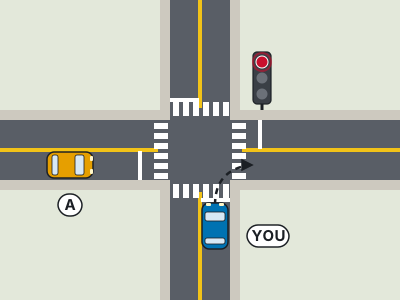
- Only after the signal has been red for one minute
- Whenever the driver slows and sees no car nearby
- After a full stop, if safe and no sign prohibits the turn
- Before stopping if the intended road is empty
Show answer
After a full stop, if safe and no sign prohibits the turn. A steady red requires a stop first. A right turn may follow only after the vehicle has fully stopped, the movement is safe, and no posted sign forbids turning on red. An empty-looking road does not replace the stop, and the signal does not impose a one-minute waiting period. Before turning, check crossing traffic and pedestrians in front of the vehicle. The key sequence is stop, check, and turn only under the permitted conditions.
Study this in the handbook: Traffic signals and arrows
5. What following interval does the manual use as the basic minimum space ahead?
- Two car lengths regardless of speed
- Exactly one second in every condition
- At least three seconds
- A five-second interval only on city streets
Show answer
At least three seconds. The basic spacing test is the three-second rule. Watch the vehicle ahead pass a fixed object, count the time until your vehicle reaches that same point, and increase the gap if you arrive before the count ends. Speed alone makes a fixed number of car lengths unreliable. Slippery roads, motorcycles, heavy loads, trailers, emergency vehicles, approaching railroad crossings, and being stopped on a hill can call for four seconds instead. The cue is to measure time, not bumper distance.
Study this in the handbook: Road conditions, sight distance and wildlife
6. What should an angry or excited driver do before continuing to drive?
- Drive faster to finish the trip sooner
- Give time to cool off and stay off the road until calm
- Use the horn to release frustration
- Follow another driver closely to make progress
Show answer
Give time to cool off and stay off the road until calm. New Mexico warns that strong emotions can interfere with safe driving. An angry or excited driver should give time to cool off and stay off the road until calm, taking a short walk if needed. Speeding, horn use, and close following do not solve the emotional problem and can add distraction or conflict. The practical cue is to notice the feeling before starting or resuming the trip. Pause in a safe place, settle attention, and return to traffic only when the driver can focus on the roadway.
Study this in the handbook: Vision, fatigue, health and distraction
7. How close may you be to a vehicle ahead before switching from high beams to low beams?
- Within 500 feet only when approaching a vehicle
- Within 50 feet when following another vehicle
- Within 200 feet when following another vehicle
- Only after the other driver flashes headlights
Show answer
Within 200 feet when following another vehicle. The manual says to use your low beams within 200 feet when following another vehicle or when in heavy traffic. The 500-foot figure concerns using headlights when approaching another car, not following one, and 50 feet is far closer than the stated limit. Waiting for the other driver to flash headlights is not the rule either. Watch the gap to the vehicle ahead and switch to low beams once you are within 200 feet of it, even when the rest of the road is empty.
Study this in the handbook: Headlights, horn and turn signals
8. Unless a different limit is posted, what is the maximum speed in New Mexico business or residential areas?
- 25 mph
- 35 mph
- 45 mph
- 30 mph
Show answer
30 mph. New Mexico's default maximum in business or residential areas is 30 mph unless posted otherwise. Twenty five mph is lower than the figure in New Mexico's table. Thirty five and 45 mph are too high for this category. Remember the full ladder: 15 in a posted school zone, 30 in business or residential areas, 55 on public highways, and 75 on rural interstates.
Study this in the handbook: School buses, emergency vehicles and trains
9. How close to a traffic signal, stop sign, or yield sign may you park in New Mexico?
- No closer than 10 feet
- No closer than 15 feet
- No closer than 30 feet
- No closer than 100 feet
Show answer
No closer than 30 feet. New Mexico prohibits parking within 30 feet of a traffic signal, stop sign, or yield sign. Ten and 15 feet are too close, and would let a parked car hide the sign or signal from approaching drivers. One hundred feet overstates the rule. Keep this distance separate from the others on the list: 50 feet from a railroad crossing and 20 feet from a fire station driveway on the same side of the street.
Study this in the handbook: Speed limits
10. If the engine dies while you are driving, what should you do first?
- Turn the ignition off and release the steering wheel
- Keep a strong grip on the steering wheel
- Leave the vehicle in the travel lane and coast without steering
- Apply the parking brake sharply while still moving at speed
Show answer
Keep a strong grip on the steering wheel. When the engine stops, steering may become harder, but control is still possible. Keep both hands engaged with the wheel, guide the vehicle toward a safe location, and remain alert for the extra effort needed at the brake pedal. Releasing the wheel removes the control needed to leave the travel lane, while a sharp parking-brake application can cause a skid. Maintain direction first, then steer off the roadway and stop where you will not obstruct traffic.
Study this in the handbook: Vehicle emergencies and skids
11. What information do speed limit signs provide?
- The maximum safe speed allowed or minimum safe speed required
- The exact speed required in every condition
- The speed of the vehicle ahead
- The minimum age for driving on the road
Show answer
The maximum safe speed allowed or minimum safe speed required. New Mexico describes speed limit signs as indicating either the maximum safe speed allowed or the minimum safe speed required. A maximum is not an instruction to drive that speed in rain, ice, fog, or heavy traffic, and a minimum is not a target for every roadway. The sign's category matters, so read whether it sets an upper or lower boundary. Then account for conditions and vehicle handling before choosing a safe pace.
Study this in the handbook: Warning, regulatory and guide signs
12. How recent must a traffic record be when a driver applies for a New Mexico provisional license?
- The driver must have no traffic conviction in the preceding 12 months
- The driver must have no traffic conviction in the preceding 90 days
- The driver may have one conviction during the preceding 30 days
- The driver must wait until every older conviction is erased
Show answer
The driver must have no traffic conviction in the preceding 90 days. For a provisional license application, the manual requires no traffic conviction during the 90 days before applying. That is a lookback period, not a demand for a completely blank lifetime record or a full year without any citation. The 30 day option understates the required interval. Check the dates of convictions before scheduling the application, because the relevant question is whether one falls inside the preceding 90 days.
Study this in the handbook: Permits and the graduated license
13. How should a driver treat the maximum speed shown on this sign when conditions worsen?
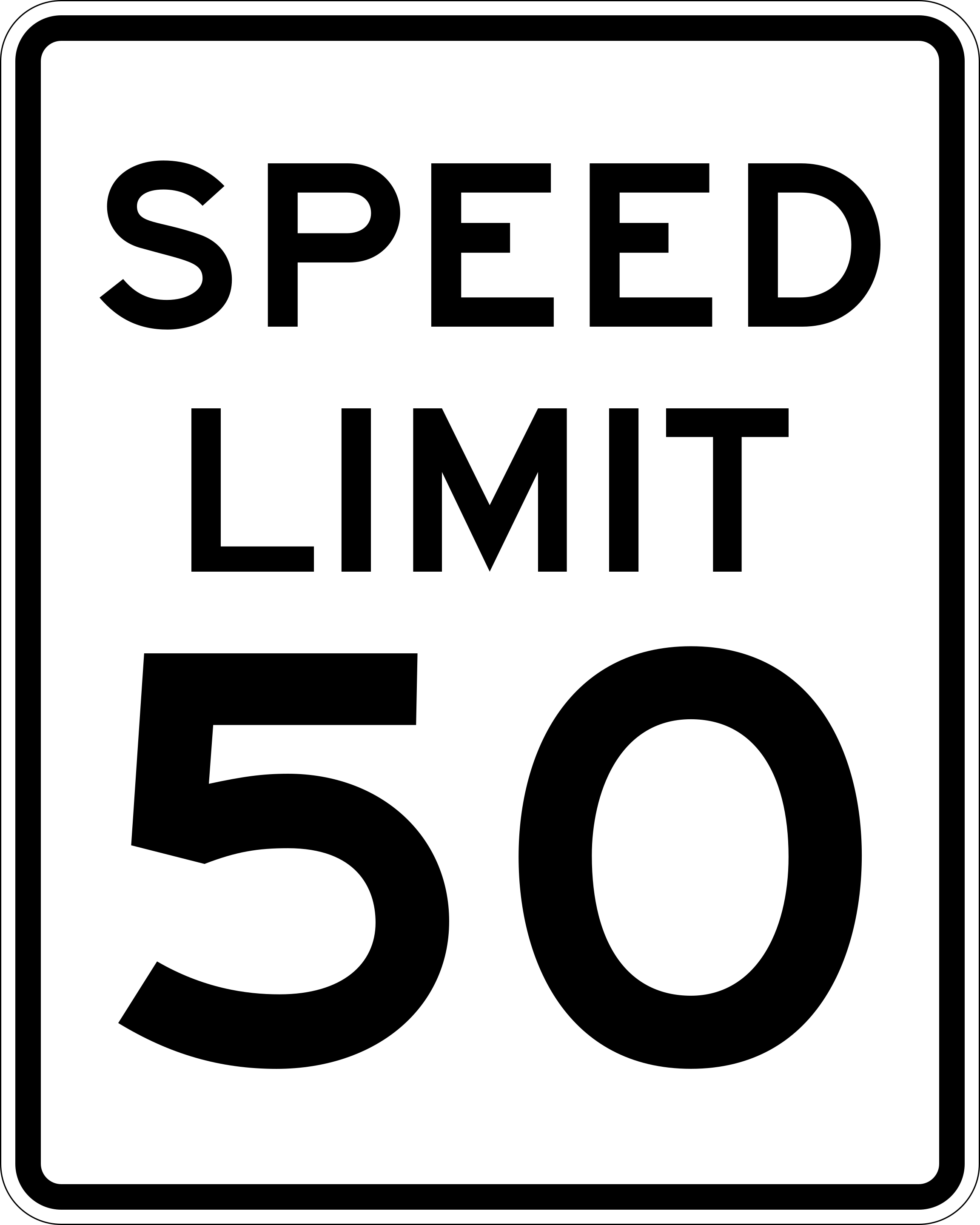
- Use the posted number only when another vehicle is nearby
- Maintain the posted number because it is safe in every condition
- Increase speed to avoid becoming a hazard on wet pavement
- Reduce speed when slippery, rainy, snowy, icy, or foggy conditions require it
Show answer
Reduce speed when slippery, rainy, snowy, icy, or foggy conditions require it. A speed-limit sign does not guarantee that its maximum number is suitable for every moment. The manual says the maximum should be driven only in ideal conditions and gives slippery roads, rain, snow, ice, and fog as reasons to reduce speed. The posted number remains an upper limit, not a target during poor visibility or traction. Watch the surface and sight distance, then choose a slower speed that preserves control. The wet-pavement cue is earlier braking and a larger following space, not extra acceleration.
Study this in the handbook: Warning, regulatory and guide signs
14. When is it legal to drive on a sidewalk in New Mexico?
- Only to cross it, and you must yield to pedestrians
- Whenever traffic in the lane is stopped
- To pass a vehicle turning left
- Never, not even to reach a driveway
Show answer
Only to cross it, and you must yield to pedestrians. The manual says it is illegal to drive on a sidewalk except to cross it, and drivers crossing a sidewalk to enter or leave a driveway, alley, or parking lot must yield to pedestrians. Stopped traffic and passing a turning vehicle are not exceptions. Saying never ignores the stated exception for crossing to reach a driveway, alley, or parking lot.
Study this in the handbook: Right of way at intersections
15. What license consequence can follow a New Mexico driver's refusal to take a BAC test requested by a police or traffic officer?
- A warning with no license consequence
- Loss of the driver license for one year
- A seven day license suspension only
- Permanent cancellation of every vehicle registration
Show answer
Loss of the driver license for one year. Refusing a requested BAC test can result in losing the driver license for one year. The consequence is tied to the refusal itself, so it is not limited to drivers who are later convicted of DWI. A warning or seven day suspension understates the stated period, while vehicle registration is a different credential. If an officer makes the request, remember that the manual describes a direct licensing consequence for refusing the test.
Study this in the handbook: Alcohol, drugs and DWI
16. What is the purpose of the yellow, usually diamond-shaped warning signs described in the manual?
- Authorize a driver to ignore a lane restriction
- Show the exact minimum speed required on the road
- Identify services such as hospitals and gas stations
- Warn drivers to slow down and prepare to stop if needed
Show answer
Warn drivers to slow down and prepare to stop if needed. Warning signs alert drivers to a special situation or hazard ahead. The manual says these signs are usually yellow and most are diamond shaped, and that drivers should slow down and be prepared to stop if necessary. Service signs identify facilities, while regulatory signs communicate rules such as speed or lane use. A warning sign does not grant permission to disregard another control. Treat the color and shape as an early cue to scan farther ahead and adjust before reaching the hazard.
Study this in the handbook: Traffic signals and arrows
17. What are common shapes and colors of regulatory signs?
- Only orange circles with green symbols
- Only yellow diamonds with blue lettering
- Square, rectangular, or special shapes, usually using white, red, or black
- Only purple triangles with white borders
Show answer
Square, rectangular, or special shapes, usually using white, red, or black. Regulatory signs are commonly square, rectangular, or a special shape, and they usually use white, red, or black with contrasting letters or symbols. These signs communicate rules about direction, lane use, turning, speed, parking, and other special situations. The other choices invent color and shape combinations not given for this sign category. Recognize the regulatory format, read the instruction, and obey it together with lane markings and any other traffic control present.
Study this in the handbook: Warning, regulatory and guide signs
18. What vision standard does the New Mexico license vision test check for?
- 20/20 in both eyes without glasses
- At least 20/40 in at least one eye, with or without corrective lenses
- At least 20/40 in both eyes without glasses
- At least 20/100 in the better eye
Show answer
At least 20/40 in at least one eye, with or without corrective lenses. New Mexico's vision test measures that you have at least 20/40 vision in at least one eye, with or without corrective lenses. Perfect 20/20 vision is not required, and glasses or contacts may be used. Requiring 20/40 in both eyes adds a condition the manual does not state. Twenty/100 is far below the standard. If you need glasses or contacts to drive, always wear them when you drive.
Study this in the handbook: Vision, fatigue, health and distraction
19. When is wildlife especially active on New Mexico roads, according to the manual?
- At dawn, dusk, and during the first few hours after darkness
- Only at noon on clear summer days
- Only after midnight when traffic is heavy
- Only during bright daylight after rainfall
Show answer
At dawn, dusk, and during the first few hours after darkness. The wildlife guidance highlights dawn, dusk, and the first few hours after darkness as times when animals are especially active. The driver should scan the roadway and edges, watch for crossing signs, and expect that more than one animal may follow the first. The daylight-only choices miss the periods named in the manual, while midnight is too narrow. Reduce speed when animals or signs appear, and be prepared to let an animal cross rather than assuming it will move away.
Study this in the handbook: Road conditions, sight distance and wildlife
20. You are about to turn into a highway exit ramp and see the do-not-enter sign shown. Why does the sign matter there?
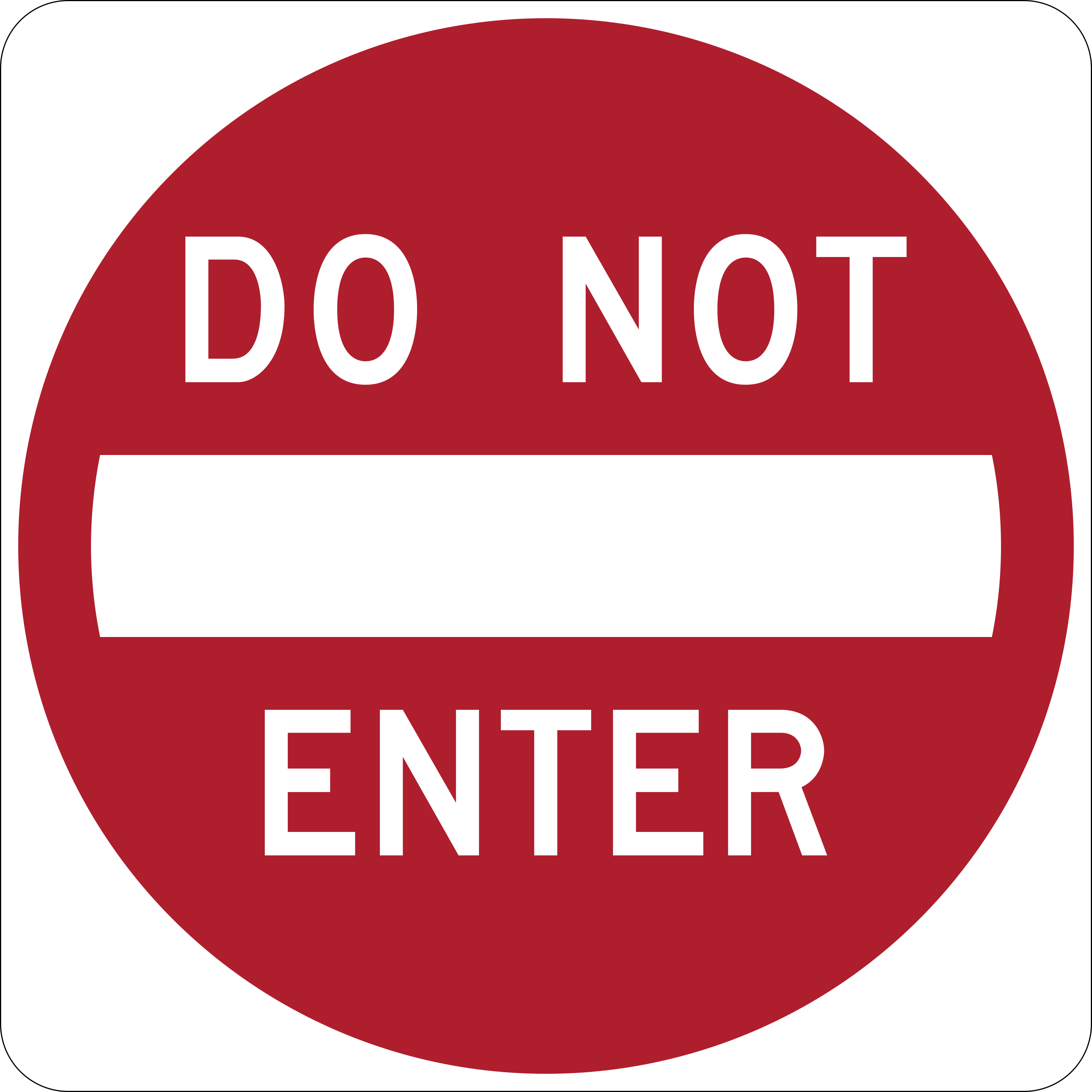
- It may mark an opening where entry would send you in the wrong direction
- It identifies a lane reserved for slow vehicles
- It announces that a divided highway is ending
- It permits a U-turn across the median
Show answer
It may mark an opening where entry would send you in the wrong direction. New Mexico places do-not-enter signs at roadway openings you should not enter, such as exit ramps where you would be going in the wrong direction. That makes the sign an immediate route and safety warning, not a speed or lane-use suggestion. Turning into the ramp would put your vehicle against the flow of traffic. The sign does not mark a slow-vehicle lane, does not announce the end of a divided highway, and never grants a U-turn. If you see it ahead, do not turn into the opening; choose a legal route that follows the direction of travel instead.
Study this in the handbook: Warning, regulatory and guide signs
QualitySpace is expanding to New Mexico
We are a California-based independent insurance brokerage working on licensing in more states. We cannot help with New Mexico insurance yet. Leave your email and we will let you know when we can.
Every question is written from the official New Mexico Driver Manual. Need paper? Printable NM practice test with answer key.
Last verified 2026-10-05. How we check every question · Study all 208 as flashcards
Frequently asked questions
How many questions are on this New Mexico practice test?
This fixed set has 20 questions. It is test 7 of 10 from the 208 question New Mexico bank.
How does this fixed test relate to the full New Mexico bank?
Each numbered test is a fixed set of questions in a fixed order, so you can retake the same test later and compare. Every test mixes road signs and the other topics in about the same proportion as the full bank. Tests 1 to 10 together cover 200 of the 208 questions in the New Mexico bank, each once. The full practice page mixes the whole bank at random.
Last verified 2026-10-05. See the New Mexico DMV facts page for sourced state details.
Return to the full New Mexico practice test · Study road signs