
Test 10 of 10 · 20 questions · Free 2026
NM Permit Practice Test 10
Jump to the test ↓A fixed 20 question set from the New Mexico bank with answers and plain English explanations.
Question 1 of 20 · 0 right so far
All 20 questions in test 10
Every question below comes from the New Mexico question bank on this page. Open a question to see the correct answer and the explanation. Nothing here is hidden behind a signup.
1. When conditions are rainy, icy, or foggy, how should a driver treat a posted maximum speed?
- Treat it as a target speed that must be maintained
- Increase speed briefly to clear the bad weather
- Reduce speed when the conditions make the posted maximum unsafe
- Ignore the limit only when visibility is reduced
Show answer
Reduce speed when the conditions make the posted maximum unsafe. A posted maximum is based on ideal driving conditions, not a promise that the same speed is safe in every situation. Rain, snow, ice, and fog reduce traction or visibility, so the driver must slow down as conditions require. The attractive but unsafe choice “Treat it as a target speed that must be maintained” turns a ceiling into a required pace. A useful cue is to evaluate the road before relying on the number on the sign: if the surface is slick or the view is limited, choose a lower speed that leaves room to react.
Study this in the handbook: Speed limits
2. What can happen in New Mexico if a vehicle is driven without the required liability insurance?
- Nothing, if the driver pays for damages later
- Non-issuance or suspension of the registration, surrender of the plates, and possible criminal penalties
- A written warning only
- Two points and no other action
Show answer
Non-issuance or suspension of the registration, surrender of the plates, and possible criminal penalties. The manual says failure to have insurance could result in non issuance or suspension of your vehicle registration, surrender of the license plates, and possible criminal penalties. Offering to pay damages later does not replace the required policy. A warning only answer understates the consequence. Driving without insurance carries no points and instead requires a court appearance, so the two points choice is also wrong. Proof of insurance must be kept in the vehicle, and the minimums are $25,000, $50,000, and $10,000.
Study this in the handbook: Renewal, points, seat belts and insurance
3. What should a driver do when a yellow arrow appears while turning in its direction?
- Continue with the protection of a green arrow
- Prepare to stop and yield to oncoming traffic before turning
- Turn without checking for approaching vehicles
- Treat the arrow as a flashing red signal
Show answer
Prepare to stop and yield to oncoming traffic before turning. A yellow arrow means the protection provided by a green arrow is ending. A driver turning in that direction should prepare to stop and give the right of way to oncoming traffic before turning. The choice “Continue with the protection of a green arrow” assumes that the green arrow protection continues, which is precisely what the yellow change warns is ending. The choice “Turn without checking for approaching vehicles” removes the required yield, and treating the arrow as a flashing red assigns it the wrong meaning. Check the intersection, anticipate the red phase, and complete a turn only after oncoming traffic has been given priority.
Study this in the handbook: Traffic signals and arrows
4. What does a green arrow permit, assuming the driver continues to check for people and other hazards?
- A turn against the arrow
- A U-turn in any lane
- A turn in the arrow's direction
- Movement without yielding to pedestrians
Show answer
A turn in the arrow's direction. A green arrow gives protected movement in the direction it points, so it can authorize a turn without the usual opposing traffic conflict. It does not authorize a U-turn merely because the vehicle is facing an arrow, and it cannot support movement in a different direction. Pedestrians remain a concern because the manual specifically tells turning drivers to watch for people crossing. Scan the intended path before moving, and remember that a signal controls the indicated movement rather than every possible maneuver from that lane.
Study this in the handbook: Traffic signals and arrows
5. How can you help keep a driver behind you at a safe distance?
- Keep a steady speed and signal before slowing or turning
- Brake sharply whenever the vehicle gets close
- Speed above the limit to open a gap
- Move onto the shoulder without checking
Show answer
Keep a steady speed and signal before slowing or turning. The manual recommends a steady speed and advance signaling when you need to slow down or turn. Those predictable actions give the driver behind more time to recognize your change and reduce speed smoothly. Sharp braking can cause a rear-end crash, and speeding creates a separate safety and legal problem. The shoulder is not a default escape route and should never be entered without checking. Watch the space behind, signal early, and make your speed changes gradual whenever traffic conditions permit.
Study this in the handbook: Following distance, passing and sharing the road
6. How far before an oncoming vehicle should a driver dim high beams under the manual's nighttime guidance?
- Within 25 feet
- About one block
- Only after the other driver flashes headlights
- At the exact moment the vehicles meet
Show answer
About one block. The manual asks drivers to dim high beams when an oncoming vehicle comes within about one block. That distance gives the other driver time to see without the glare of bright lights. Waiting for 25 feet leaves little margin and can impair the approaching driver's vision. A headlight flash is not the trigger, and changing beams at the meeting point is too late. Use low beams early enough to make the approach comfortable for both drivers, especially on an unfamiliar or dark road. The cue is the approaching vehicle's distance, not a response from its driver.
Study this in the handbook: Headlights, horn and turn signals
7. What should the winding road sign remind a driver to do before entering the first curve?

- Speed up until the road straightens
- Brake hardest while inside the curve
- Use the shoulder through the curve
- Slow before entering the curve
Show answer
Slow before entering the curve. A winding road sign warns that curves are coming, so speed should be reduced before the vehicle enters the first bend. Braking hard after the vehicle is already in a curve can take grip away from the tires and start a skid. The shoulder is not a travel path, and speeding up would leave less margin for the next turn. A good cue is the first change in direction on the sign: adjust early while the wheels are still straight and traction is easiest to manage.
Study this in the handbook: Road conditions, sight distance and wildlife
8. What does New Mexico law say about a driver's right-of-way at an uncontrolled meeting with another vehicle or pedestrian?
- The law identifies who must yield, but it does not give anyone the right-of-way
- The vehicle arriving first always receives an absolute right-of-way
- A driver may proceed whenever a rule appears to favor that driver
- A pedestrian loses priority whenever the driver has a larger vehicle
Show answer
The law identifies who must yield, but it does not give anyone the right-of-way. New Mexico’s rule assigns a duty to yield rather than granting a permanent privilege to force passage. Even when another person appears to have violated a traffic control, you still must take reasonable steps to avoid a collision. The choice “The vehicle arriving first always receives an absolute right-of-way” turns a situational rule into an absolute guarantee, which the manual specifically rejects. A practical cue is to scan for people and vehicles before committing to movement, then yield whenever continuing would create danger. This approach is especially important where signs or signals do not settle the order of travel.
Study this in the handbook: Right of way at intersections
9. How far must a truck carrying explosives, gasoline, or other dangerous materials stop from a railroad crossing?
- Only far enough to keep the front wheels off the tracks
- At least 5 feet
- At least 25 feet
- At least 15 feet
Show answer
At least 15 feet. Trucks transporting explosives, gasoline, or other dangerous materials must stop at least 15 feet from a railroad crossing before proceeding. The five foot and 25 foot figures do not match the manual's specified distance. Stopping only with the front wheels clear could leave part of the vehicle dangerously close to the tracks and ignores the special rule. The required space gives the driver a deliberate stopping point before the crossing. Watch for the railroad warning, stop at the prescribed distance, and proceed only after the crossing is safe and there is room to clear it completely.
Study this in the handbook: Warning, regulatory and guide signs
10. What does a railroad crossbuck sign mean at a railroad crossing?
- The crossing is for emergency vehicles only
- The tracks may be crossed without looking
- The sign has the same meaning as a yield sign
- A speed limit begins at the tracks
Show answer
The sign has the same meaning as a yield sign. A white X shaped railroad crossbuck carries the same meaning as a yield sign, so drivers must yield to trains crossing the roadway. It does not grant permission to cross without checking, and it does not create an emergency-only lane or a speed limit. Look and listen for trains, make sure there is room on the far side, and never enter if stopping would leave the vehicle on the tracks. The crossbuck marks the crossing and its required yielding behavior.
Study this in the handbook: School buses, emergency vehicles and trains
11. What must drivers do when a flagger controls traffic in a work area?
- Proceed unless a police vehicle is present
- Follow only the painted lane lines
- Obey the person controlling traffic
- Use the shoulder to pass the work crew
Show answer
Obey the person controlling traffic. In work areas, a person with a sign or flag may control traffic, and drivers must obey that person. Painted lane lines may be temporarily overridden by the flagger's directions, so relying only on markings can put workers and drivers at risk. A police vehicle is not required for the instruction to matter, and passing on the shoulder is unsafe. The cue is a worker actively directing traffic with a flag or sign. Slow down, watch the signal, and follow it until normal control resumes.
Study this in the handbook: Warning, regulatory and guide signs
12. What should a driver assume when one animal is crossing the roadway?
- Animals will move away from the road when headlights appear
- The first animal is always the only one present
- All animals will stop before entering the roadway
- There may be more animals crossing
Show answer
There may be more animals crossing. Where one animal is crossing, there may be more, so seeing one animal does not mean the roadway is clear. Reduce speed and continue scanning the shoulders and travel lanes for another animal following the first. The first-animal-only choice encourages a driver to accelerate too soon, while assuming animals will retreat ignores their unpredictable movement. Treat animal crossing signs as advance cues, keep an escape path, and be ready to stop without swerving into opposing traffic.
Study this in the handbook: Road conditions, sight distance and wildlife
13. What should you do first if a tire suddenly blows out while driving?
- Shift into reverse to slow the vehicle
- Press the brake pedal hard and steer off immediately
- Turn sharply toward the nearest lane edge
- Keep control, ease off the accelerator, and avoid abrupt braking
Show answer
Keep control, ease off the accelerator, and avoid abrupt braking. The first response to a blowout should preserve control rather than create a second emergency. Keep the vehicle pointed steadily, remove pressure from the accelerator, and let speed fall before applying gentle braking. A hard brake or sharp turn can make the damaged tire’s pull more dangerous. Reverse is not an appropriate emergency maneuver and could cause a collision. Keep both hands ready, avoid panic inputs, and leave the travel lane only after the vehicle is stable enough to guide safely.
Study this in the handbook: Vehicle emergencies and skids
14. With good tires, good brakes, and dry pavement, about how far may a vehicle traveling 50 mph need to react and stop?
- About 100 feet
- About 400 feet
- About 200 feet
- About 800 feet
Show answer
About 400 feet. The manual estimates about 400 feet for a vehicle at 50 mph to react to something seen and bring the vehicle to a stop when tires, brakes, and pavement are good. Two hundred feet is the listed stopping distance at 30 mph, so using it at 50 mph understates the space needed. One hundred feet is shorter still, while 800 feet is not the passenger-vehicle figure in this passage. Use visible stopping distance as a speed cue, especially near hills, curves, or blocked sight lines.
Study this in the handbook: Road conditions, sight distance and wildlife
15. What does a New Mexico yield sign require a driver to do before entering the roadway or intersection?
- Slow down and yield to traffic with the right-of-way
- Stop every time, even when no conflict exists
- Maintain speed because the sign grants priority
- Accelerate through before other vehicles arrive
Show answer
Slow down and yield to traffic with the right-of-way. A yield sign tells the driver to slow down and yield the right-of-way to traffic in the intersection being crossed or the roadway being entered. A full stop may be needed when traffic requires it, but the sign does not impose an automatic stop in every empty approach. Maintaining speed or accelerating reverses the protective purpose of the sign. Reduce speed early, scan for vehicles and pedestrians, and proceed only after the conflicting movement has been given priority.
Study this in the handbook: Warning, regulatory and guide signs
16. What qualification may apply to cell phone use while driving in some New Mexico towns?
- A phone may be held below the steering wheel
- A hands-free device may be required
- A call is allowed whenever traffic is light
- Texting is allowed at intersections
Show answer
A hands-free device may be required. The manual warns that some towns make cell phone use while driving illegal unless the driver uses a hands-free device. Local rules can therefore add a restriction beyond the general distraction warning. Holding the phone low does not make the activity hands-free, and light traffic does not create a blanket exception. The manual does not authorize texting at intersections. Check the local rule, avoid handling the phone while moving, and pull over whenever possible before placing or taking a call.
Study this in the handbook: Vision, fatigue, health and distraction
17. At what age may a person in New Mexico buy, consume, or possess alcohol under the manual's stated rule?
- 18 years
- 19 years
- 25 years
- 21 years
Show answer
21 years. The manual states that a person must be 21 years of age to buy alcohol, consume alcohol, or possess alcohol. The lower ages in the distractors do not create a partial exception for possession or consumption. This rule concerns the age threshold itself, while separate DWI rules address driving after drinking and testing. Keep the categories distinct: reaching an age does not make impaired driving safe or remove other driving penalties.
Study this in the handbook: Alcohol, drugs and DWI
18. What does a New Mexico warning sign tell a driver about the roadway ahead?
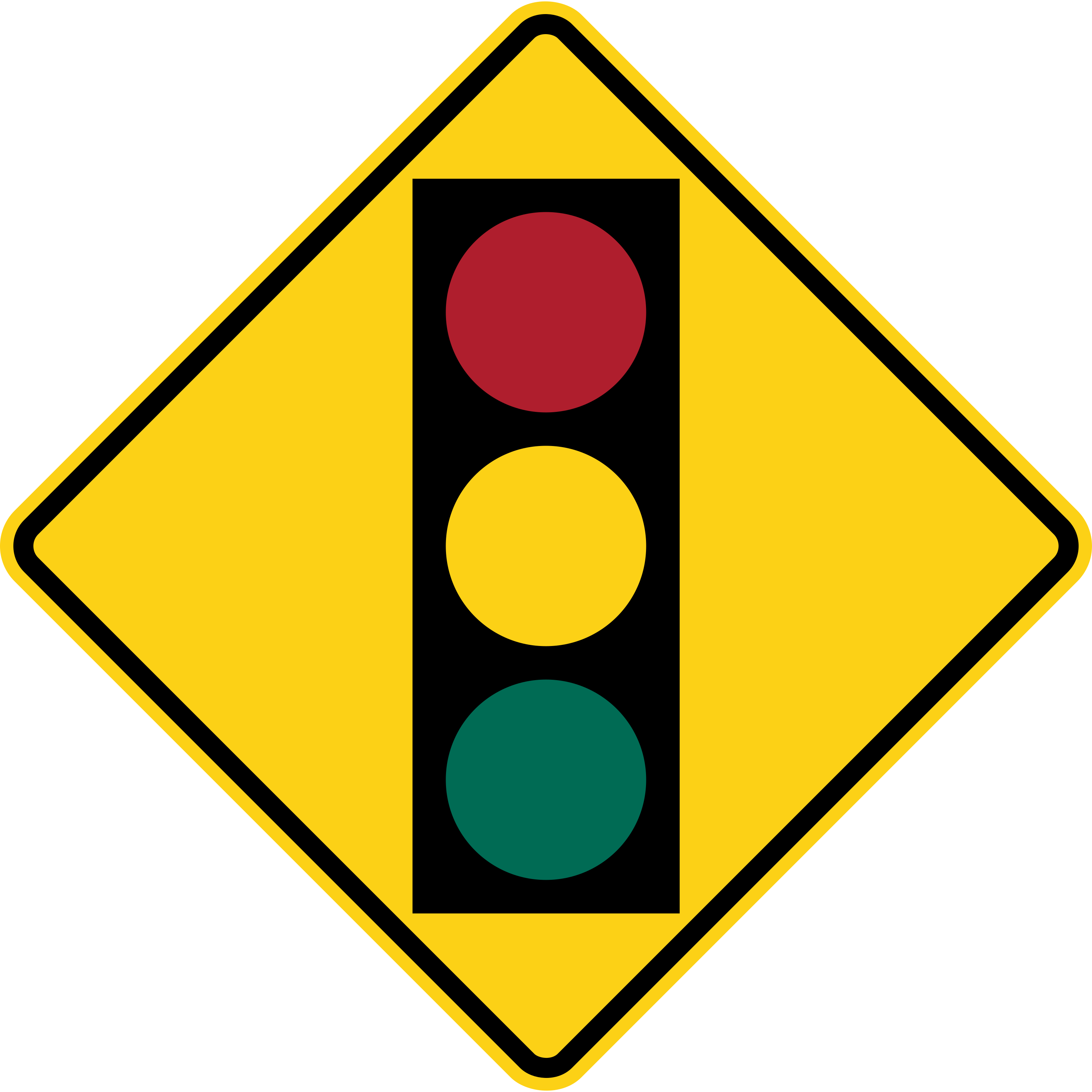
- A special situation or hazard is ahead
- The roadway is guaranteed to be clear
- All traffic must turn around
- The posted speed no longer applies
Show answer
A special situation or hazard is ahead. The manual says a warning sign indicates that a special situation or hazard is ahead. It is an advance alert, not a guarantee that the road is clear and not an order to turn around. A warning also does not cancel a posted speed limit or other regulatory instruction. Use the extra notice to scan farther ahead, reduce speed when needed, and prepare for a change in lane use, traffic control, surface, or crossing activity.
Study this in the handbook: Traffic signals and arrows
19. Who must go through New Mexico's graduated driver license system?
- Drivers under the age of 18, until they meet the unrestricted license requirements
- Every new driver, regardless of age
- Only drivers under 16
- Only drivers who fail the road test
Show answer
Drivers under the age of 18, until they meet the unrestricted license requirements. New Mexico requires anyone under 18 to participate in the graduated driver license system until they qualify for an unrestricted license. The system has three levels: instructional permit, provisional license, and unrestricted license. It is keyed to age under 18, so saying every new driver must go through it overstates the rule. Limiting it to drivers under 16 leaves out 16 and 17 year olds. Failing a road test has nothing to do with who is placed in the system.
Study this in the handbook: Permits and the graduated license
20. What are drivers responsible for checking when they park?
- That the vehicle is parked against traffic
- That the vehicle is left with its engine running
- That the vehicle is not a hazard
- That the vehicle blocks the nearest driveway
Show answer
That the vehicle is not a hazard. New Mexico places responsibility on the driver to make sure a parked vehicle is not a hazard. That means choosing a position that does not interfere with moving traffic and remains visible to approaching road users. Leaving the engine running does not make an unsafe position acceptable, and parking against traffic can create a separate problem. Blocking a driveway interferes with access rather than protecting it. Before walking away, check the vehicle's distance from traffic, its visibility, and whether it obstructs a lane, entrance, or crossing.
Study this in the handbook: Parking rules and no parking zones
QualitySpace is expanding to New Mexico
We are a California-based independent insurance brokerage working on licensing in more states. We cannot help with New Mexico insurance yet. Leave your email and we will let you know when we can.
Every question is written from the official New Mexico Driver Manual. Need paper? Printable NM practice test with answer key.
Last verified 2026-10-05. How we check every question · Study all 208 as flashcards
Frequently asked questions
How many questions are on this New Mexico practice test?
This fixed set has 20 questions. It is test 10 of 10 from the 208 question New Mexico bank.
How does this fixed test relate to the full New Mexico bank?
Each numbered test is a fixed set of questions in a fixed order, so you can retake the same test later and compare. Every test mixes road signs and the other topics in about the same proportion as the full bank. Tests 1 to 10 together cover 200 of the 208 questions in the New Mexico bank, each once. The full practice page mixes the whole bank at random.
Last verified 2026-10-05. See the New Mexico DMV facts page for sourced state details.
Return to the full New Mexico practice test · Study road signs