
Key points
Park far enough from any travel lane to avoid interfering with traffic, where vehicles from both directions can see you.
Source: Handbook p. 13
“be sure it is in a place that is (1) far enough from any travel lane to avoid interfering with traffic and (2) visible to vehicles approaching from either direction.”
New Mexico Driver Manual, Handbook p. 13Always set the parking brake and leave the car in park, or in gear with a manual transmission.
Source: Handbook p. 13
“Always set your parking brake when you park. Leave the vehicle in gear if it has a manual transmission or in “park” if it has an automatic transmission.”
New Mexico Driver Manual, Handbook p. 13On a hill, turn your wheels sharply toward the side of the road or curb so the car rolls away from traffic.
Source: Handbook p. 13
“When you park on a hill, turn your wheels sharply towards the side of the road or curb. This way, if your vehicle starts to roll downhill, it will roll away from traffic.”
New Mexico Driver Manual, Handbook p. 13Do not park within 30 feet of a traffic signal, stop sign or yield sign, or within 25 feet of a crosswalk at an intersection.
Source: Handbook p. 13
“within 30 ft. of a traffic signal, stop sign or yield sign, within 25 ft. of a crosswalk at an intersection,”
New Mexico Driver Manual, Handbook p. 13Do not park within 50 feet of a fire hydrant or a railroad crossing.
Source: Handbook p. 13
“within 50 ft. of a fire hydrant, within 50 ft. of a railroad crossing,”
New Mexico Driver Manual, Handbook p. 13Do not park more than 18 inches from the curb.
Source: Handbook p. 13
“more than 18 in. from the curb,”
New Mexico Driver Manual, Handbook p. 13Stay 20 feet from a fire station driveway on the same side, or 75 feet on the other side of the street.
Source: Handbook p. 13
“within 20 ft. of a fire station driveway on the same side of the street or within 75 ft. of a driveway on the other side of the street,”
New Mexico Driver Manual, Handbook p. 13Curb colors: white for short stops, yellow for loading or other limits, red for a fire zone, blue for handicap parking.
Source: Handbook p. 14
“white indicates that only short stops are permitted, yellow indicates a loading zone or some other restriction. red indicates a fire zone with no parking or standing permitted. blue indicates handicap parking only.”
New Mexico Driver Manual, Handbook p. 14
Numbers to know
| Number | What it means | Manual |
|---|---|---|
| 30 feet | from a traffic signal, stop sign or yield sign | Handbook p. 13 |
| 25 feet | from a crosswalk at an intersection | Handbook p. 13 |
| 50 feet | from a fire hydrant or a railroad crossing | Handbook p. 13 |
| 18 inches | farthest you may park from the curb | Handbook p. 13 |
| 20 feet | from a fire station driveway on the same side | Handbook p. 13 |
| 75 feet | from a fire station driveway across the street | Handbook p. 13 |
Recognize these signs
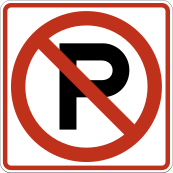
No parking 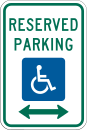
Handicap parking
3 questions from the New Mexico practice test
1. What are drivers responsible for checking when they park?
- That the vehicle is parked against traffic
- That the vehicle is left with its engine running
- That the vehicle is not a hazard
- That the vehicle blocks the nearest driveway
Show answer
That the vehicle is not a hazard. New Mexico places responsibility on the driver to make sure a parked vehicle is not a hazard. That means choosing a position that does not interfere with moving traffic and remains visible to approaching road users. Leaving the engine running does not make an unsafe position acceptable, and parking against traffic can create a separate problem. Blocking a driveway interferes with access rather than protecting it. Before walking away, check the vehicle's distance from traffic, its visibility, and whether it obstructs a lane, entrance, or crossing.
2. How far from a travel lane should a driver park when possible?
- Close enough to occupy part of the travel lane
- Far enough away to avoid interfering with traffic
- Only one foot from moving traffic
- On the lane line whenever the shoulder is clear
Show answer
Far enough away to avoid interfering with traffic. The parking guidance calls for enough separation from a travel lane that the parked vehicle does not interfere with traffic. A vehicle partly occupying the lane can force approaching drivers to swerve or stop, while a fixed one-foot rule is not the manual's standard. The lane line is a boundary, not a parking target. Select a place that leaves moving traffic a clear path, then check visibility from both directions. This principle applies even when no curb color or temporary sign supplies a more specific restriction.
3. What does a red-painted curb indicate in New Mexico?
- A place where only short stops are permitted
- A fire zone where parking or standing is not permitted
- A loading zone for any vehicle at any time
- Handicap parking reserved for vehicles without permits
Show answer
A fire zone where parking or standing is not permitted. A red-painted curb marks a fire zone where parking or standing is not permitted. The short-stop rule belongs to a white curb, while a yellow curb indicates a loading zone or another restriction. Blue curb markings identify handicap parking only, subject to the required plate, tag, or sticker. Treat the red marking as a keep-clear area for emergency access. Do not pull over there simply because the stop will be brief, and do not confuse curb color with permission to wait in the vehicle.
Practice this topic
Lock it in with parking questions from the free New Mexico practice test. Every answer comes with a plain English explanation.
Source: the New Mexico Driver Manual, Rules of the Road. This lesson is a plain English summary, not the law itself; where it differs, the manual and the statute govern. Last checked 2026-09-27.