
Test 8 of 10 · 20 questions · Free 2026
ND Permit Practice Test 8
Jump to the test ↓A fixed 20 question set from the North Dakota bank with answers and plain English explanations.
Question 1 of 20 · 0 right so far
All 20 questions in test 8
Every question below comes from the North Dakota question bank on this page. Open a question to see the correct answer and the explanation. Nothing here is hidden behind a signup.
1. What is the maximum speed when approaching a railway crossing where the view of the track is obstructed?
- 45 miles per hour unless otherwise posted
- 25 miles per hour unless otherwise posted
- 20 miles per hour unless otherwise posted
- 55 miles per hour unless otherwise posted
Show answer
20 miles per hour unless otherwise posted. When the driver's view of a railway crossing is obstructed, the maximum approach speed is 20 miles per hour unless another speed is posted. The 25 mile choice belongs to a business or residential district, while the higher numbers fit open roadway categories rather than this limited view. Reduce speed early enough to see the crossing and stop if needed. The visual obstruction is the cue that activates this special limit.
Study this in the handbook: North Dakota speed limits
2. Unless otherwise posted, what is the maximum speed on a paved and divided multi-lane highway in North Dakota?
- 55 miles per hour on a paved and divided multi-lane highway
- 70 miles per hour on a paved and divided multi-lane highway
- 65 miles per hour on a paved and divided multi-lane highway
- 80 miles per hour on a paved and divided multi-lane highway
Show answer
70 miles per hour on a paved and divided multi-lane highway. The listed maximum for a paved and divided multi-lane highway is 70 miles per hour unless a different limit is posted. The nearby figures apply to different road types: 55 for certain gravel, dirt, loose-surface, and unposted county or township roads; 65 for rural paved two-lane highways when posted; and 80 for rural Interstate highways. Identify the road design before selecting a number, and remember that conditions can require a slower speed than the maximum.
Study this in the handbook: Right of way rules
3. What does a warning sign for a turn or sharp turn tell you to do?

- Pass any vehicle traveling more slowly
- Maintain speed until the turn is over
- Use the shoulder to straighten the path
- Reduce speed before entering the turn
Show answer
Reduce speed before entering the turn. A turn warning identifies a change in roadway direction that deserves extra preparation. The manual says these signs give you time to reduce your speed before you enter the curve or turn, so slow down early and keep the vehicle under control. Maintaining speed ignores the caution, using the shoulder is unsafe, and the sign says nothing about passing. These signs are often supplemented with an advisory speed sign showing the maximum recommended speed to negotiate the turn.
Study this in the handbook: Warning, school and work zone signs
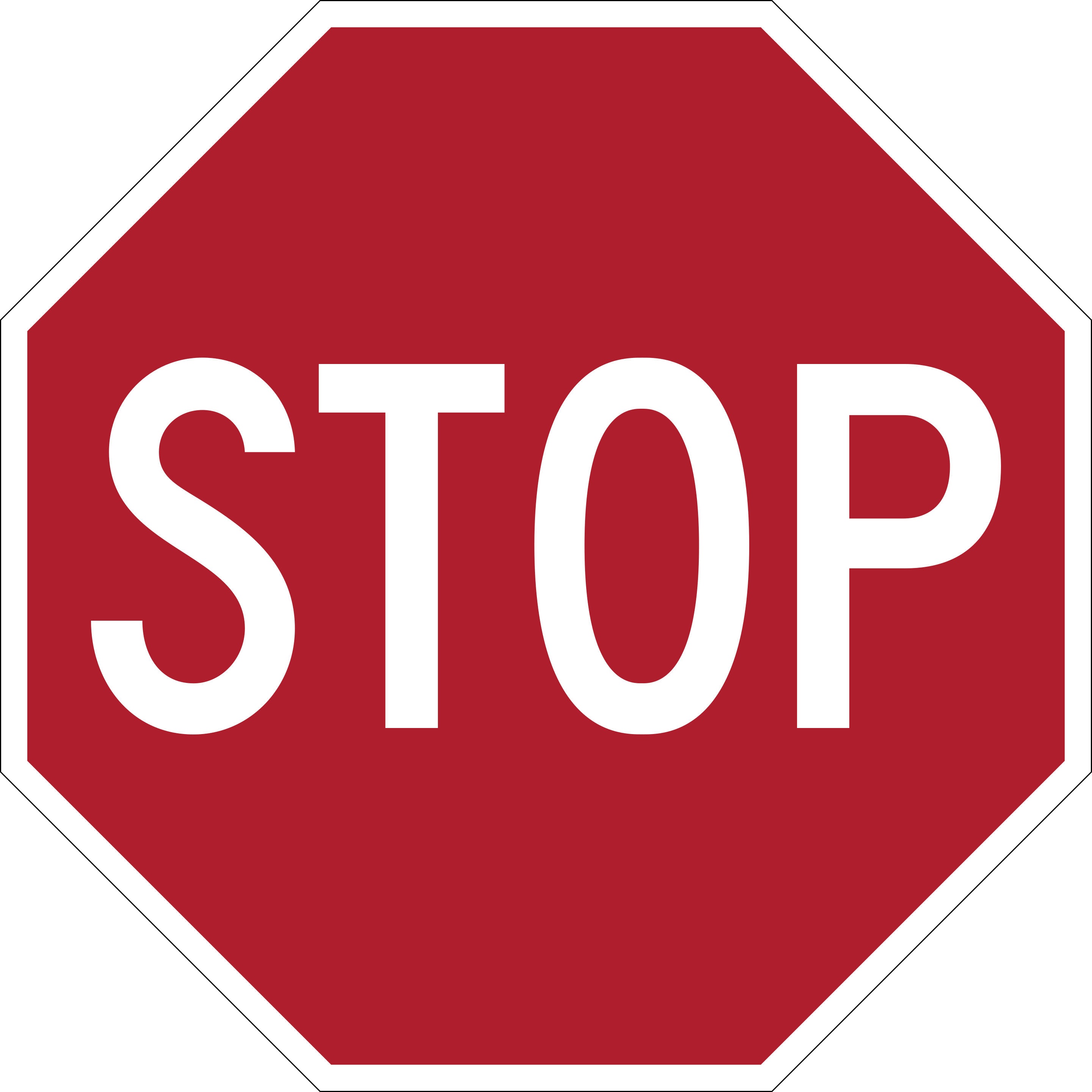
4. At this stop sign, where must you bring the vehicle to a complete stop?
- Only after the front wheels pass the crosswalk
- After entering the intersection so cross traffic can see you
- At the far side of the intersection
- Before the stop line or crosswalk area
Show answer
Before the stop line or crosswalk area. The Stop sign tells you that you must come to a complete stop before the stop line or crosswalk area. If neither is present, stop as near as possible before the intersection where you can safely see traffic approaching from all directions. Stopping after entering the intersection, beyond the crosswalk, or on the far side places the vehicle where crossing traffic and pedestrians move. Use the stop line or crosswalk as the cue for your stopping position.
Study this in the handbook: Regulatory and guide signs
5. A North Dakota driver commits a third DUI offense within seven years with an alcohol concentration of .18 or greater. How long is the license suspended?
- 91 days
- Three years
- Two years
- One year
Show answer
Three years. For a third and subsequent offense in seven years, North Dakota suspends the license for two years, or three years when the alcohol concentration is .18 or greater. The same two year period applies to a second offense with an AC of .18 or greater. Ninety-one days is the first offense suspension, and one year is the standard second offense period.
Study this in the handbook: Alcohol, BAC and implied consent
6. A North Dakota driver under 18 wants to use a phone while driving. Which situation is an allowed exception?
- Getting emergency assistance or preventing a crime about to be committed
- Reading a text at a red light
- Calling a friend with a hands-free headset
- Sending a message on an empty road
Show answer
Getting emergency assistance or preventing a crime about to be committed. Permit holders of any age and licensed drivers under 18 may not use electronic communication devices to talk, compose, read, or send messages while driving. The only exceptions are to get emergency assistance, to prevent a crime that appears about to be committed, or when an individual's life or safety is reasonably believed to be in danger. Hands-free calls, reading at a red light, and messages on empty roads are all still prohibited.
Study this in the handbook: Instruction permits and licenses for minors
7. What is the North Dakota fine for a second uninsured vehicle violation within three years?
- $150
- $300
- $500
- $1,000
Show answer
$300. Operating an uninsured motor vehicle in North Dakota is fined $150 for a first violation and $300 for a second or later violation within three years, and it may lead to a license suspension. A person convicted of No Liability Insurance must also provide proof of insurance for one year and buy a restricted duplicate license. The $500 figure is the littering fine, and $1,000 is the maximum fine for driving while suspended after an alcohol violation.
Study this in the handbook: Residency, license classes and insurance
8. A police officer is directing traffic at a crash scene. Whose directions must a driver follow?
- A road sign that directs traffic around the crash
- The nearest traffic signal, even when the officer signals something different
- The route chosen by the driver before reaching the scene
- The police officer's instructions at the scene
Show answer
The police officer's instructions at the scene. At a crash scene, an officer may direct traffic around hazards and changing road conditions. The manual specifically requires drivers to obey the officer's instructions when an officer is directing traffic at the scene. A road sign, a nearby traffic signal, or the route you planned before arriving cannot override a different command from the officer. Slow down as you approach, watch the officer's position and hand signals, and make only the movement indicated, even if it differs from what the signs or signals would normally require.
Study this in the handbook: Right of way rules
9. At a flashing red signal, what must happen before your vehicle proceeds?
- Stop, then proceed when the intersection is clear of pedestrians and vehicles
- Slow to walking speed and continue without stopping
- Yield only to vehicles approaching from the left
- Wait for the signal to become a steady green light
Show answer
Stop, then proceed when the intersection is clear of pedestrians and vehicles. North Dakota treats a flashing red indication like a stop sign. Bring the vehicle to a complete stop, then check for pedestrians and vehicles before moving. The choice about slowing without stopping misses the required action, while waiting for steady green would unnecessarily hold traffic because the signal permits movement after the stop and a clear intersection. A useful cue is to read the red flash as STOP first, then look in every direction before entering.
Study this in the handbook: Traffic signals and arrows
10. Where are applications for a North Dakota operator’s license or permit made?
- The Department of Health
- The Department of Public Instruction
- The Highway Patrol only
- The Driver License Division of the Department of Transportation
Show answer
The Driver License Division of the Department of Transportation. Applications for a North Dakota operator’s license or permit are made with the Driver License Division of the Department of Transportation. The Department of Public Instruction is associated with driver education certificates, but it is not the licensing office named for applications. The Highway Patrol and Department of Health have different public roles and do not replace the licensing division. On a permit or license question, identify the agency that receives the application rather than an agency involved in training, enforcement, or health records.
Study this in the handbook: Instruction permits and licenses for minors
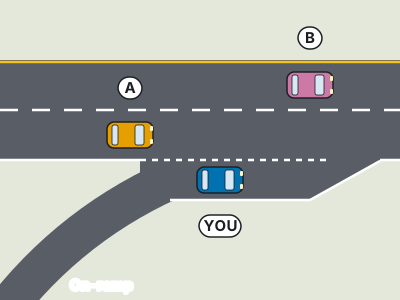
11. Who has the right of way when a vehicle enters a freeway from an entrance ramp?
- Vehicles already on the main roadway
- The vehicle entering from the ramp
- The vehicle with the faster acceleration
- The vehicle that signals first
Show answer
Vehicles already on the main roadway. Unless signs say otherwise, traffic entering a freeway from an entrance ramp must yield to vehicles already on the main roadway. The ramp gives the entering driver space to adjust speed and find a safe opening, but it does not grant priority. Acceleration, signaling, and arrival order do not replace the yield rule. Match your speed to the available gap, watch the main roadway, and merge only when the movement is safe.
Study this in the handbook: Right of way rules
12. Even though North Dakota vehicles have electric turn and brake lights, what does the manual say drivers should still know?
- How to rewire a brake light
- The basic hand signals
- The Morse code for stop
- Nothing beyond the electric signals
Show answer
The basic hand signals. Even though vehicles are equipped with electrical turn and brake lights, the manual says every driver should know the basic hand signals as well. The same section says all turn signals must be given continuously during the last 100 feet before the turn, and that motorists must recognize hand signals given by motorcyclists and bicyclists and give them enough space to complete the signaled move. Rewiring a light or Morse code is not what the manual asks, and treating the electric signals as the whole story leaves you unable to read a rider's arm signals.
Study this in the handbook: Pavement markings and passing
13. For a driver who is 21 or older, what alcohol concentration makes the driver legally under the influence?
- 0.05 percent or greater
- 0.02 percent or greater
- 0.08 percent or greater
- 0.16 percent only
Show answer
0.08 percent or greater. For drivers at least 21, the manual uses 0.08 percent or greater as the alcohol concentration threshold for being legally under the influence. The 0.02 percent figure applies to a driver under 21, so using it for an adult changes the age condition. The 0.05 choice is not the stated threshold, and 0.16 is tied to a separate penalty level. Keep the age qualifier attached to the number when recalling this rule.
Study this in the handbook: Alcohol, BAC and implied consent
14. How far may a fully loaded tractor trailer need to stop on dry pavement, according to the North Dakota manual?
- About 100 feet
- About 200 feet
- More than 400 feet, longer than a football field
- About 50 feet
Show answer
More than 400 feet, longer than a football field. Tractor trailers take longer to stop than a car traveling at the same speed, and a fully loaded tractor trailer may take more than 400 feet on dry pavement to come to a complete stop, more than the length of a football field. Never cut in front of a truck and brake, and stay out of the blind spots on its sides and rear so the driver can take evasive action.
Study this in the handbook: Trucks, motorcycles, bicycles and pedestrians
15. Who suffers most work zone fatalities, according to the North Dakota manual?
- Travelers, who account for 98 percent of work zone deaths
- Flaggers
- Road workers in nearly every case
- Equipment operators
Show answer
Travelers, who account for 98 percent of work zone deaths. Over 25,000 serious injuries occur nationally in work zones each year, and 98 percent of work zone fatalities are travelers, meaning motorists and passengers suffer most of the casualties. The manual reminds drivers that workers are just inches away from traffic, that work zones can appear at any time of day, and that many work zone crashes in the summer months are related to excessive speed. Slow down, watch for the orange signs, and expect a work zone whenever the signs appear, not only during business hours.
Study this in the handbook: Regulatory and guide signs
16. If your headlights suddenly fail while driving, what should you do first?
- Turn off every remaining light and continue normally
- Accelerate until another driver notices you
- Try the parking lights and turn signals, then leave the roadway after slowing
- Stop immediately in the travel lane without slowing
Show answer
Try the parking lights and turn signals, then leave the roadway after slowing. A sudden headlight failure reduces your visibility and makes it harder for others to see you. Trying the parking lights and turn signals may restore some warning and lighting, and leaving the roadway after slowing removes the disabled vehicle from moving traffic. Accelerating increases danger, while turning off the remaining lights removes useful visibility. Stopping instantly in the lane can create a collision risk. Slow down under control, use whatever lights still work, and get safely off the road.
Study this in the handbook: Points, texting and other penalties
17. What do green direction signs tell drivers?
- That a road is slippery when wet
- That passing is prohibited immediately
- The direction of and distance to a destination
- That a hospital is the only nearby service
Show answer
The direction of and distance to a destination. Direction signs use white letters on a green background to identify the direction of and distance to a destination. They can also provide information about junctions and routes. A no passing restriction and a slippery road warning are different sign messages. A hospital is shown on a service sign, which uses white symbols on a blue background, not on a green direction sign. Read the destination and route information, then make lane decisions early enough to reach the indicated junction safely.
Study this in the handbook: Regulatory and guide signs
18. What does the round yellow railroad advance warning sign tell you?
- A school crossing is immediately open
- A railroad crossing is nearing
- A construction lane must be entered
- A hospital is located on the next block
Show answer
A railroad crossing is nearing. The round yellow railroad advance warning sign means a railroad crossing is ahead. It calls for slower approach and readiness to stop if a train is coming. A school, construction, or hospital message uses different sign meanings and does not explain this circular symbol. Treat the warning as an early search cue: look for the crossing devices, listen for a train, and make sure the tracks are clear before proceeding. Never let the familiar road pattern replace that check.
Study this in the handbook: Warning, school and work zone signs
19. How much following distance may sometimes be needed when conditions call for extra space?
- No following distance if traffic is light
- One second or less
- Exactly two seconds
- Four or more seconds
Show answer
Four or more seconds. The manual says that sometimes a driver needs as much as four or more seconds of following distance. The three-second rule is a baseline cushion, while additional space helps when traction, visibility, vehicle size, load, or surrounding traffic increases the time needed to react. One second is too little for those conditions, and light traffic does not erase the need for a safe gap. Treat the time count as a way to create room, not as permission to follow closely.
Study this in the handbook: Following distance, lane changes and headlights
20. A 15-year-old in North Dakota holds a restricted Class D license. At 10:30 p.m. on a trip that is not for work, school, or religion, who must be in the vehicle?
- A parent, legal guardian, or an individual at least 18 years of age
- No one; restricted licenses have no curfew
- Any licensed friend of any age
- Only a certified instructor
Show answer
A parent, legal guardian, or an individual at least 18 years of age. At age 15 with a restricted Class D license, the driver may not operate a vehicle without a parent, legal guardian, or an individual at least 18 years of age between the later of sunset or 9:00 p.m. and 5:00 a.m. The only exceptions are driving directly to or from work, an official school activity, or a religious activity. A friend under 18 does not qualify, and no instructor is required. The restriction ends when the license becomes unrestricted at 16.
Study this in the handbook: Instruction permits and licenses for minors
QualitySpace is expanding to North Dakota
We are a California-based independent insurance brokerage working on licensing in more states. We cannot help with North Dakota insurance yet. Leave your email and we will let you know when we can.
Every question is written from the official North Dakota Noncommercial Driver License Manual. Need paper? Printable ND practice test with answer key.
Last verified 2026-10-05. How we check every question · Study all 205 as flashcards
Frequently asked questions
How many questions are on this North Dakota practice test?
This fixed set has 20 questions. It is test 8 of 10 from the 205 question North Dakota bank.
How does this fixed test relate to the full North Dakota bank?
Each numbered test is a fixed set of questions in a fixed order, so you can retake the same test later and compare. Every test mixes road signs and the other topics in about the same proportion as the full bank. Tests 1 to 10 together cover 200 of the 205 questions in the North Dakota bank, each once. The full practice page mixes the whole bank at random.
Last verified 2026-10-05. See the North Dakota DMV facts page for sourced state details.
Return to the full North Dakota practice test · Study road signs