
Test 7 of 10 · 20 questions · Free 2026
ND Permit Practice Test 7
Jump to the test ↓A fixed 20 question set from the North Dakota bank with answers and plain English explanations.
Question 1 of 20 · 0 right so far
All 20 questions in test 7
Every question below comes from the North Dakota question bank on this page. Open a question to see the correct answer and the explanation. Nothing here is hidden behind a signup.
1. What is the North Dakota penalty for distracted driving, such as texting or losing control due to an unnecessary activity?
- $25 and one point
- $500 fine
- $250 fine
- $100 fine
Show answer
$100 fine. North Dakota's distracted driving rule covers texting and failing to maintain control because of an activity not necessary to operate the vehicle that impairs, or would reasonably be expected to impair, safe driving. The penalty is a $100 fine. Twenty-five dollars and one point is the child restraint penalty, $250 is for entering a closed road, and $500 is for littering on a public highway.
Study this in the handbook: Points, texting and other penalties
2. What license does a restricted Class D operator's license become when the holder reaches age 16?
- A temporary instruction permit
- A motorcycle permit
- An unrestricted operator's license
- A commercial driver license
Show answer
An unrestricted operator's license. North Dakota removes the restricted Class D stage at age 16 by transitioning that license to an unrestricted operator's license. It is not a motorcycle permit, because that credential covers a different vehicle class. Nor does the driver return to an instruction permit or qualify for a commercial license through this age change. The practical cue is simple: the birthday at issue is the transition point from the minor restricted license to ordinary unrestricted driving privileges.
Study this in the handbook: Instruction permits and licenses for minors
3. After a North Dakota DUI conviction, what insurance proof does the law require?
- Proof of financial responsibility through SR 22 insurance coverage
- A new vehicle title from the county auditor
- A commercial vehicle permit
- A medical examination certificate
Show answer
Proof of financial responsibility through SR 22 insurance coverage. A person who refuses an alcohol concentration test or is convicted of a DUI must show proof of financial responsibility through SR 22 insurance coverage. The title, commercial permit, and medical certificate choices address unrelated paperwork and do not satisfy this post conviction insurance requirement. Keep the trigger in mind: either refusal or conviction activates the proof requirement. The practical cue is SR 22, which identifies the special financial responsibility filing rather than ordinary insurance paperwork.
Study this in the handbook: Trucks, motorcycles, bicycles and pedestrians
4. Before entering a roundabout, whom must you yield to?
- Only vehicles approaching from behind
- Pedestrians, bicyclists, and traffic already circulating
- No one, because entering traffic has priority
- Only trucks using the center island apron
Show answer
Pedestrians, bicyclists, and traffic already circulating. The manual's roundabout steps tell you to reduce your speed, yield to pedestrians and bicyclists, and yield to circulating traffic when entering the roundabout. Vehicles already in the circle travel counter-clockwise around the center island, and entering drivers do not gain priority merely by arriving at the entry. The duty is not limited to trucks or to traffic behind you. Search the crosswalk and the circle for a safe gap, then enter and stay in your lane.
Study this in the handbook: Right of way rules
5. What should you do when passing a stranded vehicle with flashing hazard lights on a multilane highway?
- Stay beside it at the same speed to provide assistance
- Move safely to the lane not adjacent to it, or slow down if that is the only safe lane
- Stop directly behind it in the travel lane
- Pass on the shoulder without changing speed
Show answer
Move safely to the lane not adjacent to it, or slow down if that is the only safe lane. North Dakota’s Move Over guidance calls for yielding and moving to a lane that is not adjacent to the stranded vehicle when that can be done safely. If the adjacent lane is the only lane available for a safe move, proceed with caution and reduce speed. Staying alongside, stopping in the travel lane, or using the shoulder creates additional danger and does not provide the protected space intended by the rule. Look well ahead for hazard lights, signal early, and make the lane decision before reaching the stopped vehicle.
Study this in the handbook: Move over and crash reporting
6. At an uncontrolled T-intersection, who must yield?
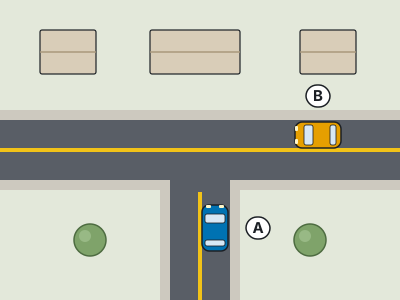
- The vehicle on the terminating street
- The vehicle on the continuing street
- The vehicle that reaches the center first
- The vehicle traveling at the lower speed only
Show answer
The vehicle on the terminating street. At a T-intersection, the road that ends has a vehicle entering the continuing roadway, so that vehicle must yield to traffic already using the continuing street. The continuing-street choice reverses the assigned responsibility. Reaching the center first is not a substitute for yielding, and speed alone does not decide this situation. Look for the roadway that stops rather than continues through, slow before entering, and wait until the through traffic has passed before crossing or turning onto it.
Study this in the handbook: Right of way rules
7. Which color pattern is common on regulatory signs?
- Orange with blue letters
- White with black letters or red with white letters
- Yellow with green letters only
- Brown with white letters only
Show answer
White with black letters or red with white letters. Regulatory signs commonly use white with black letters or red with white letters. Their appearance supports the mandatory traffic instruction, such as stopping, yielding, or obeying a posted limit. Orange belongs mainly to work-area signs, while yellow is associated with warnings rather than the stated regulatory pattern. Brown is used for a different sign purpose. When scanning ahead, combine the sign color with its message and obey the instruction it presents.
Study this in the handbook: Regulatory and guide signs
8. When do teen drivers show the greatest improvement, according to the North Dakota manual?
- After 10 years
- In the first 1,000 to 5,000 miles of driving
- Only after a crash
- In the first 100 miles
Show answer
In the first 1,000 to 5,000 miles of driving. Teens will show the greatest improvement in the first 1,000 to 5,000 miles of driving, and the manual says new drivers need a lot of practice to handle daily hazards and unexpected situations. Its tips for each practice session are to practice when both of you are ready, in good moods, and well rested, and to adjust mirrors, seat belts, seats, and steering wheel position before starting. It also urges extensive practice in varied types of weather. Ten years, the first 100 miles, or only after a crash do not match the stated range.
9. If the accelerator pedal sticks, which response follows the manual?
- Brake hard while keeping the transmission in drive
- Turn the ignition to the lock position while moving
- Pump the accelerator until it releases
- Depress the clutch or shift into neutral
Show answer
Depress the clutch or shift into neutral. A stuck accelerator can keep the vehicle powered when the driver needs to slow down. Depressing the clutch or shifting into neutral separates engine power from the driven wheels and gives you a chance to control the vehicle. The lock-position choice is dangerous because the steering can lock while the vehicle is moving. Pumping the pedal may not release the fault, and braking without addressing the power may make control harder. Once neutral is selected, steer toward a safe roadside location and stop.
Study this in the handbook: Skids, blowouts, equipment failure and railroad crossings
10. A child is younger than eight and shorter than 57 inches. How must the child be secured in a vehicle?
- With no restraint when seated in back
- With a lap belt only
- With an adult passenger's seat belt
- With a child restraint such as a car seat or booster seat
Show answer
With a child restraint such as a car seat or booster seat. A North Dakota child under eight must be properly secured in a child restraint, such as a car seat or booster seat, when the child is below 57 inches tall. The seat-belt substitution applies only when a child is at least 57 inches tall, so the lap-belt-only option changes the height condition. An adult passenger cannot replace the required restraint, and the back seat does not create an exemption. Keep the child restraint installed and used according to its manufacturer instructions. The violation carries a $25 penalty and one point against the driver's license.
Study this in the handbook: Seat belts, child seats and heatstroke
11. What roadway feature is represented by this winding warning symbol?

- A bridge that opens for boats
- A lane reserved for bicycles
- Curves or turns in the road
- A railroad crossing immediately ahead
Show answer
Curves or turns in the road. The warning signs shown indicate curves or turns in the road. They provide advance notice so a driver has time to reduce speed before entering the curve or turn. The symbol does not designate a bicycle lane, movable bridge, or railroad crossing, each of which has its own warning or regulatory treatment. Read the winding shape as a cue to manage speed early and keep the vehicle controlled through the entire sequence of bends.
Study this in the handbook: Warning, school and work zone signs
12. What fine applies for entering a North Dakota road that is officially closed because of hazardous conditions?
- $100
- $1,000
- $500
- $250
Show answer
$250. Under the manual's winter driving rules, it is not legal to enter a road that is officially closed due to hazardous conditions, and the penalty is a $250 fine. The larger $500 amount is the littering fine on a public highway, while the other choices are not the closed road penalty. Treat the official closure as the key condition: the rule addresses entering the closed roadway, not driving slowly on an open route in bad weather.
Study this in the handbook: Points, texting and other penalties
13. What does a warning about fewer traffic lanes require you to do?

- Move safely into the proper remaining lane
- Accelerate on the shoulder until the lane returns
- Stay in the ending lane and force others to stop
- Reverse to the previous intersection
Show answer
Move safely into the proper remaining lane. A lane-reduction warning means fewer traffic lanes are ahead, so the driver should move safely into the proper remaining lane. Accelerating along the shoulder creates a separate hazard and does not preserve lawful lane use. Staying in a lane that ends can force a conflict with neighboring traffic, while reversing is dangerous and unnecessary. Check mirrors, signal as appropriate, choose a safe gap, and merge with patience. The central visual cue is the narrowing roadway, which calls for an orderly lane change before the lane disappears.
Study this in the handbook: Warning, school and work zone signs
14. What is the maximum speed for a rural Interstate highway unless another speed is posted?
- 80 miles per hour
- 70 miles per hour
- 65 miles per hour
- 50 miles per hour
Show answer
80 miles per hour. North Dakota lists 80 miles per hour as the maximum on rural Interstate highways unless a different speed is posted. The 70 mile figure belongs to paved and divided multilane highways, while 65 applies to a rural paved two lane highway only when posted. The 55 mile figure covers gravel, dirt, loose surface roads and certain unposted county or township roads. Identify the road type before selecting the number.
Study this in the handbook: North Dakota speed limits
15. How close to an intersection does North Dakota prohibit passing?
- Passing is permitted up to the stop line if the road is clear
- Within 25 feet of an intersection
- Within 200 feet of an intersection only at night
- Within 100 feet of an intersection
Show answer
Within 100 feet of an intersection. The manual places intersections among the locations where a driver must never pass and gives a 100 foot boundary. The restriction also covers railroad crossings and tunnels. A 25 foot distance is not the stated rule, and the 200 foot choice combines an unrelated passing guideline with a nighttime condition that does not appear here. Check the distance before beginning a pass, since a clear view alone does not remove the location-based prohibition.
Study this in the handbook: Pavement markings and passing
16. How should you treat an intersection when its traffic signals are dark?
- Continue through because no indication is displayed
- Stop and yield the right of way to any vehicle in the intersection
- Treat the roadway with more lanes as automatically favored
- Wait for a police officer before making any movement
Show answer
Stop and yield the right of way to any vehicle in the intersection. Dark signals, such as during a power outage, do not remove the driver’s duty to control the approach. Stop and yield the right of way to any vehicle already in the intersection. Continuing merely because the lamps are off risks entering against traffic, and lane count does not create a special priority in the manual’s rule. You also do not need to wait for an officer if the intersection can be handled safely. Treat the unlit signal as a stop and yield situation, then proceed carefully.
Study this in the handbook: Traffic signals and arrows
17. According to the North Dakota manual, which drinks contain about the same alcohol?
- A beer has far less than a glass of wine
- A shot has ten times the alcohol of a beer
- A 12 ounce beer, a 4 ounce glass of wine and a 1 ounce glass of whiskey
- Wine has the least of the three
Show answer
A 12 ounce beer, a 4 ounce glass of wine and a 1 ounce glass of whiskey. In the average drink the alcohol content is about the same whether it is a 12 ounce can of beer, a 4 ounce glass of wine, or a 1 ounce glass of scotch or whiskey. Mixed drinks at home or at a party vary a great deal and tend to be stronger. How much you drink and over what period of time determine your blood alcohol, and only time brings it down.
Study this in the handbook: Seat belts, child seats and heatstroke
18. At night, within what distance must you dim your headlights when following another vehicle?
- Within 200 feet
- Within 100 feet
- Within 300 feet
- Within 500 feet
Show answer
Within 300 feet. When following another vehicle at night, dim your headlights within 300 feet. The separate 500-foot figure applies before meeting oncoming traffic, so choosing 500 feet confuses two different situations. One hundred and 200 feet are shorter than the stated following distance and could leave the other driver facing glare too long. Watch the road ahead, switch to low beams in time, and remember that the goal is to avoid blinding the driver whose mirrors are reflecting your light.
Study this in the handbook: Following distance, lane changes and headlights
19. What does the sign below a railroad crossbuck tell you when more than one track is present?
- The number of tracks at the crossing
- The distance to the nearest track
- Whether the crossing is active or passive
- The direction from which trains usually approach
Show answer
The number of tracks at the crossing. A supplemental sign below a railroad crossbuck identifies how many tracks are at the crossing. That information matters because clearing one track does not prove that every track is clear. The sign does not give the distance to the nearest track, show whether the crossing is active or passive, or tell you which direction trains usually come from. The manual says to make sure all the tracks are clear and no trains are approaching before you cross, and never to stop or park on railroad tracks for any reason.
Study this in the handbook: Skids, blowouts, equipment failure and railroad crossings
20. What additional type of speed limit may North Dakota authorities post when needed for safe traffic movement?
- A speed limit that replaces every warning sign
- A speed limit applying only to motorcycles
- A minimum speed limit
- A speed limit that applies only during daylight
Show answer
A minimum speed limit. North Dakota may use minimum speed limits when a lower travel speed would interfere with safe movement of traffic. That is different from a motorcycle-only restriction, a rule that displaces warning signs, or a daylight-only number. The practical cue is to look for the word minimum and remember that it sets a floor, while an ordinary posted maximum sets a ceiling. Drivers must still respond to actual conditions around them.
Study this in the handbook: Right of way rules
QualitySpace is expanding to North Dakota
We are a California-based independent insurance brokerage working on licensing in more states. We cannot help with North Dakota insurance yet. Leave your email and we will let you know when we can.
Every question is written from the official North Dakota Noncommercial Driver License Manual. Need paper? Printable ND practice test with answer key.
Last verified 2026-10-05. How we check every question · Study all 205 as flashcards
Frequently asked questions
How many questions are on this North Dakota practice test?
This fixed set has 20 questions. It is test 7 of 10 from the 205 question North Dakota bank.
How does this fixed test relate to the full North Dakota bank?
Each numbered test is a fixed set of questions in a fixed order, so you can retake the same test later and compare. Every test mixes road signs and the other topics in about the same proportion as the full bank. Tests 1 to 10 together cover 200 of the 205 questions in the North Dakota bank, each once. The full practice page mixes the whole bank at random.
Last verified 2026-10-05. See the North Dakota DMV facts page for sourced state details.
Return to the full North Dakota practice test · Study road signs