
Test 11 of 25 · 20 questions · Free 2026
ND Permit Practice Test 11
Jump to the test ↓A fixed 20 question set from the North Dakota bank with answers and plain English explanations.
Question 1 of 20 · 0 right so far
All 20 questions in test 11
Every question below comes from the North Dakota question bank on this page. Open a question to see the correct answer and the explanation. Nothing here is hidden behind a signup.
1. What must a person have to operate a snowmobile on a highway right of way?
- A valid driver license or a snowmobile safety certificate
- Only a verbal okay from a parks officer
- A hunting license issued during that season
- Registration papers for the motor vehicle only
Show answer
A valid driver license or a snowmobile safety certificate. In order to operate a snowmobile on a highway right of way, you must have in your possession a valid driver's license or a snowmobile safety certificate issued by the North Dakota Parks and Recreation Department. Registration papers alone do not show the operator qualification the rule demands in hand. For complete minimum age information, the guidance points to the Parks and Recreation Department. Carry the credential with you rather than leaving it in the tow vehicle.
2. A rear tire goes flat while you are driving. How will the vehicle tend to behave?
- It will pull toward the side of the flat tire
- It will sway back and forth as you drive
- It will stop steering in both directions
- It will accelerate without throttle input
Show answer
It will sway back and forth as you drive. A flat rear tire will cause the vehicle to sway back and forth, unlike a front blowout, which pulls the vehicle in the direction of the blown tire. The sway warns you to regain control before braking. Grasp the steering wheel tightly and steer straight ahead, easing up on the accelerator. Do not brake until you have regained full control, then turn onto the shoulder when almost stopped.
Study this in the handbook: Points, texting and other penalties
3. What should a driver do when encountering a bicyclist?
- Reduce speed and give the bicyclist room.
- Sound the horn and pass without slowing.
- Move into the bicycle lane before passing.
- Follow closely until the bicyclist stops.
Show answer
Reduce speed and give the bicyclist room.. The bicycle-sharing guidance tells drivers to reduce speed when encountering bicyclists, recognize dangerous situations, and give the rider space. Sounding the horn and passing without slowing ignores that guidance. A driver should not move into a bicycle lane as a general passing method, and following closely removes the room a rider may need to react. The safest response begins by lowering speed and preserving space around the bicycle.
Study this in the handbook: Trucks, motorcycles, bicycles and pedestrians
4. Why must lap and shoulder belts always be used with an air bag?
- Because air bags only work at low speeds in town
- To keep the air bag from ever deploying
- Because belts charge the air bag system
- To protect occupants in side-impact and roll-over crashes
Show answer
To protect occupants in side-impact and roll-over crashes. Air bags provide supplemental protection for belted front-seat occupants in a frontal crash, and lap/shoulder belts must always be used in conjunction with an airbag to protect occupants in side-impact and roll-over crashes. An air bag alone cannot hold an occupant in place when the vehicle rolls or is struck from the side. Air bags work best when everyone is buckled. Children age 12 and younger should be properly restrained in the back seat.
Study this in the handbook: Points, texting and other penalties
5. A gasoline truck must stop at a railroad crossing. How far from the tracks must it stop?
- At least 100 feet before the railroad tracks
- Closer than 15 feet to the tracks
- Within 50 feet, but not less than 15 feet
- More than 50 feet before the tracks
Show answer
Within 50 feet, but not less than 15 feet. School buses, passenger buses, and vehicles carrying explosives or flammable liquids must stop within 50 feet and not less than 15 feet from the tracks. Stopping closer than 15 feet puts the vehicle too near a passing train, while stopping beyond 50 feet or 100 feet back does not meet the stated stopping zone. Drivers behind such a vehicle should expect the stop at every crossing and must not pass it while it is stopped there, even when no train can be seen yet.
Study this in the handbook: Skids, blowouts, equipment failure and railroad crossings
6. A driver doubles the vehicle weight with a heavy load. What happens to braking distance?
- It stays the same as before
- It drops to half the distance
- It grows by a small fixed amount
- It will double with the weight
Show answer
It will double with the weight. Doubling vehicle weight will double braking distance, just as doubling speed quadruples it. A heavy load does not leave stopping room unchanged, and weight never shortens the distance needed to stop. The growth follows the load rather than a small fixed addition. Drivers who haul cargo or tow should brake earlier, keep a longer following gap, and test pedal feel at low speed after loading. That early check shows how much extra road the loaded vehicle now needs before a stop sign.
7. What does alcohol do to a driver's judgment?
- Alcohol dulls judgment
- Alcohol sharpens judgment
- Alcohol leaves judgment unchanged
- Alcohol improves judgment after food
Show answer
Alcohol dulls judgment. Alcohol dulls judgment and creates a false sense of confidence, while depressing the central nervous system and slowing down brain activity. A drinking driver may feel capable while choices about speed, gaps, and risk get worse. Food in the stomach does not restore judgment, and judgment does not stay unchanged after drinking begins. Reactions, vision, and concentration weaken at the same time. The safe pattern is simple: plan the ride home before drinking, and hand the keys to a sober driver every time.
Study this in the handbook: Alcohol, BAC and implied consent
8. What does the North Dakota manual say about placing two children in one seat belt?
- Two children may share one seat belt in the back seat.
- Two children may share one seat belt on short trips.
- Two children must not share one seat belt.
- Two children may share one seat belt with an adult nearby.
Show answer
Two children must not share one seat belt.. The child-restraint guidance says never to buckle two children into one seat belt. Each child needs a separate position and an appropriate restraint so the belt can hold that child correctly. A back seat, a short trip, or an adult sitting nearby does not make sharing one belt safe. The rule applies whenever children are riding, so do not solve a seating shortage by placing two children under the same belt.
Study this in the handbook: Points, texting and other penalties
9. What must the space between you and the vehicle ahead allow while you follow it?
- A passing vehicle to come in without danger
- A second vehicle to follow beside you
- Room for you to speed up and pass at once
- Space for a vehicle to park between you
Show answer
A passing vehicle to come in without danger. The gap ahead must be large enough for a passing vehicle to come into that space without danger. Two vehicles cannot follow side by side in one lane, and closing the gap to pass at once removes the room a passing driver needs. Parking between moving vehicles is not a use the gap serves. Keep enough distance that you can stop safely if the vehicle ahead stops suddenly, and hold that cushion as speeds rise on open roads outside town.
Study this in the handbook: Pavement markings and passing
10. Rain has just begun falling on a hard surface road. How is the surface at first?
- It grips better than dry pavement right away
- It is very slippery just after rain starts
- It affects only gravel and dirt roads
- It stays dry until puddles form deeply
Show answer
It is very slippery just after rain starts. A hard surface roadway is very slippery just after rain starts, as water mixes with road dirt and oil into a slick film under the tires. Grip does not improve at the first drops, and paved roads are affected as much as gravel or dirt. Puddles are not needed before the film forms. Slow down early in a storm, be alert for skids, and leave more room ahead until the rain has washed the surface and your tires can bite again.
Study this in the handbook: Night, winter and deer
11. What penalty does North Dakota's child passenger safety law state for violating its child restraint and seat belt requirements?
- A 100 dollar fine and two points for the driver
- A warning for the first offense in a year
- Loss of license for ten days on conviction
- A 25 dollar penalty and one point on the license
Show answer
A 25 dollar penalty and one point on the license. The child passenger safety law states a penalty of $25 and one point against the driver's license for a violation. The same section requires children under eight to use a child restraint unless they are at least 57 inches tall, and it requires children ages eight through seventeen to be secured in a seat belt or child restraint. The penalty in this question belongs to those child restraint and seat belt requirements, not to a separate first-offense warning or license suspension rule.
Study this in the handbook: Points, texting and other penalties
12. What does the family driving guideline require about seat belt use for a teen?
- Belts only on highways where speeds exceed fifty
- Belts for the driver but optional for rear passengers
- Belts whenever the family drives after dark only
- Seat belt use for the teen and all passengers at all times
Show answer
Seat belt use for the teen and all passengers at all times. The family driving guideline requires the teen and every passenger to use a seat belt at all times. It does not limit that requirement to highways, a particular speed, the rear seat, or nighttime driving. A rule limited to highways above fifty would omit ordinary trips. Allowing rear passengers to go unbelted would leave out people covered by the guideline, and restricting belts to after dark would remove the all times requirement. Before moving, confirm that the teen and every passenger are buckled.
13. Why does the aggressive driver guidance tell you to wear your seat belt during a confrontation?
- It holds you behind the wheel and protects you in a crash
- It signals the other driver that you feel threatened
- It is required only when speeds pass fifty miles
- It keeps you awake during a long tense drive
Show answer
It holds you behind the wheel and protects you in a crash. Wear your seat belt when confronted by an aggressive driver because it will hold you in your seat and behind the wheel in case you need to make an abrupt driving maneuver, and it will protect you in a crash. A belt worn for that reason is about control and protection, not about signaling feelings to the other driver. First make every attempt to get out of their way. Avoid eye contact and refuse to return gestures while you create distance.
14. What can happen to windshield washer fluid at high speeds in very cold temperatures?
- It boils off before reaching the windshield glass
- It may freeze and totally obscure your vision
- It turns into a cleaning foam that helps vision
- It only freezes when the vehicle is parked outside
Show answer
It may freeze and totally obscure your vision. The windshield washing fluid should contain an anti-freeze solution, however at high speeds in very cold temperatures the fluid may freeze on the windshield and totally obscure your vision. Spraying more fluid onto a frozen windshield deepens the whiteout instead of clearing it. Allow the defroster to warm up properly while scraping ice off windows before departure. Keep the windshield clear throughout a winter trip, since a sudden freeze can arrive at highway speed.
Study this in the handbook: Points, texting and other penalties
15. How many people may be carried on a bicycle or motorized bicycle?
- Two people on any bicycle with a long seat
- Only the number it was designed to carry
- Three people if the ride is under a mile
- Any number at speeds below ten per hour
Show answer
Only the number it was designed to carry. The bicycle guideline permits no more people than the bicycle or motorized bicycle was designed to carry. A long seat does not by itself establish a two-person design, and neither a short trip nor a low speed creates permission to add riders. The same section requires a brake and an approved helmet for a person under 18 operating a motorized bicycle, but those are separate safety rules. Passenger capacity still depends on the vehicle's design.
Study this in the handbook: Trucks, motorcycles, bicycles and pedestrians
16. In a multi-lane roundabout, which lane should a driver use to turn right?
- The left lane for a right turn
- Either lane even against posted arrows
- The right lane to turn right
- The center island apron lane area
Show answer
The right lane to turn right. If more than one lane exists in a roundabout, use the left lane to turn left, the right lane to turn right, and all lanes to go through unless signs and pavement markings direct otherwise. Taking the left lane for a right exit forces a late crossing of the through lane at the exit point. Reduce speed on approach and pick the lane before entering the circle. Stay in your lane within the roundabout until your exit opens.
Study this in the handbook: Right of way rules
17. When are some traffic signals operated like flashing beacons instead of full signals?
- During the morning rush hour peak
- Late at night or when traffic volumes are light
- Whenever a school bus is approaching
- Only during winter storms at night
Show answer
Late at night or when traffic volumes are light. Some traffic signals are operated like flashing beacons late at night or when traffic volumes are light. Rush hour is precisely when full signal control earns its keep, coordinating heavy flows from every approach. A flashing red side demands a stop while a flashing yellow side proceeds with caution, so identify your color before moving. Treat the darkened side streets as active approaches even at two in the morning.
Study this in the handbook: Traffic signals and arrows
18. A car with antilock brakes must stop on an icy road. How should the driver use the brake pedal?
- Pump the pedal quickly on and off
- Tap the pedal once and release
- Hold firm, continuous pressure
- Avoid the brake and coast
Show answer
Hold firm, continuous pressure. With antilock brakes, the handbook says to keep firm and continuous pressure on the pedal. The system pulses the brakes faster than a driver can, so pumping or releasing the pedal turns that control off and on and reduces effectiveness. A single tap, or avoiding the brake entirely, leaves the car rolling toward the hazard. On ice, hold the pedal down and steer where you want the front of the car to go while the system works.
Study this in the handbook: Points, texting and other penalties
19. What colors are North Dakota construction and maintenance signs like the one shown?
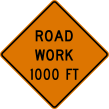
- Orange with a black legend
- Yellow with a black legend
- White with black letters
- Green with white letters
Show answer
Orange with a black legend. Signs used in highway work zones are orange with a black legend. Most are diamond shaped and a few are rectangular, and you may also see electronic signs with changing messages. Yellow with black is the color of ordinary warning signs, white with black letters is used for most regulatory signs, and green with white letters gives directions. When you see orange, slow down through the construction or maintenance zone and watch for workers.
Study this in the handbook: Warning, school and work zone signs
20. A vehicle is parked on a public highway overnight. Which lamps must it display?
- Only the four-way hazard flashers
- A red lamp at every corner of the vehicle
- White or amber in front and red in the rear
- Headlights on high beam and hazard flashers
Show answer
White or amber in front and red in the rear. Between one half hour after sunset and one half hour before sunrise, a vehicle parked on a public highway must show at least one white or amber lamp in front and a red light on the rear. Both must be visible for 1,000 feet. Hazard flashers alone do not satisfy the front and rear lamp requirement, and an all red corner arrangement leaves out the required white or amber front light. High beams do not replace a red rear lamp. Walk to the front and rear of the car and confirm both directions show a light.
Every question is written from the official North Dakota Noncommercial Driver License Manual. Need paper? Printable ND practice test with answer key.
Last verified 2026-10-05. How we check every question · Study all 500 as flashcards
Frequently asked questions
How many questions are on this North Dakota practice test?
This fixed set has 20 questions. It is test 11 of 25 from the 500 question North Dakota bank.
How does this fixed test relate to the full North Dakota bank?
Each numbered test is a fixed set of questions in a fixed order, so you can retake the same test later and compare. Every test mixes road signs and the other topics in about the same proportion as the full bank. Tests 1 to 25 together cover every question in the North Dakota bank once. The full practice page mixes the whole bank at random.
Last verified 2026-10-05. See the North Dakota DMV facts page for sourced state details.
Return to the full North Dakota practice test · Study road signs