
Test 5 of 10 · 20 questions · Free 2026
ND Permit Practice Test 5
Jump to the test ↓A fixed 20 question set from the North Dakota bank with answers and plain English explanations.
Question 1 of 20 · 0 right so far
All 20 questions in test 5
Every question below comes from the North Dakota question bank on this page. Open a question to see the correct answer and the explanation. Nothing here is hidden behind a signup.
1. At what point total does North Dakota move to suspend a driver's license?
- 12 or more points
- 6 points
- 20 points
- Any points at all
Show answer
12 or more points. Points are added to the driver's record normally within 10 days of a conviction, and when the record reveals a total of 12 or more points the driver is informed that the authorities intend to suspend the license, with the right to an administrative hearing. Points drop by one for every three month period without new points, and by three for completing an approved driver improvement course.
Study this in the handbook: Points, texting and other penalties
2. How should you position your vehicle before making a right turn at an intersection?
- Stay as far right as possible and turn close to the right curb
- Approach beside the centerline and turn wide
- Enter the left lane before turning right
- Use the shoulder as the normal turning path
Show answer
Stay as far right as possible and turn close to the right curb. For a right turn, approach as far to the right as possible and complete the turn close to the right curb. This positioning makes the intended movement clear and reduces the chance of drifting into another lane. A centerline approach is associated with different turning situations, while the left lane and shoulder choices create unnecessary conflicts. Before turning, check for pedestrians, signal continuously, and keep the vehicle under control through the corner.
Study this in the handbook: Following distance, lane changes and headlights
3. Why does a roundabout have an apron around its center island?
- To provide a place for vehicles to stop before entering
- To mark the edge of the center island for passenger vehicles
- To provide a separate lane for entering traffic
- To provide extra room for the rear wheels of large trucks
Show answer
To provide extra room for the rear wheels of large trucks. Roundabouts are designed to accommodate all vehicle types, including truck and trailer combinations. To assist large trucks, the center island includes an apron to accommodate the rear wheels of the vehicle. The apron is not a waiting area before entry, an extra entry lane, or simply an edge marker for passenger cars. When you share a roundabout with a large truck, stay in your lane, do not pass it, and assume it needs all available space.
Study this in the handbook: Right of way rules
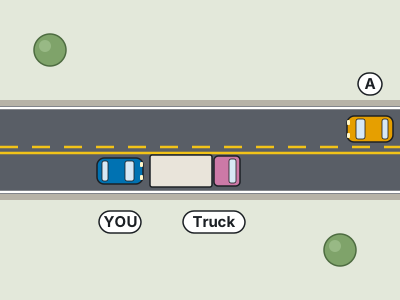
4. What does one solid yellow line beside one broken yellow line mean for the lane with the solid line?
- Traffic must turn right immediately
- Passing is required before the next intersection
- The lane is reserved for parking
- Passing is not allowed from that lane
Show answer
Passing is not allowed from that lane. The paired yellow marking assigns different passing permissions by lane. A driver in the lane beside the solid line may not pass, and the solid line can be crossed only for a left turn. The marking does not require an overtake, create a parking lane, or force an immediate right turn. Check which line borders your lane before moving left. If the solid line is on your side, remain behind the slower vehicle until a legal passing condition appears.
Study this in the handbook: Traffic signals and arrows
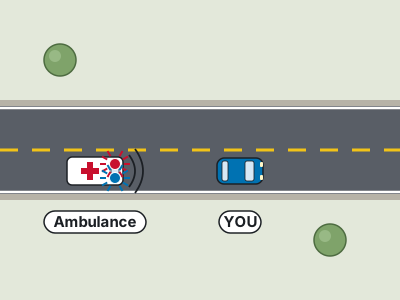
5. An emergency vehicle approaches with flashing lights or a siren. Where must you stop?
- On the left shoulder, even on a divided highway
- Along the right-hand curb or edge of the road
- In the middle of the intersection so traffic can go around
- In the nearest travel lane without changing position
Show answer
Along the right-hand curb or edge of the road. North Dakota requires an immediate stop along the right-hand curb or edge of the road when an emergency or law enforcement vehicle is using its warning lights or siren. Remain stopped until that vehicle has passed, and do not stop in the middle of an intersection. The left-shoulder choice may put you in the emergency vehicle's path, while stopping in the travel lane or intersection leaves traffic obstructed. The practical cue is simple: warning lights or siren behind you means move right, stop, and wait.
Study this in the handbook: Right of way rules
6. During what hours must a 15 year old with a restricted Class D license have a supervising adult present?
- From 10:00 p.m. until 6:00 a.m. on weekends only
- From 6:00 p.m. until midnight every day
- From the later of sunset or 9:00 p.m. until 5:00 a.m.
- From sunset until sunrise with no stated exceptions
Show answer
From the later of sunset or 9:00 p.m. until 5:00 a.m.. A 15 year old with a restricted Class D license may not operate without a parent, legal guardian, or adult at least 18 during the period beginning at the later of sunset or 9:00 p.m. and ending at 5:00 a.m. Direct travel to work, an official school activity, or a religious activity is the stated exception. The other time windows change the start or end point. Remember later of sunset or 9:00 p.m., then 5:00 a.m.
Study this in the handbook: Instruction permits and licenses for minors
7. When may a driver travel 65 miles per hour on a rural paved two lane highway?
- Whenever the driver is passing
- Whenever the road is dry
- When that speed is posted
- Only between sunrise and sunset
Show answer
When that speed is posted. The 65 mile maximum applies on a rural paved two lane highway only when the highway is posted for that speed. Dry pavement, a passing maneuver, and daylight do not create an exception to the posting requirement. Even a posted 65 remains a maximum, so poor visibility or traffic can require a slower pace. Look for the sign before treating this road category as a 65 mile roadway.
Study this in the handbook: North Dakota speed limits
8. Traffic in a North Dakota roundabout travels:
- Clockwise around the center island
- Counter-clockwise around the center island
- Straight across the center island
- In alternating directions chosen by each driver
Show answer
Counter-clockwise around the center island. A roundabout is built around a center island, and vehicles circulate counter-clockwise. That consistent direction lets entering drivers identify the circulating stream and yield appropriately. Clockwise travel would put vehicles into the wrong flow, while driving across the island is not the normal path for passenger vehicles. Individual drivers cannot choose alternating directions without creating conflicts. Approach slowly, yield to traffic already circulating, stay in your lane, and leave at the intended exit after completing the required movement.
Study this in the handbook: Right of way rules
9. Whose vehicles may a 15 year old operate with a restricted Class D operator's license?
- Only a vehicle registered to the state
- Any vehicle owned by a licensed adult
- Only a vehicle owned by a driving school
- A parent, guardian, grandparent, sibling, aunt, or uncle
Show answer
A parent, guardian, grandparent, sibling, aunt, or uncle. The restricted Class D license at age 15 limits the driver to vehicles belonging to a parent, guardian, grandparent, sibling, aunt, or uncle. It does not open the privilege to every licensed adult's vehicle, and the manual does not limit it to school or state vehicles. The family relationship list is the key cue. Check the vehicle's connection to one of those listed relatives before the young driver operates it.
Study this in the handbook: Instruction permits and licenses for minors
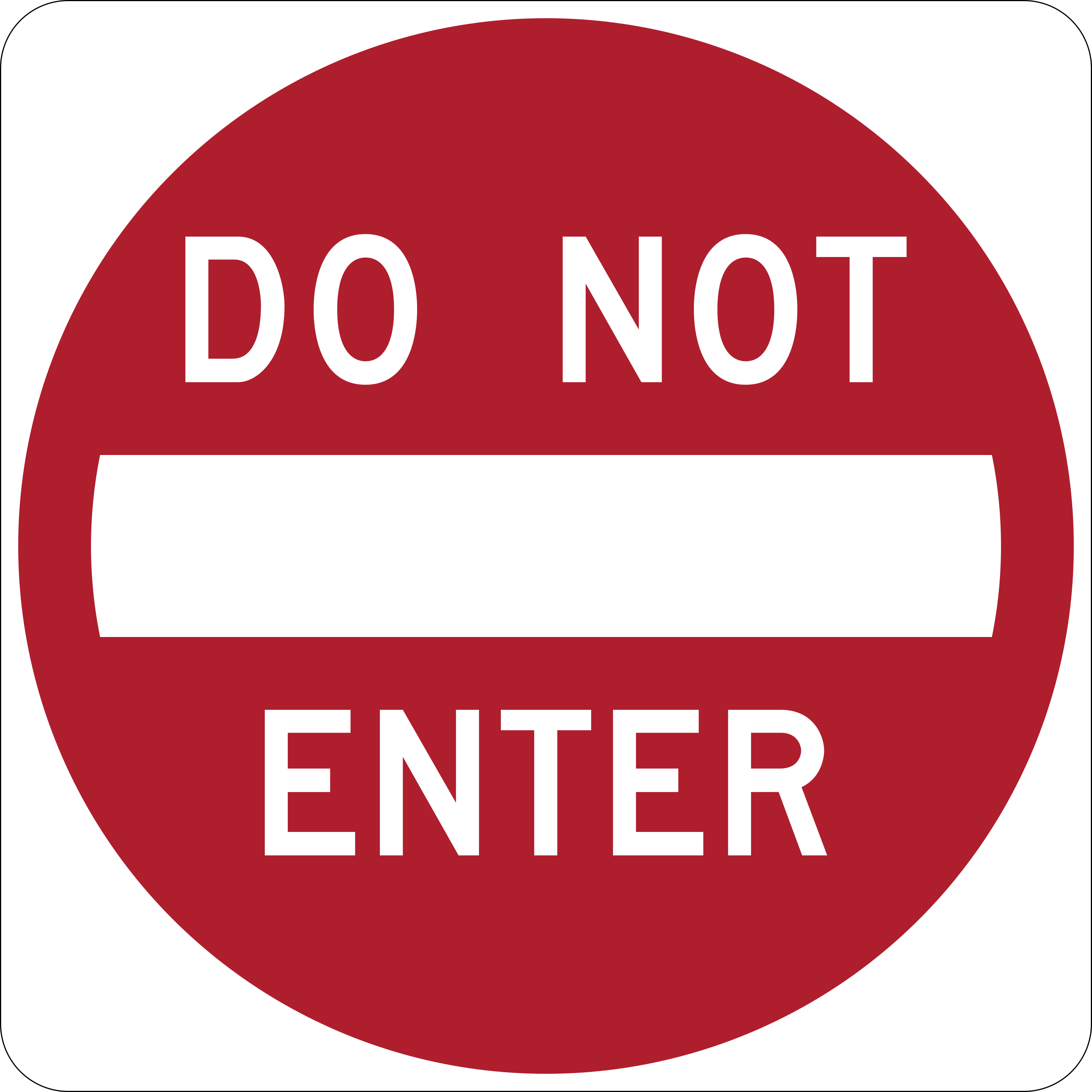
10. What does this red and white sign tell a driver about the road section ahead?
- The driver may enter only to pass a stopped vehicle
- The roadway becomes a parking zone
- The driver is prohibited from entering a restricted road section
- The road is open only to bicycles
Show answer
The driver is prohibited from entering a restricted road section. The Do Not Enter sign prohibits the driver from entering a restricted road section. The passing option still involves entering and therefore violates the instruction. Nothing in the sign creates parking permission or limits the roadway to bicycles. Treat the message as an immediate entry restriction: do not drive into that section, and find a lawful route instead, turning around only where traffic conditions allow it safely and the law permits.
Study this in the handbook: Regulatory and guide signs
11. What is the mandatory minimum jail sentence for driving while suspended or revoked after an alcohol related violation?
- One day
- Four days
- Ten days
- Thirty days
Show answer
Four days. North Dakota specifies four days as the mandatory minimum jail sentence for driving while suspended or revoked after an alcohol related violation. Ten days is connected to a second DUI conviction within seven years, not this separate offense. One day and thirty days do not state the manual's minimum. The useful cue is to connect the suspended or revoked status and prior alcohol violation with the four day floor, while remembering that a fine may also apply.
Study this in the handbook: DUI license suspensions and court penalties
12. You approach this octagonal sign with no stop line or crosswalk. Where should you stop?
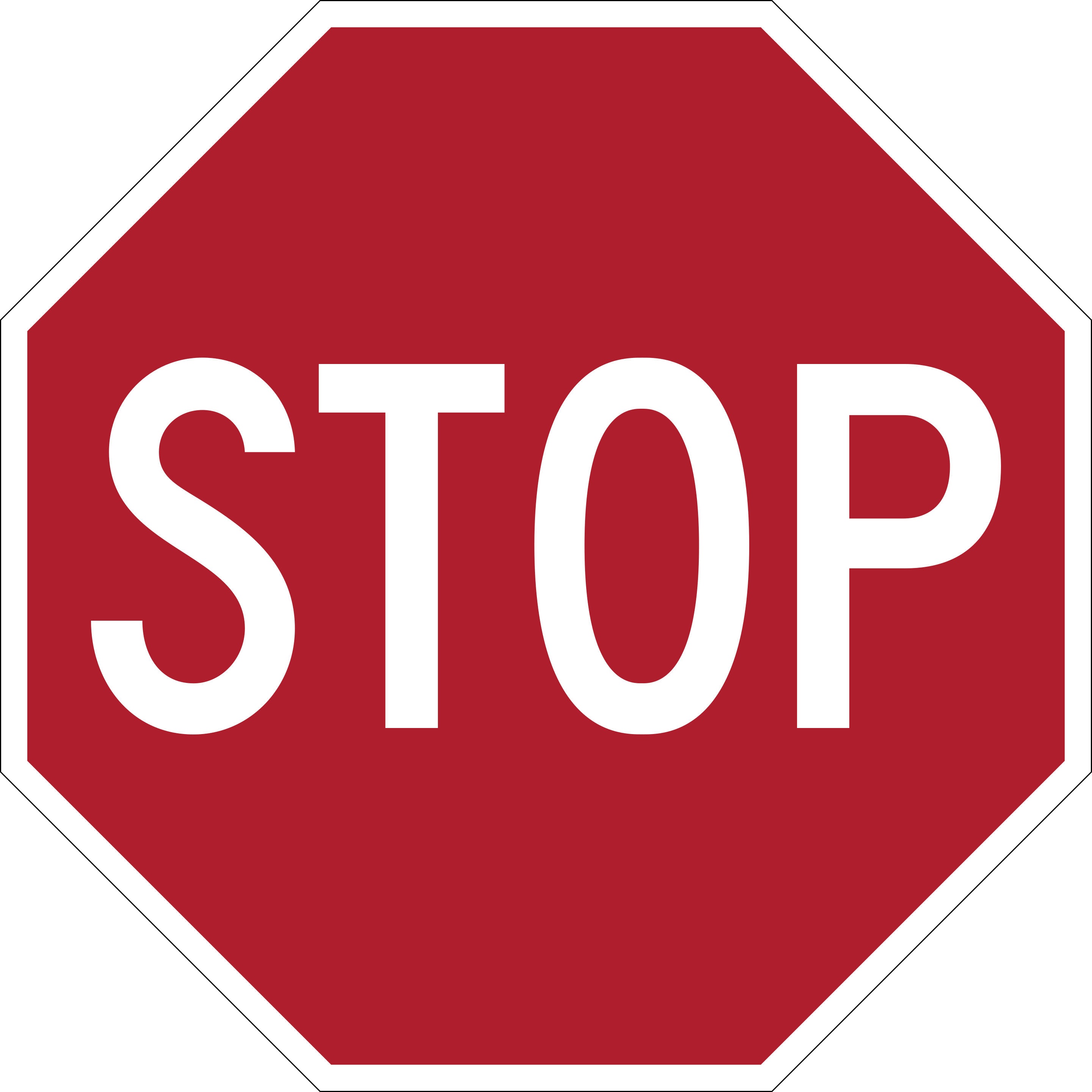
- As near as possible before the intersection where traffic can be seen safely
- After entering the intersection
- Only at the nearest driveway
- At the next marked crosswalk
Show answer
As near as possible before the intersection where traffic can be seen safely. A stop sign requires a complete stop before the stop line or crosswalk area. When neither marking exists, the driver should stop as near as possible before the intersection while retaining a safe view of approaching traffic from every direction. Stopping after entering the intersection defeats the protective purpose of the sign. A driveway is not the controlling reference point, and waiting for a later crosswalk places the vehicle beyond the required stopping location. The practical cue is complete stop first, then scan before proceeding.
Study this in the handbook: Regulatory and guide signs
13. What revocation range follows refusal of an alcohol concentration test or roadside preliminary breath test in North Dakota?
- 180 days to three years
- 30 days to 90 days
- One year only
- Five years to life
Show answer
180 days to three years. Refusing either listed test leads to a license revocation ranging from 180 days to three years. The manual treats refusal of an alcohol concentration test and refusal of a roadside preliminary breath test alike for this stated range. A one year only result is too rigid, and the shorter range does not reflect the rule. The memory cue is the paired testing options followed by the same 180 day to three year consequence.
Study this in the handbook: Alcohol, BAC and implied consent
14. What is the fine for a first violation of operating an uninsured motor vehicle in North Dakota?
- $100
- $500
- $300
- $150
Show answer
$150. The first uninsured motor vehicle violation carries a $150 fine. A $300 fine applies to a second or subsequent violation within three years, so selecting it confuses repeat conduct with the initial offense. The remaining amounts are not the manual's listed first violation penalty. Also remember that the consequence can include license suspension and a later proof of liability insurance restriction, making the insurance requirement more than a paperwork detail.
Study this in the handbook: Residency, license classes and insurance
15. At a yield sign, what must a driver do before entering the intersection?
- Accelerate through before cross traffic reaches the junction
- Stop at the sign every time, even when the intersection is empty
- Yield the right of way, slowing and stopping if necessary
- Yield only to vehicles coming from the left
Show answer
Yield the right of way, slowing and stopping if necessary. A yield sign requires the driver to give priority to other traffic and to slow down, stopping if necessary. It is not an automatic full-stop command in every situation, so the empty-intersection choice adds a condition the sign does not require. Speeding through defeats the purpose, and yielding only to left-side traffic overlooks vehicles approaching from other directions and pedestrians. Reduce speed early, scan the full intersection, and enter only when the right of way is clear.
Study this in the handbook: Regulatory and guide signs
16. What makes a passive railroad crossing different from an active crossing?
- A passive crossing is controlled only by a train operator
- A passive crossing has flashing red lights but no gates
- A passive crossing always requires a full stop
- A passive crossing has no traffic control device and requires the driver to decide whether to stop or proceed
Show answer
A passive crossing has no traffic control device and requires the driver to decide whether to stop or proceed. At a passive crossing, no traffic control device regulates the approach, so the driver must recognize the crossing, search for a train, and decide whether there is enough clear space to cross safely. Gates and flashing red lights describe active control equipment, not passive operation. The lack of a device never removes the need to look and listen. Yellow circular warning signs, pavement markings, and a crossbuck can identify the location, but the driver remains responsible for the final safety decision.
Study this in the handbook: Skids, blowouts, equipment failure and railroad crossings
17. How can the three second rule help you measure following distance?
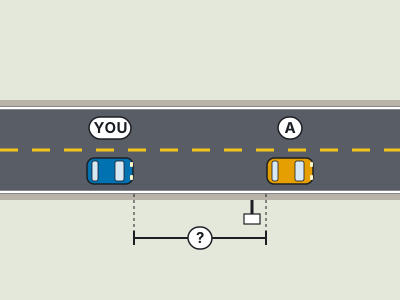
- Use a fixed car-length gap at every speed
- Reach the same mark after about two seconds on a dry road
- Reach a roadside mark at least three seconds after the vehicle ahead passes it
- Count seconds from the moment you begin following
Show answer
Reach a roadside mark at least three seconds after the vehicle ahead passes it. The three second rule uses a fixed roadside object as a time check. Begin counting when the rear bumper of the vehicle ahead passes the mark, and make sure your vehicle does not reach that spot before one thousand and three. Arriving sooner means the cushion is too small. A fixed car length gap cannot account for changing speeds, two seconds falls short of the rule, and counting from the moment you begin following has no fixed reference point. The manual adds that four or more seconds may be needed on slippery roads or behind motorcycles.
Study this in the handbook: Following distance, lane changes and headlights
18. What does the maximum number on this regulatory SPEED LIMIT sign represent?
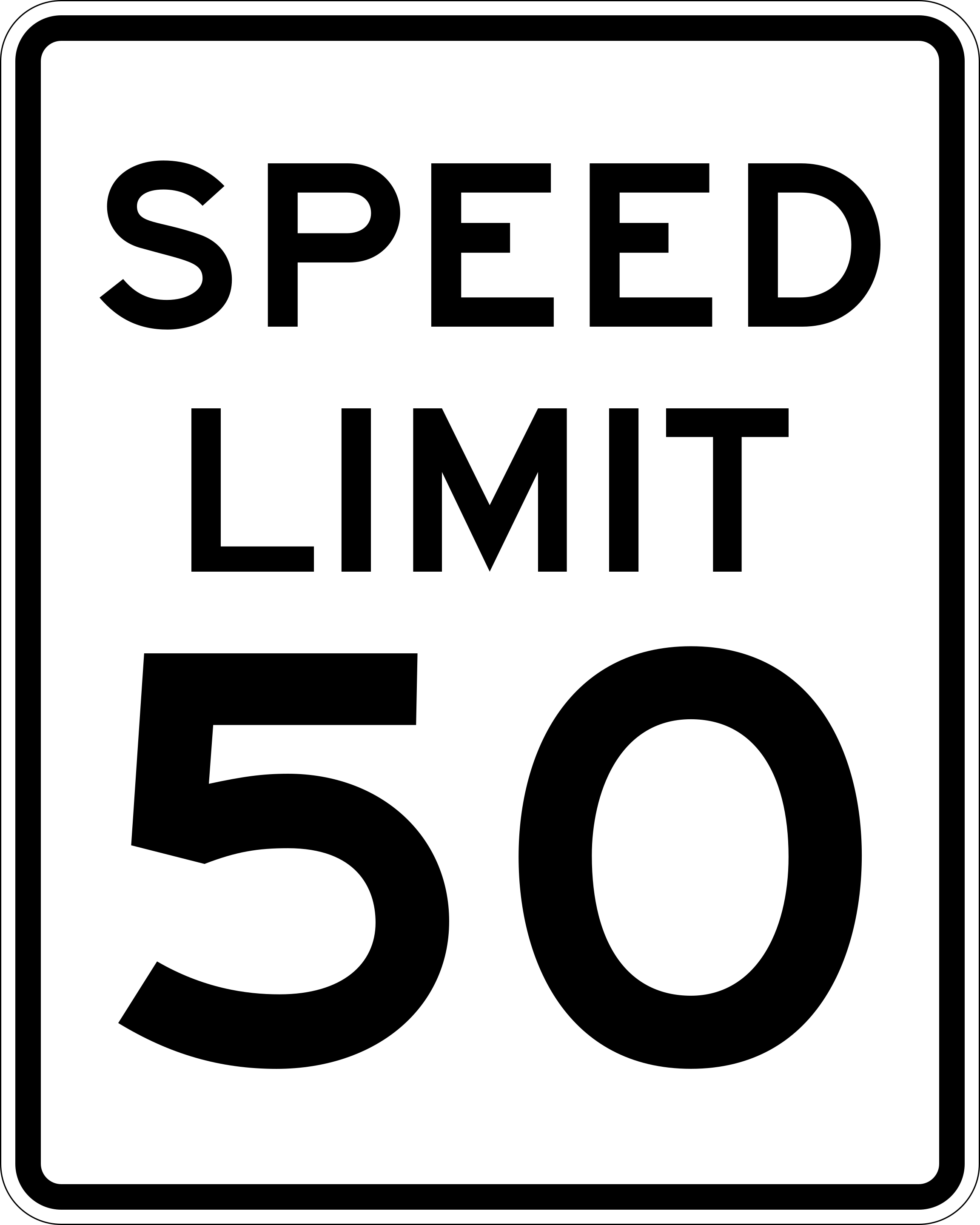
- A speed that must be maintained in every condition
- The maximum speed permitted under ideal conditions
- A recommended speed for a sharp curve
- The minimum speed for the right lane
Show answer
The maximum speed permitted under ideal conditions. A Speed Limit sign shows the maximum speed permitted under ideal conditions. It is not a promise that the posted number is safe during snow, ice, poor visibility, congestion, or another hazard. The driver is not required to maintain that speed, and the sign is different from an advisory curve-speed plaque or a minimum-speed rule. Check the posted number, then adjust downward when conditions require it. The white regulatory design is a cue that the number carries legal significance.
Study this in the handbook: Regulatory and guide signs
19. In North Dakota, the driver behind you wants to pass. What does the manual say about your following distance?
- Close the gap to the vehicle ahead so the driver cannot cut in
- Allow even more following distance, as much as four or more seconds
- Speed up so the driver no longer needs to pass
- Brake hard to warn the driver to back off
Show answer
Allow even more following distance, as much as four or more seconds. The manual says that sometimes you need even more following distance, as much as four or more seconds, and it lists a driver behind you who wants to pass as one of those situations. The extra space ahead gives the passing driver room to return to the lane and gives you more room to brake. Closing the gap or braking hard raises the risk of a crash, and the manual also says that when being passed, do not speed up.
Study this in the handbook: Following distance, lane changes and headlights
20. How large is the no zone around a truck or bus, according to the North Dakota manual?
- About 15 feet on all sides
- About 100 feet
- Only directly behind the trailer
- About 2 feet
Show answer
About 15 feet on all sides. The no zone with trucks or buses is about 15 feet on all sides, and if you cannot see the truck driver's mirrors the driver cannot see you. Keep a 3 to 4 second space in traffic, check mirrors every 6 to 8 seconds, and never linger beside a large vehicle. A loaded truck needs more than 400 feet to stop, so give it room in front as well.
QualitySpace is expanding to North Dakota
We are a California-based independent insurance brokerage working on licensing in more states. We cannot help with North Dakota insurance yet. Leave your email and we will let you know when we can.
Every question is written from the official North Dakota Noncommercial Driver License Manual. Need paper? Printable ND practice test with answer key.
Last verified 2026-10-05. How we check every question · Study all 205 as flashcards
Frequently asked questions
How many questions are on this North Dakota practice test?
This fixed set has 20 questions. It is test 5 of 10 from the 205 question North Dakota bank.
How does this fixed test relate to the full North Dakota bank?
Each numbered test is a fixed set of questions in a fixed order, so you can retake the same test later and compare. Every test mixes road signs and the other topics in about the same proportion as the full bank. Tests 1 to 10 together cover 200 of the 205 questions in the North Dakota bank, each once. The full practice page mixes the whole bank at random.
Last verified 2026-10-05. See the North Dakota DMV facts page for sourced state details.
Return to the full North Dakota practice test · Study road signs