
Test 10 of 10 · 20 questions · Free 2026
ND Permit Practice Test 10
Jump to the test ↓A fixed 20 question set from the North Dakota bank with answers and plain English explanations.
Question 1 of 20 · 0 right so far
All 20 questions in test 10
Every question below comes from the North Dakota question bank on this page. Open a question to see the correct answer and the explanation. Nothing here is hidden behind a signup.
1. Who is prohibited from using an electronic communication device while driving in North Dakota?
- Only drivers who are under 16
- Instruction permit holders and licensed drivers under 18
- Only drivers carrying passengers
- Only commercial drivers on interstates
Show answer
Instruction permit holders and licensed drivers under 18. The restriction covers anyone driving with an instruction permit, regardless of age, and licensed drivers younger than 18. The rule reaches beyond phone calls: it includes composing, reading, or sending electronic messages. The under 16 option misses licensed teens, while passenger status and highway type do not define the prohibition. Remember the two groups together, then recall that emergency assistance and a few urgent safety situations are exceptions.
Study this in the handbook: Instruction permits and licenses for minors
2. What should a driver do when conditions require traveling below the posted speed limit?
- Stop on the roadway whenever visibility changes
- Maintain the posted number in every condition
- Add five miles per hour to preserve traffic flow
- Drive slower than the posted limit when conditions require it
Show answer
Drive slower than the posted limit when conditions require it. A posted speed limit assumes ideal driving conditions, but weather, traffic, visibility, or the road surface may require a lower speed. The driver must reduce speed rather than treat the posted number as a target that must always be maintained. Adding speed or stopping in the traffic lane creates a separate hazard, and the fixed number choice ignores the condition of the roadway. Use visibility and available control as the cue for slowing.
Study this in the handbook: Right of way rules
3. A North Dakota driver's first offense in seven years involves an alcohol concentration of 0.10%. How long is the license suspended?
- 30 days
- 180 days
- 91 days
- One year
Show answer
91 days. North Dakota suspends the license for 91 days for a first offense in seven years. If the alcohol concentration is .18 or greater, a first offense brings 180 days instead, so 180 days is the high-AC figure, not this one. One year (365 days) is the suspension for a second offense in seven years. A temporary restricted license can be issued after at least 30 days of suspension, or 14 days in the 24/7 Sobriety Program.
Study this in the handbook: Alcohol, BAC and implied consent
4. When does a North Dakota crash trigger the crash reporting duties?
- Any crash, however minor
- Only if a vehicle is towed
- Combined damage of $4,000 or more, or any personal injury or death
- Damage of $500 or more
Show answer
Combined damage of $4,000 or more, or any personal injury or death. The crash reporting rules apply when a crash results in combined damage of $4,000 or more, or in personal injury or death. The manual then directs the driver to report it immediately to the local police when in a city, or to the Highway Patrol or the County Sheriff's Office when outside city limits. A minor crash below the threshold with no injuries does not trigger the rule, towing is not the test, and $500 is not the North Dakota figure.
Study this in the handbook: Residency, license classes and insurance
5. A North Dakota driver's record reaches exactly 12 points and the suspension is upheld. How long is the suspension?
- 30 days
- 7 days
- 12 days
- 90 days
Show answer
7 days. North Dakota's suspension table sets 7 days at 12 points. At 13 points and above, the suspension is 7 days for each point over 11, so 13 points means 14 days and 14 points means 21 days. The driver is first notified of the intent to suspend and may request an administrative hearing. Thirty, twelve, and ninety days do not match the table for 12 points.
Study this in the handbook: Points, texting and other penalties
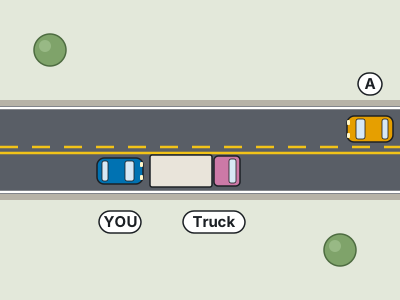
6. What does one solid yellow line beside one broken yellow line mean for the driver in the solid-line lane?
- The road is restricted to emergency vehicles in that direction
- Passing is allowed whenever the driver signals for three seconds
- Both lanes may cross the lines to pass on a straight roadway
- Passing is prohibited from that lane, though a left turn may cross the line
Show answer
Passing is prohibited from that lane, though a left turn may cross the line. The solid line controls the lane beside it. A driver in that lane may not pass across the center marking, but may cross it to make a left turn. The broken line on the other side does not grant passing permission to the solid-line driver. Signaling for three seconds cannot override a pavement restriction, and the marking does not designate an emergency-only roadway. Before crossing, identify which side of the paired lines your vehicle occupies.
Study this in the handbook: Traffic signals and arrows
7. After a crash involving injury or damage, what information must the drivers exchange?
- Vehicle make, model, and color but no insurance details
- Only each driver's name and telephone number
- Name, address, insurance company, and policy number
- A written statement only after the police arrive
Show answer
Name, address, insurance company, and policy number. For crashes involving injury or damage, the manual lists four items for exchange: the driver's name, address, motor vehicle insurance company, and policy number. The name-and-telephone choice omits the address and coverage information. Vehicle description alone is not the required set, and the rule does not postpone the exchange until police arrive. Keep this checklist in mind at the scene, while also making the required report to local police, the Highway Patrol, or the county sheriff depending on where the crash occurred.
Study this in the handbook: Move over and crash reporting
8. What should you do if the windshield wipers fail during rain or snow?
- Slow down, look through the side window, and leave the roadway
- Keep your speed and wait for the rain or snow to stop
- Turn on hazard lights and continue until visibility returns
- Stop immediately in your traffic lane until the wipers work again
Show answer
Slow down, look through the side window, and leave the roadway. A wiper failure during rain or snow can quickly remove the driver’s forward view. The manual says to slow down, stick your head out the side window to see, and leave the roadway. Keeping your speed or driving on with hazard lights does not solve the visibility problem and exposes you and other drivers to a vehicle whose driver cannot see ahead. Stopping in the traffic lane invites a rear end crash. The cue is a sudden loss of wiping during precipitation: reduce speed immediately, signal, and reach a safe roadside location.
Study this in the handbook: Points, texting and other penalties
9. What should be true of your position if the vehicle ahead suddenly stops?
- You should move onto the shoulder immediately
- You should follow closely to react faster
- You should be far enough behind to stop safely
- You should accelerate to pass before braking
Show answer
You should be far enough behind to stop safely. The manual says that if the vehicle in front suddenly stops, you should be far enough behind to come to a stop safely. A following cushion gives you time to recognize the brake lights, respond smoothly, and avoid striking the vehicle ahead. Following closely does not improve reaction time; it removes room to brake. Moving onto the shoulder or accelerating to pass creates an unnecessary conflict. Use the three-second rule as a starting check, then add space when road or traffic conditions reduce your margin.
Study this in the handbook: Following distance, lane changes and headlights
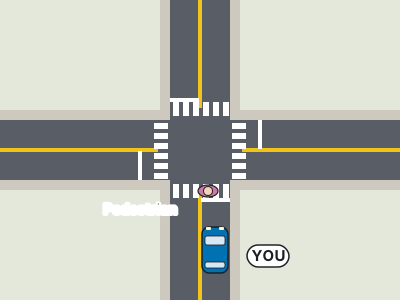
10. A person is crossing in your lane at a marked or unmarked crosswalk. What must you do?
- Yield only when the driver is making a left turn
- Yield only when painted crosswalk lines are present
- Yield only when the pedestrian is using a signal device
- Yield whenever the person is in your lane, marked crosswalk or not
Show answer
Yield whenever the person is in your lane, marked crosswalk or not. Pedestrians have the right of way in both marked and unmarked crosswalks, and a driver must yield when the pedestrian is in the driver's lane of travel. Painted lines are not the condition that creates the protection. A signal device or a left turn is not required either. The practical cue is to stop behind the crosswalk area and leave the pedestrian an unobstructed path whenever the person is crossing in your lane.
Study this in the handbook: Pavement markings and passing
11. At what core body temperature does heatstroke begin, according to the North Dakota manual?
- About 104 degrees, with about 107 degrees being lethal
- About 99 degrees
- About 120 degrees
- About 95 degrees
Show answer
About 104 degrees, with about 107 degrees being lethal. Heatstroke begins when the core body temperature reaches about 104 degrees and the body's cooling system is overwhelmed, and a core temperature of about 107 degrees is lethal. The manual warns that an outside temperature in the mid 60s can cause a vehicle's inside temperature to rise above 110 degrees. It adds that even great parents can forget a child in the back seat, especially caregivers who are not used to driving kids or whose routine suddenly changes.
Study this in the handbook: Seat belts, child seats and heatstroke
12. What may a driver do with a flashing yellow left-turn indication?
- Turn left immediately without checking opposing traffic
- Turn left cautiously after yielding to oncoming traffic and pedestrians
- Wait for a red indication before beginning the turn
- Use the indication to travel straight in either lane
Show answer
Turn left cautiously after yielding to oncoming traffic and pedestrians. A flashing yellow left-turn indication allows a cautious left turn, but it does not provide an unqualified right of way. Yield to oncoming vehicles and pedestrians before entering the turn. The red indication requires left-turning drivers to stop and wait, while the flashing yellow is the permissive condition. It also applies to the left-turn movement, not straight travel. As the arrow flashes, reduce speed, check the opposing lane and crosswalk, and turn only after those road users have been given priority.
Study this in the handbook: Traffic signals and arrows
13. A North Dakota resident on active military duty outside the state held a valid license when leaving. How long does it stay valid?
- It expires on the normal date regardless of service
- Until 30 days after discharge or separation from the service
- Until 1 year after discharge
- Until age 21
Show answer
Until 30 days after discharge or separation from the service. For North Dakota residents on active duty in the Armed Forces outside the state, a valid operator's license held when they left remains valid until 30 days after discharge or separation from the service. That exemption overrides the normal expiration date while the person serves. One year after discharge and age 21 are not part of the rule. Non-resident service members stationed in North Dakota may instead drive on their home state license.
Study this in the handbook: Instruction permits and licenses for minors
14. What does a yellow warning sign showing an intersection ahead tell you?

- A passing lane is guaranteed ahead
- The road is closed to all vehicles
- Parking is required on the shoulder
- Vehicles may be entering the flow of traffic
Show answer
Vehicles may be entering the flow of traffic. Intersection warning signs alert you to traffic that may enter your path from another roadway. Reduce your speed as needed, scan for vehicles approaching from the sides, and be ready to yield under the applicable right of way rule. A closure, parking requirement, or guaranteed passing lane is not conveyed by this warning. The practical cue is to search the side roads before reaching the intersection, especially where sight distance is limited by terrain, buildings, or vegetation.
Study this in the handbook: Warning, school and work zone signs
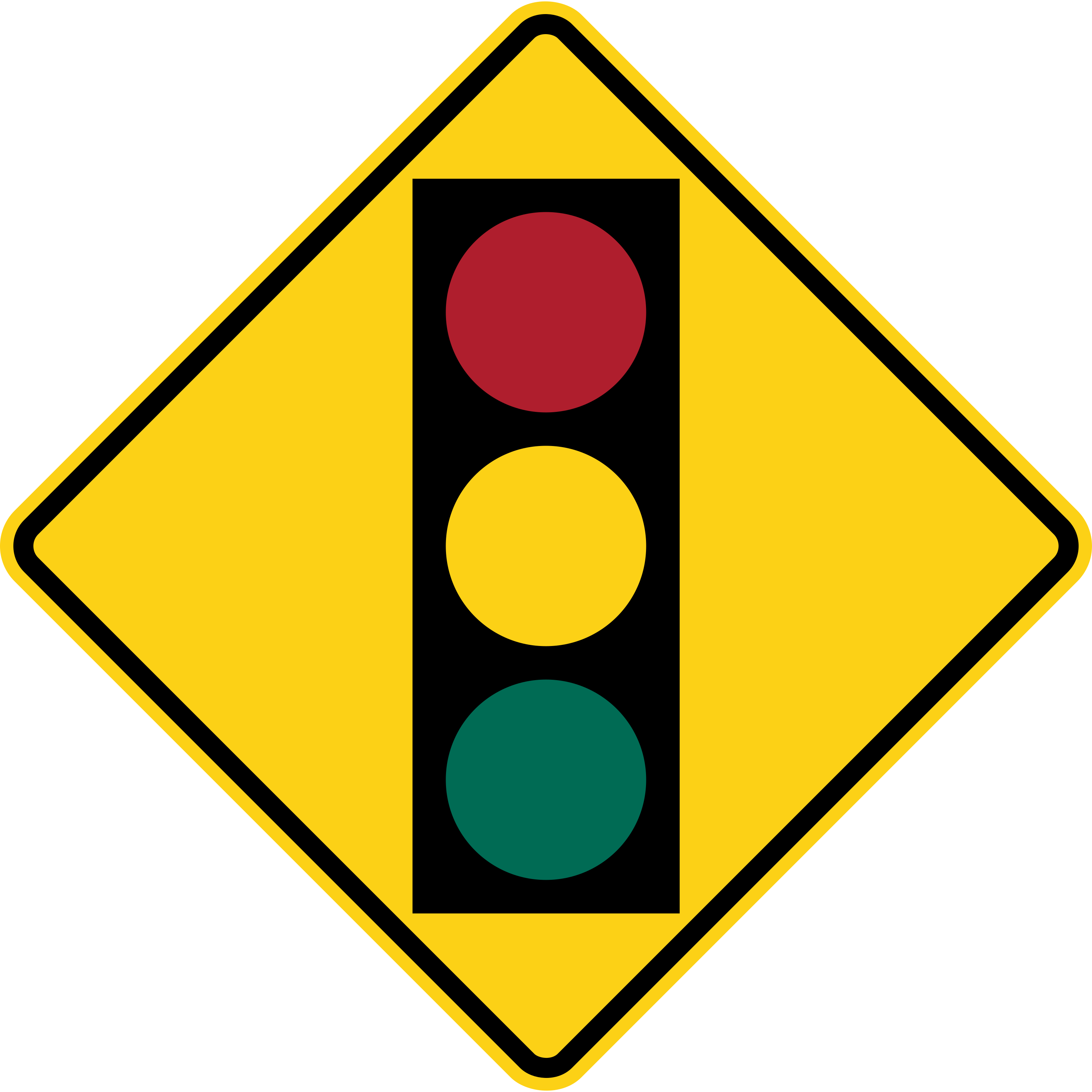
15. What do these warning signs indicate about the road ahead?
- A guaranteed clear route with no need to adjust speed
- A potentially hazardous condition ahead that calls for extra caution
- A service area where parking is required
- A lane that is reserved for emergency vehicles
Show answer
A potentially hazardous condition ahead that calls for extra caution. Warning signs identify potentially hazardous conditions ahead and tell drivers to proceed with extra caution. The pictured signal-ahead sign is one example of that warning function, so it gives time to prepare for the traffic control ahead. It does not promise a clear route, create a required parking area, or reserve a lane for emergency vehicles. Treat the yellow diamond as advance notice: check speed, lane position, and surrounding traffic before reaching the condition shown.
Study this in the handbook: Warning, school and work zone signs
16. How soon must a North Dakota driver report a change of name or address?
- Within 10 days, with documentary evidence of the change
- Within 30 days
- Within 90 days
- At the next renewal
Show answer
Within 10 days, with documentary evidence of the change. If you change your name or address, you must notify the Driver License Division within 10 days and provide documentary evidence of the change; the website lists acceptable documents. Thirty days, 90 days, and waiting until the next renewal all allow far more time than the manual gives. Treat the 10 day deadline as part of moving or changing your legal name, and keep the documentary evidence ready when you report it.
Study this in the handbook: Residency, license classes and insurance
17. In a North Dakota work zone, the diagonal stripes on a barricade or vertical panel slope downward to the left. Which way should you pass?
- Keep to the left
- Keep to the right
- Stop and wait for a flagperson
- Either side, whichever looks clearer
Show answer
Keep to the left. The diagonal stripes on a barricade or vertical panel guide the driver toward the direction in which traffic is to pass. Stripes sloping downward to the right mean keep to the right, and stripes sloping downward to the left mean keep to the left. Here the stripes slope to the left, so keep left. The stripes do not call for a stop, and they do not leave the side up to the driver. Slow down and follow the channelizing devices through the work zone.
Study this in the handbook: Warning, school and work zone signs
18. How does the North Dakota manual say a pedestrian should walk at night?
- With traffic, in dark clothing
- Facing traffic, wearing light or white clothing
- On the shoulder with a flashlight pointed down
- In the center of the road
Show answer
Facing traffic, wearing light or white clothing. When you walk at night, walk facing traffic and wear light or white clothing so drivers can see you. You may not stand on the traveled portion of a street or highway to hitchhike. Pedestrians have the right of way in crosswalks but must yield elsewhere, and drivers must always be on the lookout for them; the manual warns that pedestrians at night may be wearing dark clothing and be difficult to see. Walking with traffic in dark clothing or in the center of the road reverses this advice.
Study this in the handbook: Trucks, motorcycles, bicycles and pedestrians
19. What action is required when you see a Yield sign?
- Yield the right of way
- Always come to a full stop before entering, even when the way is clear
- Proceed without yielding when no vehicle is visible
- Yield only to traffic already stopped at the intersection
Show answer
Yield the right of way. A Yield sign means you must yield the right of way. The manual adds that the sign tells you to slow down and stop if necessary so you can yield. It does not require a full stop when the way is clear, and it never lets you skip yielding just because no vehicle is visible yet. Yielding also applies to approaching traffic, not only to vehicles already stopped. Slow early, check for vehicles and pedestrians, and enter only when it is safe.
Study this in the handbook: Regulatory and guide signs
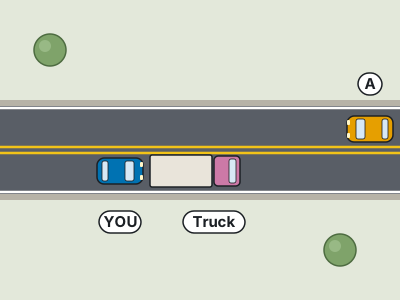
20. On a two-lane road, what do two solid yellow lines mean?
- Only vehicles in the left lane may pass
- Passing is allowed for both directions
- No passing in either direction
- The centerline may be crossed for any reason
Show answer
No passing in either direction. Two solid yellow lines on a two-lane road prohibit passing in both directions. Crossing the centerline remains limited to a left-turn maneuver, so the broad crossing choice is wrong even when a driver wants to overtake. There is no special passing privilege for one side, and the roadway marking does not authorize passing from both directions. Read the paired solid lines as a strong restriction: stay in your lane for travel and cross only when completing a permitted left turn.
Study this in the handbook: Pavement markings and passing
QualitySpace is expanding to North Dakota
We are a California-based independent insurance brokerage working on licensing in more states. We cannot help with North Dakota insurance yet. Leave your email and we will let you know when we can.
Every question is written from the official North Dakota Noncommercial Driver License Manual. Need paper? Printable ND practice test with answer key.
Last verified 2026-10-05. How we check every question · Study all 205 as flashcards
Frequently asked questions
How many questions are on this North Dakota practice test?
This fixed set has 20 questions. It is test 10 of 10 from the 205 question North Dakota bank.
How does this fixed test relate to the full North Dakota bank?
Each numbered test is a fixed set of questions in a fixed order, so you can retake the same test later and compare. Every test mixes road signs and the other topics in about the same proportion as the full bank. Tests 1 to 10 together cover 200 of the 205 questions in the North Dakota bank, each once. The full practice page mixes the whole bank at random.
Last verified 2026-10-05. See the North Dakota DMV facts page for sourced state details.
Return to the full North Dakota practice test · Study road signs