
Test 1 of 10 · 20 questions · Free 2026
ND Permit Practice Test 1
Jump to the test ↓A fixed 20 question set from the North Dakota bank with answers and plain English explanations.
Question 1 of 20 · 0 right so far
All 20 questions in test 1
Every question below comes from the North Dakota question bank on this page. Open a question to see the correct answer and the explanation. Nothing here is hidden behind a signup.
1. When a green arrow appears while the light is red, what movement may you make?
- Turn in the direction of the arrow after yielding to pedestrians and vehicles already in the intersection
- Make any turn without checking the intersection
- Proceed straight regardless of the arrow direction
- Remain stopped until the circular signal turns green
Show answer
Turn in the direction of the arrow after yielding to pedestrians and vehicles already in the intersection. A green arrow authorizes the movement shown by that arrow, even when the circular signal is red. That permission is conditional: pedestrians and vehicles already in the intersection still have priority, so look and yield before entering. The arrow does not authorize unrelated turns or straight travel, and waiting for a circular green would ignore the movement specifically displayed. Read the arrow direction, check the conflict area, and complete only that indicated maneuver when the path is open.
Study this in the handbook: Traffic signals and arrows
2. What must drivers approaching a school bus do when its red lights are flashing?
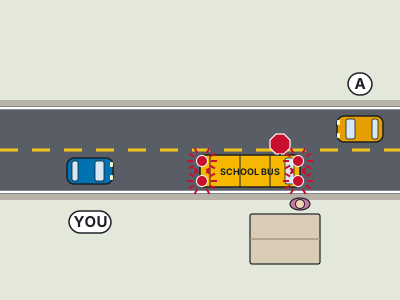
- Continue if the driver can see an open lane
- Stop only if traveling behind the bus
- Pass slowly after checking for children
- Stop from both directions
Show answer
Stop from both directions. When a school bus is stopped with red lights flashing, drivers approaching from both directions must stop because children are being loaded or unloaded. The rule is not limited to vehicles behind the bus, and an open lane does not authorize passing. Remain stopped until the bus begins moving, the bus driver signals that traffic may pass, or the red lights stop flashing. The strongest roadside cue is the combination of a stationary school bus and red flashing lights, which calls for an immediate stop and patient wait.
Study this in the handbook: Right of way rules
3. When visibility is less than 1,000 feet because of fog, what lighting action does the manual require?
- Use only the parking lights and leave headlights off
- Use the vehicle's headlights
- Turn on hazard lights while keeping all other lights off
- Use high beams continuously so the fog reflects more light
Show answer
Use the vehicle's headlights. North Dakota calls for headlights during inclement weather when visibility falls below 1,000 feet because of rain, snow, sleet, hail, smoke, or fog. The visibility threshold is the key detail, not a time of day rule. Parking lights alone or hazard lights alone do not meet a rule that names headlights, and the manual says nothing about running high beams continuously in fog. Use the headlights and slow down so you can stop within the distance your headlights cover.
Study this in the handbook: Right of way rules
4. When a school bus is stopped with red lights flashing, who must stop?
- Only drivers traveling toward the bus
- Only drivers traveling behind the bus
- Drivers approaching from both directions
- No one if the bus is on a straight road
Show answer
Drivers approaching from both directions. A stopped school bus with flashing red lights requires drivers approaching from both directions to stop because children may be loading or unloading. The bus location, road straightness, or your direction of travel does not remove that protection. Wait until the bus moves, the driver signals that traffic may pass, or the red lights stop flashing. The key roadside cue is the red light condition, so begin checking for the bus and children before you reach it rather than braking at the last moment.
Study this in the handbook: Emergency vehicles and school buses
5. What roadway change should you anticipate from this added-lane warning?

- The roadway will gain an additional lane of traffic
- Your lane will end at the next driveway
- All traffic must enter the left shoulder
- The road becomes one-way immediately
Show answer
The roadway will gain an additional lane of traffic. The Added Lane warning shows a roadway joining from the right and continuing as a separate lane. Unlike a Merge sign, the two upward arrows remain separate, so an immediate merging movement is not required. Continue in the appropriate lane and check traffic before changing lanes. The extra lane does not remove the need to watch vehicles beside you or to signal before moving across a lane line.
Study this in the handbook: Warning, school and work zone signs
6. What roadway condition is represented by the two opposing arrows?
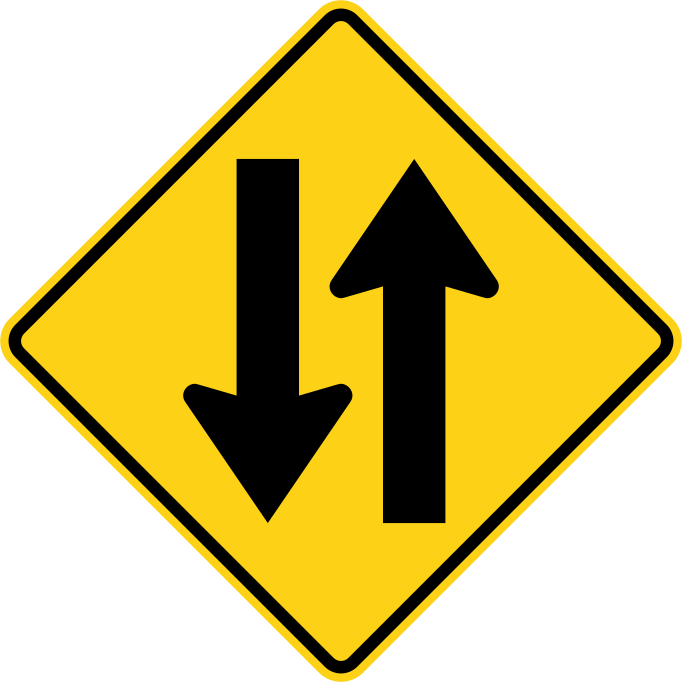
- Traffic may pass on either shoulder
- The road has two-way traffic
- The highway is divided permanently
- Only turning vehicles may continue
Show answer
The road has two-way traffic. Two opposing arrows warn that the road has two-way traffic, so vehicles may approach from the opposite direction in the next lane. Passing on the shoulder is not a normal travel rule, and the divided highway choice describes the opposite condition, where a median separates the two directions. The sign also does not reserve the road for turning vehicles. On two-way roads you must drive on the right side, so keep right and watch for oncoming traffic.
Study this in the handbook: Warning, school and work zone signs
7. Why does the manual emphasize watching for deer in North Dakota?
- Deer crossing signs mean animals cannot enter the road
- Deer may legally use any lane during daylight
- Federal law requires every state manual to feature deer
- Deer are a recurring roadway hazard, especially in low light
Show answer
Deer are a recurring roadway hazard, especially in low light. The manual treats deer as a recurring roadway hazard and links extra attention to dawn, dusk, and posted crossing areas. The other choices invent a lane privilege, a federal publishing requirement, or a guarantee that signage keeps animals away. A driver should use the warning as a cue to scan the roadside and reduce speed, not as proof that the roadway is protected from wildlife. Anticipating movement is the safety habit being tested.
Study this in the handbook: Warning, school and work zone signs
8. What does the slash over the left-pointing arrow prohibit?
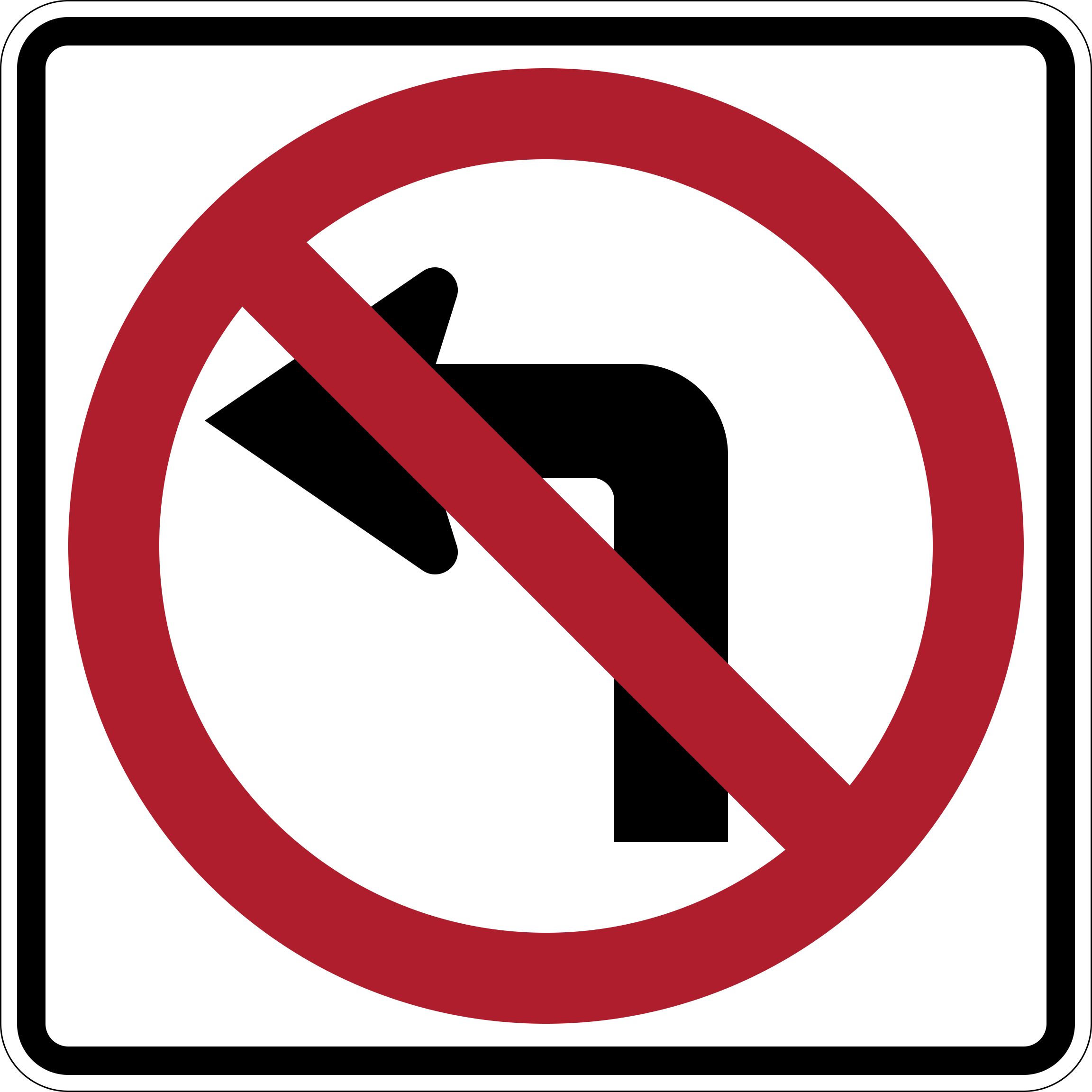
- Stopping at a red light
- A right turn from a side street
- Passing a bicyclist with room
- A left turn at the posted location
Show answer
A left turn at the posted location. The sign forbids the left-turn movement shown by its arrow. The right-turn option points to a different maneuver, while safely passing a bicyclist and stopping at a red light are separate driving actions. The manual explains that a red circle with a red slash marks the action that is forbidden, so read the underlying arrow before acting. Continue straight or choose another lawful route until the restriction ends, and do not assume a clear intersection cancels the posted prohibition.
Study this in the handbook: Regulatory and guide signs
9. What color and legend do North Dakota warning signs use?
- Green with a white legend
- Blue with a white legend
- Yellow with a black legend
- White with a red legend
Show answer
Yellow with a black legend. North Dakota warning signs are yellow with a black legend. This color and lettering combination helps drivers recognize information about hazards before reaching the condition. Blue and white are commonly associated with services, while green and white identify guide information such as directions. A white sign with red lettering is not the warning-sign pattern described here. When the yellow and black combination appears, read the symbol or message and adjust speed and attention for what lies ahead.
Study this in the handbook: Warning, school and work zone signs
10. How much following time should a driver normally keep as a cushion?
- No space if traffic is moving slowly
- One second in every condition
- Exactly ten car lengths
- At least three seconds
Show answer
At least three seconds. The manual uses a three second rule to measure a following cushion. Pick a fixed object, begin counting when the vehicle ahead passes it, and make sure your own vehicle reaches that spot no sooner than one thousand and three. One second is too little for ordinary reaction time, car lengths change with speed, and slow traffic still requires room to stop. Add four or more seconds when roads are slippery, a motorcycle or trailer is involved, or your view is blocked.
Study this in the handbook: Following distance, lane changes and headlights
11. Why should a driver slow down after rain begins on a hard-surface road?
- Only visibility changes; pavement traction remains the same
- Rain makes tires grip harder and shortens stopping distance
- The roadway becomes safer once water covers the oil
- Water mixes with dirt and oil to form a slick film
Show answer
Water mixes with dirt and oil to form a slick film. The manual warns that a hard surface roadway is very slippery just after it starts raining, because water combines with road dirt and oil to form a slick film between your tires and the roadway surface. That condition calls for lower speed and alert driving. Rain does not improve grip, and covering the oil does not remove the hazard. The visibility only choice overlooks the loss of traction. The manual adds that most skids result from driving too fast for the conditions on slippery roadways.
Study this in the handbook: Night, winter and deer
12. In North Dakota, when may a driver take a driver improvement course instead of having points added for a violation?
- For violations assigned five or fewer points, once every 12 months
- For any violation, as often as desired
- Only for DUI
- Never; courses only reduce points later
Show answer
For violations assigned five or fewer points, once every 12 months. A person may elect to attend a driver improvement course in lieu of points on the record for violations assigned five or fewer points. The option is valid once every 12 months and cannot be combined with the three point reduction for completing an approved course. It is not unlimited, and it does not cover violations assigned more than five points. Points also drop by one for every three month period with no new points recorded.
Study this in the handbook: Points, texting and other penalties
13. Who may supervise a North Dakota instruction permit holder?
- A person 18 or older, licensed for that vehicle class, with at least three years of driving experience
- Any licensed driver 16 or older
- Only a parent or legal guardian
- A person 21 or older with one year of experience
Show answer
A person 18 or older, licensed for that vehicle class, with at least three years of driving experience. Whenever you drive on an instruction permit in North Dakota, a person with a valid license for the class of vehicle being driven, who is at least 18 and has at least three years of driving experience, must ride in the seat beside you. It does not have to be a parent. A 16-year-old is too young, and 21 with one year of experience does not match either part of the rule. The supervisor sits beside the permit holder, and no one else may sit in front unless the vehicle has only a front seat.
Study this in the handbook: Instruction permits and licenses for minors
14. A North Dakota driver refuses an alcohol concentration test but is never convicted of DUI. Is an SR22 filing still required?
- No, SR22 applies only after a conviction
- Yes, refusing the test also requires proof of financial responsibility (SR22)
- Only if there was a crash
- Only for commercial drivers
Show answer
Yes, refusing the test also requires proof of financial responsibility (SR22). The manual says that if you refuse to take an AC test, or if you are convicted of a DUI, the law requires you to show proof of financial responsibility through SR22 insurance coverage. A refusal alone triggers the requirement, so conviction is not needed. A crash and a commercial license are not conditions of the rule. The manual warns that insurance rates could double or triple.
Study this in the handbook: Trucks, motorcycles, bicycles and pedestrians
15. Under North Dakota's child passenger safety law, how must a 12-year-old be secured?
- No restraint is required after age 8
- Only in the back seat, with or without a belt
- In a seat belt or child restraint
- Only in a booster seat
Show answer
In a seat belt or child restraint. North Dakota requires children under eight to ride in a child restraint such as a car seat or booster seat (a seat belt may be used for a child at least 57 inches tall), and children ages eight through seventeen to be properly secured in a seat belt or child restraint. A 12-year-old therefore must be belted or restrained. Turning eight does not end the requirement, and a booster is not the only option at that age. Violations cost the driver $25 and one point.
Study this in the handbook: Points, texting and other penalties
16. What is the lowest BAC threshold for North Dakota's under-21 alcohol driving rule?
- 0.05 percent
- 0.02 percent
- 0.08 percent
- 0.10 percent
Show answer
0.02 percent. North Dakota uses a lower alcohol concentration threshold for drivers under 21: .02 percent. The .08 percent figure applies to the general adult threshold, so choosing it overlooks the special age based rule. The .05 and .10 options do not match either figure stated in the manual. On a knowledge test, pair the age condition with .02 percent and keep .08 percent associated with the standard adult threshold.
Study this in the handbook: Alcohol, BAC and implied consent
17. What must a pedestrian do when crossing a North Dakota roadway where there is no crosswalk?
- Cross diagonally to shorten the distance
- Claim the same priority as a marked crosswalk
- Yield to all vehicles on the roadway
- Wait only for a vehicle to flash its headlights
Show answer
Yield to all vehicles on the roadway. A pedestrian crossing where no crosswalk exists must yield the right of way to all vehicles on the roadway. The crosswalk priority does not transfer to every location, and crossing diagonally does not create a safer or superior right. A headlight flash is not the required permission. The useful cue is to find a crosswalk whenever possible, and otherwise wait for a gap that leaves every approaching vehicle clear to continue.
Study this in the handbook: Trucks, motorcycles, bicycles and pedestrians
18. When should vehicle headlights be used under North Dakota's night driving guidance?
- Only after 9 p.m.
- From sunset to sunrise and whenever needed for safe driving
- Only during rain
- Only on roads without streetlights
Show answer
From sunset to sunrise and whenever needed for safe driving. North Dakota's guidance calls for headlights from sunset to sunrise and at any other time necessary for safe driving. Rain alone is too narrow because snow, sleet, hail, smoke, fog, or other conditions can also reduce visibility. A clock time or absence of streetlights does not define the full rule. Think of sunset to sunrise as the baseline, then add any weather or visibility condition that requires lights for safety.
Study this in the handbook: Right of way rules
19. When is a U-turn prohibited because the driver's view is too limited?
- Only when another vehicle is already turning
- Any time the road has two lanes
- Near a hill crest or curve where the driver cannot see at least 500 feet
- Only after sunset
Show answer
Near a hill crest or curve where the driver cannot see at least 500 feet. A U-turn is prohibited near the crest of a hill or on a curve when the driver cannot see 500 feet or more. The concern is whether approaching traffic can be seen in time, not the number of lanes, the presence of a vehicle already turning, or the time of day. Before turning around, check the sight distance in both directions and choose a location where other road users can recognize the maneuver safely.
Study this in the handbook: Right of way rules
20. If you are in the lane with a solid line beside a broken yellow line, what does the marking mean?
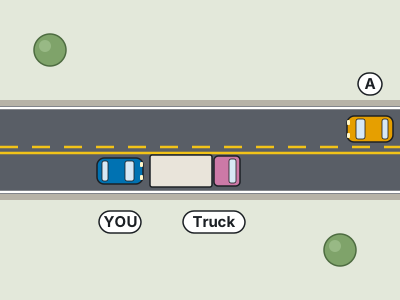
- No passing from your lane; cross the solid line only to turn left
- Passing is allowed whenever you can see the road ahead
- You must cross the solid line before continuing straight
- The lane is reserved for emergency vehicles
Show answer
No passing from your lane; cross the solid line only to turn left. A solid line paired with a broken line restricts the direction that has the solid line. From that lane, passing is prohibited, and the solid line may be crossed only for a left turn. The clear-road choice overlooks the side-specific restriction, while the required-crossing and emergency-lane choices describe rules not created by this marking. Identify which line borders your lane before deciding whether to pass, and remember that the broken line benefits the opposite direction, not yours.
Study this in the handbook: Traffic signals and arrows
QualitySpace is expanding to North Dakota
We are a California-based independent insurance brokerage working on licensing in more states. We cannot help with North Dakota insurance yet. Leave your email and we will let you know when we can.
Every question is written from the official North Dakota Noncommercial Driver License Manual. Need paper? Printable ND practice test with answer key.
Last verified 2026-10-05. How we check every question · Study all 205 as flashcards
Frequently asked questions
How many questions are on this North Dakota practice test?
This fixed set has 20 questions. It is test 1 of 10 from the 205 question North Dakota bank.
How does this fixed test relate to the full North Dakota bank?
Each numbered test is a fixed set of questions in a fixed order, so you can retake the same test later and compare. Every test mixes road signs and the other topics in about the same proportion as the full bank. Tests 1 to 10 together cover 200 of the 205 questions in the North Dakota bank, each once. The full practice page mixes the whole bank at random.
Last verified 2026-10-05. See the North Dakota DMV facts page for sourced state details.
Return to the full North Dakota practice test · Study road signs