
Test 4 of 10 · 20 questions · Free 2026
ND Permit Practice Test 4
Jump to the test ↓A fixed 20 question set from the North Dakota bank with answers and plain English explanations.
Question 1 of 20 · 0 right so far
All 20 questions in test 4
Every question below comes from the North Dakota question bank on this page. Open a question to see the correct answer and the explanation. Nothing here is hidden behind a signup.
1. What do North Dakota speed limit signs show when driving conditions are ideal?
- The maximum permitted speed
- The minimum speed required
- A recommended speed that has no legal effect
- The speed reserved for emergency vehicles
Show answer
The maximum permitted speed. A posted speed limit is a ceiling for travel when conditions are ideal. It is not permission to drive that fast through rain, glare, congestion, or a limited sight distance. The minimum speed choice reverses the meaning of the sign, while the recommendation choice understates its legal force. A useful cue is to treat the number as the upper boundary, then reduce speed whenever the roadway or weather calls for more control.
Study this in the handbook: Regulatory and guide signs
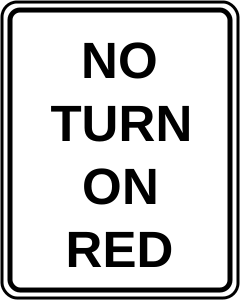
2. What does this NO TURN ON RED sign require at an intersection?
- A complete stop before the crosswalk
- Do not turn while the traffic signal is red
- A left turn after yielding
- A straight movement on a green light
Show answer
Do not turn while the traffic signal is red. The NO TURN ON RED sign prohibits turning during the red signal. Stopping first does not remove this restriction, and a gap in traffic does not create an exception. Wait for a signal that permits the movement, then check for pedestrians and other traffic before turning. The sign does not prohibit every right turn at every signal phase. Read the posted restriction together with the traffic signal before deciding whether you may proceed.
Study this in the handbook: Regulatory and guide signs
3. During which dates may studded snow tires be used legally in North Dakota?
- September 1 through May 1
- November 1 through March 31
- October 15 through April 15
- December 1 through February 28
Show answer
October 15 through April 15. North Dakota permits studded snow tires from October 15 through April 15. The other date ranges shift the start or end of the authorized season and therefore do not reproduce the rule. This is a calendar question, so retain both boundary dates instead of reducing the answer to a vague winter period. The quick cue is mid October through mid April, with the fifteenth marking each side of the allowed window.
Study this in the handbook: Points, texting and other penalties
4. What does North Dakota require on a trailer towed faster than 25 mph?
- Safety chains or brakes capable of holding the trailer if the coupling breaks
- A red flag on the hitch
- Nothing beyond a hitch
- A second driver
Show answer
Safety chains or brakes capable of holding the trailer if the coupling breaks. When traveling faster than 25 miles per hour, you need safety chains or brakes capable of holding the trailer if the coupling breaks. The trailer also needs turn signals, stop lights, two red reflectors and two red taillights mounted on the rear. Check the hitch, chains and lights before every trip, since a loose trailer at highway speed is a runaway.
5. How must you treat a flashing red traffic signal?
- Like a green light and proceed without checking
- Like a flashing yellow signal and proceed without stopping if clear
- Like a steady red signal until the light changes
- Like a stop sign, then proceed when the intersection is clear
Show answer
Like a stop sign, then proceed when the intersection is clear. A flashing red signal has the same meaning as a stop sign. Stop first, then proceed only when the intersection is clear of pedestrians and vehicles. Treating it as yellow removes the required stop, and treating it as green ignores the traffic control entirely. Waiting as if it were a steady red is also wrong, because the flashing red lets you go once you have stopped and the way is clear. Use the same routine as at a stop sign: stop at the marked line or crosswalk when present, look in every direction, and enter only after yielding.
Study this in the handbook: Traffic signals and arrows
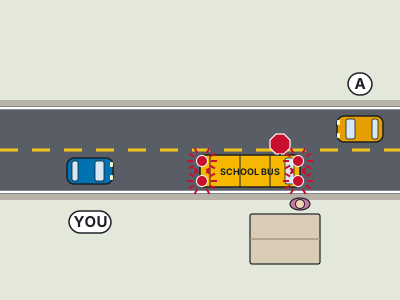
6. What must drivers approaching from both directions do when a school bus is stopped with its red lights flashing?
- Pass slowly after checking the opposite lane
- Stop because children are being loaded or unloaded
- Continue if no child is visible
- Stop only when traveling behind the bus
Show answer
Stop because children are being loaded or unloaded. When a school bus is stopped and flashing its red lights, drivers approaching from both directions must stop because children are being loaded or unloaded. The rule applies to traffic coming toward the bus as well as traffic behind it. Passing slowly is still passing, and the absence of a visible child does not cancel the stop requirement. A driver should wait until the bus begins moving, the bus driver signals permission to pass, or the red lights stop flashing before proceeding.
Study this in the handbook: Right of way rules
7. What do yellow warning signs with black legends tell drivers?
- Potentially hazardous conditions are ahead
- A service facility is available immediately
- A legal parking exemption is in effect
- The road is reserved for commercial vehicles
Show answer
Potentially hazardous conditions are ahead. Yellow warning signs with black legends alert drivers to potentially hazardous conditions ahead. Their purpose is to prompt extra caution and preparation, not to identify services, parking permissions, or commercial-only access. A warning may involve a curve, merge, intersection, pedestrian area, or another change in the roadway. When the yellow diamond appears, look beyond the sign for the condition it describes, adjust speed early, and position the vehicle so the upcoming hazard can be handled smoothly.
Study this in the handbook: Warning, school and work zone signs
8. How should you respond to a flashing yellow signal at an intersection?
- Stop and wait for a green arrow
- Proceed with caution
- Reverse away from the intersection
- Speed up before cross traffic arrives
Show answer
Proceed with caution. A flashing yellow signal permits movement, but it requires caution while you enter and cross the intersection. Scan for vehicles, pedestrians, and changing conditions, then proceed only when the path is safe. A complete stop is associated with a flashing red indication, not this signal. Reversing is unpredictable, and increasing speed reduces the time available to respond to cross traffic. The best habit is to lift off the accelerator, look in every relevant direction, and continue at a controlled speed.
Study this in the handbook: Traffic signals and arrows
9. How often does the North Dakota manual tell a new driver to check the mirrors?
- Every 6 to 8 seconds
- Once a minute
- Only before turning
- Every 30 seconds
Show answer
Every 6 to 8 seconds. Keep your eyes moving and use your mirrors to check around and behind the vehicle every 6 to 8 seconds, keep at least a 3 to 4 second space between your vehicle and others, and stay centered in your lane. Avoid the no zone around trucks and buses, roughly 15 feet on all sides; if you cannot see the truck driver's mirrors, the driver cannot see you.
10. How long may a new North Dakota resident drive on another state's license before getting a North Dakota license?
- One year
- 10 days
- Indefinitely, as long as the license is valid
- 60 days for Class D or M, but only 30 days for Class A, B or C operators
Show answer
60 days for Class D or M, but only 30 days for Class A, B or C operators. You may operate a Class D or M vehicle with an operator's license from another state for a period of 60 days after you become a resident of North Dakota, and then you must take the necessary tests for a North Dakota license. Commercial Class A, B or C operators have only 30 days. The clock starts when residency is established, not when the old license expires.
Study this in the handbook: Residency, license classes and insurance
11. What penalty does North Dakota list for a fourth or subsequent DUI offense?
- A $500 fine
- A $2,000 fine, one year and one day in jail, and the 24/7 Sobriety Program as a condition of probation
- A 30 day suspension
- A warning
Show answer
A $2,000 fine, one year and one day in jail, and the 24/7 Sobriety Program as a condition of probation. A fourth or subsequent DUI offense brings a $2,000 fine, one year and one day in jail, and participation in the 24/7 Sobriety Program as a mandatory condition of probation. A first conviction carries a $500 fine, and a third conviction within seven years carries $2,000 and 120 days in jail. All convicted offenders must also complete a mandatory alcohol addiction evaluation.
Study this in the handbook: DUI license suspensions and court penalties
12. How wide may a North Dakota motorized bicycle be, and what engine size and speed define it?
- No more than 32 inches wide, up to 49.98 cc, and no faster than 30 mph on level ground
- Any width, up to 250 cc
- Under 24 inches wide and 100 cc
- No limits, if it has pedals
Show answer
No more than 32 inches wide, up to 49.98 cc, and no faster than 30 mph on level ground. A motorized bicycle is a two or three wheeled vehicle no more than 32 inches wide with foot pedals or footrests, a maximum piston or rotor displacement of 49.98 cc enabling a speed not to exceed 30 miles per hour on a level surface, and an automatic drive system with no clutch. The rider must be at least 14 and carry a valid license or permit.
Study this in the handbook: Trucks, motorcycles, bicycles and pedestrians
13. What following-distance method does the manual recommend as a cushion behind another vehicle?
- Keeping close enough to prevent another vehicle from merging
- One car length for every five miles per hour in all conditions
- A one-second gap whenever the road is dry
- The three-second rule, using a fixed roadside mark to measure the gap
Show answer
The three-second rule, using a fixed roadside mark to measure the gap. The three-second rule uses a shadow, mark, or roadside object as a reference. When the vehicle ahead passes it, count until your vehicle reaches the same spot. Reaching the mark before the count ends means the gap is too short. The manual also notes that slippery roads, motorcycles, heavy loads, trailers, large vehicles, or a passing driver can require four or more seconds. The method measures time, so it adapts better than a fixed car-length rule.
Study this in the handbook: Following distance, lane changes and headlights
14. What should you do when brake lights ahead signal a sudden traffic problem?
- Keep your speed because brake lights do not identify a hazard
- Accelerate toward the stopped vehicles to clear the queue
- Reduce speed and prepare to stop or change lanes safely
- Stop in the lane immediately without checking traffic behind
Show answer
Reduce speed and prepare to stop or change lanes safely. The manual's defensive-driving direction is to stay alert and be prepared to reduce speed quickly or come to a complete stop during an emergency. Brake lights ahead are a concrete warning that traffic conditions may be changing, so ease off the accelerator, increase your attention, and choose a safe escape path only after checking surrounding traffic. Accelerating removes your response time. Holding speed ignores the warning, and an abrupt lane stop can create a second collision. Give yourself room before the hazard becomes unavoidable.
Study this in the handbook: Residency, license classes and insurance
15. For how long before a turn must a driver continuously signal?
- Only while the steering wheel is being turned
- The last 25 feet before the turn
- The last 100 feet before the turn
- At least 500 feet on every roadway
Show answer
The last 100 feet before the turn. The manual requires a continuous turn signal during the last 100 feet before a turn. Starting the signal only as the wheel moves gives other road users too little notice, while 25 feet understates the required distance. The 500 foot choice overstates the rule and would not be the stated general requirement. Signal before the final approach, keep it on through the last 100 feet, check pedestrians and traffic, then make the turn when clear.
Study this in the handbook: Following distance, lane changes and headlights
16. What does a warning sign indicate when it shows the median or divided highway begins?

- The road is changing to one-way traffic in both directions
- Traffic is separated by a new median or divided highway
- A railroad crossing is immediately ahead
- The lane ends without any change in traffic flow
Show answer
Traffic is separated by a new median or divided highway. The warning sign for the beginning of a median or divided highway tells the driver that traffic will become separated. Expect a change in roadway layout, keep the vehicle in its lane, and watch for the new traffic pattern. The railroad and lane-ending choices refer to different warnings. The claim that both directions become one-way misses the key feature: opposing traffic is divided by the median, not placed on the same path.
Study this in the handbook: Warning, school and work zone signs
17. A North Dakota permit holder is practicing in a sedan with a supervisor beside them. May a friend ride in the front seat too?
- Yes, if the friend is licensed
- Yes, if the friend wears a seat belt
- No, only the supervising driver and the permit holder may be in front, unless the vehicle has only a front seat
- Yes, on rural roads only
Show answer
No, only the supervising driver and the permit holder may be in front, unless the vehicle has only a front seat. North Dakota says an individual other than the supervising driver and the permit holder may not be in the front seat, unless the vehicle has only a front seat, in which case the supervisor must sit next to the permit holder. A sedan has a back seat, so the friend must ride there. Being licensed or belted does not change the rule, and there is no rural road exception.
Study this in the handbook: Instruction permits and licenses for minors
18. What is the purpose of right-of-way rules at intersections?
- To give entering vehicles priority over all pedestrians
- To let the fastest vehicle proceed first
- To remove the need to yield when no sign is posted
- To establish orderly traffic movement and reduce crashes
Show answer
To establish orderly traffic movement and reduce crashes. Right-of-way rules establish orderly traffic movement and can reduce crashes when everyone follows them. They do not award priority to the fastest vehicle, disappear when a sign is absent, or allow entering traffic to ignore pedestrians. Drivers must still be ready to yield defensively when another road user fails to follow a rule. At an intersection, slow enough to identify the applicable control, watch for people and vehicles, and give way whenever safety requires it.
Study this in the handbook: Pavement markings and passing
19. What court penalty does North Dakota set for a first DUI conviction with an alcohol concentration of .16% or greater?
- $500 fine only
- A warning
- $2,000 fine and 120 days
- At least a $750 fine and two days imprisonment, which may be converted to community service
Show answer
At least a $750 fine and two days imprisonment, which may be converted to community service. A first conviction carries a $500 fine, but if the AC is .16% or greater the minimum is at least a $750 fine and two days imprisonment, and the jail time may be converted to community service. The $500 fine alone understates the penalty at this level. The $2,000 fine with 120 days is the third conviction within seven years. All convicted offenders must also complete an alcohol addiction evaluation.
Study this in the handbook: Alcohol, BAC and implied consent
20. What should you do when the curve warning sign appears ahead?

- Stop in the travel lane before turning
- Accelerate until the curve is complete
- Reduce speed before entering the curve
- Treat the sign as permission to pass
Show answer
Reduce speed before entering the curve. A curve warning gives you advance notice that the roadway will bend, so your speed should be reduced before the turn begins. Waiting until the vehicle is already in the bend can make steering and braking less stable. Accelerating through the curve defeats the warning, while stopping in the lane creates a new hazard. The sign does not change passing rules. A useful cue is to finish the speed adjustment while the wheels are still pointed straight, then guide the vehicle smoothly through the bend.
Study this in the handbook: Warning, school and work zone signs
QualitySpace is expanding to North Dakota
We are a California-based independent insurance brokerage working on licensing in more states. We cannot help with North Dakota insurance yet. Leave your email and we will let you know when we can.
Every question is written from the official North Dakota Noncommercial Driver License Manual. Need paper? Printable ND practice test with answer key.
Last verified 2026-10-05. How we check every question · Study all 205 as flashcards
Frequently asked questions
How many questions are on this North Dakota practice test?
This fixed set has 20 questions. It is test 4 of 10 from the 205 question North Dakota bank.
How does this fixed test relate to the full North Dakota bank?
Each numbered test is a fixed set of questions in a fixed order, so you can retake the same test later and compare. Every test mixes road signs and the other topics in about the same proportion as the full bank. Tests 1 to 10 together cover 200 of the 205 questions in the North Dakota bank, each once. The full practice page mixes the whole bank at random.
Last verified 2026-10-05. See the North Dakota DMV facts page for sourced state details.
Return to the full North Dakota practice test · Study road signs