
Test 2 of 10 · 20 questions · Free 2026
ND Permit Practice Test 2
Jump to the test ↓A fixed 20 question set from the North Dakota bank with answers and plain English explanations.
Question 1 of 20 · 0 right so far
All 20 questions in test 2
Every question below comes from the North Dakota question bank on this page. Open a question to see the correct answer and the explanation. Nothing here is hidden behind a signup.
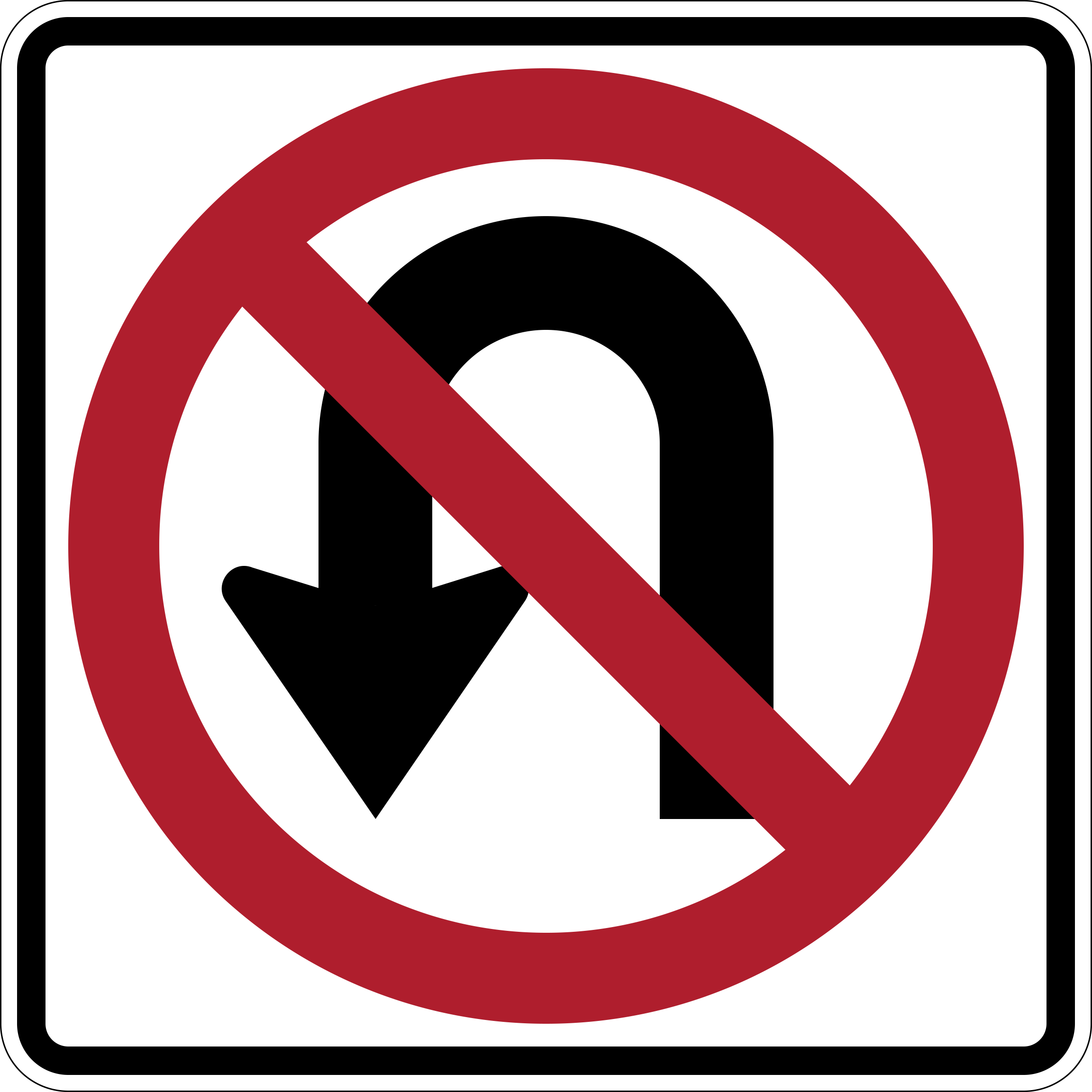
1. Which movement is forbidden by the red circle and slash over the U-shaped arrow?
- Yielding to a pedestrian
- Turning into a legal driveway
- Following the lane straight ahead
- Making a U-turn at that location
Show answer
Making a U-turn at that location. The pictured U-shaped movement is the action being prohibited, so a driver must not make a U-turn at that location. Turning into a lawful driveway, continuing straight, and yielding to a pedestrian describe different actions and are not what this symbol depicts. Regulatory signs with a red circle and slash identify a forbidden action by placing the mark over its symbol. Before changing direction, scan for a permitted intersection or other legal place to turn without crossing the posted restriction.
Study this in the handbook: Regulatory and guide signs
2. What should you do as this railroad warning indicates that a crossing is near?

- Stop on the tracks to listen for a train
- Accelerate to clear the tracks before looking
- Slow down so you can safely stop if a train is coming
- Treat the crossing as an ordinary intersection
Show answer
Slow down so you can safely stop if a train is coming. The railroad advance warning information directs drivers to slow down near a crossing so they can safely stop if a train is coming. Accelerating reduces the time available to respond, and stopping on the tracks creates a severe hazard. An ordinary intersection approach does not provide the necessary rail-crossing caution. Scan both directions, listen, and be prepared to stop before the tracks. The round railroad warning design and nearby crossing should trigger an early speed reduction, not a last-second maneuver.
Study this in the handbook: Warning, school and work zone signs
3. How long must a 16 or 17 year old hold an instruction permit before completing the road test or waiving it?
- Twelve months in every case
- Three months regardless of age
- Six months or until age 18, whichever comes first
- Until age 21
Show answer
Six months or until age 18, whichever comes first. An applicant who is 16 or 17 must hold the instruction permit for six months or until turning 18, whichever comes first, before completing or waiving the road test. Three months is too short, while twelve months ignores the separate rule for this age group. The age 21 choice has no connection to the permit period. Pair the six month period with the age 18 endpoint when remembering the requirement.
Study this in the handbook: Instruction permits and licenses for minors
4. A North Dakota parent cannot appear to sign a teen's permit sponsorship and designates another adult by notarized document. Who keeps financial liability?
- The designated adult
- The state
- The teen alone
- The father, mother, or legal guardian
Show answer
The father, mother, or legal guardian. If the father, mother, or legal guardian cannot appear, they may designate an individual through a notarized document to sign temporarily, but financial liability remains with the father, mother, or legal guardian. The designee only signs; the liability does not transfer to that person, to the teen alone, or to the state. If there is no living parent or guardian, another adult swearing responsibility for the minor may sign.
Study this in the handbook: Instruction permits and licenses for minors
5. When may a driver proceed cautiously instead of moving over for a stranded vehicle under North Dakota's move over rule?
- When changing lanes cannot be done safely
- Whenever the driver is in a hurry
- Only when the parked vehicle has no lights
- Only after passing the vehicle once
Show answer
When changing lanes cannot be done safely. A lane change is not a safe maneuver in every traffic pattern, so the rule allows the driver to slow and proceed with caution when moving over cannot be done safely. Hurry is not a legal exception, and flashing lights identify the hazard rather than remove the duty. Passing once does not cure the situation. First look for a safe lane change; if it is unavailable, reduce speed and pass carefully with attention to the shoulder.
Study this in the handbook: Move over and crash reporting
6. Under North Dakota's DUI law, how many separate penalty processes can affect your driving privileges?
- Only a court conviction
- Only an administrative license action
- None until a third offense
- Two: an administrative license penalty and a court conviction penalty
Show answer
Two: an administrative license penalty and a court conviction penalty. There are two separate penalties under the North Dakota DUI law: an administrative license penalty and a court conviction penalty, and driving privileges may be suspended through either or both. If convicted in court, the driver also faces mandatory fines and jail on top of losing the license. Neither process waits for a third offense. Every convicted offender must also complete an alcohol addiction evaluation and any recommended treatment.
Study this in the handbook: Alcohol, BAC and implied consent
7. What must North Dakota motorists do when a motorcyclist or bicyclist gives a hand signal?
- Sound the horn to acknowledge it
- Recognize the signal and give them enough space to make the move
- Pass immediately before they turn
- Ignore it, since only vehicle signals count
Show answer
Recognize the signal and give them enough space to make the move. Motorcyclists and bicyclists often signal turns and stops with their arms, and the manual says motorists must be able to recognize those hand signals and give the rider sufficient space to complete the signaled move. Honking can startle a rider, passing before the turn cuts across their path, and ignoring the signal treats a legal signal as if it did not exist. Read the arm, slow down, and hold back until the rider has finished the maneuver.
Study this in the handbook: Pavement markings and passing
8. Where must an open alcohol container be placed in a North Dakota vehicle?
- Under the front passenger seat
- In a locked glove compartment
- In the trunk
- In a cup holder if the driver does not drink
Show answer
In the trunk. North Dakota's open container rule requires open containers to be placed in the trunk. The rule applies even when the driver is not drinking, so a cup holder is not a lawful workaround. A glove compartment or space under a seat is also not the location stated by the manual. The easy memory cue is that the container must be separated from the passenger area, with the trunk serving that purpose.
Study this in the handbook: Trucks, motorcycles, bicycles and pedestrians
9. What is Alive at 25, according to the North Dakota manual?
- A driving simulator test
- A 4.5 hour interactive program for drivers under 25 that focuses on behavior and responsibility
- A state insurance discount
- A motorcycle safety course
Show answer
A 4.5 hour interactive program for drivers under 25 that focuses on behavior and responsibility. Alive at 25 is a highly interactive 4.5 hour program targeted toward drivers under the age of 25 that helps young drivers take greater responsibility for their driving. Where driver education teaches car handling and state law, Alive at 25 focuses on behavior and decision making. Approved courses in North Dakota can also earn an insurance discount and point reduction.
10. When can a North Dakota driver get a temporary restricted license after an alcohol suspension?
- After at least 30 days of suspension, or after 14 days if in the 24/7 Sobriety Program
- Never
- After one year
- Immediately
Show answer
After at least 30 days of suspension, or after 14 days if in the 24/7 Sobriety Program. A temporary restricted license can be issued after serving at least 30 days of suspension, or after serving at least 14 days if the driver participates in the 24/7 Sobriety Program. Participation in the 24/7 program is required until the driver is one year violation free. Waiting a full year, getting a license immediately, or never being eligible does not match the stated periods. The manual also notes that refusing an alcohol concentration test brings a revocation of 180 days to three years, a separate consequence from this suspension.
Study this in the handbook: DUI license suspensions and court penalties
11. What should a driver do when approaching or passing a stranded vehicle with flashing hazard lights?
- Yield the right of way and move safely to the lane not adjacent to the vehicle
- Stop in the travel lane until the vehicle is removed
- Pass on the shoulder without slowing
- Maintain speed beside the vehicle
Show answer
Yield the right of way and move safely to the lane not adjacent to the vehicle. A driver approaching or passing a stranded vehicle with flashing hazard lights should yield the right of way and move safely to the lane not adjacent to that vehicle. This creates separation for people who may be outside the vehicle or working near it. Stopping in a travel lane creates a new hazard, and using the shoulder at speed does not provide the required cautious response. If the only safe lane is adjacent, proceed cautiously and reduce speed. Look ahead for the flashing lights and plan the lane change early.
Study this in the handbook: Move over and crash reporting
12. Which equipment does the North Dakota manual address as a seasonal winter driving topic?
- Extra windshield curtains
- Colored grille covers
- Roof mounted warning flags
- Studded snow tires
Show answer
Studded snow tires. Studded snow tires receive specific treatment in the manual, including the period when their use is permitted. The other equipment choices are not presented as the seasonal topic described here. Do not infer that every winter accessory has a legal season simply because North Dakota has severe weather. The useful cue is the word studded, which distinguishes a regulated tire feature from general cold weather preparation.
Study this in the handbook: Points, texting and other penalties
13. What roadway change does this divided-highway warning show?

- The median or divided highway begins and traffic is separated
- The median ends and opposing traffic shares one lane
- A three-way intersection replaces the highway
- U-turns are required across the median
Show answer
The median or divided highway begins and traffic is separated. The warning shows that a median or divided highway begins and traffic becomes separated. The median-ending option describes a different sign, while an intersection or required U-turn is not implied. Adjust your lane position as the roadway divides, follow the channelized path, and never cross the median simply to change direction. The split arrows provide a strong visual cue: opposing streams are being separated, so each direction follows its own side of the highway.
Study this in the handbook: Warning, school and work zone signs
14. A North Dakota license applicant has a history of seizures. When may the applicant still be licensed?
- After no seizures for at least six consecutive months, with a required medical examination
- Never
- After one seizure-free week
- Only with a doctor riding along
Show answer
After no seizures for at least six consecutive months, with a required medical examination. North Dakota lists conditions that bar a license, including those causing blackouts, seizures, fainting spells, or other lapses of consciousness. The exception applies when the person has had no seizures for at least six consecutive months and is willing to submit to the required medical examination. A single seizure-free week is far too short, and a doctor riding along is not an option. The answer is not never, because of this exception.
Study this in the handbook: Instruction permits and licenses for minors
15. Broken yellow center lines are used on:
- Roads where opposing traffic never meets
- One-way roads only
- Parking lots with no moving traffic
- Two-lane, two-way roads
Show answer
Two-lane, two-way roads. Broken yellow center lines separate opposing traffic on two-lane, two-way roads. They may be crossed for a left turn or to pass another vehicle when the maneuver is safe and lawful. The one-way and no-opposing-traffic choices conflict with the purpose of a center line, and a parking lot is not the roadway type identified in the manual. When you see broken yellow lines, first confirm that the road carries traffic in both directions before considering a crossing.
Study this in the handbook: Pavement markings and passing
16. A slow-moving vehicle emblem is mounted on a farm vehicle. At about what speed is that vehicle traveling?
- 35 miles per hour or less
- 25 miles per hour or less
- 45 miles per hour or less
- 55 miles per hour or less
Show answer
25 miles per hour or less. The emblem signals that the vehicle or equipment is moving at 25 miles per hour or less. That figure is the useful clue when deciding how quickly traffic will catch it and how much time a pass may require. Choosing 35, 45, or 55 miles per hour raises the expected speed beyond the manual's stated threshold and could lead you to approach too fast. A tractor displaying the triangle may still turn or occupy the roadway, so slow down, observe its movement, and pass only when the road is clear and the maneuver is legal.
Study this in the handbook: Warning, school and work zone signs
17. What does a yellow traffic signal warn a driver about?
- The signal is acting like a stop sign
- The light is changing from green to red
- Cross traffic must yield without checking
- The light grants a protected turn
Show answer
The light is changing from green to red. A yellow indication warns that the signal is changing from green to red. A driver should judge whether stopping can be done safely and avoid treating the remaining yellow time as an invitation to accelerate. The stop sign choice belongs to a red indication, while the other options invent priority that yellow does not grant. Use the color as a transition cue: ease off the accelerator, scan the intersection, and stop when a safe stop is available.
Study this in the handbook: Traffic signals and arrows
18. Which sign category gives mandatory instructions to drivers?
- Recreational area signs
- Guide signs
- Regulatory signs
- Milepost signs
Show answer
Regulatory signs. Regulatory signs are the category that controls traffic and gives mandatory instructions. Guide signs provide directions, distances, services, or points of interest, while recreational signs identify recreation information and mileposts report route distance. Those other categories help drivers navigate but do not answer the question about required behavior. A practical reading habit is to distinguish a command or prohibition from information about where you are going, then follow the command before proceeding.
Study this in the handbook: Regulatory and guide signs
19. What should you do when another driver ignores a right of way rule?
- Insist on proceeding because your priority is legal
- Drive defensively and be ready to yield
- Accelerate to punish the other driver
- Turn off your lights and continue unseen
Show answer
Drive defensively and be ready to yield. North Dakota tells drivers to remain defensive because other operators may ignore right of way rules. Being legally entitled to proceed does not protect you from a collision if another vehicle fails to yield. Insisting on priority, accelerating in anger, or becoming less visible increases danger rather than controlling it. Scan for the other driver’s position and likely movement, ease off when necessary, and preserve a path to escape. The safest priority is avoiding impact while respecting the rule that normally governs the intersection.
Study this in the handbook: Pavement markings and passing
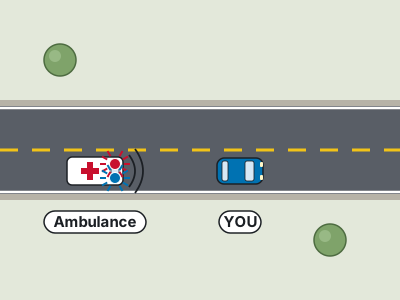
20. What must you do when an emergency vehicle uses lights or a siren?
- Follow it closely through the next signal
- Stop in the middle of the intersection
- Stop along the right hand curb or edge until it passes
- Continue normally if your lane is open
Show answer
Stop along the right hand curb or edge until it passes. When an emergency or law enforcement vehicle is displaying the specified lights or using its siren, North Dakota requires an immediate stop along the right hand curb or road edge. Remain stopped until the vehicle has passed. The middle of an intersection is specifically unsafe, and an open lane does not cancel the duty to yield. Following the emergency vehicle can interfere with its movement. As soon as the warning is heard or seen, check the right side and stop where you will not block the intersection.
Study this in the handbook: Emergency vehicles and school buses
QualitySpace is expanding to North Dakota
We are a California-based independent insurance brokerage working on licensing in more states. We cannot help with North Dakota insurance yet. Leave your email and we will let you know when we can.
Every question is written from the official North Dakota Noncommercial Driver License Manual. Need paper? Printable ND practice test with answer key.
Last verified 2026-10-05. How we check every question · Study all 205 as flashcards
Frequently asked questions
How many questions are on this North Dakota practice test?
This fixed set has 20 questions. It is test 2 of 10 from the 205 question North Dakota bank.
How does this fixed test relate to the full North Dakota bank?
Each numbered test is a fixed set of questions in a fixed order, so you can retake the same test later and compare. Every test mixes road signs and the other topics in about the same proportion as the full bank. Tests 1 to 10 together cover 200 of the 205 questions in the North Dakota bank, each once. The full practice page mixes the whole bank at random.
Last verified 2026-10-05. See the North Dakota DMV facts page for sourced state details.
Return to the full North Dakota practice test · Study road signs