
Test 9 of 10 · 20 questions · Free 2026
MT Permit Practice Test 9
Jump to the test ↓A fixed 20 question set from the Montana bank with answers and plain English explanations.
Question 1 of 20 · 0 right so far
All 20 questions in test 9
Every question below comes from the Montana question bank on this page. Open a question to see the correct answer and the explanation. Nothing here is hidden behind a signup.
1. What is the fine for a Montana driver who violates the safety belt law?
- $20
- $100
- $500
- A warning only
Show answer
$20. No person may drive a motor vehicle in Montana unless each occupant is wearing a properly adjusted and fastened safety belt, and a driver who violates the law will be fined $20. Montana law places responsibility on the driver to ensure each occupant is properly buckled or in a child safety seat. The manual adds that whenever possible, children under age 13 should be secured in the backseat. Buckle up on every trip, even short trips at low speeds.
Study this in the handbook: Required lights and equipment
2. According to the Montana manual, what should you do if your windshield glass is damaged?
- Cover the damaged area with paper
- Have the windshield replaced
- Drive only below 15 mph
- Use high beams to see around it
Show answer
Have the windshield replaced. The Montana manual says to keep your windshield clear so you can focus on the road ahead. Damaged glass blocks your view of the road and can break more easily in a minor collision or when something hits the windshield, so the manual says to have the windshield replaced if the glass is damaged. Covering the damage, driving slowly, or switching on high beams does nothing to restore the glass or clear your view.
Study this in the handbook: Required lights and equipment
3. What does a typical yellow diamond warning sign tell a Montana driver?
- All traffic must stop at the sign
- A legal speed limit is ending immediately
- A fuel or lodging service is available
- A dangerous condition lies ahead and extra caution is needed
Show answer
A dangerous condition lies ahead and extra caution is needed. Yellow diamond signs are warning devices for dangerous conditions ahead, so the driver should approach with great caution. They do not usually impose a speed limit, advertise services, or require every vehicle to stop at the sign. Those functions belong to other sign categories. The useful cue is the combination of yellow, diamond, and warning language: expect a hazard and adjust attention and speed.
Study this in the handbook: Road signs by shape and color
4. What does a red circle with a red slash over a symbol mean in Montana?
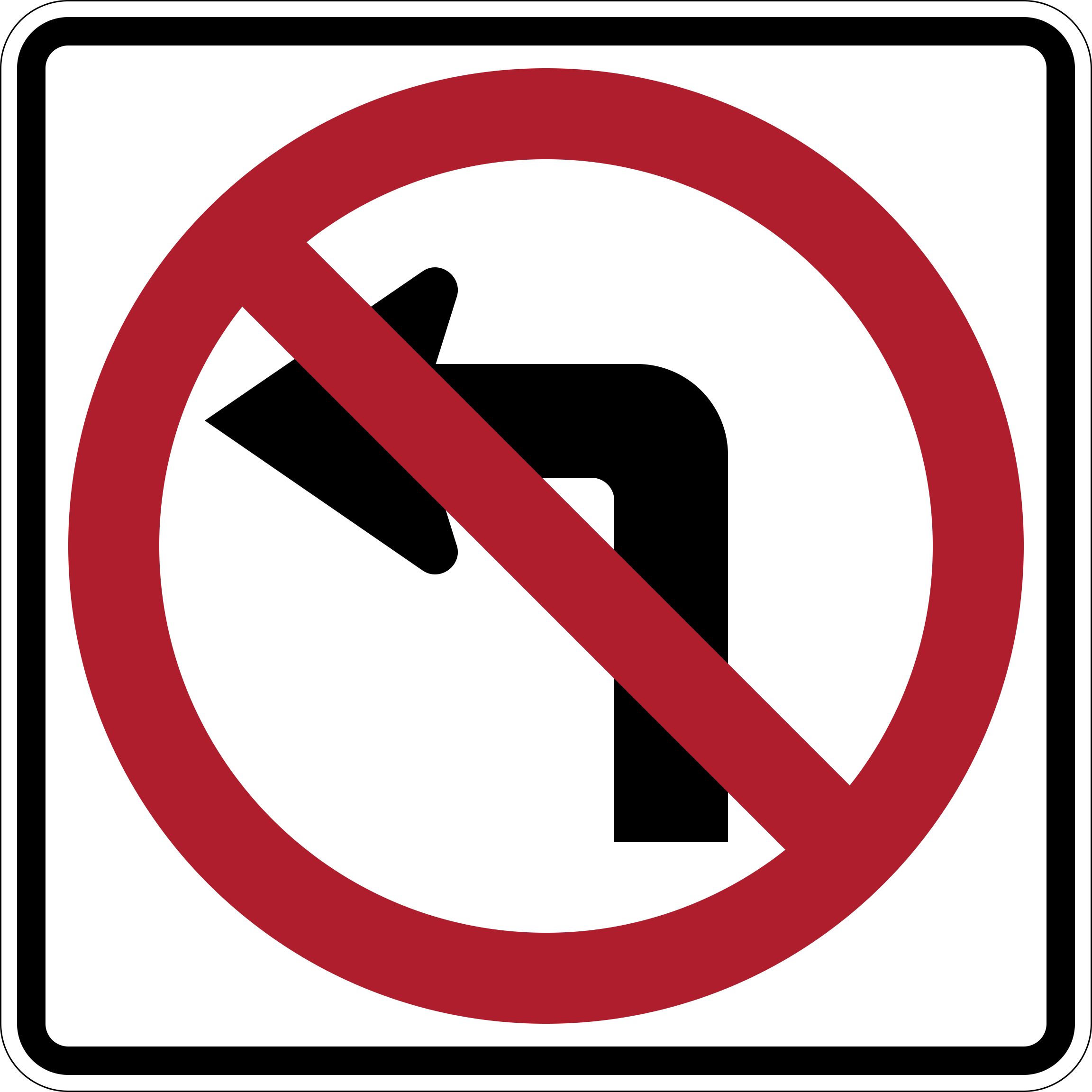
- The road is reserved for the symbol shown
- The action shown is recommended in the next block
- The action shown by the symbol is prohibited
- The symbol identifies a service area ahead
Show answer
The action shown by the symbol is prohibited. A red circle and slash is a prohibition marker. Montana explains that the driver must not do whatever the black arrow or symbol depicts. The sign does not recommend the movement, reserve the road for it, or identify a service. Read the underlying symbol first, then apply the slash to that action. For example, a crossed U turn symbol means do not turn around there. The quick visual cue is red around the symbol with a diagonal bar: the pictured maneuver is forbidden.
Study this in the handbook: Road signs by shape and color
5. What must a driver do before turning left on a flashing yellow arrow?
- Yield only to vehicles already stopped in the intersection
- Turn immediately because the arrow protects the movement
- Wait for a steady red arrow before making the turn
- Yield to oncoming traffic and pedestrians, then turn through a safe gap
Show answer
Yield to oncoming traffic and pedestrians, then turn through a safe gap. A flashing yellow arrow allows the left turn but does not protect it from opposing road users. Oncoming traffic has a green light, and pedestrians may also be crossing, so the driver must judge whether a safe gap exists before moving. The immediate-turn choice mistakes a permissive indication for a protected one. Waiting for red is unnecessary and may create confusion, while yielding only to stopped vehicles ignores moving traffic and people in the crossing. Associate the flashing yellow arrow with permission plus a careful yield check.
Study this in the handbook: Traffic signals, roundabouts and railroad crossings
6. What is the usual shape of a Montana warning sign?
- Circle
- Rectangle
- Octagon
- Diamond
Show answer
Diamond. Warning signs are usually diamond shaped, and they alert drivers to dangerous conditions that require great caution. The octagon is reserved for STOP, while rectangles commonly carry regulatory or guide information. A circle is a special warning shape used for the railroad crossing ahead sign, so it is not the usual pattern. When a yellow diamond appears, look for the hazard it represents, adjust speed and position early, and expect conditions such as a curve, intersection, school, or narrowing roadway.
Study this in the handbook: Road signs by shape and color
7. When do Montana first-year restricted license limitations automatically end?
- On the date shown on the license or when the driver turns 18, whichever comes first
- Exactly one year after the driver turns 18
- When the driver completes 50 additional practice hours
- Only after a court removes the restrictions
Show answer
On the date shown on the license or when the driver turns 18, whichever comes first. The restrictions end automatically at the date printed on the back of the license or when the individual turns 18, whichever occurs first. That means the earlier event controls; the driver does not wait for both events. Extra practice hours and court action are not listed as termination requirements. Read the phrase whichever occurs first literally, because it resolves the timing question.
Study this in the handbook: Learner license and the teen GDL steps
8. If another driver is tailgating and there is a right lane, what response does Montana recommend?
- Brake sharply to force the other driver back
- Move over to the right
- Accelerate until the tailgater falls farther behind
- Straddle the centerline to block a pass
Show answer
Move over to the right. When a driver is being followed too closely and a right lane is available, Montana advises moving over to the right. If no right lane exists, the driver should wait for a clear opportunity and reduce speed slowly. Sudden braking can cause a rear-end crash, while acceleration may encourage continued aggressive driving. Straddling the centerline creates a separate lane-position hazard and is not a defensive response. The goal is to create room and let the impatient vehicle pass safely. Check mirrors, signal, and move only when the lane is clear.
Study this in the handbook: Following distance, merging and passing
9. How far must Montana headlights and taillights be visible on vehicles built after January 1, 1956?
- 1,000 feet
- 100 feet
- 500 feet, with white or amber light to the front and red or amber to the rear
- 50 feet
Show answer
500 feet, with white or amber light to the front and red or amber to the rear. Vehicles manufactured after January 1, 1956 must emit white or amber light to the front and red or amber light to the rear, visible for 500 feet, and must have two tail lamps except motorcycles, motor driven cycles, quadricycles and truck tractors. The license plate lamp must light the plate for 50 feet, and mirrors must give 200 feet of visibility to the rear.
Study this in the handbook: Required lights and equipment
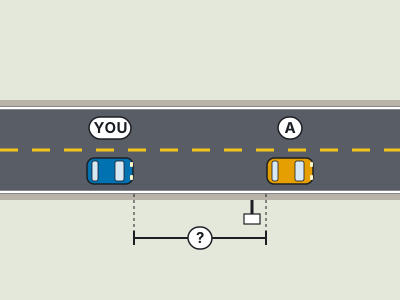
10. What following interval does Montana's Three-Second Rule use at any speed?
- Ten seconds only on interstate highways
- Exactly one second behind the vehicle ahead
- A distance of three vehicle lengths
- At least three seconds between reaching the same fixed point
Show answer
At least three seconds between reaching the same fixed point. The Three-Second Rule is a time-based check that works at any speed. Watch the vehicle ahead pass a fixed object, count one-one-thousand through three-one-thousand, and make sure your vehicle does not reach that object before the count ends. One second leaves too little reaction and braking time. Vehicle lengths change with car size and speed, so they are not the manual's measure. Ten seconds is associated with passing at 55 mph, not ordinary following. Pick a sign or pole and count rather than guessing by appearance.
Study this in the handbook: Following distance, merging and passing
11. When may a driver turn right at a red light in Montana?
- After stopping and yielding, unless a sign or police officer prohibits the turn
- Before stopping if no pedestrians are visible
- Only after waiting for a green arrow
- Whenever the driver signals, even if traffic is approaching
Show answer
After stopping and yielding, unless a sign or police officer prohibits the turn. At a steady red signal, Montana lets you cautiously turn right after stopping when entering a two-way street. You may make the turn unless a sign or police officer tells you not to turn against the red light, and you must yield to pedestrians, bicyclists, and traffic in the intersection. Turning before stopping skips the first requirement, a green arrow is not needed, and signaling alone does not create a safe gap.
Study this in the handbook: Traffic signals, roundabouts and railroad crossings
12. At an intersection with no stop sign or traffic signal, which vehicle should a Montana driver generally yield to?
- A vehicle approaching from the left
- A vehicle approaching from the right
- Only a vehicle traveling faster
- No vehicle, because the intersection is uncontrolled
Show answer
A vehicle approaching from the right. At an uncontrolled intersection, Montana's general priority rule is to yield to a vehicle coming from the right, while remaining prepared to yield to prevent a crash. The left-side choice reverses the stated direction, and speed does not determine this basic priority. Uncontrolled means there is no device assigning movement, not that drivers may continue without checking. Ease off the accelerator and cover the brake as you look both ways.
Study this in the handbook: Who yields at intersections
13. How many deaths and injuries per year result from animal crashes, according to the CDC figures in the Montana manual?
- About 10 deaths and 100 injuries
- About 200 deaths and 26,000 injuries
- Almost none
- About 5,000 deaths
Show answer
About 200 deaths and 26,000 injuries. Crashes involving direct hits or swerving to avoid an animal result in about 200 deaths and 26,000 injuries per year according to the Centers for Disease Control and Prevention. Large animals such as deer, bear, moose, horses, elk and cattle were involved in many of these crashes. Look for animals especially at sunrise and sunset, slow down when you see one, and if there is no time to stop, do not swerve sharply into oncoming traffic or the ditch.
Study this in the handbook: Adjusting speed for roads, weather and sight distance
14. What right of way does a Montana pedestrian using a guide dog or carrying a white cane have?
- Absolute right of way
- Right of way only at traffic lights
- Right of way only in marked crosswalks
- No special right of way
Show answer
Absolute right of way. A pedestrian using a guide dog or carrying a white cane has absolute right of way. Drivers must not use the horn because the sound could confuse or frighten the blind pedestrian. Limiting the protection to signals or marked crosswalks understates the rule. The safe response is to yield, remain patient, and give the pedestrian space to cross without pressure from the vehicle.
Study this in the handbook: Pedestrians, school buses, funerals and bicycles
15. How much should a Montana driver reduce speed on packed snow?
- About 5 mph
- About 10 mph
- Not at all if the tires are new
- Cut speed in half
Show answer
Cut speed in half. The manual gives rough speed cuts for slippery roads: reduce speed about 10 mph on a wet road, cut it in half on packed snow, and slow to a crawl on ice. A 10 mph reduction is the wet road guidance, so it is too little on packed snow, and 5 mph is even less. New tires do not remove the need to slow down. Use snow tires or chains when the road has snow on it.
Study this in the handbook: Adjusting speed for roads, weather and sight distance
16. Which occupant is exempt from Montana's seatbelt law?
- A passenger riding less than one mile
- A back seat passenger in a vehicle built in 2010
- An occupant carrying a written physician's statement that he or she cannot wear a seatbelt for medical reasons
- Any adult who signs a waiver with the driver
Show answer
An occupant carrying a written physician's statement that he or she cannot wear a seatbelt for medical reasons. Montana requires every occupant to wear a properly adjusted and fastened safety belt, and the driver is responsible for making sure everyone is buckled. Exceptions are narrow: vehicles made before January 1, 1968, operators of special mobile equipment, and occupants who carry a written statement from a physician saying they cannot wear a belt for medical reasons. Short trips are not exempt, a modern vehicle's back seat is covered, and no private waiver exists. The driver's fine is $20.
Study this in the handbook: Required lights and equipment
17. A Montana police officer asks a driver to take a blood alcohol test. What can happen if the driver refuses?
- The driver can lose the driver license
- Nothing, because the test is voluntary
- The driver gets a warning if no crash occurred
- The officer must release the driver immediately
Show answer
The driver can lose the driver license. Montana's manual is direct: if a police officer asks you to take a test, you must do so, and you can lose your driver license if you refuse a BAC test. Treating the test as voluntary is the mistake that costs drivers their license. There is no warning only exception for refusals without a crash, and a refusal does not force the officer to let the driver go. The test is usually a breath, blood, or urine test that measures blood alcohol concentration.
Study this in the handbook: Alcohol, drugs and the law
18. After moving to a new home, how soon must a Montana driver notify the Driver Services Bureau?
- Within 30 days
- Within 10 days
- Within 15 days
- At the next license renewal
Show answer
Within 10 days. Montana requires drivers to notify the Driver Services Bureau of the Department of Justice within 10 days of any change of address. Fifteen or thirty days is too late, and waiting for renewal could leave the state unable to reach you for years. The deadline matters because the licensing authority may need to send orders or requirements about your driving privilege, and a driver who never receives them can lose the privilege without knowing why.
Study this in the handbook: Your Montana license, renewal and insurance
19. What roadway situation does the yellow crossroad warning sign identify?

- A four-way intersection with possible cross traffic
- A location where all turning movements are prohibited
- A school bus stop with children loading
- A divided highway that is ending
Show answer
A four-way intersection with possible cross traffic. The crossroad sign announces a four-way intersection and warns you to watch for traffic entering from the sides. A prohibition sign would carry a required action, and a school bus stop has its own warning symbol. The divided-highway choice describes a change in roadway separation, not crossing traffic. Ease off the accelerator, check both sides, and be ready to yield as you approach the intersection.
Study this in the handbook: Road signs by shape and color
20. If the brake pedal stops working, which first response is recommended?
- Apply the parking brake sharply
- Turn off the ignition immediately at speed
- Pump the brake pedal several times
- Shift into reverse and steer toward traffic
Show answer
Pump the brake pedal several times. A loss of normal braking calls for a controlled sequence. Montana advises pumping the pedal several times because that may build enough pressure to stop. Snatching the parking brake can lock the rear wheels, and switching off the ignition at speed is not the first step listed for brake failure. Reverse gear is not an emergency stopping method. If pumping fails, use the parking brake gradually, then lower gears and a safe place off the road.
Study this in the handbook: Brake failure, blowouts and other vehicle emergencies
QualitySpace is expanding to Montana
We are a California-based independent insurance brokerage working on licensing in more states. We cannot help with Montana insurance yet. Leave your email and we will let you know when we can.
Every question is written from the official Montana Driver Manual. Need paper? Printable MT practice test with answer key.
Last verified 2026-10-05. How we check every question · Study all 212 as flashcards
Frequently asked questions
How many questions are on this Montana practice test?
This fixed set has 20 questions. It is test 9 of 10 from the 212 question Montana bank.
How does this fixed test relate to the full Montana bank?
Each numbered test is a fixed set of questions in a fixed order, so you can retake the same test later and compare. Every test mixes road signs and the other topics in about the same proportion as the full bank. Tests 1 to 10 together cover 200 of the 212 questions in the Montana bank, each once. The full practice page mixes the whole bank at random.
Last verified 2026-10-05. See the Montana DMV facts page for sourced state details.