
Test 20 of 25 · 20 questions · Free 2026
MT Permit Practice Test 20
Jump to the test ↓A fixed 20 question set from the Montana bank with answers and plain English explanations.
Question 1 of 20 · 0 right so far
All 20 questions in test 20
Every question below comes from the Montana question bank on this page. Open a question to see the correct answer and the explanation. Nothing here is hidden behind a signup.
1. A bicycle is traveling in your lane and you need to turn right. What should you check first?
- Whether the cyclist has stopped or can pass you first
- Whether your horn can warn the cyclist to speed up
- Whether the cyclist is riding in single file or not
- Whether a bicycle lane begins after the corner ahead
Show answer
Whether the cyclist has stopped or can pass you first. Before turning right across a bicycle traveling in the same lane, check that the cyclist has either stopped to let you turn or has passed you before you begin the turn. Turning across a rider who is still coming can cut the rider off at the corner. A horn blast telling the cyclist to speed up is not a substitute for waiting. File formation and a lane beyond the corner do not settle the immediate conflict at your right side.
2. A Montana driver is choosing a curb space near a corner. How far must the vehicle stay from the crosswalk or sidewalk at the intersection?
- At least 10 feet
- At least 50 feet
- At least 30 feet
- At least 20 feet
Show answer
At least 20 feet. Montana bars parking within 20 feet of a crosswalk or sidewalk at an intersection. The 30 foot figure protects a traffic signal, stop sign, or yield sign, so it names a different object even though it is a real parking distance. Ten feet is not a distance the manual uses at a corner, and 50 feet is the railroad crossing rule. A useful cue is to picture the corner zone as roughly one and a half car lengths: keep the crosswalk and the sidewalk ramp clear so pedestrians and turning drivers can see each other.
3. In a heavy rain, at about what speed can a Montana driver's tires lose all traction with the road?
- 25 mph
- 70 mph
- 35 mph
- 50 mph
Show answer
50 mph. In a heavy rain the manual warns that tires can lose all traction with the road at about 50 mph. Thirty-five mph is the point where most tires still have good grip on a wet road, so it is not the full loss speed. Twenty-five mph is lower still, and 70 mph is beyond the stated figure. Bald or badly worn tires lose traction at much lower speeds. If the steering feels light, ease off the gas and keep the wheel straight until grip returns.
Study this in the handbook: Adjusting speed for roads, weather and sight distance
4. Why should a driver stay cautious while passing a bicycle on a rural road?
- Cyclists always speed up when cars approach
- The cyclist may swerve into traffic avoiding an object
- Bicycles legally own the entire lane always
- Passing bicycles is forbidden on rural roads
Show answer
The cyclist may swerve into traffic avoiding an object. A cyclist cruising the edge can dart sideways without warning to dodge glass, a grate, or a dead animal lying in the path. Granting no margin because the rider looks steady invites disaster the instant that front wheel deflects. Passing remains lawful, yet patience governs it: wait for a clear view, swing wide with generous space, and treat every wobble as the start of a swerve into your lane.
Study this in the handbook: Scanning, blind spots and signaling
5. How little alcohol can begin affecting a person's driving ability?
- After three drinks spread across an hour
- After a blood level near the legal limit
- Even one alcoholic beverage can affect driving
- After hard liquor, unlike beer or wine
Show answer
Even one alcoholic beverage can affect driving. A single alcoholic beverage can already dull driving ability, long before any legal threshold enters the picture. Waiting for three drinks assumes a safe ramp that physiology never provides, since judgment erodes from the first glass and hides its own decline. Beer and wine count fully alongside spirits, ounce of alcohol for ounce. Decide the ride home while sober: designated driver, rideshare, or staying put beats negotiating with impaired judgment later.
Study this in the handbook: Alcohol, drugs and the law
6. Above a reversible lane, a flashing yellow X is displayed. What does it permit?
- Using the lane only for turning
- Traveling through at reduced speed
- Parking in the lane during off peak hours
- Passing slower traffic on either side
Show answer
Using the lane only for turning. A flashing yellow X reserves the lane below it for turning only, never for through travel. Cruising through at reduced speed still occupies a lane whose direction may soon reverse. Parking there during quiet hours leaves a vehicle in a live turn lane. Passing on either side treats the lane as general pavement it is not. Overhead signals deserve a glance at every entry: green arrows invite travel, red X forbids entry, and the flashing yellow X narrows use to turns alone.
Study this in the handbook: Lane lines and pavement markings
7. A Montana driver who is 78 years old receives a new driver license. When does it expire?
- On the driver's 21st birthday after issuance
- On the birthday eight years after issuance
- After the driver reaches 90 years of age
- On the birthday four years or less after issuance
Show answer
On the birthday four years or less after issuance. For a driver who is 75 years of age or older, a Montana license expires on the driver's birthday four years or less after the date it was issued. The 21st birthday rule applies to younger drivers whose license term runs to that birthday. A term of up to eight years fits drivers between 21 and 75, not this older driver. Age 90 is not the stated ending point. Older drivers should watch the printed expiration date and renew within the allowed window.
Study this in the handbook: Learner license and the teen GDL steps
8. Posted speed limits in Montana are set for which kind of conditions?
- Wet or icy roads with standing water
- Ideal conditions on the road ahead
- Heavy traffic during busy travel hours
- Poor visibility in rain, fog, or snow
Show answer
Ideal conditions on the road ahead. Speed limits are posted for ideal conditions, so they assume a road and view that let a driver use the full posted speed safely. When the road is wet or icy, traffic is heavy, or visibility is poor, a driver must slow below the limit. Standing water adds a further reason to reduce speed and guard against losing traction. Read the posted number as a ceiling for good conditions, then set a lower speed whenever the road falls short of that picture.
Study this in the handbook: Adjusting speed for roads, weather and sight distance
9. How close to a crosswalk at an intersection may a Montana driver park?
- Right at the crosswalk edge if hazards flash
- No closer than 20 feet from the crosswalk
- Five feet away on quiet residential streets
- Inside the crosswalk during overnight hours
Show answer
No closer than 20 feet from the crosswalk. Parking must stop at least 20 feet short of a crosswalk or sidewalk at an intersection, keeping sight lines open for people stepping off the curb. Sitting at the crosswalk edge with hazards flashing still blocks the view between pedestrians and approaching drivers. Five feet on a quiet street shrinks the buffer to a car length and hides children behind your hood. Overnight hours do not suspend the ban on standing inside the crossing itself. Count roughly one car length plus a gap before the paint begins.
10. How often does Montana advise drivers to have their eyes checked by a specialist?
- Only once, right before the first license is issued
- Every ten years, at the same time as a physical exam
- Only after a crash or a failed roadside screening
- Every year or two by an eye specialist
Show answer
Every year or two by an eye specialist. Vision can slip so gradually that a driver never notices the loss, so Montana advises an eye specialist check every year or two. Waiting until the first license exam leaves decades of driving with no fresh measurement of sharpness. Stretching the interval to ten years lets a slow decline run far past the point where new lenses would help. Tying checks to a crash or a failed roadside screening waits for trouble to announce itself. Book the exam on a calendar cycle, not after a scare.
Study this in the handbook: Scanning, blind spots and signaling
11. Where pedestrian signals are installed, which signals must pedestrians obey?
- Vehicle traffic lights in every case.
- A driver's hand gesture from the nearest lane.
- Pedestrian signals rather than red-yellow-green traffic lights.
- Bicycle symbols painted beside the crosswalk.
Show answer
Pedestrian signals rather than red-yellow-green traffic lights.. Special pedestrian signals control people crossing when they are installed, so pedestrians follow those signals rather than the red-yellow-green lights for vehicles. A driver's gesture cannot override the crossing indication, and bicycle symbols show lane use rather than when a pedestrian may cross. Vehicle signals alone can conflict with the pedestrian phase. Look for the WALK figure or the orange hand and follow that indication at the crossing.
Study this in the handbook: Traffic signals, roundabouts and railroad crossings
12. About how many injuries in Montana result from a drinking or drunk driver?
- About 210 injuries statewide
- Over 2,100 injuries
- About 21,000 injuries
- Fewer than 100 injuries
Show answer
Over 2,100 injuries. Montana counts over 2,100 injuries tied to drinking or drunk drivers, a toll spread across passengers, other motorists, and pedestrians. Two hundred ten shrinks that harm by a factor of ten. Twenty one thousand inflates it just as badly in the other direction. Fewer than one hundred would make impaired driving a minor footnote rather than a leading killer. Remembering the scale matters at the curb: a two minute phone call or offered ride interrupts real odds, not rare freak events.
Study this in the handbook: Alcohol, drugs and the law
13. Which action toward a funeral procession is forbidden for drivers outside the procession?
- Joining the procession to gain its right-of-way
- Yielding to the procession at corners
- Watching for the escort vehicle
- Slowing near the procession route
Show answer
Joining the procession to gain its right-of-way. A driver may not join a funeral procession merely to secure the right of way the procession enjoys through intersections. Slipping into the line borrows a privilege meant only for mourners traveling together. Yielding at corners and watching for escort vehicles both honor the rule. Slowing nearby shows ordinary courtesy. Wait for the last vehicle, marked by flashing signals, then proceed under the normal signals governing your lane.
Study this in the handbook: Pedestrians, school buses, funerals and bicycles
14. A driver who takes insulin for diabetes should avoid driving in which situation?
- After a regular meal
- When there is any chance of going into shock
- While wearing prescribed glasses
- On roads with posted limits
Show answer
When there is any chance of going into shock. Diabetics who take insulin should not drive when any chance of going into shock exists, such as after skipping a meal or taking a wrong dose. A regular meal supports stable blood sugar rather than danger. Prescribed glasses improve vision and never bar driving. Posted limits govern every road equally. Keep snacks within reach on long trips, and hand the keys over whenever dosage changes or meals slip off schedule.
Study this in the handbook: Alcohol, drugs and the law
15. A blind pedestrian using a white cane is crossing ahead. What should a Montana driver avoid doing?
- Stopping before the crosswalk
- Yielding the right of way
- Sounding the horn
- Waiting until the pedestrian clears the lane
Show answer
Sounding the horn. Pedestrians using a guide dog or carrying a white cane have absolute right of way, and the manual says not to use the horn because it could confuse or frighten the blind pedestrian. Stopping, yielding, and waiting are exactly what the driver should do. The cue is silence and patience: hold the brake, let the cane or dog guide the person across, and move only after the path is clear.
Study this in the handbook: Speed limits, passing and turning
16. Why does the Montana manual say new drivers are more affected by alcohol than experienced drivers?
- They are still learning to drive
- They weigh less on average
- They drink stronger beverages
- They drive smaller vehicles
Show answer
They are still learning to drive. The manual explains that new drivers are more affected by alcohol because they are still learning to drive. Alcohol takes judgment and skill that an inexperienced driver has not yet made automatic, so the same amount can hurt more. Body weight can influence impairment, but the manual does not give lower average weight as the reason. Drink strength and vehicle size are not offered as explanations. The cue is that experience is not protection either: the manual says no one can drink and drive safely.
Study this in the handbook: Alcohol, drugs and the law
17. What should a driver do when passing a stationary emergency or police vehicle on a highway posted at 50 MPH or more?
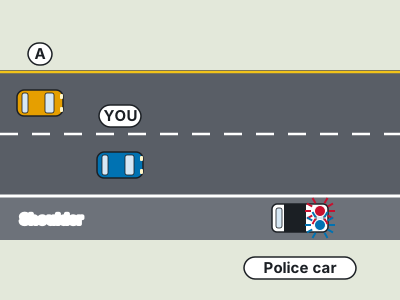
- Stop in the adjacent lane beside the emergency vehicle
- Keep the posted speed if the emergency lights are visible
- Slow to at least 20 miles below the posted speed limit
- Speed up to clear the lane before responders can move
Show answer
Slow to at least 20 miles below the posted speed limit. On a highway posted at 50 MPH or more, traffic in the lane directly beside a stationary emergency or police vehicle displaying emergency signals must slow to at least 20 miles below the posted limit. If possible, change to a farther lane as well. Keeping full speed exposes responders to passing traffic, while stopping beside them or accelerating creates another hazard. Scan ahead for emergency lights and plan the lane change early.
Study this in the handbook: Crashes, emergency vehicles and traffic stops
18. A driver purposely ignores or strikes a traffic control device in a highway work zone. What is that driver guilty of?
- A parking violation handled with a warning only
- A misdemeanor with the penalty for reckless driving
- A equipment defect that must be fixed in ten days
- No offense if traffic was moving slowly nearby
Show answer
A misdemeanor with the penalty for reckless driving. Knowingly or negligently driving in a highway construction zone in a way that endangers people or property, or purposely removing, ignoring, or intentionally striking a traffic control device, is a misdemeanor. The penalty matches reckless driving, so it is far beyond a warning or a parking ticket. It is not an equipment defect with a repair deadline, and slow traffic nearby does not excuse it. Obey flaggers and devices, since workers stand close to moving vehicles.
Study this in the handbook: Road signs by shape and color
19. Drivers in a funeral procession are on a city street posted at 35 mph. How slow may they drive in the procession?
- No slower than 30 mph, within 5 mph of the limit
- As slow as 15 mph anywhere in the procession
- Up to 55 mph, the highway procession speed
- At any speed the lead driver chooses to set
Show answer
No slower than 30 mph, within 5 mph of the limit. On streets and roads other than qualifying highways, a driver in a funeral procession may not drive more than 5 miles per hour below the posted speed limit. On a street posted at 35, that means staying at 30 or above while following the vehicle ahead closely. Fifteen would hold the procession far below the rule. Fifty five belongs to the highway provision for limits of 55 or more, and the lead driver cannot set any speed at will.
Study this in the handbook: Pedestrians, school buses, funerals and bicycles
20. What should a driver always do with the parking brake when leaving a vehicle parked?
- Set it only when parking on a hill
- Set it only when parking overnight
- Always set the parking brake when parking
- Set it only with a manual transmission
Show answer
Always set the parking brake when parking. Montana says to set the parking brake whenever you park. For a manual transmission, leave the vehicle in gear; for an automatic, leave it in park as well. The rule is not limited to hills, overnight parking, or manual transmissions. A driver who uses the brake only on hills can leave a parked vehicle unsecured on level ground. Make setting the brake part of every parking routine.
Every question is written from the official Montana Driver Manual. Need paper? Printable MT practice test with answer key.
Last verified 2026-10-05. How we check every question · Study all 500 as flashcards
Frequently asked questions
How many questions are on this Montana practice test?
This fixed set has 20 questions. It is test 20 of 25 from the 500 question Montana bank.
How does this fixed test relate to the full Montana bank?
Each numbered test is a fixed set of questions in a fixed order, so you can retake the same test later and compare. Every test mixes road signs and the other topics in about the same proportion as the full bank. Tests 1 to 25 together cover every question in the Montana bank once. The full practice page mixes the whole bank at random.
Last verified 2026-10-05. See the Montana DMV facts page for sourced state details.