
Test 7 of 10 · 20 questions · Free 2026
MT Permit Practice Test 7
Jump to the test ↓A fixed 20 question set from the Montana bank with answers and plain English explanations.
Question 1 of 20 · 0 right so far
All 20 questions in test 7
Every question below comes from the Montana question bank on this page. Open a question to see the correct answer and the explanation. Nothing here is hidden behind a signup.
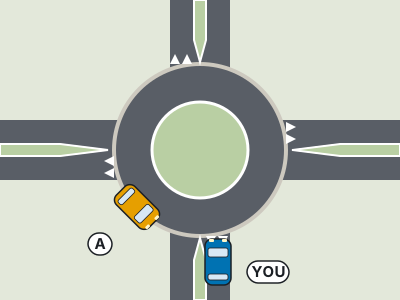
1. What should a Montana driver do when entering a roundabout?
- Stop in the circle before choosing an exit
- Force circulating traffic to stop
- Drive left of the center island
- Yield to vehicles already in the roundabout
Show answer
Yield to vehicles already in the roundabout. Traffic already circulating in the roundabout has the right of way, so an entering driver must yield before joining. The driver should keep right of the center island and should not stop when the path is clear. Forcing entry or driving left of the island reverses the intended flow. Slow down, look left, yield, and enter only when a safe gap is available.
Study this in the handbook: Traffic signals, roundabouts and railroad crossings
2. How many months must a new Montana driver under 18 use a learner license before applying for a first-year restricted license?
- Three consecutive months
- Nine consecutive months
- Six consecutive months
- Twelve consecutive months
Show answer
Six consecutive months. A driver younger than 18 must hold the learner license for at least six consecutive months before applying for the first-year restricted license. Three months does not satisfy the minimum, and twelve months confuses the holding period with the learner license validity period, which can be up to one year. The useful memory cue is six months held continuously before moving to the next graduated step.
Study this in the handbook: Learner license and the teen GDL steps
3. When may a Montana driver on a two-lane road exceed the speed limit by 10 mph?
- To overtake and pass another vehicle and return safely to the right lane
- Whenever traffic is light
- Only while descending a hill
- Whenever the driver is running late
Show answer
To overtake and pass another vehicle and return safely to the right lane. The manual describes a narrow passing exception on a two-lane road: a vehicle may exceed the speed limit by 10 mph to overtake another vehicle and return safely to the right lane. Light traffic or being late does not create that permission. Even during a pass, the driver must make sure the maneuver can be completed safely and must return to the proper lane.
Study this in the handbook: Speed limits, passing and turning
4. For the first six months of a Montana first-year restricted license, how many unrelated passengers under 18 are allowed without adult supervision?
- One
- None
- Two
- Three
Show answer
One. For the first six months, the teen may carry only one unrelated passenger younger than 18 unless a licensed adult driver supervises. The three passenger limit belongs to the second six months, so it is not the rule for the opening period. The word unrelated also matters: do not turn the limit into a blanket ban on every passenger. Check the supervision condition before counting seats.
Study this in the handbook: Learner license and the teen GDL steps
5. A signal is not working at an intersection. What should you do?
- Stop only if you are turning left
- Continue through if no other vehicle is visible
- Treat the intersection as though stop signs face every direction
- Yield only to vehicles approaching from the left
Show answer
Treat the intersection as though stop signs face every direction. A dark or malfunctioning signal removes the normal light cycle, so Montana drivers should stop as though every approach has a stop sign. The driver who stops first generally proceeds first, but that courtesy does not remove the duty to check for hazards. The tempting idea is to continue because no light is displayed, yet an unregulated intersection can still contain cross traffic or pedestrians. Treat the location as an all way stop, make a full stop, scan carefully, and proceed only when safe.
Study this in the handbook: Traffic signals, roundabouts and railroad crossings
6. About how long does sending or reading a text take a driver's eyes off the road, and what does that equal at 55 mph?
- About 5 seconds, like driving the length of a football field blindfolded
- About 1 second, like driving one car length
- About 10 seconds, like driving one mile
- About 2 seconds, like crossing one intersection
Show answer
About 5 seconds, like driving the length of a football field blindfolded. Texting combines manual, visual, and cognitive distraction, which is why the manual calls it the most alarming distraction. Sending or reading a text takes your eyes off the road for 5 seconds, and at 55 mph that is like driving the length of an entire football field blindfolded. One or two seconds understates the time, and 10 seconds and a mile overstate it. Pull over and stop before handling a phone.
Study this in the handbook: Scanning, blind spots and signaling
7. What must a driver who is not part of a moving funeral procession avoid doing?
- Waiting for the procession to clear before proceeding
- Yielding to the procession at an intersection
- Driving between the vehicles forming the procession
- Remaining outside the procession's line of vehicles
Show answer
Driving between the vehicles forming the procession. A driver outside the procession may not drive between the vehicles while the procession is moving, unless authorized by a police officer or operating an emergency vehicle. Cutting through breaks can separate the procession and create conflicts at intersections. Yielding, waiting, and staying outside the line are all consistent with respecting its right-of-way. The rule does not make the procession immune from reasonable care, but it does prohibit inserting an unrelated vehicle into the moving line. Spot the lead and following vehicles, slow down, and let the group pass together.
Study this in the handbook: Pedestrians, school buses, funerals and bicycles
8. At an uncontrolled intersection, what should a Montana driver do?
- Stop every time, even when the roadway is empty
- Maintain speed because no sign assigns right of way
- Cover the brake, look left, right, and left, and be ready to yield
- Yield only to vehicles approaching from the left
Show answer
Cover the brake, look left, right, and left, and be ready to yield. At an uncontrolled intersection, the driver should remove the foot from the accelerator, cover the brake, scan left, right, and left again, and prepare to yield. Maintaining speed ignores hidden hazards, while stopping every time overstates the rule. Limiting attention to the left misses traffic from the other direction and pedestrians. The repeated scan is the practical cue before crossing or turning through the intersection.
Study this in the handbook: Who yields at intersections
9. Montana requires headlamps during which period each day?
- From sunset to sunrise only
- From a half hour after sunset to a half hour before sunrise
- From a half hour before sunset to a half hour after sunrise
- Only when streetlights are off
Show answer
From a half hour after sunset to a half hour before sunrise. Headlamps are required at all times from a half hour after sunset to a half hour before sunrise, and at any other time when weather or blowing dust cuts visibility below 500 feet. Reversing the half hours, so the period starts before sunset and ends after sunrise, gets the rule backward. Sunset to sunrise leaves out the half hour margins, and streetlights do not replace the rule. At dusk or on overcast days, turning headlights on earlier is still wise.
Study this in the handbook: Required lights and equipment
10. Where may an open alcoholic beverage container be kept in a Montana vehicle?
- In the driver's door pocket if it has a lid
- In an unlocked cup holder beside the driver
- On the floor behind the front passenger seat
- In a locked glove compartment or storage compartment
Show answer
In a locked glove compartment or storage compartment. An open alcoholic beverage container must be kept in a locked glove compartment or storage compartment, among the lawful storage locations listed by Montana. An unlocked cup holder, a door pocket, and a floor area in the passenger compartment leave the container accessible. The key detail is that the compartment must be locked, not merely covered or located away from the driver’s hand. Check the storage location before driving on a highway.
Study this in the handbook: Alcohol, drugs and the law
11. When a vehicle begins to slide, what steering action helps regain control?
- Hold the wheel rigidly and accelerate
- Turn the wheel toward where you want the vehicle to go
- Brake hard until the tires lock
- Turn sharply away from the intended path
Show answer
Turn the wheel toward where you want the vehicle to go. During a skid, the tires have lost their normal grip, so abrupt braking can worsen the slide. Montana says to stay off the brake, remove your foot from the accelerator, look where you want to go, and steer in that direction. Holding the wheel while accelerating does not address the slide, and locked tires reduce control. Once the vehicle starts to straighten, correct back so it does not swing into another skid.
Study this in the handbook: Adjusting speed for roads, weather and sight distance
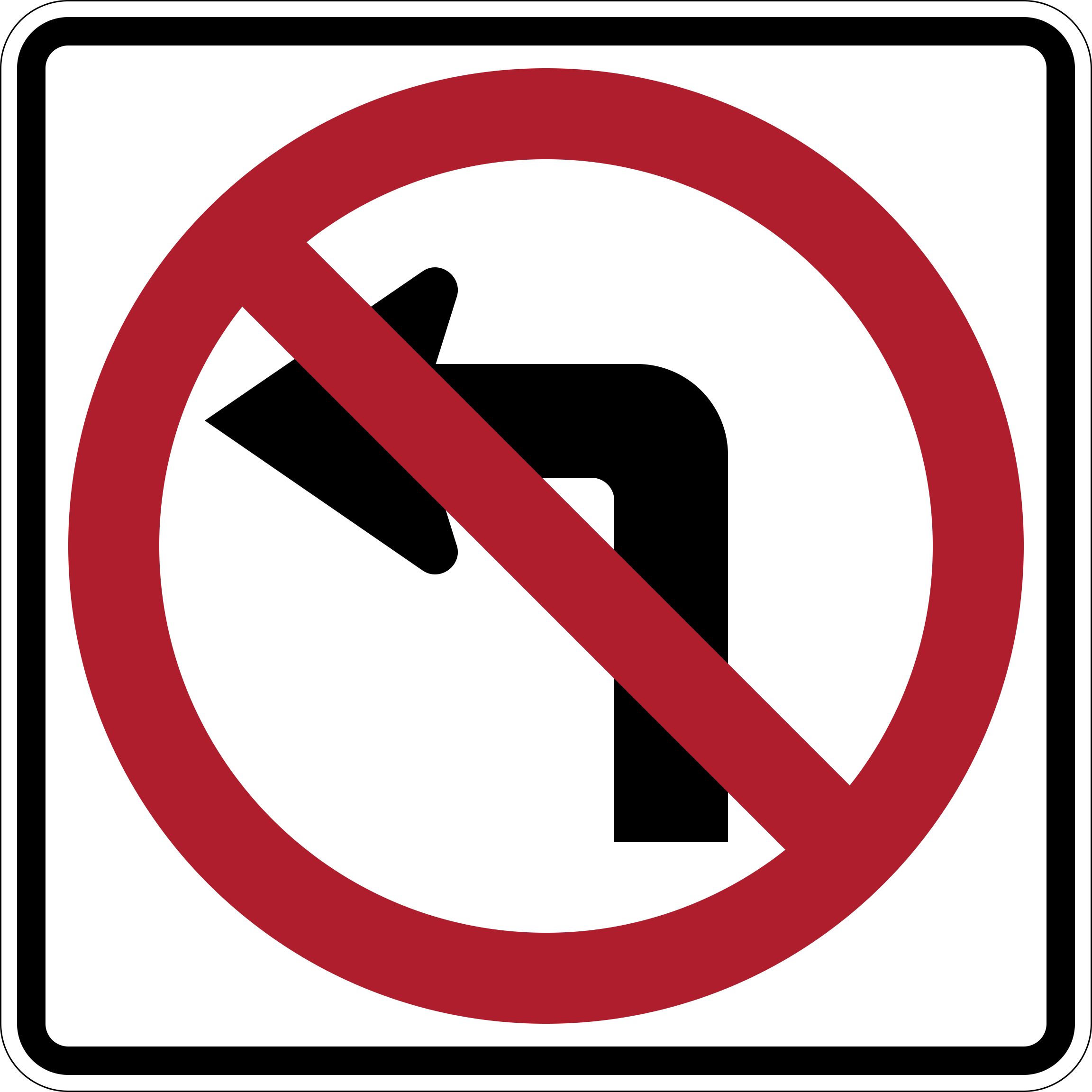
12. Which movement is forbidden at the intersection shown by this sign?
- Making a right turn
- Making a left turn
- Driving straight ahead
- Changing lanes after clearing the intersection
Show answer
Making a left turn. The NO LEFT TURN sign bars a left turn at the intersection. It does not prohibit a right turn or straight travel unless another sign or signal says so. Changing lanes after the intersection is a separate maneuver and is not what the red slash over the left-turn arrow addresses. Drivers should select a permitted movement, continue without turning left, and look for a later legal route. The arrow symbol matters: the restriction follows the pictured movement, not every possible movement through the intersection.
Study this in the handbook: Road signs by shape and color
13. What share of driving decisions are based on what we see, according to the Montana manual?
- 50 percent
- 25 percent
- 10 percent
- 90 percent
Show answer
90 percent. Driving requires decision making and critical thinking, and 90 percent of driving decisions are based on what we see. That is why Montana requires a vision test before issuing a license, measuring at least 20/40 vision in at least one eye, with or without corrective lenses. The manual also recommends having your eyes checked regularly. Keep windows and lights clean so you can see and be seen, because 50, 25 and 10 percent understate the figure.
Study this in the handbook: Scanning, blind spots and signaling
14. This five-sided sign marks a Montana school crossing. What must you do if pedestrians are waiting to cross there?

- Sound the horn and continue at a slow speed
- Stop for the waiting pedestrians
- Continue unless a crossing guard is present
- Change lanes and pass around them
Show answer
Stop for the waiting pedestrians. The five-sided School Crossing sign marks the point where school children cross the roadway, and the Montana manual says you must stop if pedestrians are waiting to cross. Waiting pedestrians are enough; a child does not have to be in the lane first, and a crossing guard does not have to be present. Honking does not give you the right to continue, and passing around waiting children puts them at risk. Slow down as you approach so you can stop smoothly.
15. What do Montana school speed limit signs indicate?
- A mandatory 5 mph limit whenever children are nearby
- A single 25 mph limit at every school
- That no speed change applies near a school
- Posted speeds or reduced speeds authorized by local authorities
Show answer
Posted speeds or reduced speeds authorized by local authorities. School speed limit signs identify a posted speed or a reduced speed authorized by the local authority. Montana therefore does not use one universal number for every school location. The 25 mph and 5 mph choices invent fixed statewide limits, while the no-change choice ignores the signs, markings, and flashing lights that signal a change. Read the roadside devices at each school zone and adjust accordingly.
Study this in the handbook: Road signs by shape and color
16. If a vehicle begins to slide on a wet road, which response follows Montana guidance?
- Stay off the brake, ease off the accelerator, and steer where you want to go
- Brake hard and turn opposite the direction of travel
- Accelerate to force the tires to grip the pavement
- Close your eyes briefly while the vehicle straightens
Show answer
Stay off the brake, ease off the accelerator, and steer where you want to go. For a slide, Montana emphasizes control through smooth correction. Stay off the brake while the vehicle slows, remove your foot from the accelerator, look where you want to go, and steer in that direction. Hard braking can worsen the skid before the tires regain grip, while acceleration adds force without solving the traction problem. Turning opposite the desired path can send the vehicle into a new skid. Keep your eyes on the intended route and make quick, measured steering changes as the vehicle begins to straighten.
Study this in the handbook: Adjusting speed for roads, weather and sight distance
17. At a steady red signal with no stop line, where should a driver stop?
- Beside the signal pole regardless of the roadway layout
- Past the crosswalk so the front tires reach the intersection
- Before the nearest crosswalk, or before the intersection if there is no crosswalk
- Only at the curb if pedestrians are present
Show answer
Before the nearest crosswalk, or before the intersection if there is no crosswalk. The stopping location follows a clear order. Stop before the pavement stop line when one exists. If there is no line, stop before entering the nearest crosswalk. If there is no crosswalk, stop before entering the intersection. Rolling past the crosswalk can put the vehicle in a pedestrian's path, while a signal pole is not the prescribed reference point. The curb option makes stopping depend on pedestrians when the red signal applies regardless. Scan for the first applicable boundary and keep the vehicle behind it.
Study this in the handbook: Traffic signals, roundabouts and railroad crossings
18. A Montana teen with a learner license wants to practice driving. Who may ride along as the supervisor?
- Any licensed driver who is at least 16, seated anywhere in the car
- Any adult passenger, even one without a driver license
- Only a licensed driver education instructor
- A licensed driver education instructor, a parent or legal guardian, or another adult with the parent's or guardian's permission, sitting beside the driver
Show answer
A licensed driver education instructor, a parent or legal guardian, or another adult with the parent's or guardian's permission, sitting beside the driver. A learner license is valid for a Class D vehicle only when the teen is accompanied by a licensed driver education instructor, a parent or legal guardian, or another adult who has the parent's or guardian's permission, and that person must occupy the seat beside the driver. The GDL section adds that the supervising parent, guardian, or authorized adult must be licensed, so an unlicensed adult does not qualify. A 16 year old friend is not an adult supervisor, and the back seat is the wrong place. Instructors are one option, not the only one.
19. When a parent signs the consent form for a Montana applicant under 18, what does the signature commit the parent to?
- Accepting financial responsibility for damage caused by the minor's driving
- Certifying that the teen has already passed a driver education course
- Riding along on every trip until the teen turns 18
- Confirming only that the teen's date of birth is correct
Show answer
Accepting financial responsibility for damage caused by the minor's driving. A teen under 18 needs a consent form signed by a parent or guardian before testing can begin. Signing is not a formality about the birth date or a statement about driver education. It obligates the parent or guardian to accept financial responsibility for any damage that results from the minor operating a motor vehicle. The form does not require the parent to supervise every trip; supervision rules come from the learner license and GDL steps instead. Parents should understand that the signature carries real financial risk.
20. How far from the nearest rail must a driver stop when a train is approaching a Montana crossing?
- Exactly 5 feet from the rail
- As close as practicable but not less than 15 feet
- At least 50 feet from the crossing in every case
- Only far enough back to keep the vehicle off the tracks
Show answer
As close as practicable but not less than 15 feet. When a train's approach is indicated by warning signals, gates, a stop sign, or a watchman, Montana requires a stop as close as practicable but at least 15 feet from the nearest rail. The rule creates a protected space for the vehicle and the crossing operation. Five feet is too close, 50 feet is not the stated universal distance, and merely clearing the tracks may leave the vehicle inside the required stopping zone. Treat active railroad warnings as a precise distance command, then wait until crossing is safe.
Study this in the handbook: Traffic signals, roundabouts and railroad crossings
QualitySpace is expanding to Montana
We are a California-based independent insurance brokerage working on licensing in more states. We cannot help with Montana insurance yet. Leave your email and we will let you know when we can.
Every question is written from the official Montana Driver Manual. Need paper? Printable MT practice test with answer key.
Last verified 2026-10-05. How we check every question · Study all 212 as flashcards
Frequently asked questions
How many questions are on this Montana practice test?
This fixed set has 20 questions. It is test 7 of 10 from the 212 question Montana bank.
How does this fixed test relate to the full Montana bank?
Each numbered test is a fixed set of questions in a fixed order, so you can retake the same test later and compare. Every test mixes road signs and the other topics in about the same proportion as the full bank. Tests 1 to 10 together cover 200 of the 212 questions in the Montana bank, each once. The full practice page mixes the whole bank at random.
Last verified 2026-10-05. See the Montana DMV facts page for sourced state details.